
Deciding between the tactile precision of hand grating and the lightning-fast efficiency of a food processor often comes down to your specific culinary goals and the volume of your prep work. While a classic box grater offers superior control over texture-producing those delicate, airy shreds that melt beautifully on pasta or blend seamlessly into batters-the food processor is the undisputed champion of high-volume cooking, turning dense blocks of cheese or firm vegetables into uniform piles in mere seconds. Whether you prioritize the artisanal, "melt-in-your-mouth" quality of manual labor or the sheer convenience of modern technology, understanding how each method impacts the moisture and structure of your ingredients is the secret to elevating your final dish.
| Feature | Hand Grating | Food Processor Shredding |
|---|---|---|
| Speed & Volume | Slow; best for single servings or small blocks. | Ultra-fast; processes pounds of food in seconds. |
| Texture Quality | Fluffy, long, and clean-cut; preserves moisture. | Short, slightly compressed, and rougher edges. |
| Physical Effort | High; requires significant arm and wrist strength. | Minimal; motorized operation does the work. |
| Safety Level | High risk of finger/knuckle nicks on open blades. | Low risk; blades are enclosed in a housing unit. |
| Clean-up Prep | Instant; usually just one easy-to-rinse tool. | Moderate; requires washing bowl, lid, and disc. |
| Best Application | Garnishes, melting cheeses, and baking. | Canning, meal prep, and large-scale salads. |
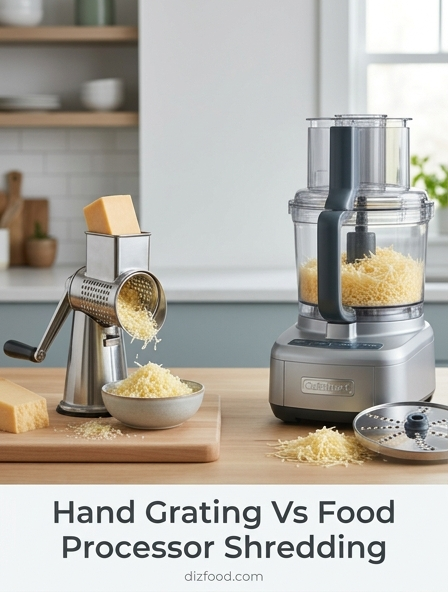
Efficiency Comparison Manual Grating vs Electric Shredding
When evaluating efficiency in the kitchen, the choice between manual grating and electric shredding often depends on the total volume of ingredients and the value of the cook's time. Manual grating relies entirely on physical exertion and repetitive motion. While a box grater is highly efficient for a single block of cheddar or a couple of carrots, the "setup-to-output" ratio favors the manual tool only for small tasks. The user can grab the grater from a drawer, finish the task, and rinse it before a food processor could even be retrieved from a bottom cabinet.
In contrast, electric shredding via a food processor is the undisputed champion of high-volume efficiency. Once the machine is assembled, it can process pounds of produce or cheese in a matter of seconds. For a large family meal or meal prep for the week, the motor does the heavy lifting, preventing physical fatigue and saving significant time during the active cooking phase. However, the overhead of assembling the bowl, lid, and specific shredding disc must be accounted for in the total efficiency equation.
| Factor | Manual Grating | Electric Shredding |
|---|---|---|
| Setup Time | Negligible | Moderate |
| Processing Speed | Slow/Physical | Very Fast/Motorized |
| Physical Effort | High | Low |
Texture and Consistency Differences in Shredded Foods
The texture of the final product is a primary differentiator between these two methods. Hand grating offers a certain "rustic" variability. Because the angle and pressure of the hand change slightly with every stroke, the resulting shreds have varied lengths and thicknesses. This can be desirable in dishes like potato pancakes or certain salads where a handmade look is preferred. Furthermore, hand graters often feature multiple sides, allowing the cook to switch between fine, medium, and coarse textures instantly to suit the specific needs of a garnish or a melting cheese.
Electric food processors provide unparalleled consistency. The spinning disc maintains a constant speed and pressure, resulting in uniform strands that look professional and cook at an even rate. This is particularly beneficial for baking, such as making zucchini bread or carrot cake, where uniform pieces ensure even moisture distribution. However, the high speed of the processor can sometimes lead to a "mushier" texture if the ingredient is soft, as the centrifugal force may bruise delicate cells or slightly melt high-fat cheeses due to friction heat.
- Hand Grated: Jagged edges, varied lengths, better for aeration in salads.
- Electric Shredded: Smooth edges, uniform thickness, ideal for bulk baking.
- Zesting: Manual tools are superior for extracting oils without the pith.
Cleaning and Maintenance Time Hand Grater vs Processor
The post-cooking cleanup is often where the manual grater wins the favor of home cooks. A standard box grater or microplane is typically a single piece of stainless steel. Cleaning usually involves a quick scrub with a dish brush to remove particles from the holes and a rinse under hot water. There are no hidden nooks, gaskets, or motorized bases to worry about. Maintenance is also minimal; a high-quality stainless steel grater can remain sharp for years without any intervention other than proper drying to prevent spotting.
Food processors present a more complex cleaning challenge. A standard shredding task involves cleaning the work bowl, the lid, the pusher, and the sharp metal shredding disc. Many of these components have small crevices where food can become trapped, requiring careful attention or a cycle in the dishwasher. Furthermore, the base of the unit must be wiped down to remove splashes. While most modern parts are dishwasher safe, the sheer volume of items taking up space in the rack can be a deterrent for those making a quick snack. Over time, the plastic components may cloud or crack, requiring replacement parts that are not a factor with manual tools.
Safety Considerations for Manual and Electric Tools
Safety is a paramount concern when handling sharp kitchen tools. Manual graters are notorious for "knuckle-busting." As the ingredient being grated becomes smaller, the user's fingers move closer to the sharp perforations. Without a food holder or protective glove, the risk of minor cuts and abrasions is high. However, the speed of the injury is limited by the user's own physical movement, which usually prevents catastrophic accidents. Using a flat palm or a specialized finger guard can mitigate these risks significantly.
Electric food processors offer a different safety profile. Most are designed with interlocking systems that prevent the motor from spinning unless the lid and pusher are securely in place, making it nearly impossible to touch the blade while it is in motion. The primary danger with electric shredders occurs during assembly, disassembly, and cleaning. The shredding discs are incredibly sharp and can cause deep lacerations if handled carelessly. Because the motor is powerful, any foreign object-or a misplaced finger if the safety mechanism is bypassed-can result in a serious injury instantly.
- Always use the food pusher with an electric processor; never use hands.
- Use a cut-resistant glove when hand grating small remnants.
- Store shredding discs in protective sleeves or cases.
- Ensure the grater is placed on a stable, non-slip surface before starting.
Precision and Control Benefits of Hand Grating
Precision is where the manual grater excels, particularly for delicate tasks. When a recipe calls for exactly one teaspoon of lemon zest or a light dusting of parmesan over a pasta dish, a hand tool provides tactile feedback that a machine cannot replicate. The cook can feel the resistance of the food and adjust the pressure to achieve the perfect flake or fine powder. This level of control is essential when working with expensive ingredients like truffles or whole nutmeg, where every milligram counts and over-processing would lead to waste.
Electric shredders are blunt instruments by comparison. They are designed for "all-or-nothing" tasks. It is difficult to process a very small amount of food in a large bowl, as the pieces often get caught between the disc and the lid before they are fully shredded. For recipes that require a specific mix of textures-such as a slaw that needs both coarse and fine shreds-the manual grater allows for instantaneous switching. The cook's ability to stop exactly when they have enough, without having to disassemble a machine to check the volume, makes the manual method the choice for precision-driven culinary arts.
Best Method for Small vs Large Batch Preparation
The scale of the task is the most reliable metric for choosing between these two tools. For small-batch preparation-such as topping a single pizza, grating ginger for a tea, or adding a bit of carrot to a side salad-the manual grater is the logical choice. The time saved during the actual shredding process with an electric tool is outweighed by the time spent retrieving, assembling, and cleaning the appliance. Efficiency in the kitchen is often about minimizing "dead time," and for small tasks, the manual grater keeps the workflow moving without interruption.
Large-batch preparation is where the food processor becomes indispensable. If the task involves shredding five pounds of potatoes for latkes or multiple heads of cabbage for sauerkraut, the manual method becomes physically exhausting and time-prohibitive. In these scenarios, the food processor's ability to maintain a high output rate allows the cook to focus on other aspects of the recipe. Professional kitchens and home cooks hosting large gatherings rely on the electric shredder to maintain consistency across hundreds of servings, a feat that would be nearly impossible to achieve manually without significant help.
Kitchen Space and Storage Requirements Comparison
In many modern kitchens, "countertop real estate" is at a premium. A food processor is a bulky appliance that requires significant storage space. Even the most compact models include a heavy motor base and a variety of attachments, such as multiple discs, blades, and bowls. These items often require a dedicated shelf or a large section of a kitchen cabinet. For those living in apartments or small homes, the footprint of a food processor can be a significant drawback, often leading to the "out of sight, out of mind" phenomenon where the tool is rarely used because it is difficult to access.
Manual graters, conversely, are the epitome of space efficiency. A flat grater can slide into a utility drawer alongside spatulas and whisks, while a box grater occupies only a few square inches of shelf space. They are lightweight, require no electrical outlet, and do not have cords that clutter the workspace. For minimalist cooks or those who prefer an uncluttered kitchen environment, the manual grater provides all the necessary functionality without the logistical burden of a large appliance. The portability of manual tools also makes them ideal for outdoor cooking or small prep stations.
Durability and Long Term Value of Shredding Tools
When considering long-term value, the simplicity of the manual grater often translates to superior durability. A high-quality stainless steel grater has no moving parts, no electronic circuitry, and no motor to burn out. It is virtually indestructible under normal kitchen conditions. If dropped, it might dent, but it will likely remain functional. Because it is a low-tech tool, it does not become "obsolete," and a well-made model can easily last twenty years or more, representing an exceptional return on a small initial investment.
Food processors are more of a long-term gamble. While high-end models are built to last, they are still subject to mechanical failure. Capacitors can blow, gears can strip, and the plastic bowls can become brittle and crack over time. If a specific manufacturer stops producing a certain model, finding replacement parts like a specific lid or shredding disc can become impossible, rendering the entire unit useless. While the food processor provides immense value in terms of labor saved, its lifespan is generally shorter, and its higher price point means the "cost per use" may be higher than that of a simple manual grater.
Impact on Flavor and Mouthfeel of Ingredients
The mechanical action of shredding can subtly alter the flavor profile of certain foods. Manual grating tends to be a slower, cooler process. This is particularly important for cheese. When cheese is grated by hand, it retains its moisture and fat structure. The resulting shreds are often airy and light, which allows them to melt quickly and evenly when heat is applied. This creates a superior mouthfeel in dishes like grilled cheese or pasta carbonara, where the texture of the melted cheese is central to the experience.
Electric shredders generate heat through the high-speed friction of the metal disc. For sensitive ingredients like soft cheeses or fatty chocolates, this heat can cause the edges to slightly melt or smear, leading to a denser, clumpier final product. Additionally, the rapid "chopping" motion of an electric shredder can bruise the cell walls of vegetables more aggressively than a manual stroke. While this might not be noticeable in a cooked soup, it can impact the crispness and fresh aroma of raw salads. The jagged, high-surface-area edges produced by a hand grater also tend to "grab" dressings and sauces more effectively, enhancing the overall flavor delivery.
Choosing the Right Shredding Tool for Every Recipe
The final decision on which tool to use should be guided by the specific requirements of the recipe and the desired culinary outcome. It is not a matter of one tool being "better" than the other, but rather which tool is better suited for the task at hand. A versatile cook understands the strengths of both and selects their equipment accordingly. By considering factors such as volume, texture, and cleanup time, you can optimize your kitchen workflow and improve the quality of your finished dishes.
- Choose a Hand Grater for: Garnishing pasta, zesting citrus, grating small amounts of hard cheese, or when you want maximum control over texture.
- Choose a Food Processor for: Making coleslaw for a crowd, shredding potatoes for hash browns, bulk-prepping vegetables for stir-fry, or grating soft cheeses in large quantities.
- Choose a Microplane for: Hard spices like nutmeg, garlic pastes, or ultra-fine chocolate shavings.
Ultimately, having both tools available is the best approach. The manual grater serves as the reliable, everyday workhorse for quick tasks, while the food processor remains the heavy-duty solution for intensive prep work. Matching the tool to the scale and sensitivity of the ingredients ensures that you achieve the best possible results with the least amount of frustration.


Comments