
Choosing between a Lazy Susan and a tiered spice rack often comes down to your kitchen's specific layout and how you prefer to navigate your seasoning collection. While a Lazy Susan excels in deep cabinets or awkward corner spaces by utilizing a 360-degree spin to bring hidden items to the front, a tiered spice rack offers "stadium-style" visibility that ensures every label is identifiable at a single glance. If you are dealing with a standard-depth pantry shelf, a tiered organizer maximizes vertical real estate and prevents smaller jars from getting lost behind larger ones. Ultimately, the best choice for your spice organization depends on whether you prioritize the effortless rotation of a turntable or the organized, orderly display of a multi-level shelf.
| Feature | Lazy Susan (Turntable) | Tiered Spice Rack |
|---|---|---|
| Best For | Deep corner cabinets & round containers. | Standard upper cabinets & pantries. |
| Visibility | Outer jars visible; inner jars hidden until spun. | All labels visible via "stadium seating" levels. |
| Space Usage | Circular footprint; leaves corners unused. | Rectangular; fills shelf width wall-to-wall. |
| Accessibility | High; spin-to-reach eliminates digging. | Moderate; requires reaching over front rows. |
| Jar Versatility | Excellent for various sizes and bulk oils. | Best for uniform, standard-sized spice jars. |
| Stability | Items may tip if spun too quickly. | Very stable; no moving parts or rotation. |
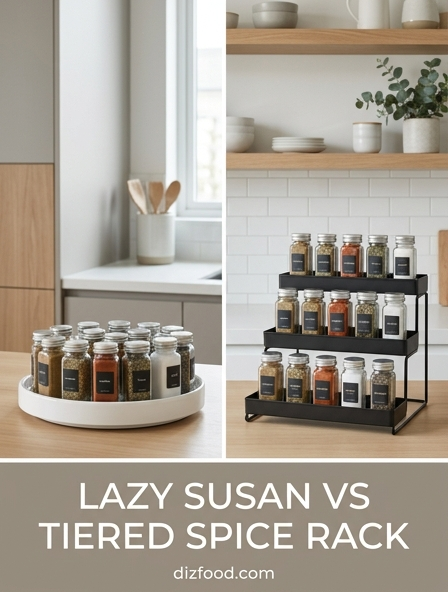
Lazy Susan vs Tiered Spice Rack Comparison
Choosing between a Lazy Susan and a tiered spice rack is a fundamental decision in kitchen organization that depends largely on your cabinet dimensions and cooking habits. A Lazy Susan utilizes a rotating platform, allowing users to spin the device to bring items from the back to the front. In contrast, a tiered spice rack employs a "stadium seating" design, elevating each row of spices slightly higher than the one in front of it. While both aim to eliminate the frustration of rummaging through a cluttered cabinet, they solve the problem using different spatial logic.
The following table provides a quick look at the primary differences between these two popular storage solutions:
| Feature | Lazy Susan | Tiered Spice Rack |
|---|---|---|
| Movement | 360-degree rotation | Static / Fixed position |
| Visibility | High for items at the edge | High for all front labels |
| Best Fit | Corner cabinets / Deep shelves | Standard wall cabinets / Pantries |
| Shape | Circular or D-shaped | Rectangular / Expandable |
Ultimately, the comparison boils down to whether you prefer to reach for an item by spinning a tray or by looking over the tops of jars. Lazy Susans are often praised for their mechanical simplicity, whereas tiered racks are celebrated for their visual clarity and ability to maximize every inch of a rectangular shelf's width.
Benefits of Using a Rotating Lazy Susan
The rotating Lazy Susan is a classic kitchen staple for a reason. Its primary advantage is its ability to make deep or awkward spaces fully accessible. By utilizing a central pivot point, the Lazy Susan ensures that no spice jar is ever truly "lost" in the dark recesses of a cabinet. This is particularly beneficial for those who struggle with mobility or have deep upper cabinets where reaching the back row is physically demanding. With a simple flick of the wrist, the cinnamon hidden at the rear becomes the most accessible item in the kitchen.
- 360-Degree Access: Eliminates the need to move multiple jars to reach one item.
- Versatility: Can hold oddly shaped containers, such as taller oil bottles or bulk spice containers, alongside standard jars.
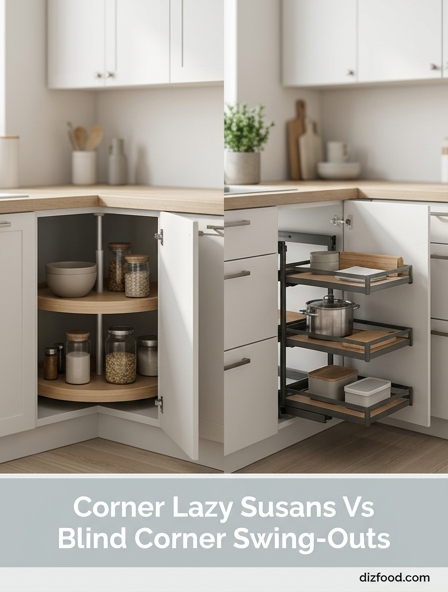
- Corner Optimization: The best solution for "blind" corner cabinets where space often goes to waste.
- Clutter Reduction: Keeps a variety of items contained within a specific perimeter, preventing them from migrating across the shelf.
Beyond spices, the Lazy Susan is an excellent multi-tasker. Because many models come with a non-slip surface or a raised rim, jars remain stable during rotation. This stability makes it an ideal choice for heavier glass jars or liquid ingredients that might otherwise tip over on a stepped rack. If your cooking style involves a wide variety of bottle sizes beyond the standard spice jar, the open-platform nature of the Lazy Susan offers the flexibility you need.
Why Choose a Tiered Spice Rack Instead
A tiered spice rack is often the preferred choice for those who value absolute visual organization. By staggering the heights of your spice jars, these racks allow you to see the labels of every single item simultaneously. This "stadium" effect is perfect for cooks who have a large collection of uniform spice jars and want to find what they need at a glance without having to spin a wheel or hunt through layers. Tiered racks are typically designed to fit the rectangular footprint of standard kitchen cabinets perfectly, leaving no empty "dead zones" in the corners.
- Instant Label Recognition: Since every row is elevated, you can read the names of the spices without picking them up.
- Fixed Stability: There are no moving parts, which means there is no risk of the mechanism jamming or items flying off due to centrifugal force.
- Width Customization: Many tiered racks are expandable, allowing them to stretch to the exact width of your cabinet.
- Linear Organization: Ideal for organizing spices alphabetically or by cuisine type, as the order remains fixed.
Furthermore, tiered racks encourage a minimalist and aesthetic kitchen look. When paired with uniform glass jars, they create a professional "apothecary" appearance that many homeowners find appealing. Because they don't require the clearance needed for a circle to rotate, they can often hold more jars per square inch of shelf space than a Lazy Susan of similar width. For the methodical cook who wants a static, reliable system, the tiered rack is the superior option.
Space Efficiency in Small Kitchen Cabinets
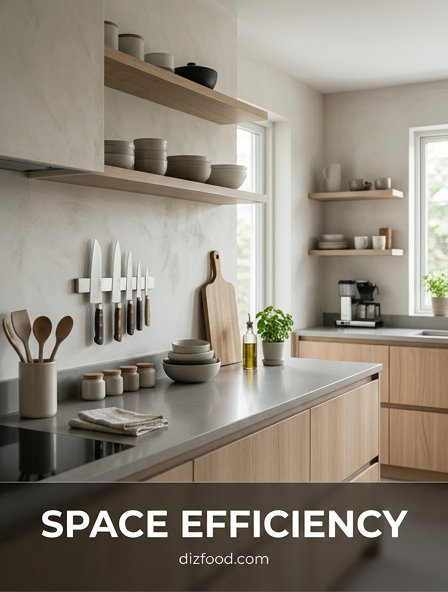
In a small kitchen, every square inch of cabinet real estate is precious. When evaluating space efficiency, the shape of the organizer becomes the deciding factor. Standard kitchen cabinets are rectangular, which naturally favors the tiered spice rack. Because a tiered rack is also rectangular, it sits flush against the back and side walls of the cabinet, utilizing nearly 100% of the available shelf surface. This is a significant advantage for those with narrow cabinets where a rotating circle simply wouldn't fit or would leave significant gaps.
Lazy Susans, however, introduce the "corner problem." Because you are placing a circular object into a square space, the four corners of the cabinet shelf become unusable. This can result in roughly 20% to 25% of wasted space on that specific shelf level. However, Lazy Susans compensate for this by allowing you to use the full depth of very deep cabinets that might otherwise be inaccessible. If your cabinet is deep but narrow, a tiered rack might leave the back half of the shelf empty or hard to reach, whereas a Lazy Susan brings that back space into active play.
For those dealing with very tight vertical heights, the tiered rack can be a challenge. The highest tier raises the jars significantly, which may cause them to hit the shelf above. In these scenarios, a low-profile Lazy Susan is often more efficient because it keeps all jars at the base level of the shelf. Ultimately, if your goal is to maximize horizontal width, go with a tiered rack; if your goal is to reclaim the depth of a deep cabinet, the Lazy Susan is the more efficient tool.
Visibility and Accessibility for Spice Jars
Visibility is the cornerstone of an efficient kitchen. Nothing stalls a recipe faster than being unable to find the cream of tartar or the smoked paprika. A tiered spice rack offers "front-facing" visibility. You can see the top half of every jar, which is usually where labels are located. This allows for a quick visual scan. However, accessibility can be slightly hampered if the rack is placed on a high shelf; you may find yourself reaching over the front rows and accidentally knocking jars over like dominoes to get to the back row.
Lazy Susans offer a different type of visibility. While you can only see the jars on the outer "ring" clearly at any one time, every jar has the potential to be at the very front with a quick turn. This makes accessibility arguably higher for a Lazy Susan, as you never have to reach "over" one item to grab another. You simply rotate until the desired jar is within arm's reach.
- Tiered Visibility: Best for eye-level cabinets where labels are easily scanned.
- Lazy Susan Visibility: Best for lower or very high cabinets where you can't see the "depth" of the shelf.
- Tiered Accessibility: Can be tricky for those with shorter stature or deep shelves.
- Lazy Susan Accessibility: Superior for physical ease, as it brings the item to the user.
If you prefer to organize your spices by frequency of use, a Lazy Susan works well by placing common items on the edges and rare items in the center. Conversely, if you want to see your entire inventory at once to know when you are running low on supplies, the tiered rack provides a more comprehensive "inventory at a glance" experience.
Lazy Susan Pros and Cons for Storage
The Lazy Susan is a polarizing tool in the world of kitchen organization. Its utility depends heavily on the specific items being stored and the habits of the cook. Understanding the trade-offs is essential before making a purchase. While it offers unparalleled access to deep spaces, it requires a certain amount of clearance to function correctly, which may not be available in all kitchen layouts.
| Pros | Cons |
|---|---|
| Accesses deep cabinet corners easily | Wastes corner space in square cabinets |
| Smooth rotation brings items to you | Items can fall off if spun too quickly |
| Handles various container sizes/shapes | Center items can be hard to see |
| Ideal for heavy or bulky items | Mechanism can wear out over time |
One major "con" often overlooked is the "center graveyard" effect. While items on the perimeter are easy to see, the items placed near the center pivot point can become obscured by the outer jars. This means you may still find yourself moving jars to see what is in the middle. Additionally, if a jar falls off a Lazy Susan inside a cabinet, it can jam the rotation mechanism or get stuck behind the tray, requiring you to empty the entire shelf to retrieve it. Despite these drawbacks, for corner cabinets or deep pantry shelves, the pros of the Lazy Susan almost always outweigh the cons.
Tiered Rack Advantages for Organization
The tiered spice rack is the gold standard for the "organized" kitchen aesthetic. Its primary advantage is structural discipline. Because it is a static object, it encourages the user to return each spice jar to its specific "assigned" spot. This makes it much easier to maintain an alphabetical or category-based system (such as baking spices on the top tier, savory herbs on the middle, and heat/peppers on the bottom). The lack of movement ensures that your organization system stays exactly as you left it.
- Uniformity: Works best with sets of identical jars, creating a clean, professional look.
- Expandability: Many models feature a "slide-out" design to fit varying cabinet widths.
- Grip Surfaces: Most quality tiered racks feature rubberized "linens" on each step to prevent jars from sliding.
- No Hidden Zones: Unlike a Lazy Susan, there is no "center" where jars can hide; every jar has its own level.
Another advantage is the lack of mechanical failure. With no bearings to rust or plastic pivots to snap, a tiered rack is essentially a lifetime purchase. It is also more adaptable to different heights. If you have a shelf with limited vertical clearance, you can find low-profile tiered racks that only provide a slight lift. Furthermore, tiered racks are excellent for use inside drawers (in a slanted format), offering a level of versatility that circular rotating trays simply cannot match in a standard drawer configuration.
Best Spice Storage for Deep Upper Cabinets
Deep upper cabinets are notorious "black holes" in a kitchen. Items pushed to the back are often forgotten until they are years past their expiration date. When choosing an organizer for this specific environment, the Lazy Susan is frequently the winner. In a deep cabinet, a tiered rack would sit at the front, leaving a vast, empty, and unreachable space behind it. Alternatively, if you pushed the tiered rack to the back, you would never be able to see or reach the spices without a step stool.
The Lazy Susan solves this by turning the depth of the cabinet into a functional radius. A large-diameter Lazy Susan (12 to 18 inches) can occupy almost the entire depth of a standard upper cabinet. By placing it there, you effectively bring the back of the cabinet to the front with every 180-degree turn. This ensures that even the spices you use only once a year, like cream of tartar or cloves, remain within easy reach.
However, if your deep cabinet is also very narrow, you might consider a "pull-out" tiered rack instead. These are hybrid devices that sit on a track, allowing you to pull the entire tiered assembly out of the cabinet. This provides the label-visibility of a tiered rack with the back-to-front accessibility of a Lazy Susan. If a pull-out is not an option, the Lazy Susan remains the most ergonomic and cost-effective way to manage the "deep cabinet" dilemma, ensuring your spices are always in rotation-literally.
Comparing Durability and Ease of Cleaning
Kitchen environments are prone to spills, dust, and grease. Therefore, the durability and "cleanability" of your spice organizer are vital considerations. Tiered spice racks are generally easier to clean because they are static, single-piece items. Most are made of high-impact plastic, stainless steel, or bamboo. Plastic and metal versions can often be wiped down with a damp cloth or even placed in the top rack of a dishwasher if they are small enough. There are no crevices or mechanisms where spilled powders can hide.
Lazy Susans are slightly more complex. They consist of a base, a rotating platform, and a ball-bearing mechanism. Over time, fine powders like turmeric or cinnamon can find their way into the bearing tracks, causing the rotation to become gritty or squeaky. Cleaning a Lazy Susan often requires more effort, as you must clean the top surface, the underside, and the rim where dust tends to collect.
- Material Choice: Plastic is best for easy cleaning; wood/bamboo offers durability and style but can stain.
- Mechanical Longevity: Tiered racks have no moving parts and cannot "break."
- Spill Containment: Many Lazy Susans have high lips to contain spills, whereas tiered racks might let a spill drip down to lower levels.
- Stability: Heavy-duty steel Lazy Susans are incredibly durable but can be noisy.
If you are a "messy" cook who frequently knocks over jars or spills ingredients, a plastic tiered rack is likely the lower-maintenance option. However, if you invest in a high-quality stainless steel Lazy Susan with sealed bearings, you can enjoy the benefits of rotation with minimal durability concerns. For most households, the simplicity of the tiered rack wins on the cleaning front.
Final Verdict on the Best Spice Organizer
The "best" spice organizer is entirely dependent on your kitchen's unique architecture. There is no one-size-fits-all answer, but there are clear winners for specific scenarios. If you are dealing with a standard-depth wall cabinet and you want to be able to see every label at a glance for fast-paced cooking, the tiered spice rack is the superior choice. Its ability to provide total visual clarity and maximize the width of a rectangular shelf makes it the favorite for most modern kitchen setups.
On the other hand, if you are struggling with a deep corner cabinet, a pantry with deep shelving, or have physical limitations that make reaching the back of a cabinet difficult, the Lazy Susan is the undisputed champion. It transforms "dead space" into a dynamic storage area. It is also the better choice if your spice collection includes a mix of small jars, large canisters, and bottles of vinegar or oil, as the flat surface of the rotating tray is more accommodating than the narrow steps of a tiered rack.
For the ultimate organized kitchen, many homeowners find that a combination of both is the most effective strategy. Use a tiered rack for your everyday "alphabetized" spices in an eye-level cabinet, and reserve a Lazy Susan for larger baking supplies, oils, or less-frequently used seasonings in a corner or lower cabinet. By matching the tool to the specific storage challenge, you ensure a functional, stress-free cooking environment where the right flavor is always just a second away.

Comments