
Vertical Storage Solutions for Professional Prep
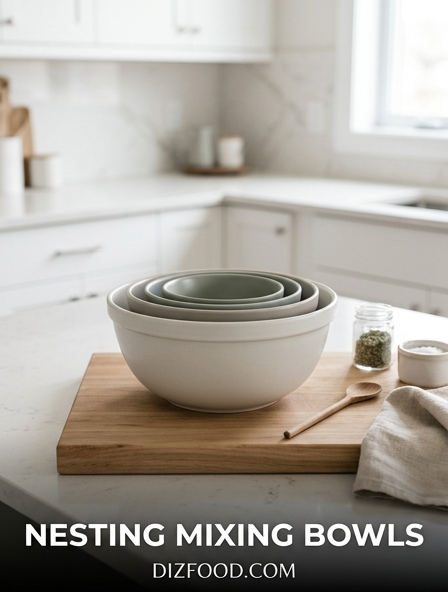
In high-performance kitchens, square footage is often the most valuable asset. Vertical storage solutions, specifically nesting mixing bowls, allow chefs to maximize cabinet and shelf space by condensing a full suite of equipment into the footprint of a single large vessel. This configuration is essential for maintaining a clear environment where multiple tasks occur simultaneously. By utilizing verticality, professional kitchens can store a diverse range of sizes-from small condiment bowls to massive salad basins-without cluttering the prep area.
- Minimizes the footprint of essential gear in tight cabinetry.
- Allows for easier inventory checks at a single glance.
- Reduces the risk of breakage by keeping sets securely stacked.
- Provides quick access to various volumes from one centralized location.
The efficiency of vertical stacking extends beyond simple storage; it facilitates a more disciplined workflow. When tools are housed in a predictable, nested manner, prep cooks spend less time searching through disparate cupboards and more time on technical execution. This systematic approach to organization is a hallmark of culinary professionalism, ensuring that even the smallest galley kitchen can function with the output capacity of a much larger facility.
Streamlining Mise en Place with Graduated Sizes
Effective mise en place relies on having the right size container for every ingredient, from a pinch of saffron to several pounds of flour. Nesting sets provide a graduated range of volumes that allow for precise organization of components before the cooking process begins. Using a bowl that is perfectly scaled to the ingredient prevents cross-contamination and ensures that delicate items are not lost in oversized containers. This granularity in sizing is what transforms a chaotic countertop into an organized station of culinary readiness.
- Select the smallest bowls for spices, herbs, and aromatics.
- Use mid-sized bowls for pre-cut vegetables and liquid components.
- Reserve the largest bowls for proteins or bulk mixing tasks.
- Arrange the graduated set in the order of the recipe execution.
By employing graduated sizes, chefs can create a visual map of their recipe on the counter. This logical progression reduces cognitive load during the heat of service, as the size of the bowl often signals its contents and its role in the final dish. Streamlining the preparation phase through these diverse sizes results in a more fluid transition from raw ingredients to finished plates.
Optimizing Counter Space During Large Batch Cooking
Large batch cooking often leads to an explosion of equipment across every available surface. Nesting mixing bowls mitigate this issue by allowing empty vessels to be consolidated immediately after use, rather than taking up valuable real estate while waiting for the cleanup phase. This practice keeps the primary working area clear for rolling dough, carving meats, or plating multiple portions simultaneously. A clean counter is directly proportional to the speed and safety of the kitchen staff.
| Bowl Size | Optimal Batch Task | Counter Footprint Impact |
|---|---|---|
| 1.5 Quart | Whisking Vinaigrettes | Minimal / Stackable |
| 3.0 Quart | Beating Egg Whites | Moderate |
| 5.0 Quart | Mixing Bread Dough | Significant / Primary |
Strategic counter management is especially critical when dealing with hot ingredients or sharp tools. By ensuring that only the bowls currently in use occupy the central workspace, the risk of accidental spills or knocked-over equipment is significantly lowered. The ability to nest bowls during the process provides a dynamic environment that adapts to the shifting needs of a complex, multi-stage culinary project.
The Role of Material Durability in High Volume Kitchens
In the rigorous environment of a high-volume kitchen, the durability of nesting bowls is paramount. Equipment must withstand constant impact, temperature fluctuations, and the abrasive nature of metal whisks and electric mixers. Professional nesting sets are typically manufactured from materials that prioritize longevity and sanitation. While glass and ceramic are aesthetically pleasing for home use, commercial settings often favor heavy-duty metals or reinforced polymers to ensure the set remains functional through years of abuse.
- Stainless Steel: Highly resistant to rust, staining, and impact damage.
- Tempered Glass: Safe for microwave use and non-reactive with acidic foods.
- Melamine: Lightweight and durable, though generally not for heat applications.
- BPA-Free Plastic: Cost-effective for cold prep and easy to transport.
Choosing the right material impacts not only the lifespan of the tool but also the quality of the food. Stainless steel, for example, is excellent for chilling ingredients over ice baths, while tempered glass allows for visibility during fermentation or proofing. A durable nesting set represents a long-term investment in kitchen infrastructure, reducing the frequency of replacements and ensuring consistent performance during peak hours of operation.
Reducing Prep Time with Quick Access Nesting Sets
Time is the most scarce resource in any kitchen, and nesting sets are designed to shave seconds off the preparation process. The standardized design of a nesting set means that handles, rims, and bases are uniform in style, making them easier to handle even when hands are wet or covered in flour. When a chef can reach for a single stack and find five or six different capacities instantly, the momentum of the cooking process is maintained without interruption. This accessibility is a key factor in achieving a high-speed culinary output.
Furthermore, the ergonomic design of many professional sets includes wide rims for better grip and pouring spouts for accuracy. These small features, combined with the convenience of nested storage, eliminate the friction points that often slow down prep work. Instead of struggling with mismatched lids or awkwardly shaped containers, the cook can focus entirely on the technique at hand. Quick access to a full range of sizes allows for a more responsive cooking style, where adjustments can be made on the fly without searching for secondary equipment. Efficiency is built into the very structure of the set.
Maintaining Kitchen Order During Intensive Meal Prep
Intensive meal prep, such as Sunday batch cooking or holiday catering, can quickly descend into chaos without a strict organizational system. Nesting mixing bowls act as a foundation for this order by providing a predictable framework for handling ingredients. Maintaining order requires a disciplined approach to how tools are utilized and stored during the active cooking window. When every bowl has a specific place within a stack, the mental map of the kitchen remains clear, allowing the cook to navigate complex recipes with confidence.
- Clear all non-essential items from the prep zone.
- Unstack the nesting set and line them up by size.
- Assign each bowl a specific ingredient category.
- Nest empty bowls as soon as they are rinsed to reclaim space.
Consistency in the kitchen leads to consistency in the final product. By using a uniform set of nesting bowls, the chef ensures that measurements and mixing volumes are familiar across different sessions. This familiarity reduces the chance of errors, such as overfilling a vessel or underestimating the space needed for dough to rise. Ultimately, the order provided by a well-organized nesting set translates into a more relaxed and successful cooking experience.
Transitioning from Food Preparation to Compact Storage
The utility of nesting bowls does not end once the food is in the oven or on the table. One of their most significant advantages is the seamless transition from active food preparation to long-term storage. Many modern nesting sets come equipped with airtight lids, transforming mixing vessels into storage containers in seconds. This eliminates the need to transfer food to separate Tupperware, which reduces the total volume of dirty dishes and preserves the integrity of the ingredients by minimizing handling.
When the cooking session is over, the compact nature of the set ensures that storage remains manageable. Even a set of eight bowls can be stored in the space of the largest one, making it easy to fit into refrigerators or pantry shelves. This is particularly useful for marinating meats overnight or storing large quantities of pre-made salads. The transition is efficient and logical, moving from the heat of the prep station to the cold of the fridge without any loss of organization. This lifecycle efficiency is why nesting sets remain a staple in both residential and professional kitchens worldwide, bridging the gap between creation and preservation.
Impact of Bowl Stability on Efficiency and Speed
Stability is often an overlooked aspect of kitchen efficiency, but it plays a critical role when performing high-energy tasks like whisking, folding, or kneading. A bowl that slides across the counter not only slows down the process but can also lead to spills and wasted ingredients. Premium nesting bowls often feature silicone bases or weighted bottoms to ensure they remain anchored to the work surface. This stability allows the chef to use both hands-one for adding ingredients and the other for vigorous mixing-without needing to manually steady the vessel.
- Non-slip silicone bottoms prevent lateral movement on wet surfaces.
- Contoured bases allow for easy tilting during precision pouring.
- Heavy-gauge materials provide the necessary inertia for thick batters.
- Wider bases offer a lower center of gravity to prevent tipping.
When a bowl is stable, the speed of execution increases naturally. The chef can apply more force and work at a faster tempo, knowing the equipment will not fail. This physical reliability is essential in high-pressure environments where every second counts. By investing in stable, well-designed nesting sets, a kitchen can achieve a higher level of mechanical efficiency, allowing the staff to focus on the nuances of flavor rather than the physics of their equipment.
Simplified Cleanup Routines for High Volume Tasks
Post-prep cleanup is often the most labor-intensive part of the culinary process. Nesting bowls simplify this routine through their uniform design and stackable nature, which carries over into the washing and drying phases. Because they are designed to fit within one another, they can often be run through a dishwasher or soaked in a sink with minimal displacement. This uniformity ensures that no odd-shaped containers are left behind, cluttering the drying rack or taking up excessive space in the machine.
| Cleaning Feature | Benefit for High Volume | Time Saved |
|---|---|---|
| Dishwasher Safe | Hands-free sanitization | High |
| Non-Porous Surface | Resists odors and stains | Medium |
| Nesting Dryness | Vertical air-dry efficiency | Medium |
A simplified cleanup routine directly impacts the turnover rate of the kitchen. When bowls can be washed, dried, and re-nested quickly, they are immediately available for the next round of prep. This cycle of use and reuse is vital for maintaining momentum in a professional setting. By choosing nesting sets with smooth interiors and rounded edges, kitchens can avoid the buildup of food particles in crevices, ensuring a higher standard of hygiene with less effort.
Essential Features for Commercial Grade Organization
Commercial-grade organization requires more than just basic containers; it demands features that enhance the functionality of every piece of equipment. When selecting nesting bowls for a professional environment, certain characteristics distinguish a standard set from a truly organizational tool. These features are designed to solve common kitchen problems, such as measurement inaccuracies, grip fatigue, and storage instability. Incorporating these elements into a kitchen's arsenal ensures that the workflow remains uninterrupted and the quality of the output stays high.
- Etched Measurement Markings: Internal lines for precise volume tracking.
- Extended Rims: Provides a secure 360-degree grip for heavy lifting.
- Airtight, Flat Lids: Enables stable stacking even when bowls are full.
- Vibration-Dampening Materials: Reduces noise in busy, echoing kitchens.
The integration of these features allows for a more sophisticated level of organization. For instance, etched measurements eliminate the need for separate measuring cups, further reducing clutter. Flat lids allow for "nested stacking" even within the refrigerator, maximizing every inch of cooling space. By prioritizing these essential features, a kitchen manager can ensure that the staff has the best possible tools to maintain order, speed, and precision throughout the most demanding service shifts.

Comments