
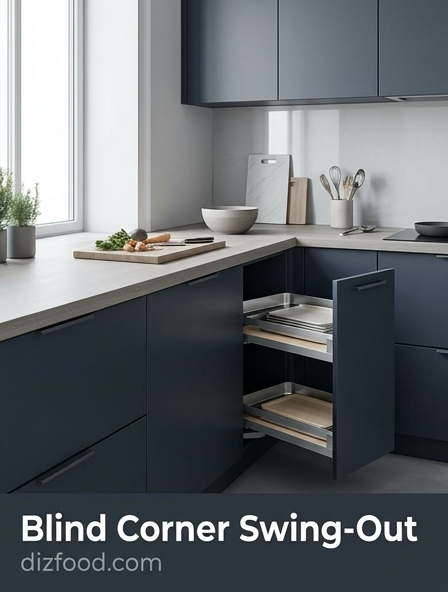
Taming the "black hole" of a kitchen corner requires choosing between two heavyweights of spatial efficiency: the classic Corner Lazy Susan and the modern Blind Corner Swing-Out. While Lazy Susans utilize a 360-degree rotating carousel ideal for diagonal cabinets and quick access to dry goods, Blind Corner Swing-Outs-often referred to as "Magic Corners"-feature sophisticated gliding tracks that pull heavy pots and pans out of deep, 90-degree recesses and into the light. Choosing the right solution depends on your cabinet's structural footprint and whether you prioritize the seamless, circular motion of a traditional spinner or the ergonomic, back-saving extension of a mechanical pull-out. Both systems effectively eliminate dead space, but understanding their mechanical limits and weight capacities is essential for a kitchen that flows as well as it functions.
| Feature | Corner Lazy Susan | Blind Corner Swing-Out |
|---|---|---|
| Cabinet Geometry | Diagonal or L-shaped corner cabinets. | Standard "Blind" cabinets (hidden depth). |
| Access Mechanism | 360° central pole or inset rotation. | Multi-tier pivoting or slide-out tracks. |
| Best Use Case | Small items, spices, and canned goods. | Large cookware, mixers, and heavy pots. |
| Storage Volume | High (uses full circular diameter). | Moderate (limited by track clearances). |
| Installation | DIY-friendly; simple center-pole mount. | Professional recommended; complex hardware. |
| Price Point | Budget-friendly ($100 - $350). | Premium investment ($400 - $1,200+). |
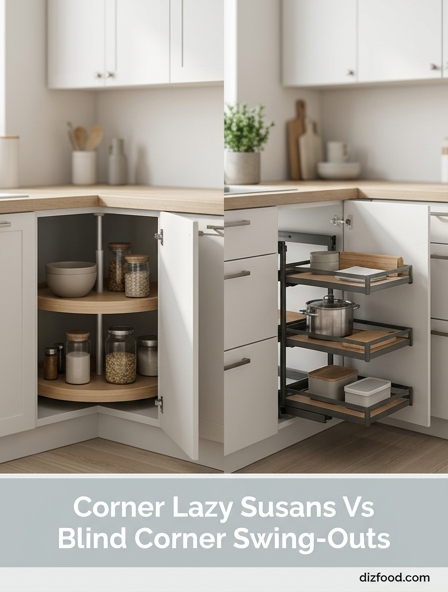
Maximizing Kitchen Corner Storage Efficiency
The kitchen corner has long been regarded as the "Bermuda Triangle" of interior design, a place where Tupperware lids, heavy stockpots, and specialty appliances go to be forgotten. In a standard kitchen layout, corner cabinets often provide a significant amount of cubic footage, yet the physical constraints of a ninety-degree angle make much of that space nearly impossible to reach without significant effort. Achieving peak efficiency in these areas is not just about having the most room; it is about ensuring that every square inch is usable and accessible. Without a dedicated organizational system, these deep voids become wasted "dead zones" that disrupt the flow of meal preparation and lead to cluttered countertops elsewhere in the room.
Maximizing this efficiency requires a strategic choice between two primary mechanical solutions: the rotating Lazy Susan and the articulating blind corner swing-out. Each system approaches the problem of depth differently. While one utilizes circular motion to bring items to the front, the other uses complex tracking to pull the entire contents of the cabinet out into the open air of the kitchen. When evaluating these options, homeowners must consider the ergonomics of their workflow. A well-designed corner solution reduces the need for kneeling or stretching, thereby protecting the user's physical health while simultaneously increasing the resale value of the home. Modern hardware innovations have transformed these once-clunky mechanisms into smooth, silent, and highly durable assets that can handle the weight of cast iron and heavy pantry staples alike.
Lazy Susan vs Blind Corner Swing Out Comparison
While both systems aim to solve the same problem, their mechanical executions are fundamentally different. A Lazy Susan typically operates on a central pole or a bottom-mounted swivel, allowing shelves to spin 360 degrees. In contrast, a blind corner swing-out-often referred to as a "cloud" or "LeMans" unit-uses a series of pivots and tracks to glide non-circular shelves out of a rectangular cabinet opening. The choice between them often depends on the specific cabinet construction, as Lazy Susans are most frequently found in L-shaped corner cabinets, whereas swing-outs are designed specifically for "blind" cabinets where one section is hidden behind a neighboring row of drawers or cupboards.
| Feature | Lazy Susan | Blind Corner Swing-Out |
|---|---|---|
| Movement | Rotational (360 Degrees) | Linear and Pivoting Pull-out |
| Cabinet Type | Diagonal or L-Shaped Corner | Rectangular Blind Corner |
| Visibility | High for items on the perimeter | High for all items once extended |
| Typical Use | Small spice jars, oils, bowls | Pots, pans, large appliances |
The Lazy Susan offers a simpler mechanical design, which often translates to a lower price point and easier long-term maintenance. However, the blind corner swing-out provides a more sophisticated aesthetic and allows for the utilization of deep, narrow spaces that a circular tray simply cannot fill. Homeowners should weigh the visual appeal of a modern pull-out against the classic, reliable functionality of a rotating tray system before making a final commitment to their cabinetry hardware.
Understanding Blind Corner Cabinet Solutions
A blind corner cabinet occurs when two base cabinets meet at a right angle, but one cabinet's end is completely obscured by the adjacent unit. This creates a deep, dark cavern that is accessible only through a single door. Unlike an L-shaped corner where the door is positioned at the intersection, the blind corner door is set to one side. This specific architectural challenge requires a specialized solution that can "reach" into the hidden depths and bring the stored items forward. Blind corner organizers are engineered precisely for this layout, utilizing heavy-duty slides and articulating arms to navigate the narrow opening while carrying heavy loads.
- The Magic Corner: A system of rectangular baskets that pull out in a sequence, effectively bringing the back-stored items to the front.
- The LeMans/Cloud Pull-Out: Features organic, kidney-shaped shelves that pivot independently and extend fully out of the cabinet.
- Slide-and-Pivot Systems: Basic trays that slide forward and then rotate to allow access to the secondary tray hidden in the "blind" area.
Understanding these solutions is crucial for any kitchen renovation because they allow for a seamless run of cabinetry without the need for a corner-cut diagonal door. This results in a cleaner, more modern aesthetic with straight lines and flush surfaces. While these systems are more complex than a standard shelf, they eliminate the frustration of having to climb into a cabinet to find a missing lid. They are particularly beneficial for those with limited mobility, as they bring the entire inventory of the cabinet directly to the user's fingertips with a gentle pull.
Storage Capacity and Accessibility Differences
When comparing storage capacity, the debate often centers on "volume vs. usability." A Lazy Susan, due to its circular shape, naturally leaves the four corners of a square cabinet empty. This results in a loss of raw square footage. However, because the shelves spin, every item placed on the perimeter of the circle is equally accessible. The center of the Lazy Susan is where things tend to get lost; items placed near the pole are harder to see and may be knocked over when the unit is spun rapidly. This makes the Lazy Susan ideal for smaller, lighter items like spices, canned goods, or condiments that can be organized in rows along the edge of the carousel.
Blind corner swing-outs, particularly the "cloud" style, maximize the usable surface area by following the rectangular footprint of the cabinet more closely. These shelves are often larger and can accommodate bulky items like slow cookers, mixers, or large frying pans. In terms of accessibility, the swing-out wins for high-visibility. Once the unit is fully extended, the user can see every single item from a standing position. There is no need to rotate or dig through layers of items. However, the clearance required to swing these shelves out means that the kitchen floor space must be clear, and the cabinet door must be opened to a full 90 or 110 degrees to avoid damaging the hardware or the door finish. Ultimately, while the Lazy Susan offers quick access to many small items, the swing-out offers superior access to large, heavy equipment.
Pros and Cons of Rotating Lazy Susans
The Lazy Susan is a staple of American kitchen design for a reason: it is intuitive and effective. One of its primary advantages is its simplicity. With fewer moving parts than a multi-tier swing-out, there is less that can go wrong over decades of use. They are generally more affordable and can be installed in a variety of cabinet styles, including wall-mounted upper corners. Furthermore, a Lazy Susan with a "pie-cut" door-where the door is attached to the unit and rotates inward-preserves the exterior look of the cabinetry while providing instant access to the contents.
- Pro: 360-degree access ensures no item is truly stuck at the very back of the cabinet.
- Pro: Generally lower cost for hardware and installation compared to high-end pull-outs.
- Con: Items can fall off the edges and become jammed in the bottom of the cabinet, requiring the removal of the entire unit to retrieve them.
- Con: Central poles can obstruct the storage of larger items like wide platters or baking sheets.
- Con: Significant "dead space" remains in the corners of the cabinet box where the circle does not reach.
Modern iterations have addressed some of these downsides. Many new Lazy Susans feature high side-walls or "fences" to prevent items from flying off during a spin. Others are designed as "D-shaped" or "Moon-shaped" to better fit specific cabinet depths. Despite these improvements, the fundamental limitation remains the central axis; if a tall bottle is placed too close to the middle, it may tip over, potentially causing a mess or mechanical obstruction that is difficult to clear without unloading the entire shelf.
Advantages of Modern Blind Corner Pull Outs
Modern blind corner pull-outs are often considered the gold standard for premium kitchen remodels. Their primary advantage is the "wow factor" of their engineering, which allows heavy, deep shelves to glide out with the touch of a finger. These units are specifically designed to solve the reach-in problem of deep blind cabinets. By bringing the shelves entirely out of the cabinet carcass, they eliminate the need for the user to bend over and reach into a dark space. This ergonomic benefit cannot be overstated, especially for aging homeowners or those with back concerns who wish to maintain an active cooking lifestyle.
Another significant advantage is the weight distribution. High-quality swing-outs like the LeMans system use sophisticated tracking that can support up to 50 or 60 pounds per shelf. This makes them the perfect home for heavy Dutch ovens and stand mixers that would be too cumbersome for a spinning Lazy Susan. Additionally, most modern pull-outs come equipped with soft-close technology, ensuring that the heavy shelves don't slam into the cabinetry, which protects both the hardware and the delicate items stored on the shelves. The aesthetic of these units, often finished in polished chrome or sleek anthracite with non-slip surfaces, adds a layer of luxury to the interior of the kitchen that traditional plastic Lazy Susans simply cannot match. They turn a frustrating corner into a highlight of the kitchen's functional design.
Installation Requirements and Space Constraints
Choosing between these two systems often comes down to the physical dimensions of the existing or planned cabinetry. Lazy Susans are flexible but usually require a "diagonal" or "L-shaped" corner footprint. A standard 36-inch corner base cabinet is the traditional requirement for a full-circle Lazy Susan. If the opening is too narrow, the diameter of the circle must be reduced, which significantly diminishes the storage capacity. Installation is relatively straightforward, often involving a single vertical pole tension-mounted or screwed into the top and bottom of the cabinet box.
- Measure the Opening: Blind corner pull-outs require a specific minimum door opening (usually 15 to 21 inches) to allow the shelves to pass through.
- Check the Depth: Ensure there are no plumbing pipes or electrical conduits at the back of the cabinet that could interfere with the swing-out tracks.
- Account for Obstructions: Check that the unit won't hit the handle of the oven or a nearby dishwasher when it is fully extended.
- Verify Door Swing: Most swing-outs require the cabinet door to open at least 90 degrees, and some require 110 degrees for full clearance.
Installation for blind corner pull-outs is significantly more complex than for Lazy Susans. It requires precise templates to mount the heavy-duty tracks to the floor and side walls of the cabinet. Because these units exert a high amount of leverage on their mounting points when fully loaded and extended, the cabinet box itself must be sturdy and properly secured to the wall studs. Retrofitting these into older cabinets can be challenging if the face frame dimensions do not align with modern hardware standards, making it a task often best left to professional installers during a full renovation.
Weight Capacity and Durability Evaluation
Durability is a major factor for high-traffic kitchens where cabinets are opened and closed dozens of times a day. Lazy Susans are generally durable due to their mechanical simplicity. A bottom-mounted swivel with ball bearings can last for decades with minimal maintenance. However, the plastic trays found in cheaper models can crack or sag over time if overloaded with heavy canned goods. If a central pole becomes misaligned, it can cause the shelves to scrape against the cabinet sides, leading to wear on both the hardware and the wood. High-end wood or wire-frame Lazy Susans offer better longevity but come at a higher price point.
Blind corner swing-outs are marvels of engineering, but their complexity means there are more potential points of failure. High-quality European brands use aircraft-grade aluminum and hardened steel tracks to ensure that the shelves glide smoothly even under maximum load. The durability of these units is directly tied to the quality of the hardware; a "budget" version of a magic corner may develop "shelf sag" or begin to squeak within a few years. When evaluating weight capacity, it is important to look at the "dynamic load" rating-how much weight the unit can handle while in motion-rather than just the "static load." A premium swing-out is designed to maintain its alignment even when carrying 50 pounds of cookware at full extension, making it a robust choice for serious cooks who need reliable, heavy-duty storage.
Choosing the Right Hardware for Your Kitchen
The decision between a Lazy Susan and a blind corner pull-out should be guided by three main factors: your cabinet layout, your storage needs, and your budget. If you are working with an L-shaped corner cabinet and want a cost-effective way to access items, the Lazy Susan is the logical choice. It is particularly effective for households that store many small items like baking supplies or snacks. The 360-degree rotation is fast and efficient for "spin and grab" access. If your kitchen features a contemporary aesthetic with clean lines, a pie-cut Lazy Susan that hides behind a 90-degree folding door is an excellent way to maintain the visual flow.
On the other hand, if you are dealing with a blind corner cabinet where one side is "dead," a swing-out is almost mandatory to make the space functional. It is the superior choice for storing heavy cookware and large appliances that would be awkward to lift out of a rotating tray. While the initial investment for a high-quality pull-out can be three to four times higher than a standard Lazy Susan, the long-term benefit in terms of ergonomics and home value often justifies the cost. Consider the "clearance zone" in your kitchen; if your corner is in a tight galley where a swing-out would block all traffic when open, a Lazy Susan might be the more practical daily option. Ultimately, the best hardware is the one that removes the most friction from your specific cooking routine.
Final Verdict on Corner Cabinet Organizers
In the final analysis, there is no single "best" option, but rather a "right" option for your specific kitchen configuration. The Lazy Susan remains the champion of the L-shaped corner, offering a time-tested, reliable, and affordable solution for general pantry storage. It is the workhorse of the traditional kitchen, providing easy access to the perimeter of the cabinet and keeping everyday items within reach. For many homeowners, the simplicity and lower cost of the Lazy Susan make it the most sensible choice, especially in secondary storage areas or rental properties where high-end hardware might not be treated with care.
However, for the modern, high-functioning kitchen, the blind corner swing-out represents the pinnacle of storage innovation. It solves the "blind" cabinet problem with an elegance and efficiency that a circular tray cannot match. By bringing the entire contents of the cabinet out to the user, it transforms the most difficult corner of the kitchen into its most accessible feature. It is a premium upgrade that significantly improves the user experience and utilizes every available cubic inch of space. Whether you choose the classic rotation of the Lazy Susan or the sophisticated glide of a swing-out, the key is to move away from static shelving. By investing in specialized corner hardware, you turn a potential source of frustration into a streamlined component of a high-performance kitchen.


Comments