
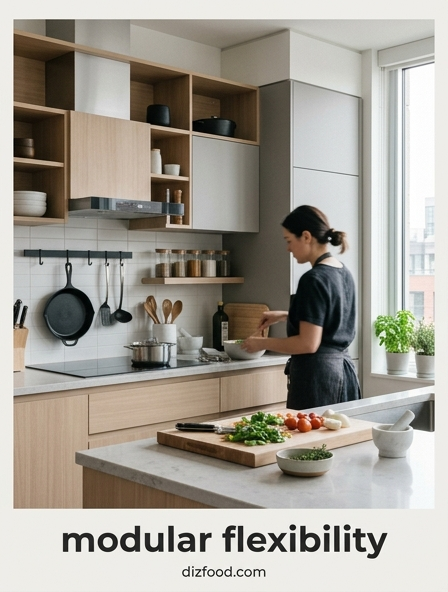
Achieving a clutter-free culinary space often hinges on the debate between the versatile adaptability of expandable utensil trays and the streamlined precision of fixed drawer inserts. While expandable models offer a "one-size-fits-most" convenience by sliding to eliminate unsightly gaps in non-standard cabinetry, fixed inserts provide the structural integrity and bespoke aesthetic typical of high-end kitchen designs. Choosing the right solution requires balancing your need for modular flexibility-perfect for renters or evolving tool collections-against the rock-solid stability and dedicated storage capacity of a stationary organizer.
| Feature | Expandable Utensil Trays | Fixed Drawer Inserts |
|---|---|---|
| Fit Adaptability | Telescoping sides; adjusts to varied widths. | Static dimensions; requires precise measuring. |
| Stability | Potential for slight movement if not weighted. | High; snug fit prevents sliding during use. |
| Installation | Instant "drop-in" with manual adjustment. | May require spacers or adhesive for gaps. |
| Storage Layout | Variable; side wings add extra compartments. | Uniform; optimized for specific cutlery counts. |
| Durability | Moderate; sliding tracks can collect debris. | High; solid construction with no moving parts. |
| Ideal Use Case | Renters and non-standard vintage drawers. | Custom cabinetry and heavy-duty tool sets. |
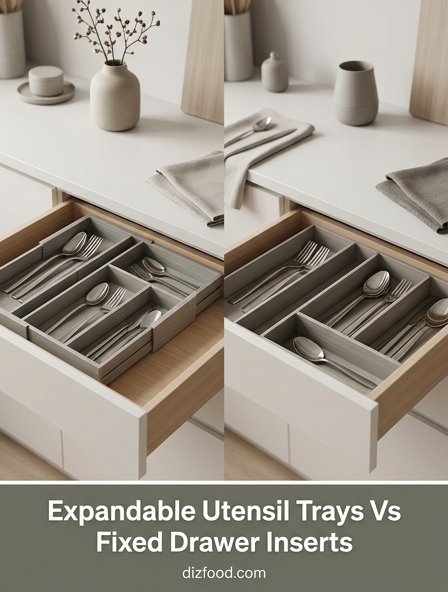
Expandable Utensil Trays Versus Fixed Drawer Inserts
The debate between expandable utensil trays and fixed drawer inserts often centers on the balance between versatility and precision. Expandable trays are designed with a sliding mechanism that allows the user to adjust the width of the unit to match the interior dimensions of a kitchen drawer. This "one-size-fits-most" approach is particularly popular for renters or homeowners who do not wish to invest in custom-built cabinetry. By sliding out the side wings, these organizers can cover the entire surface area of a drawer, preventing the tray from shifting when the drawer is opened or closed.
In contrast, fixed drawer inserts are static units with predetermined compartments. These are often manufactured in standard sizes that may or may not perfectly align with every cabinet brand. While they lack the adjustability of their expandable counterparts, fixed inserts offer a level of structural integrity that moving parts cannot replicate. Users often choose between these two based on their specific storage needs and the longevity of their current kitchen setup. Below is a comparison of their primary characteristics:
| Feature | Expandable Trays | Fixed Inserts |
|---|---|---|
| Adjustability | High - Slides to fit | None - Static size |
| Installation | Tool-free / Instant | Drop-in / May need spacers |
| Stability | Moderate | High |
| Custom Feel | Low to Moderate | High (if sized correctly) |
Ultimately, the choice depends on whether the user prioritizes a quick, flexible solution or a permanent, heavy-duty organization system that feels integrated into the kitchen's architecture.
Maximizing Kitchen Storage With Adjustable Width Trays
Adjustable width trays are engineered to solve the problem of wasted space that occurs when a standard organizer is significantly smaller than the drawer it occupies. In a busy kitchen, every square inch of horizontal space is valuable. Expandable trays typically feature a central core for primary cutlery-knives, forks, and spoons-and one or two side wings that pull out to accommodate larger cooking tools like spatulas, whisks, and rolling pins. This modularity ensures that specialized gadgets do not end up in a cluttered "junk drawer."
One of the primary benefits of this design is the ability to maximize storage without the need for professional measurements. Most kitchen drawers range between 12 and 24 inches in width. An expandable tray can often bridge this gap, transforming a standard tray into a full-width organizational masterpiece. This is particularly useful for:
- Accommodating oversized serving pieces that do not fit in standard slots.
- Adapting to different drawer widths during a move to a new home.
- Eliminating the "sliding tray" effect where organizers move to the back of the drawer.
- Providing extra compartments for small items like corn-on-the-cob holders or wine stoppers.
By utilizing the full width of the drawer, these trays prevent items from falling into the gaps between the organizer and the drawer wall. This not only keeps the kitchen more organized but also protects the interior finish of the cabinetry from scratches caused by loose metal utensils.
The Stability and Seamless Look of Fixed Inserts
Fixed drawer inserts are often the preferred choice for those seeking a high-end, "built-in" aesthetic. Unlike expandable models, which have visible seams and overlapping plastic or wood edges, a fixed insert provides a clean, uniform look. Because these units are solid pieces, they do not have joints that can loosen over time or rails that might catch on stray crumbs. This lack of moving parts translates to superior stability; when you place a heavy stack of stainless steel spoons into a fixed compartment, there is no risk of the tray expanding or contracting unexpectedly.
The visual appeal of fixed inserts is most apparent in custom kitchen designs. When a fixed insert is sized perfectly to the drawer, it creates a seamless transition that looks like part of the cabinetry itself. This prevents the "rattle" often associated with cheaper, ill-fitting organizers. For homeowners who value a quiet, premium kitchen experience, the solid construction of a fixed insert is a significant advantage. Furthermore, because they are not designed to slide, manufacturers can often use thicker materials, such as solid maple, oak, or high-density polymers, which add a tactile sense of quality to the drawer's operation. While they require more careful measuring before purchase, the payoff is a professional-grade organization system that stays exactly where it is placed, year after year.
Solving the Gap Problem in Standard Kitchen Drawers
One of the most frustrating aspects of kitchen organization is the "dead space" or gap that exists when an organizer does not perfectly match the drawer width. These gaps become magnets for dust, crumbs, and small utensils that inevitably slip over the edge. Fixed inserts frequently suffer from this issue unless they are custom-ordered or happen to match a specific cabinet brand's dimensions perfectly. When a gap exists, the tray tends to slide forward or backward every time the drawer is jerked open, leading to a disorganized and noisy kitchen environment.
Expandable trays are specifically designed to solve this gap problem. By extending the side compartments until they meet the side walls of the drawer, the tray effectively wedges itself into place. This eliminates the need for adhesive strips, museum wax, or rubber bumpers to keep the organizer stationary. To ensure a perfect fit and solve the gap problem effectively, users should follow these steps:
- Clear the drawer completely and wipe down the interior surface.
- Place the expandable tray in the center of the drawer.
- Slowly pull the adjustable wings outward until they sit flush against the left and right walls.
- Apply slight pressure to ensure the locking mechanism (if present) is engaged.
- Fill the side compartments with larger items to further weight the tray down.
By filling the entire width, the expandable tray ensures that every millimeter of the drawer is functional, leaving no room for debris to accumulate in hard-to-reach crevices.
Durability Comparison Between Moving Parts and Solid Frames
When considering longevity, the structural differences between expandable trays and fixed inserts are significant. Expandable organizers rely on mechanical joints, sliding tracks, or overlapping panels to function. While modern engineering has made these quite sturdy, any moving part represents a potential point of failure. Over years of use, the friction from sliding components can wear down the material, or the locking mechanisms can become loose, causing the tray to "creep" inward and lose its snug fit. This is particularly true for lower-end plastic models where the tabs may snap under the weight of heavy cutlery.
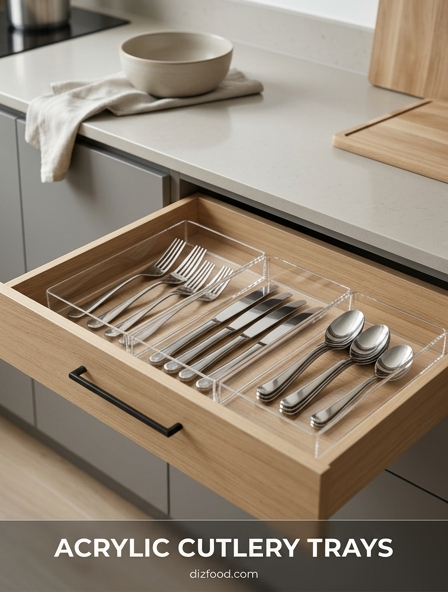
Fixed inserts, by contrast, feature solid-frame construction. Without the need for sliding tracks, these units can be built with reinforced corners and thicker dividers. A solid wood or heavy-duty acrylic fixed insert can easily last for decades without any change in performance. There are no seams for moisture to seep into and no hinges to break. However, it is important to note that durability also depends on material choice. A high-quality bamboo expandable tray may still outlast a cheap, thin plastic fixed insert. Generally, if the kitchen sees heavy daily use and the drawers are frequently opened with force, a solid frame insert offers the most robust resistance to wear and tear. For those who prioritize a "buy it once" philosophy, the simplicity of the fixed design is almost always the superior choice for long-term durability.
Easy Installation Benefits of Expandable Organizers
The primary appeal of expandable organizers lies in their "plug-and-play" nature. In a modern world where convenience is king, the ability to walk into a store, purchase a single item, and have it fit perfectly in any drawer in the house is a major benefit. There is no need for measuring tapes, mathematical calculations, or the frustration of returning items that are a quarter-inch too wide. For many, the installation process of an expandable tray takes less than thirty seconds, providing immediate gratification and instant organization.
This ease of installation makes expandable trays the ideal solution for several specific scenarios:
- Rental Properties: Tenants can take their organizers with them and adapt them to a new kitchen regardless of drawer size.
- Gift Giving: Because they are universal, they make excellent housewarming gifts without needing the recipient's cabinet specs.
- Temporary Solutions: Perfect for organizing a kitchen quickly before a party or holiday event.
- Non-Standard Cabinetry: Useful in older homes where drawer sizes may be inconsistent or asymmetrical.
Beyond just the physical fit, these trays often require no tools or hardware. While some fixed inserts might require spacers or even a bit of sanding to fit a tight spot, the expandable tray is designed to be forgiving. It accommodates the user's needs rather than forcing the user to accommodate the tray's dimensions, making it the most user-friendly option on the market.
Cost Analysis of Universal Versus Custom Solutions
From a financial perspective, the difference between universal expandable trays and custom-fixed solutions can be substantial. Expandable trays are mass-produced "universal" products. This mass production allows manufacturers to keep costs low, typically ranging from $15 to $50 depending on the material (plastic vs. bamboo). Because one product can fit thousands of different drawer configurations, the economy of scale works in favor of the consumer. This makes them a highly cost-effective way to achieve a semi-custom look on a budget.
Fixed inserts can vary wildly in price. Standard-sized plastic fixed inserts are the cheapest option, sometimes costing less than $10, but they often leave gaps that diminish the "custom" feel. On the other end of the spectrum, true custom-fitted inserts-those made by cabinetry companies to fit a specific drawer line-can cost upwards of $100 to $200 per drawer. These are often made from premium hardwoods and matched to the cabinet finish. When analyzing the value, consumers should consider the "cost per year of use." While a custom fixed insert is more expensive upfront, its durability might mean it never needs replacing. However, for the average household, the expandable tray offers about 90% of the functionality at 20% of the cost of a custom solution. For those on a budget, the universal expandable model provides the highest return on investment by maximizing utility without the "custom" price tag.
Cleaning and Maintenance of Modular Drawer Dividers
Maintenance is an often-overlooked factor when choosing kitchen organizers. Kitchen drawers are notorious for collecting "crumbs"-bits of dried pasta, flour, and general dust. Fixed inserts are generally easier to clean because they consist of a single, continuous surface. To clean a fixed insert, one can usually just lift the entire unit out, shake it over a bin, and wipe it down with a damp cloth. There are no hidden areas where debris can hide, making it a more hygienic choice for food-adjacent storage.
Expandable trays, due to their modular nature, present a greater cleaning challenge. The areas where the panels overlap create narrow crevices and tracks that are difficult to reach with a standard sponge. Dust and crumbs can migrate into the sliding mechanism, potentially jamming the movement or creating an unsanitary buildup over time. To properly maintain an expandable tray, users should occasionally:
- Fully contract the tray to expose the hidden sections of the sliding wings.
- Use a vacuum attachment or canned air to blow out debris from the tracks.
- Hand-wash the unit, ensuring it is completely dry before re-expanding to prevent mold or wood rot in the joints.
- Apply a food-safe mineral oil to bamboo models to keep the sliding parts moving smoothly.
While the expandable tray requires more "finesse" during cleaning, many modern plastic versions are dishwasher-safe, which can mitigate some of the maintenance hassles compared to wooden fixed inserts.
Visual Harmony and Aesthetics in Kitchen Organization
The visual impact of a drawer organizer should not be underestimated, especially in kitchens designed with a minimalist or luxury aesthetic. Visual harmony is achieved when the organizer complements the materials and colors of the cabinetry. Fixed inserts often win in this category because they can be matched precisely to the drawer box. If your drawers are made of light maple, a matching maple fixed insert creates a cohesive, high-end look that feels intentional and calm. The absence of visible adjustment lines or sliding seams contributes to a sense of order and tranquility.
Expandable trays can sometimes look "cluttered" because of the visible layers where the wings overlap. However, manufacturers have improved these designs significantly. High-quality bamboo expandable trays offer a warm, organic feel that works well in modern and traditional kitchens alike. To achieve the best aesthetics with an expandable tray, it is important to choose a material that contrasts or matches well with the drawer interior. For example, a dark grey or black plastic tray can look very sophisticated inside a white drawer. While fixed inserts provide the ultimate "tailored" look, a well-chosen expandable tray can still provide a significant aesthetic upgrade over a mess of loose utensils. The goal is to minimize visual noise; a full-width tray-even an expandable one-looks significantly better than a small tray floating in a sea of empty drawer space.
Choosing the Best Fit for Your Cabinet Configuration
Selecting the right organizer ultimately comes down to a few critical measurements and lifestyle factors. Before making a purchase, it is essential to measure not just the width, but also the depth (front-to-back) and height of your drawers. Many people forget that expandable trays only adjust in width, not in depth. If your drawer is 22 inches deep and the tray is only 18 inches, you will still have a gap at the back. In such cases, a fixed insert that comes in various depth options might actually be the better fit.
To choose the best fit for your configuration, consider the following checklist:
- Drawer Width: If your drawer is an odd size (e.g., 17.5 inches), an expandable tray is almost always the best choice.
- Utensil Volume: Do you have a standard 5-piece set, or do you have dozens of specialized gadgets? More items usually require the extra compartments found in expanded wings.
- Drawer Height: Ensure the tray (especially the overlapping parts of an expandable model) isn't so tall that it prevents the drawer from closing.
- Longevity: If you plan to stay in your home for 10+ years, investing in a high-quality fixed insert is worthwhile. If you are a renter, go with an expandable model.
By carefully evaluating how you use your kitchen and the specific dimensions of your cabinetry, you can choose an organizer that not only fits your space but also enhances your daily cooking and cleaning routine.



Comments