
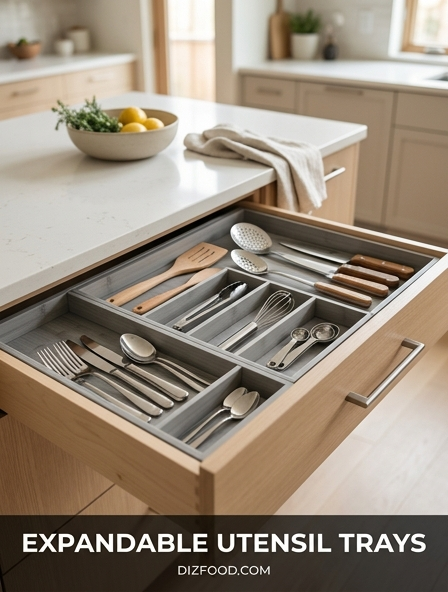
Challenges of Non-Standard Drawer Dimensions
Kitchen drawers rarely follow a universal manufacturing standard, especially in older homes or artisanal builds. Many homeowners purchase fixed-size inserts only to find they are an inch too narrow or slightly too long, creating frustrating gaps where small items like corn holders or twist ties inevitably disappear. These non-standard dimensions often force a compromise between a cluttered drawer and a poorly fitted organizer. When a tray does not meet the side walls of the drawer, it slides back and forth with every pull, causing noise and disarray.
The core challenge lies in the variance of internal clearance; even modern cabinetry can fluctuate based on the thickness of the wood or the type of glides used. This inconsistency makes the "one size fits all" approach obsolete. Finding a solution that bridges the gap between a 15-inch and a 20-inch opening is essential for maintaining order. Without adaptability, the user is left with dead zones that serve no functional purpose, complicating the daily ritual of food preparation and meal service. Addressing these dimensional hurdles requires a system that prioritizes adjustable boundaries over rigid plastic molds.
Eliminating Wasted Space in Custom Cabinetry
Custom cabinetry often features unique depths and widths designed to maximize a specific kitchen layout, yet these premium features are frequently undermined by generic storage solutions. When an organizer is too small for a custom drawer, the remaining peripheral space becomes "dead space"-areas where dust accumulates and utensils are haphazardly tossed. Expandable trays solve this by stretching to the exact interior perimeter of the drawer, ensuring every square inch is utilized for storage.
- Full edge-to-edge coverage prevents small items from falling into the drawer base.
- Eliminates the need for multiple small bins that create a cluttered appearance.
- Maximizes the storage capacity of wide "pot and pan" drawers repurposed for tools.
- Creates a flush surface that mimics the look of high-end integrated dividers.
By filling the entire footprint of the drawer, these trays allow for a more logical flow of kitchen tools. Users can designate specific zones for everything from primary cutlery to specialized baking equipment, ensuring that no volume is left unproductive in the heart of the home.
How Expandable Trays Adapt to Every Width
The engineering behind expandable utensil trays relies on a sliding "wing" mechanism that allows the unit to grow or shrink based on the available horizontal space. Typically consisting of a central core with one or two lateral sections, these trays utilize a telescopic design. When the drawer is narrow, the wings remain tucked beneath or alongside the main body. For wider drawers, the user simply pulls the side compartments outward until they make contact with the drawer walls.
This mechanical adaptability is crucial for renters or people who move frequently, as it allows the same organization system to function in various kitchen configurations. The friction between the sliding components is usually calibrated to keep the tray at its set width without the need for hardware or adhesives. This versatility ensures that regardless of whether a kitchen features narrow 12-inch utility drawers or expansive 36-inch island storage, the tray can be configured in seconds to provide a snug, reliable fit that holds its position over years of heavy use.
Achieving a Bespoke Look Without the Custom Cost
Professional kitchen organization often involves expensive, built-in wooden dividers that are permanent and difficult to modify. Expandable trays offer a middle ground, providing the aesthetic of a custom-fitted system at a fraction of the price. When an expandable tray is fully extended to the walls of a drawer, it creates a seamless transition that looks like it was handcrafted specifically for that cabinet. Materials like bamboo, acacia, or high-grade brushed polymers contribute to this high-end feel.
The visual continuity of a wall-to-wall tray hides the unfinished bottom of the drawer, elevating the interior design of the cabinetry. It transforms a standard utility space into a curated display of culinary tools. Because these trays are mass-produced but adjustable, they bypass the labor costs associated with hiring a carpenter for "inner-drawer" architecture. This allows homeowners to achieve a sophisticated, organized kitchen environment while maintaining the flexibility to remove or clean the inserts easily. The result is a professional-grade appearance that enhances the overall value and functionality of the kitchen workspace without a significant financial investment.
Versatility for Deep and Shallow Kitchen Drawers
While width is a primary concern, the vertical profile of a utensil tray is equally important for drawer functionality. Expandable trays are designed with a low-profile height to ensure they fit within standard shallow cutlery drawers while remaining substantial enough to hold larger tools in deeper units. The following table illustrates how different tray configurations accommodate various kitchen items based on typical drawer depths:
| Drawer Type | Typical Depth | Recommended Tray Use |
|---|---|---|
| Standard Cutlery | 3 - 4 inches | Flatware, tea spoons, and paring knives. |
| Utility Drawer | 4 - 5 inches | Expanded wings for spatulas and whisks. |
| Deep Tool Drawer | 6+ inches | Tiered expandable trays for maximum volume. |
This dimensional versatility ensures that the tray does not interfere with the drawer's opening and closing mechanism. A tray that is too tall will snag on the cabinet frame, while one too shallow wastes vertical real estate. Expandable designs balance these needs by offering scalable widths without compromising the clearance needed for smooth operation.
Preventing Tray Shifting and Lateral Movement
One of the most common irritations in kitchen organization is the "sliding tray" syndrome. Every time a drawer is opened or closed with force, a poorly fitted insert shifts toward the back or slams against the sides. This movement not only creates noise but also leads to disorganized utensils as items jump out of their designated slots. Expandable trays naturally mitigate this issue by creating a friction fit against the side walls of the drawer.
When the tray is expanded to the full width of the internal cavity, there is no room for lateral movement. Many high-quality expandable models also feature non-slip rubberized feet or gaskets on the bottom and sides to further anchor the unit. This stability is vital for protecting the longevity of the cabinetry, as it prevents the constant impact of plastic or wood against the drawer's interior finish. By locking into place through physical expansion, these trays provide a stationary, reliable foundation for your most-used tools, ensuring that the layout you set in the morning remains exactly the same by dinner time.
Organizing Oddly Shaped Cooking Utensils
Standard utensil trays are often designed for uniform forks and knives, leaving no room for the "misfits" of the kitchen. Expandable trays solve this by providing oversized side compartments that emerge as the tray is pulled open. These extra-long or extra-wide sections are perfect for items that do not fit into traditional 10-inch slots. Common items that benefit from this extra space include:
- Long-handled silicone spatulas and soup ladles.
- Balloon whisks that require more width to prevent crushing.
- Rolling pins and wine bottle openers.
- Tongs and oversized chef's knives.
- Microplanes and box graters.
By using the expandable wings for these bulky or irregularly shaped items, the central compartments remain dedicated to everyday cutlery. This separation prevents the "drawer jam" often caused by a whisk getting caught in the upper frame. Having a specific, appropriately sized home for awkward tools reduces clutter and saves time during high-pressure cooking moments, as every item is visible and accessible without digging through layers of equipment.
The Advantage of Adjustable Compartment Layouts
Beyond simply changing width, many expandable trays offer internal modularity. The advantage of an adjustable layout is the ability to tailor the storage to your specific inventory rather than forcing your tools to fit a pre-molded shape. Some models feature removable dividers or sub-bins within the expandable sections. This allows for a "dynamic" storage environment where the user can create long channels for barbecue tools or smaller square pockets for corn holders and wine stoppers.
As a household grows or culinary interests change-perhaps shifting from baking to sushi making-the tray can be reconfigured to reflect those new requirements. This level of customization ensures that the organization remains tight and efficient. It eliminates the frustration of having one compartment that is awkwardly empty while another is overflowing. Adjustable layouts empower the user to define their own logic of organization, grouping items by frequency of use, size, or function, which ultimately streamlines the workflow in a busy kitchen environment.
Long-Term Flexibility for Kitchen Renovations
Investing in kitchen organization can be risky if you plan to renovate or move in the future. Fixed-size inserts are often discarded during a move because they rarely fit the dimensions of a new home's cabinetry. Expandable utensil trays offer long-term flexibility that protects your investment. Because they can be adjusted to fit a wide range of drawer sizes, they are essentially "future-proof." If you move from an apartment with narrow drawers to a home with wide, custom cabinets, the tray adapts with you.
Furthermore, during a renovation where old cabinets are replaced with new ones, these trays can be repurposed into different areas of the house if they are no longer needed in the kitchen. Their neutral design and adjustable nature make them suitable for office supplies, craft rooms, or vanity drawers. This versatility reduces waste and ensures that you do not have to start your organization journey from scratch every time your living situation changes. The durability of materials like bamboo combined with this adaptability makes expandable trays a sustainable choice for organized living.
Maximizing Vertical and Horizontal Drawer Real Estate
Efficiency in the kitchen is measured by how much functionality can be squeezed into a limited footprint. Expandable trays maximize both horizontal and vertical real estate by providing a structured environment that discourages stacking and burying items. Horizontally, the expansion wings capture space that would otherwise be wasted. Vertically, many modern designs incorporate tiered levels or "stepped" compartments that allow cutlery to overlap slightly without becoming entangled.
By organizing utensils in a single, well-distributed layer across the entire width of the drawer, you increase the visibility of every tool. This prevents the "junk drawer" effect where items are piled on top of one another. When every tool has a designated horizontal coordinate, the vertical clearance of the drawer remains clear, ensuring smooth operation. Maximizing real estate in this way is particularly beneficial in small kitchens or urban apartments where drawer count is limited. It allows one drawer to do the work of two, keeping your countertops clear and your essential tools within arm's reach at all times.



Comments