
The Hidden Struggles of Blind Corner Cabinets
In many traditional kitchen layouts, the blind corner cabinet is often referred to as a "dead zone" or a "black hole." This architectural necessity occurs where two rows of base cabinets meet at a right angle, creating a deep, cavernous space that is notoriously difficult to access. The primary struggle for homeowners involves the physical strain required to reach items stored in the furthest recesses. Without a specialized organizational system, users are frequently forced to kneel on the floor or stretch uncomfortably to retrieve heavy pots, pans, or dry goods.
- Reduced visibility leading to expired food items and forgotten cookware.
- Physical discomfort and potential for back strain during retrieval.
- Accumulation of dust and debris in corners that are nearly impossible to clean.
- Waste of premium kitchen square footage that remains underutilized.
The geometric design of these cabinets means that nearly fifty percent of the internal volume is shielded by the cabinet frame. This creates a psychological barrier where the homeowner eventually stops using the space altogether, leading to cluttered countertops elsewhere as storage options dwindle.
Defining the Magic Corner Storage System
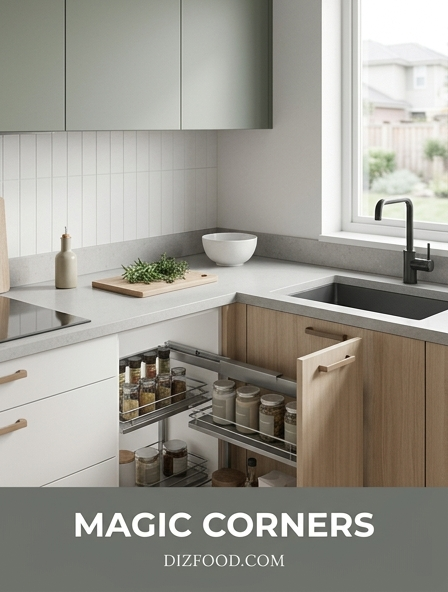
The Magic Corner is an advanced kitchen hardware solution specifically engineered to transform the inaccessible depths of a blind corner into a fully functional storage hub. Unlike static shelving, this system utilizes a complex series of articulated tracks and interconnected baskets. When the cabinet door is opened and pulled outward, the internal mechanism triggers a synchronized movement. The front baskets swing out of the way while simultaneously drawing the rear baskets forward into the front opening of the cabinet.
This "magic" movement ensures that every item stored within the unit is brought directly into the user's line of sight and within easy arm's reach. Most modern Magic Corner systems are constructed from high-grade chrome or powder-coated steel to support significant weight. They are designed with precision engineering to ensure that the transition between the "hidden" and "accessible" positions is smooth, quiet, and effortless. By bridging the gap between deep storage and daily convenience, these systems represent the pinnacle of modern kitchen cabinetry innovation.
Maximizing Every Inch of Corner Space
Effective kitchen design is measured by how well it utilizes available volume. Magic Corners excel in this regard by converting a static void into dynamic storage. While a standard shelf in a blind corner leaves the back corner empty or inaccessible, the tiered basket system of a Magic Corner fills the vertical and horizontal planes of the cabinet efficiently. This allows homeowners to store bulky items that would otherwise take up valuable pantry space or clutter the primary prep areas.
| Storage Metric | Standard Shelf | Magic Corner System |
|---|---|---|
| Usable Surface Area | Low (approx. 40%) | High (approx. 85%) |
| Item Visibility | Poor / Obscured | 100% at full extension |
| Access Speed | Slow / Manual shift | Rapid / Pull-out motion |
By using rectangular baskets that conform better to the cabinet's internal dimensions than circular alternatives, these units maximize the footprint. This ensures that even the most awkward kitchen corners contribute significantly to the overall storage capacity of the home.
Ergonomic Advantages for Modern Kitchens
Ergonomics in the kitchen is about reducing repetitive strain and making the environment adaptable to the user's physical needs. Magic Corners are a cornerstone of ergonomic design because they eliminate the need for bending, crouching, or overextending the reach. For elderly users or those with limited mobility, the ability to bring the entire contents of a deep cabinet into the light with a single, fluid motion is a significant safety and comfort benefit.
- Minimal physical exertion required to pull the mechanism forward.
- Height-adjustable baskets allow for custom configuration based on the user's height.
- Soft-close technology prevents the need for forceful pushing or pulling.
- Clear sightlines reduce the cognitive load of searching for specific items.
Modern kitchen trends prioritize "living in place," which means designing spaces that remain functional as the residents age. By installing these intelligent systems, the kitchen becomes more inclusive and user-friendly, ensuring that the lower cabinets are just as accessible as the eye-level drawers and shelves.
Magic Corners Versus Traditional Lazy Susans
While both systems aim to solve the corner cabinet problem, they do so through different mechanical philosophies. The Lazy Susan relies on a central pole and rotating circular trays. While effective for some, the circular shape naturally leaves the "corners of the corner" empty, resulting in wasted space. Furthermore, items on a Lazy Susan can fall off the edges and become trapped behind the rotating mechanism, often jamming the entire unit and requiring frustrating manual intervention to fix.
| Feature | Lazy Susan | Magic Corner |
|---|---|---|
| Motion Type | Rotational | Slide and Pivot |
| Basket Shape | Circular / Pie-cut | Rectangular |
| Weight Capacity | Moderate | Heavy Duty |
| Risk of Item Fall | High | Low (higher railings) |
Magic Corners utilize every bit of the rectangular cabinet interior. Because the baskets pull out completely, there is no "behind the unit" for items to disappear into. This makes the Magic Corner a more robust and reliable choice for heavy cookware like cast iron skillets or stand mixers.
Innovative Pull Out Mechanics Explained
The engineering behind a Magic Corner is a marvel of kitchen hardware design. It relies on a heavy-duty slide system that operates on a dual-axis path. When the user pulls the door, the first set of baskets slides out along the main track. As these reach their limit, a secondary lever mechanism engages, pulling the back set of baskets from the "blind" side of the cabinet along a perpendicular track into the main opening. This synchronized motion is often supported by ball-bearing runners for a frictionless experience.
- Integrated dampers provide a soft-close feature, preventing slamming.
- High-load bearings support up to 15-20kg per basket.
- Universal mounting allows for installation in both left-hand and right-hand corners.
- Synchronized movement ensures the back baskets never collide with the front frames.
This complex mechanical arrangement is designed to withstand thousands of cycles. The use of reinforced steel tracks ensures that even when the baskets are fully loaded with canned goods or heavy ceramic pots, the movement remains effortless and the alignment stays true over years of daily use.
Solving the Reachability Issue in Kitchens
The core philosophy of the Magic Corner is to bring the contents to the user, rather than forcing the user to go to the contents. Reachability is a major factor in kitchen efficiency; if an item is hard to reach, it is rarely used. This leads to a cycle of buying new gadgets because the old ones are buried too deep to find. Magic Corners solve this by ensuring that the "blind" portion of the cabinet-the part hidden behind the adjacent unit-is no longer a storage graveyard.
By extending the baskets fully out of the cabinet carcass, the system provides 100% visibility. Users can see every label and every handle clearly. This is particularly useful for organizing small appliances like blenders, toasters, or food processors that are too bulky for upper cabinets but too heavy to be fetched from a dark corner. The improved reachability transforms the kitchen from a place of frustration into a streamlined workshop where every tool is available within seconds, significantly reducing the time and stress involved in meal preparation.
Tailoring Units to Your Cabinet Dimensions
One of the most versatile aspects of Magic Corner systems is their adaptability to various kitchen layouts. Manufacturers offer these units in multiple sizes to accommodate the standard variations in blind corner cabinetry. Whether a kitchen features a 900mm, 1000mm, or 1200mm corner unit, there is typically a Magic Corner frame designed to fit. Furthermore, the baskets themselves are often adjustable in height, allowing the homeowner to customize the internal spacing for tall cereal boxes or flat baking trays.
- Compatible with various door widths, typically ranging from 400mm to 600mm.
- Available in "Left-Hand" or "Right-Hand" configurations to suit the room flow.
- Baskets can be swapped or removed for easy cleaning or reconfiguration.
- Frames are designed to clear standard cabinet hinges and door handles.
This customization ensures that the hardware integrates seamlessly with custom or semi-custom cabinetry. Accurate measurement of the internal cabinet depth and the clear opening width is essential, but once selected, the unit provides a bespoke feel that maximizes the specific dimensions of the home's architecture.
Improving Workflow with Better Accessibility
A well-organized kitchen is defined by its flow. When a cook has to stop their momentum to dig through a cluttered corner cabinet, the workflow is interrupted, extending the time required for meal prep and cleanup. Magic Corners contribute to a "seamless kitchen" by keeping essential but bulky items close to the main work zones. By placing the Magic Corner near the stove or prep island, heavy pots and pans are always within reach, allowing for a more fluid transition between cooking tasks.
- Organize by frequency of use: place daily items in the front baskets.
- Categorize by task: dedicate one level to baking and another to stovetop cooking.
- Reduce countertop clutter by providing an accessible home for large appliances.
- Streamline grocery unloading by having a clear, accessible spot for bulk goods.
The increased accessibility means that the kitchen remains tidier throughout the day. When items are easy to put away, they are less likely to be left on the counter, leading to a more organized and aesthetically pleasing environment that encourages culinary creativity.
Long Term Durability of Corner Solutions
Investing in a Magic Corner is an investment in the longevity of the kitchen. Because these systems are mechanical, durability is a primary concern for manufacturers. High-quality units are typically finished with electroplated chrome or specialized anti-slip coatings that resist moisture and corrosion-essential in a kitchen environment. The frames are constructed from thick-gauge steel to prevent sagging or warping under the weight of heavy kitchenware over time. Many top-tier models are tested for up to 50,000 to 100,000 opening cycles, ensuring decades of reliable service.
Maintenance is generally minimal, usually requiring only an occasional wipe-down of the tracks and a check of the mounting screws. Unlike plastic alternatives that may crack or yellow, the metal and high-impact components of a Magic Corner are designed to handle the rigors of a busy household. By choosing a reputable brand with a solid warranty, homeowners ensure that their corner solution remains a functional part of their home for as long as the kitchen stands, providing a high return on investment through both utility and home resale value.

Comments