
Tired of losing your favorite cleaning supplies to the "black hole" beneath your plumbing? Reclaiming your kitchen or bathroom storage often comes down to a battle between two heavyweights: the budget-friendly under-sink tension rack and the premium sliding cabinet drawer. While tension racks offer an instant, tool-free fix that maneuvers around awkward pipes with adjustable shelving, sliding drawers provide a robust, "bring-the-back-to-the-front" accessibility that transforms deep cabinets into organized zones. Whether you are a renter looking for a non-permanent hack or a homeowner ready for a heavy-duty upgrade, understanding the trade-offs in weight capacity and installation is the first step toward a clutter-free sanctuary.
| Feature | Under-Sink Tension Racks | Sliding Cabinet Drawers |
|---|---|---|
| Installation | Tool-free; 5-minute pressure fit. | Requires drilling and mounting hardware. |
| Weight Capacity | Light (5-15 lbs); prone to sagging. | Heavy-duty (30-100 lbs) with ball-bearings. |
| Accessibility | Static; requires reaching into the back. | Full-extension; pulls out for 100% visibility. |
| Obstacle Handling | High; shelves move to bypass pipes. | Low; requires specific sizing to clear pipes. |
| Average Cost | Budget-friendly ($15 - $35). | Investment ($40 - $150+ per unit). |
| Best For | Renters and lightweight cleaning bottles. | Homeowners and heavy pots or bulk items. |
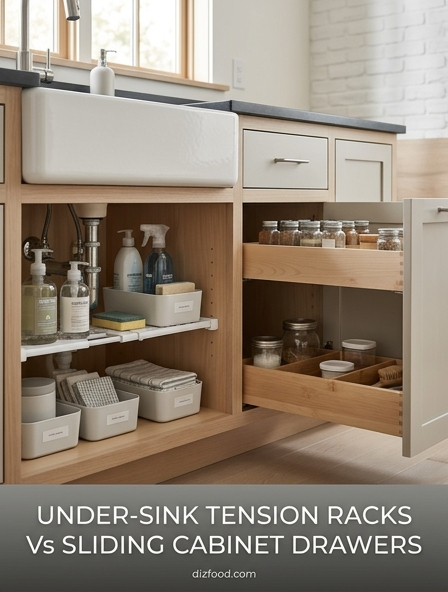
Under-Sink Tension Racks vs Sliding Cabinet Drawers Comparison
Choosing between under-sink tension racks and sliding cabinet drawers requires an understanding of your specific kitchen layout and storage needs. Under-sink tension racks are typically expandable shelving units designed to fit around the P-trap and drainage pipes. They offer a versatile, modular approach where individual shelf panels can be removed or repositioned to accommodate vertical plumbing. These are ideal for those who want a quick, non-permanent solution to organize lightweight items like sponges, spray bottles, and dish soap.
In contrast, sliding cabinet drawers are mechanical systems that pull out from the cabinet on ball-bearing tracks. These organizers prioritize accessibility and high-weight capacity. While they often require a more rigid installation footprint, they eliminate the need to reach into the dark, cramped corners of the cabinet. Below is a brief comparison of their primary characteristics:
| Feature | Tension Racks | Sliding Drawers |
|---|---|---|
| Installation | Tool-free / Tension-based | Screw-in / Permanent |
| Accessibility | Static shelves | Full extension pull-out |
| Customization | High (modular panels) | Low (fixed width) |
| Ideal For | Renters / Light items | Homeowners / Heavy items |
Ultimately, the choice depends on whether you value the flexibility of moving shelves around existing obstacles or the ergonomic luxury of bringing the contents of your cabinet out to you. Tension racks excel in awkward spaces, while sliding drawers provide a premium, long-lasting organizational feel.
Maximizing Vertical Space Around Under-Sink Plumbing
The area beneath a kitchen sink is notoriously difficult to organize due to the intrusion of the sink basin, the garbage disposal, and the complex network of drainage pipes. Maximizing vertical space in this environment is essential to prevent the "cabinet floor clutter" where items are buried and forgotten. Tension racks are specifically designed to address this by offering two or three tiers of shelving that can be adjusted in height. Because the panels are removable, you can create a "gap" in the shelf exactly where the vertical pipe descends, allowing you to use the air space on either side of the plumbing.
Sliding drawers also maximize vertical space but do so through tiered pull-out systems. Many modern sliding organizers feature a narrow top drawer and a wider bottom drawer, often referred to as an "L-shaped" organizer. This design allows the top tier to slide out alongside the sink basin while the bottom tier occupies the full width of the cabinet floor. To truly optimize this space, consider the following:
- Measure the distance from the cabinet floor to the lowest point of the sink drain to ensure top-tier clearance.
- Use stackable bins on top of sliding drawers if the cabinet height allows.
- Utilize tension rods at the very top of the cabinet to hang spray bottles by their triggers.
- Ensure that vertical supports do not interfere with the garbage disposal's vibration clearance.
By effectively layering your storage, you can double or triple the usable surface area in a standard 24-inch or 30-inch base cabinet, ensuring that vertical real estate is not wasted on empty air.
Ease of Installation Tension Racks vs Sliding Drawers
The installation process is perhaps the most significant differentiator between these two storage solutions. Tension racks are designed for immediate use and appeal strongly to those who are not handy with tools or are restricted by lease agreements. Most tension systems utilize expandable steel or plastic rods that press against the side walls of the cabinet or stand freely on legs. The process generally follows these steps:
- Expand the horizontal support rods to the width of the cabinet interior.
- Tighten the wing nuts or locking mechanisms to secure the frame.
- Snap the plastic shelf panels onto the rods, skipping the areas where pipes are located.
Sliding cabinet drawers, however, require a more involved setup. Because they must bear the weight of the contents while extended, they must be securely fastened to the cabinet floor or side walls using screws. This involves precise measuring to ensure the drawer clears the cabinet door hinges and the face frame. If the cabinet floor is made of thin particle board, additional reinforcement may be necessary to prevent the screws from pulling out under tension. While the installation of sliding drawers may take 30 to 60 minutes compared to the 5 minutes required for a tension rack, the result is a much more stable and "built-in" feel that enhances the home's value and the user's daily experience.
Comparing Weight Capacity and Durability for Sink Storage
When storing heavy kitchen essentials like gallon-sized jugs of white vinegar, bulk detergent, or heavy-duty cleaning agents, weight capacity becomes a critical factor. Under-sink tension racks are often constructed from a combination of thin-walled metal tubing and plastic snap-on plates. While they are sufficient for sponges and standard spray bottles, they are prone to sagging in the middle if overloaded. Over time, the plastic panels may warp or crack under the constant pressure of heavy items, especially in the humid environment often found near plumbing.
Sliding drawers are the clear winner regarding durability and load-bearing. Most high-quality sliding systems are built with heavy-gauge steel and industrial-grade ball-bearing glides. These systems are often rated to hold between 50 and 100 pounds, even when fully extended. This makes them suitable for heavy cookware or large containers of household cleaners.
| Component | Tension Rack Expectation | Sliding Drawer Expectation |
|---|---|---|
| Typical Load Limit | 15-25 lbs per level | 50-100 lbs total | Plastic or light aluminum | Chrome-plated or powder-coated steel |
| Failure Point | Shelf sagging or rod sliding | Drawer track misalignment (rare) |
For long-term kitchen organization, investing in the structural integrity of sliding drawers prevents the frustration of collapsed shelves and ensures that your storage solution can handle the rigors of a busy household.
Accessibility Benefits of Pull-Out Sliding Cabinet Trays
The primary drawback of any static shelving unit, including tension racks, is the "black hole" effect. Items stored at the back of the cabinet are difficult to see and even harder to reach without removing everything in front of them. This often leads to duplicate purchases of cleaning supplies because the user assumes they have run out when the product is simply hidden from view. Pull-out sliding cabinet trays solve this problem by bringing the entire contents of the cabinet into the light of the kitchen.
The ergonomic benefits are substantial, particularly for individuals with back issues or limited mobility. Instead of kneeling on the floor and reaching into a deep, dark space, the user simply pulls the handle, and the tray glides outward. This full-extension capability allows for a "birds-eye view" of inventory. Furthermore, sliding trays often feature low-profile sides, making it easy to grab handles or bottles from the side rather than lifting them straight up-a crucial feature when vertical clearance is limited by the sink basin. This streamlined access not only saves time during cleaning but also encourages better organization, as users are more likely to return items to their designated spots when the process is effortless. In a high-traffic area like the kitchen, the convenience of a sliding tray significantly reduces the daily friction of household chores.
Budget-Friendly Under-Sink Storage Tension Racks Explained
For many households, budget is a primary driver in organizational decisions. Under-sink tension racks are significantly more affordable than sliding drawer systems. Typically, a high-quality expandable tension rack can be purchased for a fraction of the cost of a single professional-grade sliding drawer. This makes them an accessible entry point for college students, renters, or those looking to organize multiple bathrooms and a kitchen simultaneously without a large financial commitment.
The cost-effectiveness of tension racks extends beyond the purchase price. Because they require no tools and do not damage the cabinetry, there is no risk of losing a security deposit or having to pay for professional installation. They are also highly portable; if you move to a new apartment, you can easily disassemble the rack and adjust it to fit a differently sized cabinet in your next home. Key budget considerations include:
- Material Cost: Plastic models are the cheapest, while stainless steel versions offer more longevity for a slight price increase.
- Maintenance: These units are easy to wipe down and do not require lubricants for tracks.
- Replacement: If a part breaks, these units are often cheaper to replace entirely than it is to buy replacement hardware for a custom drawer.
While they may lack the premium feel of metal glides, their ability to transform a chaotic cabinet into an organized space for under $30 makes them one of the most popular ROI-positive kitchen upgrades available.
Customizing Sink Organization Around Pipes and Obstacles
Under-sink cabinets are rarely empty boxes; they are usually filled with a "jungle" of plumbing. This includes the main drain pipe, the P-trap, water supply lines for the faucet, hoses for a pull-out sprayer, and potentially a garbage disposal unit. The main advantage of a tension rack is its extreme modularity. Most models come with 10 to 12 removable slats or panels. If a pipe runs down the center of the cabinet, you simply leave out the middle panels on the top shelf. This allows the shelf to "hug" the pipe without losing the storage space on either side.
Sliding drawers are generally less flexible regarding obstacles. Once the track is screwed down, the drawer follows a fixed path. To customize around pipes with sliding units, you often have to buy specific "U-shaped" drawers designed to bypass the center plumbing. However, these are often more expensive and may not align perfectly with your specific plumbing layout. For a truly bespoke fit that handles asymmetrical pipe configurations, the tension rack is superior. You can move the horizontal support bars up or down in one-inch increments to find the "sweet spot" that clears the garbage disposal while still leaving enough room on the bottom for tall spray bottles. This level of granular adjustment ensures that every square inch of the cabinet is utilized, regardless of how poorly the original plumbing was positioned.
Long-Term Reliability Metal Slides vs Expandable Tension Racks
When considering long-term reliability, the materials and moving parts of your organizer play a major role. Sliding drawers rely on ball-bearing glides, which are highly reliable but can be sensitive to the environment. In a kitchen, the area under the sink can occasionally become damp due to minor leaks or condensation. If the slides are not made of high-quality stainless steel or zinc-plated metal, they can rust over several years, leading to a "crunchy" or stuck sliding mechanism. However, if maintained or kept dry, a quality metal slide can easily last a decade or more, functioning just as smoothly as the day it was installed.
Expandable tension racks have fewer moving parts, which in theory makes them reliable. However, their reliance on friction and plastic components can be their downfall. In a humid cabinet, the tension on the rods can sometimes slip, causing the shelf to collapse unexpectedly. Furthermore, because they are often lightweight, they can shift around every time you grab an item, eventually becoming crooked. They do not "wear out" in the traditional sense, but they do tend to degrade in terms of structural tightness. For a "set it and forget it" solution that remains sturdy and functional for the life of the kitchen, the mechanical solidity of a metal sliding drawer usually outperforms the temporary nature of a tension-based system.
Tool-Free Assembly vs Permanent Cabinet Modifications
The debate between tool-free assembly and permanent modification is often a matter of "renter vs. owner." Tension racks are the pinnacle of tool-free design. They can be unboxed and fully assembled in under ten minutes using nothing but your hands. This is a massive benefit for people who do not own a drill or for those who are intimidated by the prospect of "ruining" their cabinetry. There is no risk of drilling through the bottom of the cabinet or hitting a hidden water line behind the cabinet wall.
On the other hand, permanent modifications-specifically installing sliding drawers-require a level of commitment. To install these, you will generally need:
- A power drill or a screwdriver.
- A measuring tape to find the center and ensure clearance.
- Leveling tools to ensure the drawer doesn't slide open or closed on its own.
- A pencil to mark the pilot holes for the screws.
While this sounds daunting to some, the "permanent" nature of the modification is exactly why it is preferred by homeowners. Once the screws are in, the organizer becomes a part of the house. It won't wobble, tip over, or slide out of place. It provides a level of stability that tension-based products simply cannot match. If you plan to live in your home for more than a year, the one-time effort of a permanent installation usually pays dividends in daily convenience and peace of mind.
Choosing the Right Organizer for Your Kitchen and Bathroom Sink
Deciding which organizer is right for you requires a final assessment of your constraints. If you are currently renting an apartment with old cabinetry and awkward plumbing that seems impossible to navigate, an under-sink tension rack is your best friend. Its low price point and modular nature allow you to bring order to chaos without a significant investment or the risk of losing your security deposit. It is the "quick fix" that works surprisingly well for light-duty organization.
However, if you are a homeowner looking to upgrade your kitchen's functionality and value, sliding cabinet drawers are the superior choice. The ease of access, the high weight capacity for heavy cleaners, and the smooth mechanical action provide a luxury feel that tension racks lack. You should also consider the contents of your storage; heavy glass bottles and bulk supplies demand the strength of a bolted-down drawer, while light plastic items like sponges and microfiber cloths are perfectly fine on a tension shelf. Ultimately, many people find a hybrid approach works best: using a sliding drawer on the bottom for heavy items and a small tension rod or rack above it for lighter, frequently used items. By matching the tool to the specific needs of your sink environment, you can ensure a clutter-free and highly efficient kitchen workspace.


Comments