
Navigating a hectic work week requires a tactical approach to your kitchen arsenal, and understanding the synergy between a slow cooker and an air fryer is the ultimate meal prep game-changer. While the slow cooker acts as your "marathon runner," transforming tough cuts of meat into tender, bulk-sized masterpieces while you're at the office, the air fryer is your "sprinter," delivering lightning-fast crispiness and revitalizing leftovers in mere minutes. By mastering this dual-appliance strategy, you can balance the long-game convenience of set-and-forget stews with the rapid-fire efficiency of convection roasting, ensuring that no matter how chaotic your schedule gets, you have a nutritious, chef-quality foundation ready to serve.
| Feature | Slow Cooker Strategy | Air Fryer Strategy |
|---|---|---|
| Best For | Bulk proteins, soups, and stews. | Single servings, sides, and crisping. |
| Cooking Time | 4 to 10 hours (Low/High settings). | 5 to 25 minutes (Rapid convection). |
| Texture Result | Moist, tender, and "falling-off-the-bone." | Crunchy, crispy, and golden-brown. |
| Effort Level | Zero intervention; set and leave. | Active; requires shaking or flipping. |
| Meal Prep Role | Batch-cooking base ingredients. | Quick finishing and "just-in-time" meals. |
| Cleanup | One pot; usually dishwasher safe. | Basket/tray; quick wipe or wash. |
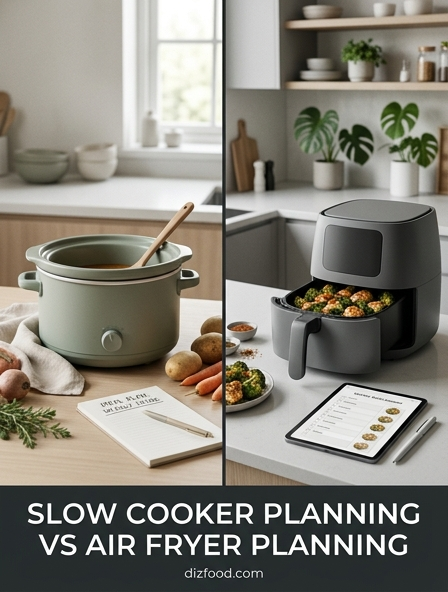
Slow Cooker vs Air Fryer Meal Prep Strategies
Successful meal planning in a modern kitchen often hinges on choosing the right tool for the specific rhythm of your week. Slow cooker meal prep is fundamentally rooted in bulk processing and liquid-based preservation. When planning for a slow cooker, the strategy involves gathering large quantities of aromatics, root vegetables, and tough proteins that benefit from prolonged heat. This method is ideal for those who prefer to do all their heavy lifting on a Sunday, portioning out "dump bags" that can be moved from the freezer to the ceramic pot with zero additional labor during the work week.
Conversely, air fryer meal prep focuses on surface area and dry seasoning. Instead of large bags of stew components, air fryer planning involves portioning proteins like chicken breasts, salmon fillets, or sliced vegetables that require rapid air circulation. The strategy here is "just-in-time" cooking, where the preparation is done in advance, but the actual cooking happens in mere minutes before the meal is served. Key differences in these strategies include:
- Moisture Management: Slow cookers require added stocks or sauces to prevent drying, while air fryers rely on a light coating of oil to facilitate crisping.
- Volume: Slow cookers are designed for 6 to 8-quart yields, making them superior for large families or leftovers, while air fryers excel at individual or double servings.
- Seasoning Intensity: Flavors in a slow cooker mellow and meld over hours; air fryer seasonings remain sharp and punchy due to the short exposure to heat.
Morning Preparation vs Last Minute Dinner Decisions
The temporal aspect of kitchen planning creates a divide between the proactive slow cooker user and the reactive air fryer enthusiast. Slow cooker planning demands a disciplined morning routine. To enjoy a meal at 6:00 PM, the preparation must typically be finalized by 8:00 AM or 9:00 AM. This requires the cook to have a clear vision of their evening appetite before the day has even truly begun. It eliminates the stress of evening cooking but replaces it with a front-loaded morning workload that not everyone can accommodate.
The air fryer is the ultimate tool for the "last minute" decision-maker. It caters to the reality of unpredictable schedules where a late meeting or a change in plans might render a pre-set slow cooker meal unappealing. With an air fryer, a frozen piece of protein or a fresh vegetable can be transformed into a complete dinner in under twenty minutes. This flexibility allows for a more spontaneous approach to dining, where the menu can be adjusted based on the current mood or energy level of the household. While the slow cooker rewards the organized planner, the air fryer saves the disorganized one, providing a high-quality alternative to takeout when the clock is ticking and hunger is high.
Batch Cooking Success for Slow Cookers and Air Fryers
Batch cooking is a cornerstone of efficient kitchen management, yet it looks remarkably different depending on the appliance used. The slow cooker is a powerhouse for "one-and-done" batching. A single pot can produce enough chili, curry, or pulled pork to last a family for three separate nights, or to fill a dozen freezer containers for future lunches. The efficiency comes from the lack of active supervision; the batch cooks itself while the kitchen remains clean.
Air fryer batch cooking is more modular. Rather than cooking a complete multi-component meal, the air fryer is often used to batch-cook specific ingredients that can be used across different dishes. For example, one might air fry a large batch of seasoned chickpeas, roasted broccoli, and chicken thighs to be used in various grain bowls throughout the week. This allows for more variety in daily eating compared to the repetitive nature of slow cooker stews. Consider the following comparison:
| Feature | Slow Cooker Batching | Air Fryer Batching |
|---|---|---|
| Primary Outcome | Unified, cohesive dishes (stews, soups) | Component-based ingredients (proteins, sides) |
| Storage Profile | Liquid-heavy, stays moist when reheated | Dry and crisp, best kept in vented containers |
| Effort Level | Low (single cycle) | Medium (requires multiple 15-minute cycles) |
Long Simmering Flavors vs Rapid Convection Crisping
The chemical transformations that occur in these two appliances result in vastly different flavor profiles, which must be accounted for during the planning stage. Slow cooking relies on the gentle breakdown of connective tissues and the infusion of spices into liquids. This process creates deep, umami-rich profiles where individual ingredients eventually surrender their distinct identities to the collective whole. It is the preferred method for traditional comfort foods where a "melt-in-your-mouth" texture is the primary goal.
The air fryer operates on the principle of convection, using a high-powered fan to circulate hot air around the food. This triggers the Maillard reaction almost instantly, creating a browned, flavorful crust while keeping the interior tender. Planning for the air fryer means prioritizing texture and contrast-the crunch of a breaded cutlet or the snap of a roasted asparagus spear. Unlike the slow cooker, which can sometimes result in "muddy" flavors if overcooked, the air fryer preserves the bright, distinct taste of each ingredient. When planning a menu, one must decide if the goal is the harmonious, concentrated depth of a long simmer or the vibrant, textured bite of a high-heat roast.
Comparing Ingredient Prep for Slow and Fast Cooking
The way you process your groceries depends heavily on which machine you intend to use. For a slow cooker, precision is rarely a requirement. Vegetables can be chopped into large, rustic chunks because the long cooking time ensures even doneness regardless of minor size variations. In fact, cutting ingredients too small in a slow cooker often leads to them disintegrating into a mushy consistency before the meat is tender. Fat trimming is also a different priority; while some fat is needed for flavor, excessive grease can pool at the top of a slow cooker because there is no evaporation.
Air fryer preparation demands much more precision and uniformity. Because the cooking window is so small-often between 8 and 12 minutes-all pieces of food must be cut to the exact same size to ensure they cook at the same rate. Crowding is the enemy of the air fryer; therefore, prep involves ensuring ingredients are dry and lightly oiled to facilitate the air-flow-driven browning. Key prep considerations include:
- Slow Cooker: Large cuts of meat, unpeeled root vegetables, and dried beans (soaked).
- Air Fryer: Thinly sliced potatoes, uniform florets, and patted-dry proteins.
- Aromatics: In slow cookers, onions and garlic are added raw; for air fryers, they often require a head start or a light sauté to avoid burning.
Energy Efficiency and Kitchen Heat Management
Kitchen logistics extend beyond the plate to the environment of the home itself. The slow cooker is a low-wattage appliance designed to run for eight hours while drawing minimal power-similar to a lightbulb. It generates very little ambient heat, making it an excellent choice for summer meal planning when using the oven would uncomfortably raise the temperature of the house. However, it does require a dedicated "safe zone" on the counter where it can sit undisturbed for the duration of the day.
The air fryer is a high-wattage device that pulls significant power but for a very short duration. While it generates more heat than a slow cooker during its operation, the cycle is so brief that it rarely affects the room temperature. It is the ultimate tool for energy efficiency when cooking small portions that would otherwise require preheating a massive 30-inch oven. For those managing a small kitchen or living in a hot climate, both tools offer significant advantages over the traditional stove. The choice often comes down to whether you prefer a low-and-slow energy draw or a quick, high-intensity burst of power.
Weekly Grocery Planning for Different Cooking Methods
A grocery list tailored for a slow cooker is often more budget-friendly. This method thrives on "utility" cuts of meat-pork shoulder, beef chuck, and chicken thighs-which are significantly cheaper than the lean cuts required for quick roasting. The list will also feature a high volume of pantry staples like canned tomatoes, broths, and dried legumes. Because these ingredients have a long shelf life, slow cooker planning allows for bulk shopping and reduced frequency of trips to the store.
Grocery planning for an air fryer leans toward fresh, high-quality proteins and produce. Since the air fryer highlights the natural flavor of the food rather than masking it in a sauce, the quality of the starting ingredient is paramount. You will find more lean cuts like sirloin tips, chicken breasts, and fresh fish on an air fryer enthusiast's list. Furthermore, the air fryer shopper focuses on the produce aisle for items that roast well, such as Brussels sprouts, bell peppers, and zucchini. While the slow cooker shopping list is built around the "base" of a meal, the air fryer list is built around the "main" and its distinct sides, often requiring more frequent trips for fresh ingredients but offering more culinary variety.
Texture and Consistency Differences in Meal Planning
The most significant divergence between these two appliances is the resulting mouthfeel of the food. Slow cooker meals are characterized by their uniformity. The liquids, fats, and fibers of the ingredients eventually reach a state of soft, cohesive tenderness. This makes the slow cooker perfect for recipes where the sauce is as important as the solid ingredients, such as pot roast or heavy stews. When planning these meals, the cook must consider adding "finishing" ingredients-like fresh herbs or a squeeze of lime-at the very end to provide the brightness and texture that the cooking process removes.
Air fryer planning is all about the "crunch factor." It is the preferred method for anyone who prioritizes a crispy exterior and a juicy interior. The consistency is much closer to deep-frying or high-heat roasting but with significantly less oil. When planning an air fryer menu, the goal is to create contrast. A typical plate might feature a crispy protein alongside a snap-tender vegetable. Unlike the slow cooker, which tends to soften everything, the air fryer reinforces the structural integrity of the food. Common texture-focused strategies include:
- Breading: Using Panko or flour coatings to maximize the convection effect.
- Dehydrating: Using low settings to create kale or potato chips.
- Glazing: Adding sugary sauces in the last two minutes to create a tacky, caramelized bark.
Slow Cooker Set It and Forget It Logistics
The "set it and forget it" nature of the slow cooker is its greatest logistical advantage, but it requires an understanding of food safety and timing. Planning a meal for the slow cooker means calculating the "hold time"-the period after the food is done but before it is eaten. Most modern machines switch to a "warm" setting automatically, but even then, food can begin to overcook and lose its structural integrity if left for more than two or three hours past its completion time.
To master the logistics of the slow cooker, one must follow a specific sequence of operations:
- Layering: Place hard root vegetables at the bottom where they are closest to the heating element.
- Liquid Ratios: Use less liquid than you think; vegetables release a significant amount of water over eight hours, and there is no evaporation.
- Safety Check: Ensure the ceramic insert is at least half-full but no more than three-quarters full to maintain a consistent internal temperature.
- Timing: Match the meat type to the setting; tough brawny meats need 8 hours on low, while leaner meats may only need 4 hours.
Air Fryer Quick Turnaround and Reheating Benefits
While the slow cooker is the king of the initial cook, the air fryer is the undisputed champion of the reheat. One of the biggest challenges in meal planning is dealing with leftovers that have gone soggy in the refrigerator. The air fryer solves this by using its convection fan to remove surface moisture and restore the original crispiness of the food. Items like leftover pizza, fried chicken, or roasted potatoes, which would be ruined by a microwave, are returned to their "just-cooked" state in three to five minutes.
Beyond reheating, the air fryer facilitates a "staggered" cooking approach. In a busy household where family members eat at different times, the air fryer allows for fresh, hot portions to be cooked on demand. Instead of a single large pot of food sitting on the stove, you can air fry a fresh salmon fillet for the person arriving home at 5:00 PM and another for the person arriving at 7:00 PM. This "quick turnaround" capability ensures that everyone receives a high-quality meal regardless of their schedule, making it a vital component of a flexible, modern kitchen strategy that values both speed and texture.


Comments