
Navigating the balance between immediate cravings and long-term security is the secret to a truly resilient kitchen. While daily grocery planning excels at providing fresh ingredients and culinary flexibility, it leaves your household vulnerable to sudden supply chain spikes or local emergencies. In contrast, emergency pantry planning acts as a nutritional insurance policy, prioritizing calorie-dense, shelf-stable goods that shield you from inflation and empty store shelves. To truly secure your food supply, you must transition from a "just-in-time" shopping mindset to a "just-in-case" strategy, blending the vibrancy of weekly fresh picks with the rock-solid reliability of a deep-stocked reserve. Understanding the structural differences between these two approaches-budgeting, shelf-life, and risk mitigation-is essential for any homeowner looking to achieve genuine food independence.
| Feature | Daily Grocery Planning | Emergency Pantry Planning |
|---|---|---|
| Primary Focus | Freshness & immediate meal variety. | Caloric density & long-term survival. |
| Inventory Type | Perishables (produce, dairy, meats). | Shelf-stable (grains, cans, freeze-dried). |
| Cost Efficiency | Higher; subject to retail price swings. | Lower; optimized via bulk & case-lot buying. |
| Supply Resilience | Low; relies on "Just-in-Time" logistics. | High; 3-12 month independent buffer. |
| Rotation Cycle | Rapid (1-7 days). | Slow (6 months - 25 years). |
| Risk Mitigation | Vulnerable to blackouts/transport strikes. | Protects against inflation & shortages. |
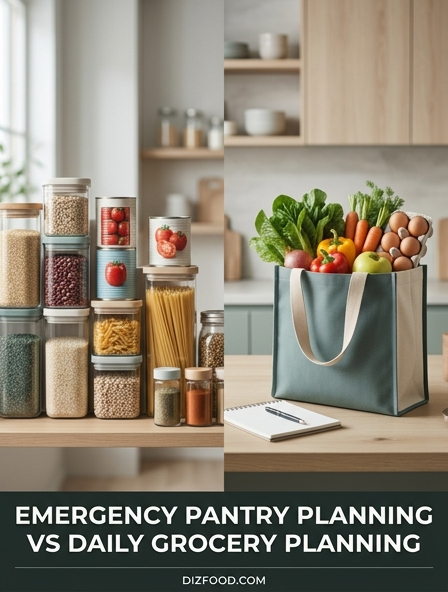
Core Differences Between Emergency Pantries and Daily Groceries
The fundamental distinction between emergency pantry planning and daily grocery management lies in the intended outcome and the timeline of utility. Daily grocery planning is built around the "just-in-time" delivery model, where the kitchen is stocked with ingredients meant for immediate consumption, often reflecting current cravings or specific meal plans for the upcoming week. In contrast, emergency pantry planning is rooted in the "just-in-case" philosophy, prioritizing a robust inventory that can sustain a household when supply chains fail or access to external markets is severed.
While daily shopping focuses on culinary variety and the pleasure of eating, emergency stockpiling focuses on survival, reliability, and security. The core differences can be categorized as follows:
- Accessibility: Daily groceries are kept in easy-to-reach cabinets, whereas emergency supplies may be stored in deep-storage areas like basements or climate-controlled lockers.
- Utility: Daily items often require fresh water, electricity, or gas for preparation. Emergency foods are frequently chosen for their ability to be prepared with minimal external resources.
- Purchasing Logic: Groceries are bought based on price and current appetite. Emergency stores are bought based on nutritional density and shelf stability.
Ultimately, a daily pantry is a revolving door of ingredients that facilitates a modern lifestyle, while an emergency pantry serves as a domestic insurance policy designed to mitigate the risks of unforeseen disruptions in the food supply.
Long Term Storage Versus Short Term Consumption Needs
The temporal focus of food storage dictates every purchase decision in the kitchen. Short-term consumption needs revolve around the biological requirements of the next seven to ten days. This cycle is dominated by highly perishable items such as dairy, leafy greens, and fresh meats, which provide the bulk of micronutrients and textural variety in a standard diet. Because these items have a rapid decay rate, the management system is simple: consume or discard.
Long-term storage, however, shifts the focus from days to years. This requires a departure from traditional packaging in favor of methods that combat the primary enemies of food preservation: light, heat, moisture, and oxygen. The following table highlights the differences in storage expectations for common kitchen categories:
| Food Category | Short-Term Window | Long-Term Potential |
|---|---|---|
| Grains & Rice | 6 - 12 Months | 25 - 30 Years (Mylar) |
| Proteins | 3 - 5 Days (Fresh) | 2 - 5 Years (Canned/Freeze-dried) |
| Vegetables | 1 Week (Fridge) | 1 - 3 Years (Canned/Dehydrated) |
| Fats & Oils | 3 - 6 Months | 1 - 2 Years (Sealed/Dark) |
Managing long-term stores involves a commitment to environmental control. While a countertop fruit bowl is sufficient for short-term needs, long-term reserves demand consistent temperatures and specialized containers, such as #10 cans or oxygen-absorbed poly bags, to ensure the caloric value remains intact over decades.
Stockpiling Essentials Versus Fresh Ingredient Shopping Habits
Shopping habits for the kitchen usually fall into two distinct psychological patterns: the scavenger hunt for freshness and the systematic acquisition of staples. Fresh ingredient shopping is a high-frequency activity. It involves selecting the ripest produce, the best cuts of meat, and seasonal specialties. This habit prioritizes the sensory experience of food-its color, aroma, and texture-and is highly sensitive to price fluctuations at the local market.
Stockpiling essentials is a low-frequency, high-volume activity. Instead of browsing for inspiration, the shopper follows a rigorous checklist of "foundation foods" that can be stored indefinitely. This approach often utilizes bulk-buy opportunities, wholesale clubs, or direct-from-farm purchases. The goal is to build a "buffer" that prevents the need for frequent trips to the store. Key differences in these habits include:
- Frequency: Fresh shopping occurs 1-2 times weekly; stockpiling occurs monthly or quarterly.
- Evaluation: Fresh goods are judged by appearance; stockpile goods are judged by caloric density and packaging integrity.
- Logistics: Fresh shopping fits in a handbasket; stockpiling often requires significant transport and storage space.
By balancing these habits, a household can enjoy the luxury of fresh ingredients while maintaining the security of a deep larder that protects against temporary market shortages or economic instability.
Budgeting Strategies for Survival Kits and Weekly Meals
Financial planning for a kitchen requires a dual-track budget to accommodate both immediate dining and long-term security. Weekly meal budgeting is an operational expense. It is a recurring cost that covers the "variable" nature of a household's appetite. This budget is often influenced by dining out, sales on favorite snacks, and the cost of seasonal produce. Most families aim to minimize this cost through couponing or meal prepping to reduce waste.
Budgeting for a survival kit or emergency pantry is more akin to a capital investment. There is a significant upfront cost to purchasing 50 pounds of grain, bulk fats, and water filtration systems. However, once these items are acquired, the "maintenance" cost is relatively low. To manage these costs without straining the weekly grocery budget, many planners use a "buy one, hide one" strategy.
For example, if a family needs two jars of peanut butter for the month, they might purchase four, placing the extra two in the emergency reserve. Over time, this builds a survival kit without a massive one-time financial hit. Additionally, emergency budgeting focuses on "cost per calorie" rather than "cost per meal," ensuring that every dollar spent maximizes the duration of survival during a crisis. This strategic allocation of funds transforms the kitchen from a place of consumption into a resource for financial and physical resilience.
Inventory Management for Deep Larders and Kitchen Cabinets
Effective kitchen management requires two different levels of oversight. In standard kitchen cabinets, inventory management is often informal. A quick glance before heading to the store is usually sufficient to identify missing items like milk or bread. Because the turnover is high, the risk of losing track of an item before it expires is relatively low. The system is visual and intuitive, relying on the cook's memory of what was used in recent recipes.
Deep larders, which store bulk emergency supplies, require a formal, documented system. Because these items are often stored in opaque bins or tucked away in secondary locations, a visual check is insufficient. A lack of organization in a deep larder leads to "forgotten" food that may expire or lose nutritional value. To manage a deep larder, the following tools are commonly used:
- Inventory Sheets: A physical or digital log detailing item type, quantity, and location.
- Expiration Trackers: A list sorted by "best-by" dates to ensure older items are moved to the front of the queue.
- Bin Labeling: Clear identification of contents, especially for bulk items like flour or sugar that look identical once packaged for long-term storage.
While a disorganized kitchen cabinet is a minor inconvenience, a disorganized deep larder is a failure of the emergency plan. Precise management ensures that the investment in survival food remains a viable asset rather than a wasted expense.
Shelf Life Priorities for Emergency Reserves and Daily Use
Shelf life is the primary metric by which all kitchen items are judged, but the threshold for "acceptable" varies wildly between daily use and emergency reserves. For daily use, shelf life is a measure of quality. A box of crackers might have a shelf life of six months, but after three, it may lose its crunch. In this context, consumers prioritize "peak freshness," often discarding items the moment they pass their printed date.
In emergency reserves, shelf life is a measure of safety and caloric stability. The priority shifts from how a food tastes to whether it remains safe to eat and calorically dense. Emergency planners often look for "eternal" foods or those with multi-decade lifespans. Priorities for these reserves include:
- Low Moisture: Dehydrated foods like pasta and beans resist bacterial growth.
- Protective Packaging: The use of oxygen absorbers and nitrogen flushing to prevent oxidation.
- Inert Ingredients: Avoiding high-fat items in long-term storage, as fats eventually go rancid regardless of packaging.
Understanding the difference between a "sell-by" date and a "safety" date is crucial. Daily use items are governed by the former to ensure a pleasant eating experience, while emergency reserves are governed by the biological limits of the food itself, ensuring that even if the flavor has diminished, the life-saving energy remains accessible when it is needed most.
Organizational Systems for Emergency Stockpiles and Regular Pantries
The physical organization of a kitchen should reflect the frequency of use. A regular pantry is designed for ergonomics. Spices are placed at eye level, frequently used grains are at the front, and heavy appliances are on lower shelves. This "working pantry" is dynamic; items are constantly being moved, opened, and replaced. The goal is to minimize the time it takes to prepare a meal.
Emergency stockpiles require an organizational system based on protection and rotation. These items are often stored in "zones" away from the heat and humidity of the kitchen. A tiered system is frequently employed to maximize space and visibility:
- Tier 1: High Turnover. Items like canned soups and pasta that are part of the regular diet but kept in surplus.
- Tier 2: Intermediate Storage. Larger containers of staples like rice and oats that are refilled every six months.
- Tier 3: Deep Storage. Freeze-dried meals and sealed grains intended for use only in a true catastrophe.
By separating these tiers, the "working" part of the kitchen remains uncluttered, while the "reserve" part remains protected. This prevents the frustration of digging through five-gallon buckets of wheat just to find a box of salt for tonight's dinner. Efficient organization bridges the gap between daily convenience and long-term readiness.
Rotation Methods for Bulk Survival Food and Perishables
Food rotation is the practice of ensuring that the oldest stock is consumed first, preventing waste and ensuring the highest possible nutritional value. In a daily kitchen, this is often referred to as FIFO (First In, First Out). When a new gallon of milk is purchased, it is placed behind the half-full gallon. This simple habit prevents perishables from spoiling at the back of the refrigerator.
For bulk survival food, rotation becomes a more complex logistical challenge. Because bulk items are heavy and often packed in large quantities, rotating them can be physically demanding. Effective rotation methods for deep larders include:
| Method | Application | Benefit |
|---|---|---|
| Gravity Racks | Canned Goods | Automatically brings oldest can to the front. |
| Date Stamping | Bulk Bags/Buckets | Large, visible dates allow for quick visual audits. |
| Annual Cycle | Seasonal Staples | Designating a specific month to eat through and replace 1/4 of the stock. |
Failure to rotate bulk stock leads to "dead" inventory-food that has sat so long it has lost its vitamins or structural integrity. By treating the emergency pantry as a slowly moving river rather than a stagnant pond, the kitchen manager ensures that the survival food is always as fresh as possible, bridging the gap between survivalism and standard culinary practice.
Caloric Density Versus Balanced Daily Nutritional Intake
The nutritional philosophy of a daily diet is built around balance: a mix of proteins, fats, carbohydrates, and a wide array of vitamins and minerals. Daily grocery planning emphasizes "eating the rainbow" to ensure a healthy gut microbiome and consistent energy levels. In this context, low-calorie fillers like celery or cucumbers are valued for their fiber and hydration properties.
In an emergency scenario, the priority shifts toward caloric density. When physical exertion may be higher and food sources limited, the body needs concentrated energy. Emergency pantries prioritize "hard" calories-foods that provide the most energy for their weight and volume. This shift in focus changes the kitchen's inventory priorities:
- Fats: Peanut butter, ghee, and oils become critical for their 9 calories per gram.
- Complex Carbs: Grains and legumes provide sustained energy and protein.
- Sugar: Honey and jam are stored for quick energy boosts and morale.
While a survival diet might lack the sophisticated flavor profiles and fresh enzymes of a daily diet, its primary goal is to prevent a caloric deficit. A well-planned emergency pantry focuses on the "Big Three" (macronutrients) to sustain life, whereas daily grocery planning focuses on micronutrients and dietary variety to sustain long-term health and wellness.
Transitioning From Basic Grocery Planning to Emergency Preparedness
Moving from a standard shopping routine to a prepared household requires a shift in mindset and a gradual expansion of kitchen habits. It does not require an overnight transformation into a "prepper," but rather a disciplined approach to inventory accumulation. The transition begins with the "Working Pantry" concept, where you simply buy more of what you already eat, creating a three-week buffer of normal meals.
Once a basic buffer is established, the transition moves into more specialized territory. This involves the following steps:
- Identify Staples: Determine which 5-10 items your family relies on most (e.g., rice, beans, flour, coffee).
- Bulk Acquisition: Purchase these staples in quantities that last 3-6 months.
- Secondary Storage: Identify a cool, dry place outside the main kitchen for overflow stock.
- Specialized Packaging: Invest in tools like vacuum sealers or Mylar bags to extend the life of bulk purchases.
By slowly integrating these practices, the kitchen evolves from a fragile system dependent on daily store runs into a resilient hub capable of weathering storms, economic downturns, or supply chain interruptions. The end result is a kitchen that provides not just the meals for today, but the security for tomorrow, ensuring that the household remains fed regardless of external circumstances.

Comments