
Deciding how to master your weekly menu often boils down to a trade-off between time-saving convenience and total creative control. Subscription meal boxes serve as a modern culinary shortcut, delivering pre-measured ingredients and chef-designed recipes directly to your door to eliminate decision fatigue and frequent grocery store runs. On the other hand, scratch-based planning remains the gold standard for budget-conscious foodies who want complete authority over their pantry, allowing for bulk savings and precise dietary adjustments. Whether you prioritize the "autopilot" efficiency of a curated kit or the infinite flexibility of sourcing your own ingredients, understanding how each method impacts your schedule and budget is the first step toward reclaiming your kitchen.
| Feature | Subscription Meal Boxes | Scratch-Based Planning |
|---|---|---|
| Time Investment | Low: 30-45 min total (No shopping) | High: 2-5 hours (List, shop, prep) |
| Cost Per Serving | Premium: $10.00 - $15.00+ | Economic: $4.00 - $8.00 (Bulk pricing) |
| Ingredient Waste | Minimal: Exact portions provided | Moderate: Often 20-30% surplus waste |
| Customization | Limited: Select from weekly menu | Absolute: Infinite recipe/macro control |
| Learning Curve | Guided: Step-by-step instructions | Self-Directed: Requires kitchen intuition |
| Sustainability | High packaging (Ice packs/plastic) | Variable (Option for zero-waste/local) |
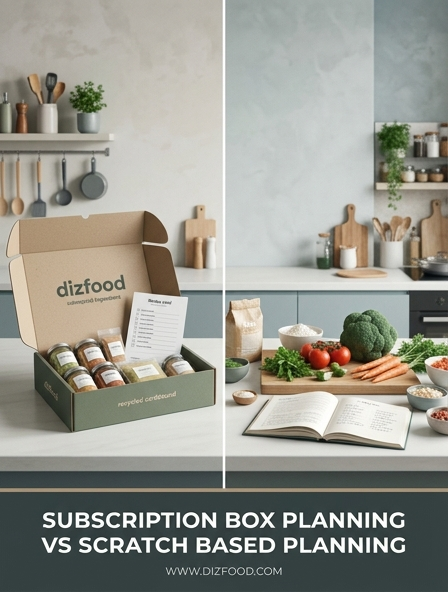
Subscription Box Frameworks vs Starting From Scratch
When entering the culinary commerce space, the foundational decision rests between adopting an established subscription box framework or building a kitchen operation from scratch. A subscription framework acts much like a professional recipe template; it provides the structural boundaries, such as pre-defined delivery intervals, standardized packaging sizes, and a curated selection of ingredients or gadgets. This approach allows entrepreneurs to focus on the brand experience rather than the underlying architecture. By utilizing a framework, the business inherits a proven workflow that accounts for common pitfalls in the food and kitchenware industry.
Conversely, starting from scratch is akin to developing an original recipe without a baseline. This method offers total creative freedom over the supply chain, allowing for unconventional box shapes, unique artisan sourcing, and highly specific niche targeting that standard frameworks might not support. While this offers a distinct competitive advantage in terms of originality, it requires a significant investment in time and research. Business owners must manually establish vendor relationships, test packaging durability for perishable items, and design their own logistics flow.
- Framework Benefits: Faster setup, predictable overhead, and built-in technical support for billing.
- Scratch Benefits: Full control over branding, unique ingredient sourcing, and no licensing fees.
- Framework Drawbacks: Monthly platform costs and limited design flexibility.
- Scratch Drawbacks: High risk of logistical errors and intense initial labor.
Scalability Comparison Subscription Models vs Manual Planning
Scalability in the kitchen industry depends heavily on how systems handle increased volume without a proportional increase in error rates. Subscription models are inherently designed for scalability because they rely on repetition and predictability. When a box contains fixed components-such as a specific set of spices or a chef's tool-the procurement process becomes a simple matter of multiplying the order. This allows the business to leverage economies of scale, reducing the per-unit cost as the subscriber base grows. Automation tools within these models handle the recurring nature of the business, ensuring that 1,000 orders are processed with the same effort as 100.
Manual planning, or "scratch" business logic, often struggles under the weight of rapid growth. Because manual systems are frequently built around bespoke orders or fluctuating menus, each new customer adds a layer of complexity to the procurement and assembly phase. In a kitchen setting, this might mean sourcing 50 different ingredients for 50 different custom kits, which leads to massive waste and logistical bottlenecks. While manual planning is excellent for high-end, boutique services, it requires significant staff increases to scale effectively.
| Feature | Subscription Model | Manual/Scratch Planning |
|---|---|---|
| Order Uniformity | High (Batch Processing) | Low (Customized/Variable) |
| Inventory Risk | Low (Predictable Demand) | High (Spoilage/Uncertainty) |
| Labor Requirements | Automated/Streamlined | Human-intensive/Specialized |
Operational Efficiency in Subscription Box Business Models
Operational efficiency in a kitchen subscription context is measured by the "dock-to-door" time. Subscription models excel here by utilizing assembly-line logic. Because the contents of the boxes are predetermined months in advance, the warehouse or commercial kitchen can be organized into stations that optimize movement. For example, a "Baking Essentials" box would have a station for dry goods, a station for silicone molds, and a final station for recipe cards. This linear progression minimizes the physical steps workers take, drastically reducing labor costs and increasing the number of units produced per hour.
Beyond physical layout, operational efficiency is bolstered by data-driven inventory management. In a subscription model, the business knows exactly how many units are needed based on the active subscriber count. This "Just-In-Time" (JIT) approach is particularly vital when dealing with perishable kitchen goods like artisanal oils or fresh herbs. By eliminating the need to store excess stock, the business frees up capital and reduces the footprint required for storage. This lean methodology ensures that every square foot of the facility is contributing to the final product rather than housing stagnant inventory that may eventually expire or become obsolete.
Customization Limits Scratch Planning vs Box Frameworks
The primary trade-off between subscription frameworks and scratch planning lies in the level of customization offered to the end consumer. Subscription box frameworks typically operate on a "surprise and delight" or "limited choice" model. This constraints the user to a specific set of options which, while efficient for the business, may alienate customers with highly specific dietary needs or niche culinary interests. For instance, a standard kitchen gadget box may not offer an "allergy-friendly" or "vegan-only" alternative because the framework is optimized for bulk purchasing and uniform assembly.
Scratch planning, however, allows for infinite customization. A business built from the ground up can offer "Build Your Own Box" (BYOB) features where customers select every individual ingredient or tool. This granular level of service creates high customer loyalty and caters to the growing demand for personalized nutrition and specialized cooking. However, this flexibility comes at a cost. The logic required to track these individual preferences often leads to "analysis paralysis" for the business, as every custom choice increases the chance of a packing error.
- Standard Frameworks: Best for broad market appeal and high-volume throughput.
- Hybrid Models: Some frameworks now allow "Add-on" items to mimic customization.
- Scratch Logic: Best for luxury or medical-grade dietary subscriptions where precision is paramount.
Cost Benefit Analysis Subscription vs Scratch Development
Analyzing the financial viability of a kitchen-based subscription requires a look at both upfront capital and long-term operational expenses. Subscription frameworks generally have a higher initial "platform fee" or per-transaction cost, but they significantly lower the cost of software development and logistical planning. For a new business, this means a lower barrier to entry. The cost benefit here is realized through speed; by launching three months earlier than a scratch-built competitor, the business can begin generating recurring revenue and recouping its investment much faster.
Scratch development requires a massive upfront investment in custom web architecture, inventory tracking software, and supply chain design. While this avoids the ongoing "tax" of a third-party framework, the "break-even" point is pushed much further into the future. However, for large-scale operations, scratch planning eventually becomes more cost-effective. Once the custom system is built and the initial investment is amortized, the business retains 100% of its margins without paying platform commissions. In the kitchen industry, where margins on food items can be slim, saving 2% to 5% on platform fees can be the difference between profit and loss at scale.
| Expense Category | Framework Approach | Scratch Development |
|---|---|---|
| Initial R&D | $2,000 - $10,000 | $25,000 - $100,000+ |
| Transaction Fees | 2% - 10% | 0.5% - 2% (Processing only) |
| Maintenance | Platform Managed | In-house/Contractor Dependent |
Speed to Market Box Templates vs Scratch Planning
In the competitive world of culinary subscriptions, being first to a niche can define the brand's success. Box templates provide a "plug-and-play" environment that can reduce the time to market from years to weeks. These templates include pre-integrated payment gateways, shipping label generators, and customer portal designs. A kitchen entrepreneur with a great idea for a "Fermentation Starter Kit" can go from concept to first shipment rapidly, capturing market share before larger competitors can react. This speed allows for real-world testing; if the market doesn't respond well, the entrepreneur can pivot or shut down with minimal sunk costs.
Scratch planning is a slow, deliberate process. It involves building every "cog in the machine" from the ground up. For a kitchen brand, this includes designing custom eco-friendly packaging, negotiating unique contracts with artisanal farmers, and coding a proprietary subscription engine. While this results in a superior, more defensible brand, it risks the possibility of the market moving on before the product launches. In the time it takes to develop a scratch-built system, a template-based competitor may have already acquired the most valuable customer segments, making the eventual market entry much more expensive in terms of customer acquisition costs.
Logistics Management Subscription Kits vs DIY Systems
Logistics in the kitchen space is complicated by the weight of cookware and the fragility of glassware or perishables. Subscription kit frameworks often include integrations with major carriers like UPS or FedEx, providing discounted shipping rates that are pre-negotiated based on the collective volume of the platform's users. This "pooled" shipping power is a massive advantage for small businesses. Furthermore, these systems often include automated tracking and delivery notifications, which are essential for maintaining customer trust when shipping food-related items that people are eager to use.
DIY (Do-It-Yourself) logistics systems require the business to negotiate its own rates and build its own tracking infrastructure. This gives the business total control over the unboxing experience-such as choosing specific regional couriers for "last-mile" delivery of fresh produce-but it places the burden of logistics failure squarely on the business. If a DIY system fails to update a customer on a late shipment of perishables, the business faces a high churn rate and potential health safety complaints. DIY systems require a dedicated logistics manager, whereas subscription kits can often be managed by the founder alone in the early stages.
- Kits: Use standardized boxes to minimize "dimensional weight" charges.
- DIY: Can use custom-branded, oddly shaped packaging for luxury appeal.
- Kits: Automated return labels and simple exchange processes.
- DIY: Manual handling of returns, which can be complex for food-contact items.
Market Entry Strategies For New Subscription Businesses
A successful market entry strategy for a kitchen subscription must balance brand identity with operational reality. For those using a framework, the strategy should focus on "content and community." Since the backend is handled by the platform, the business should spend its resources on high-quality recipe videos, influencer partnerships, and SEO-driven culinary blogs. The goal is to build a lifestyle brand where the box is the physical manifestation of the community. This "lightweight" entry strategy is ideal for chefs or influencers who already have a following and want to monetize it quickly without becoming logistics experts.
For those choosing the scratch-built route, the market entry strategy should be centered on "exclusivity and innovation." Because the system is custom-built, the business can offer features that templates cannot, such as a "Kitchen Concierge" service or hyper-local sourcing from urban farms. The entry should be positioned as a premium, artisan alternative to the "mass-market" subscription boxes. This requires a longer runway and a larger marketing budget to educate the consumer on why the custom-built experience is superior to the standardized options available on the market.
Long Term Growth Subscription Systems vs Scratch Logic
Long-term growth is where the paths of subscription systems and scratch logic diverge most sharply. Subscription systems provide a stable plateau; they are excellent for maintaining a consistent business but can eventually become restrictive. As a kitchen brand expands into international markets or looks to add complex tiered loyalty programs, they may outgrow the capabilities of a standard framework. At this stage, many successful businesses face a "migration" challenge, where they must move their data from a framework to a custom system to continue growing.
Scratch logic is built for the "long game." Because the architecture is owned by the business, it can be pivoted or expanded infinitely. If a kitchen tool subscription decides to pivot into a grocery delivery service, a scratch-built system can be recoded to handle the new logistics of temperature-controlled transport. This agility is the ultimate reward for the initial high cost of development. Furthermore, a scratch-built system is a significant intellectual property asset. If the business is ever sold, the proprietary software and logistics logic often command a much higher valuation than a brand that is merely a "tenant" on a third-party subscription platform.
- Phased Approach: Start with a framework to prove the concept, then move to scratch logic for scale.
- Retention Focus: Scratch logic allows for deeper data mining to reduce customer churn.
- Ecosystem Building: Scratch systems can integrate with smart kitchen appliances (IoT) more easily.
Resource Allocation Subscription Box vs Scratch Planning
Resource allocation is the art of deciding where every dollar and hour is spent. In a subscription box model, resources are heavily weighted toward marketing and product curation. Since the technical and logistical "plumbing" is already in place, the team can spend 80% of their time finding the best new kitchen gadgets or testing the most flavorful spice blends. This ensures a high-quality product that keeps customers engaged. This model is "front-heavy" in terms of customer acquisition but "light" in terms of technical maintenance.
In scratch planning, resource allocation is more evenly distributed across engineering, logistics, and product development. A significant portion of the budget must be reserved for software developers, UI/UX designers, and supply chain consultants. This often means that the "culinary" side of the business receives less initial funding than the "technical" side. For a kitchen-focused business, this can be a risk; if the website works perfectly but the recipes are lackluster, the business will fail. Effective scratch planning requires a larger team with a diverse set of skills, making it a more capital-intensive and management-heavy endeavor from the outset.

Comments