
When building a dish with profound depth, the choice between a luxurious wine reduction and a savory soy sauce base defines the entire culinary profile. A wine reduction brings elegance through bright acidity and concentrated fruit sugars, making it the premier choice for French-inspired sauces and braised meats where a sophisticated, balanced tang is required. Conversely, a soy sauce base acts as an umami powerhouse, offering an intense salt profile and fermented complexity perfect for glazed proteins and bold stews that demand a dark, savory punch. Understanding how these two foundations interact with heat and ingredients ensures you select the right flavor bridge to elevate your home cooking from simple to professional-grade, whether you are deglazing a pan for a silkier finish or slow-simmering for maximum intensity.
| Feature | Wine Reduction | Soy Sauce Base |
|---|---|---|
| Primary Profile | Acidity, fruitiness, and mild tannins. | Umami, deep salt, and fermentation. |
| Key Component | Tartaric acid and residual sugars. | Glutamates and high sodium content. |
| Best For | Steaks, roasts, and butter-based sauces. | Stir-frys, marinades, and glazes. |
| Technique | Slow simmer to evaporate alcohol/water. | Fast reduction or used as a liquid base. |
| Texture Impact | Syrupy, velvet-like coating. | Thin, high-gloss lacquered finish. |
| Cuisine Style | Western (French, Italian, Continental). | Eastern (Chinese, Japanese, Southeast Asian). |
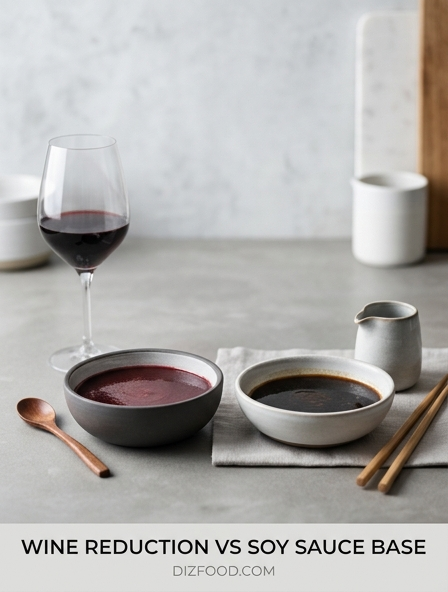
Flavor Profiles of Wine Reduction and Soy Sauce
The flavor profile of a wine reduction is characterized by a concentrated symphony of fruitiness, acidity, and subtle tannins. As wine simmers, the water and alcohol evaporate, leaving behind the structural essence of the grape. Red wine reductions often lean toward dark berries, plum, and earthy notes, while white wine reductions provide a crisp, citrusy, or floral backbone. The natural sugars in the wine caramelize slightly, adding a sophisticated sweetness that balances the inherent tartness of the tartaric and malic acids found in the fruit.
In contrast, soy sauce bases offer an explosion of fermented complexity centered on salt and savory depth. Because soy sauce is produced through the fermentation of soybeans and roasted grains, it possesses a funkiness that wine lacks. Its flavor profile is dominated by salt, but high-quality brewed soy sauces also feature notes of caramel, cocoa, and even a slight yeasty sweetness. Unlike the bright acidity of wine, soy sauce provides a "darker" flavor that anchors a dish, providing a sense of weight and seasoned richness that penetrates deep into the fibers of the ingredients it touches.
| Feature | Wine Reduction | Soy Sauce Base |
|---|---|---|
| Primary Note | Acidic & Fruity | Salty & Fermented |
| Sweetness | Natural Glucose/Fructose | Caramelized Grains |
| Aftertaste | Crisp or Tannic | Lingering Savory |
Key Differences in Umami and Acidity
Umami and acidity represent the fundamental chemical divide between these two culinary foundations. Soy sauce is one of the world's most potent sources of glutamate, the amino acid responsible for the "fifth taste." This umami profile provides a mouth-watering sensation that enhances the perception of protein. When used as a base, soy sauce acts as a flavor amplifier, making meats taste meatier and vegetables taste more substantial. It lacks significant acidity, usually hovering near a neutral or slightly acidic pH, which is why it is often paired with vinegar or citrus in recipes to provide balance.
Wine reductions, however, prioritize acidity as their structural core. The acidity in wine serves to cut through fat and cleanse the palate, making it the perfect companion for rich, heavy dishes like braised short ribs or butter-laden sauces. While some red wines contain trace amounts of umami-particularly those that are aged-they cannot compete with the sheer glutamate concentration of soy. Instead of amplifying savory notes through chemical stimulation, wine uses its acid profile to highlight the delicate nuances of the primary ingredients, providing a bright contrast rather than a deep, resonant echo of salt and protein.
The interplay between these two forces determines the "weight" of a dish. A soy-based sauce feels heavy and coating, driven by its savory density. A wine reduction feels sharp and focused, driven by its ability to pierce through the richness of fats and proteins with its bright, acidic edge.
Techniques for Crafting the Perfect Wine Reduction
Creating a professional-grade wine reduction requires patience and a keen eye for temperature control. The goal is to intensify flavors without introducing burnt or overly bitter notes. Professional chefs often begin by sweating aromatics such as shallots, garlic, and thyme in a small amount of fat before adding the wine. This provides a foundational layer of flavor that the reduction will eventually cling to. It is essential to use a wide, shallow pan to increase the surface area, which facilitates faster evaporation and prevents the wine from "stewing."
- Choose a wine you would actually drink; poor-quality wine only tastes worse when concentrated.
- Simmer the liquid over medium-low heat. A rolling boil can cause the sugars to burn and the delicate esters to vanish.
- Reduce the liquid until it reaches the "au sec" stage (nearly dry) for maximum intensity, or to a syrupy consistency known as nappe.
- Whisk in cold cubes of butter at the very end-a technique called monter au beurre-to add shine and mellow the acidity.
- Strain the reduction through a fine-mesh sieve to remove the spent aromatics for a silky finish.
Monitoring the volume is critical. A general rule of thumb is to reduce the wine by half for a light sauce or by three-quarters for a glaze. If the reduction becomes too thick or "tacky," a splash of stock or water can be used to re-emulsify the sauce. The resulting liquid should be glossy, intense, and capable of coating the back of a spoon perfectly.
Mastering the Art of Soy Sauce Bases
Mastering a soy sauce base involves more than just pouring liquid from a bottle; it is about balancing the intense salinity with complementary elements to create a harmonious "mother sauce." In Japanese cuisine, this often takes the form of *tare*, a multi-purpose base made by simmering soy sauce with mirin, sake, and sugar. The technique involves a gentle heating process that allows the alcohol in the sake to burn off while the sugars dissolve and thicken the liquid, creating a glossy, shelf-stable concentrate that can be used for glazing or dipping.
When crafting a soy base, the ratio of ingredients is paramount. A standard starting point is often a 2:1:1 ratio of soy sauce, sweetening agent (like sugar or honey), and acid (like rice vinegar). This creates a trifecta of salt, sweet, and sour that is far more versatile than plain soy sauce. Infusing the base with aromatics like smashed ginger, scallion whites, and star anise during the simmering process adds layers of complexity that emerge as the liquid reduces. Unlike wine, which is often reduced significantly to achieve body, soy bases frequently rely on the addition of starches or high-sugar liquids like mirin to reach the desired viscosity.
- Teriyaki Base: Soy sauce, mirin, and sugar reduced until syrupy.
- Ponzu Base: Soy sauce infused with citrus juice and kombu.
- Adobo Base: Soy sauce combined with vinegar, peppercorns, and bay leaves.
The cooling process is also vital for soy bases. As the sauce cools, its viscosity increases significantly. Therefore, it is often best to pull the sauce off the heat just before it reaches the target thickness to prevent it from becoming an unmanageable paste.
Culinary Uses for Wine vs Soy Liquid Bases
The culinary applications for wine reductions and soy sauce bases are largely dictated by their cultural origins and the chemical way they interact with food. Wine reductions are the cornerstone of classical French and Western cookery. They are indispensable for creating "pan sauces" that utilize the browned bits (fond) left in a skillet after searing meat. A red wine reduction is the soul of dishes like Bordelaise or Coq au Vin, where the liquid acts as a medium for long, slow braising, breaking down connective tissues while infusing the meat with a dark, sophisticated acidity.
Soy sauce bases, conversely, dominate East and Southeast Asian cuisines. They are primarily used as marinades, dipping sauces, and glazing agents for high-heat cooking like stir-frying. In these contexts, the soy sauce provides the necessary sodium for the entire dish, eliminating the need for extra salt. Because soy sauce is highly resistant to losing its flavor under high heat (unlike the delicate aromatics in wine), it is ideal for the rapid, intense environment of a wok. It is also used extensively in "red braising" in Chinese cuisine, where meats are simmered for hours in a soy-heavy liquid until they turn a deep, mahogany color.
While wine reductions are often finished with fats like butter or cream to create a rich, emulsified texture, soy bases are typically kept "clean" or thickened with starches. This makes wine reductions feel more luxurious and velvety on the palate, whereas soy bases feel more direct, savory, and sharp, highlighting the natural textures of the ingredients they coat.
Texture and Viscosity Comparison in Sauces
The physical behavior of these two liquids as they reduce is fundamentally different due to their chemical makeup. Wine consists primarily of water, alcohol, and dissolved fruit solids. As it reduces, it becomes more viscous through the concentration of natural sugars and pectins. However, even a highly reduced wine (a glaze or "gastrique") remains somewhat fluid unless a significant amount of sugar or a thickening agent like flour (roux) is added. The texture of a wine reduction is often described as "silky" or "clinging," especially when it has been emulsified with butter, which provides a glossy sheen and a smooth mouthfeel.
Soy sauce bases achieve viscosity through different means. Standard soy sauce is very thin, almost like water. To turn it into a thick glaze, chefs usually add sugar, honey, or a cornstarch slurry. Because soy sauce is so high in sodium, reducing it too far purely by evaporation can make it inedibly salty. Therefore, the "body" of a soy sauce base is often artificial-created by additives rather than the concentration of the soy itself. When thickened, a soy base tends to be "tackier" and more "glassy" than a wine reduction, which is why it works so well as a sticky coating for grilled wings or ribs.
| Property | Wine Reduction | Soy Sauce Base |
|---|---|---|
| Viscosity Source | Sugar concentration / Fat emulsion | Added sugars / Starch slurries |
| Mouthfeel | Velvety and smooth | Syrupy and tacky |
| Surface Shine | Opaque / Matte (with butter) | Translucent / High Gloss |
Deglazing Secrets for Wine and Soy Foundations
Deglazing is the technique of adding liquid to a hot pan to loosen the browned food particles (the fond) stuck to the bottom. This process is the starting point for some of the world's greatest sauces. When deglazing with wine, timing and temperature are everything. The wine should be added while the pan is hot but not scorching. The alcohol provides a solvent-like effect that dissolves flavor compounds that water alone cannot reach. It is vital to scrape the bottom of the pan vigorously with a wooden spoon as the wine hisses and bubbles, ensuring every bit of caramelized protein is incorporated into the liquid.
Deglazing with soy sauce requires more caution. Because soy sauce has a high concentration of solids and sugars, it can burn and turn bitter very quickly if the pan is too hot. When using soy as a deglazing agent, it is often wise to turn the heat down slightly or mix the soy with a bit of water, mirin, or stock before hitting the pan. This prevents the soy from instantly vaporizing and leaving behind a salty, burnt crust. The goal with soy deglazing is often to create a "lacquer" on the food rather than a separate sauce to be poured over it.
A secret used by fusion chefs is to deglaze first with a small amount of wine or dry sherry to capture the fond, let that reduce slightly, and then add the soy sauce base. This hybrid approach captures the best of both worlds: the solvent power and acidity of the wine combined with the deep umami and seasoning power of the soy sauce.
Pairing Proteins with Rich Reductions and Bases
The choice between a wine reduction and a soy base often depends on the protein being served. Red wine reductions are the classic partner for "heavy" meats. The tannins in red wine bind to the proteins in meat and help soften the perception of fat, which is why a Cabernet reduction is the gold standard for a ribeye steak or a rack of lamb. White wine reductions, being more delicate and acidic, are preferred for white-fleshed fish, scallops, and chicken breasts, where they provide a brightening effect without overpowering the subtle flavors of the meat.
Soy sauce bases are incredibly versatile but excel with proteins that can handle high salt and "funk." Pork is perhaps the best partner for soy, as the sweetness often added to soy bases complements the natural sweetness of pig meat. Fatty fish like salmon or mackerel also stand up well to soy bases, as the umami cuts through the oily texture of the fish. For plant-based proteins like tofu or tempeh, a soy base is almost mandatory, as these ingredients have little flavor of their own and require the deep seasoning that only a fermented base can provide.
- Beef: Best with Red Wine (Bordeaux, Burgundy) or Dark Soy/Ginger bases.
- Poultry: Best with White Wine/Tarragon or Honey-Soy glazes.
- Seafood: Best with Lemon-White Wine or Soy-Ginger-Sesame.
- Game Meats: Best with Port wine reductions or fermented black bean-soy bases.
Health and Nutritional Impact of Each Sauce
From a nutritional standpoint, wine reductions and soy sauce bases offer very different profiles, primarily regarding sodium and caloric density. Soy sauce is notorious for its high sodium content. A single tablespoon can contain nearly 40% of the recommended daily intake of salt. While low-sodium versions exist, the very nature of a soy base is to provide salinity. This makes it a concern for individuals with hypertension or those needing to manage salt intake. On the positive side, soy sauce is fermented, containing certain bioactive compounds and antioxidants that can aid in digestion.
Wine reductions present a different set of nutritional considerations. While most of the alcohol evaporates during the reduction process, the sugars remain. A heavily reduced wine sauce can be surprisingly high in concentrated fruit sugars. Furthermore, because many wine reductions are finished with butter (monter au beurre) or cream, the fat and calorie content can escalate quickly. However, wine reductions are naturally very low in sodium, making them a superior choice for heart-healthy diets, provided the chef does not add excessive salt during the seasoning phase.
Another factor is the presence of sulfites in wine, which can cause reactions in sensitive individuals. Soy sauce, containing gluten (unless labeled tamari), is a significant allergen concern. Choosing between the two often involves a trade-off between the high salt of the soy base and the higher sugar and fat potential of the wine-based sauce.
Substituting Wine Reduction for Soy Sauce Base
Substituting one for the other is not a direct 1:1 swap, but it can be done with careful adjustments to the flavor balance. If you are replacing a soy sauce base with a wine reduction, you must significantly increase the salt content of your dish. Wine has almost no salt, so the "punch" provided by soy will be missing. To mimic the umami of soy, one might add a small amount of Worcestershire sauce, mushroom powder, or even a touch of balsamic vinegar to the wine reduction to provide that darker, fermented edge.
Conversely, if you are using a soy sauce base to replace a wine reduction, the primary challenge is the lack of acidity and the potential for over-salting. To make a soy base behave more like a wine reduction, it should be diluted with water or unsalted stock and brightened with a strong acidic component like lemon juice or red wine vinegar. This helps mimic the palate-cleansing properties of the wine. While a soy-based Coq au Vin would be a radical departure from tradition, the underlying principles of slow-braising in a seasoned liquid remain the same.
Ultimately, substitution is most successful in stews and braises where the liquid is one of many flavor components. In delicate pan sauces, the substitution is more noticeable. A red wine reduction used in a stir-fry will result in a dish that is too tart and lacks the characteristic brown-sugar-and-salt crust, while a soy sauce base used for a filet mignon will turn it into something resembling a Japanese steakhouse dish rather than a French bistro classic.



Comments