
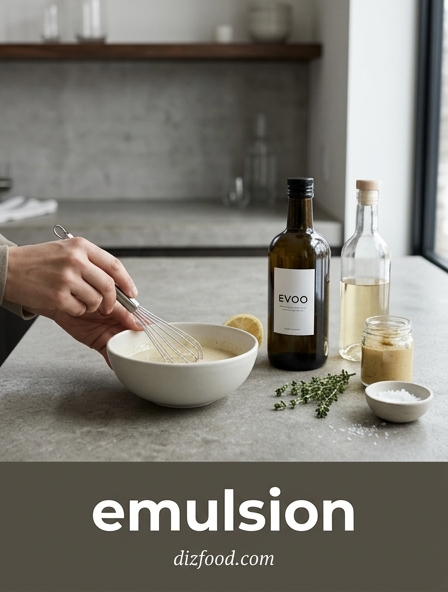
The Fundamentals of Fat and Water Emulsions
At its core, an emulsion is a colloidal dispersion where two immiscible liquids, typically fat and water, are forced into a homogenous state. In the kitchen, this requires the presence of an emulsifier-a molecule with both hydrophilic (water-loving) and lipophilic (fat-loving) properties. These molecules position themselves at the interface of the droplets, reducing surface tension and preventing the dispersed phase from coalescing.
Emulsions are categorized based on which substance is suspended. In a water-in-oil emulsion, such as butter, tiny water droplets are trapped within a continuous fat matrix. Conversely, oil-in-water emulsions, like mayonnaise or milk, feature fat globules dispersed throughout an aqueous base. The stability of these mixtures depends on the size of the dispersed droplets; smaller droplets result in a more stable and viscous texture.
| Emulsion Type | Continuous Phase | Dispersed Phase | Common Example |
|---|---|---|---|
| Oil-in-Water | Water/Aqueous | Fat/Oil | Hollandaise, Milk |
| Water-in-Oil | Fat/Oil | Water/Liquids | Vinaigrette, Butter |
Role of Temperature in Buttercream Stability
Temperature is the most critical external factor governing the integrity of buttercream. Whether preparing a Swiss meringue or a classic American style, the fat-usually butter-must remain in a plastic state. If the temperature rises above the melting point of the specific triglycerides within the butter (typically 90-95°F), the crystalline structure collapses, leading to a soup-like consistency where the fat and water phases separate entirely.
Conversely, if the mixture is too cold, the fat becomes brittle and loses its ability to coat the air bubbles or liquid phase. This results in a curdled appearance, where the fat clumps together rather than forming a smooth film. Maintaining a working environment between 68°F and 72°F is generally ideal for pastry applications. The following factors are influenced by thermal shifts:
- Viscosity: Warmer temperatures decrease the resistance to flow, thinning the emulsion.
- Aeration: Proper temperature allows for maximum air entrapment during the creaming process.
- Crystallization: Cooling too rapidly can cause uneven fat crystals, leading to a sandy mouthfeel.
Molecular Bond Between Cocoa Butter and Cream
The creation of ganache relies on a delicate molecular dance between the cocoa butter in chocolate and the water-based cream. When heated cream is poured over chocolate, the cocoa butter melts, releasing its fatty acid chains. The proteins and natural lecithins in the cream act as bridge molecules, tethering the fat droplets to the aqueous liquid. Achieving a perfect bond requires the cocoa butter to be finely dispersed into droplets no larger than a few microns.
If the ratio of fat to liquid is imbalanced, or if the temperature exceeds 110°F during the initial mixing, the cocoa butter may "split," forming an oily film on the surface. This happens because the kinetic energy overrides the stabilizing forces of the emulsifiers. A successful bond results in a "Type V" crystal structure, which provides the characteristic snap and gloss found in high-end confectionery. The molecular alignment must be preserved through gentle, consistent stirring to ensure the long-chain fats do not aggregate prematurely.
Selecting High Quality Fats for Smooth Textures
The success of a culinary emulsion is often determined before the first whisk is turned, starting with the selection of fats. High-quality fats are characterized by their purity, fatty acid profile, and water content. In professional pastry, European-style butters are favored for their higher fat percentage (82-86%) compared to standard commercial butters. This lower water content provides a more stable continuous phase for water-in-oil emulsions.
| Fat Type | Fat Content | Application Strength |
|---|---|---|
| European Butter | 82-86% | Laminated doughs, silky buttercreams |
| Vegetable Shortening | 100% | High-heat stability, structural piping |
| Cocoa Butter | 100% | Snapping textures, chocolate fluidities |
| Heavy Cream | 36-40% | Stable oil-in-water aerated foams |
Selecting fats with a high smoke point and low free fatty acid levels ensures that the emulsion does not develop off-flavors or undergo oxidative rancidity, which can chemically degrade the emulsifying agents present in the mix.
The Impact of Agitation on Emulsion Integrity
Mechanical energy, or agitation, is the catalyst that breaks down the dispersed phase into the tiny droplets necessary for a stable emulsion. The method of agitation dictates the final texture and longevity of the product. High-shear methods, such as using an immersion blender, create smaller, more uniform droplets than hand-whisking. This increased surface area allows emulsifiers to work more efficiently, resulting in a thicker, more resilient sauce or cream.
However, over-agitation can be detrimental. In the case of heavy cream, excessive whisking causes the protective membranes around fat globules to rupture, leading to the formation of butter rather than a stable foam. The goal is to provide enough shear force to achieve dispersion without introducing so much heat or friction that the molecular bonds are disrupted. In professional settings, the "vortex" method is often used to slowly incorporate oil into an aqueous base, ensuring each drop is fully encapsulated before more fat is added to the system.
Balancing Solids and Liquids in Professional Ganache
A professional ganache is more than just a mixture; it is a precisely balanced system of dry solids, fats, and water. The dry solids, primarily cocoa particles and sugar, compete for the available moisture in the cream. If the liquid content is too low, the ganache becomes overly firm and prone to cracking. If it is too high, the emulsion fails to set, remaining a liquid syrup. The ideal balance ensures that the fat phase is perfectly suspended within the sugar-water matrix.
- Fat Ratio: Usually maintained at 35-40% for truffles to ensure a melt-in-the-mouth quality.
- Solid Content: High cocoa mass increases the viscosity but requires more liquid to prevent graininess.
- Invert Sugars: Adding glucose or honey helps bind water, reducing the "water activity" and increasing the emulsion's shelf life.
- Homogenization: Using a burr mixer after the initial melt ensures the solids are evenly distributed through the fat droplets.
Properly balanced ganache will exhibit a reflective sheen and a smooth, elastic texture when stirred, indicating that the solids are fully hydrated and the fats are correctly emulsified.
Troubleshooting Broken Buttercream and Grainy Textures
An emulsion is "broken" when the dispersed droplets coalesce and separate from the continuous phase. In buttercream, this often manifests as a curdled, cottage-cheese-like appearance. This failure is usually caused by a temperature mismatch between the fat and the meringue base. If the butter is added to a base that is too warm, it melts; if the base is too cold, the butter cannot incorporate. To fix a broken buttercream, a small portion of the mixture should be gently warmed and then whisked back into the main batch to re-establish the bond.
Graininess, on the other hand, is often the result of crystallized sugar or fat. In chocolate-based emulsions, graininess occurs if the chocolate is "seized" by a small amount of moisture or if it is cooled too slowly, allowing large fat crystals to form. Ensuring all equipment is bone-dry and maintaining a consistent cooling rate are essential preventative measures. If graininess persists, passing the emulsion through a fine-mesh chinois or applying high-shear agitation can sometimes restore the desired smoothness.
Natural Emulsifiers and Their Role in Pastry
Nature provides several potent emulsifiers that are staples in the professional kitchen. The most common is lecithin, found in high concentrations in egg yolks. Lecithin acts as a phospholipid bridge, making it indispensable for custards, curds, and cakes. Beyond eggs, various proteins and plant-based mucilages contribute to stability. Understanding these ingredients allows chefs to manipulate textures without resorting to synthetic additives.
- Egg Yolks: Contain lecithin, which stabilizes mayonnaise and hollandaise.
- Casein: A milk protein that helps maintain the emulsion in processed dairy products and sauces.
- Honey: While not a pure emulsifier, it acts as a surfactant and humectant to keep mixtures cohesive.
- Mustard: Contains a mucilaginous coating on the seeds that aids in stabilizing vinaigrettes.
- Gelatin: Provides structural support that prevents the migration of water droplets in mousses.
These natural agents work by forming a protective layer around fat droplets, preventing them from bumping into one another and merging. Their effectiveness is often pH-dependent, meaning acidity levels must be carefully monitored to keep the emulsifiers active.
The Science of Mouthfeel and Flavor Release
The quality of an emulsion dictates the sensory experience of eating. Mouthfeel is the physical sensation produced by the size and distribution of fat droplets. A well-executed emulsion feels "silky" or "creamy" because the tiny droplets coat the tongue evenly. In contrast, a poorly emulsified sauce feels "greasy" because the fat has separated into large globules that coat the palate in a thick, insulating layer. This layer can actually inhibit flavor release by trapping aromatic compounds.
Flavor perception in emulsions is a timed event. In an oil-in-water emulsion, the water-soluble flavors hit the taste buds first, followed by the fat-soluble aromas as the emulsion breaks down due to the heat of the mouth. If the emulsion is too stable (chemically over-engineered), it may fail to break down, resulting in a muted flavor profile. The goal is a "clean" finish where the emulsion dissolves completely, leaving no waxy residue. This balance between stability on the plate and instability in the mouth is the hallmark of professional culinary technique.
Maintaining Emulsion Stability During Storage
An emulsion is a kinetically stable system, not a thermodynamically stable one, meaning it is constantly trying to separate. Storage conditions are vital for preventing syneresis-the weeping of liquid from the emulsion. Fluctuations in temperature can cause fat crystals to grow and pierce the interfaces between droplets, leading to eventual collapse. Refrigeration is generally required, but the transition from cold to room temperature must be managed carefully to avoid condensation and surface tension shifts.
To extend stability during storage, chefs often use stabilizers such as starches or gums. These ingredients increase the viscosity of the continuous phase, making it harder for the dispersed droplets to move and collide. Common storage practices include:
- Plastic Film: Pressing film directly onto the surface to prevent evaporation and skin formation.
- Airtight Containers: Preventing the absorption of odors and moisture from the environment.
- Gentle Re-tempering: Slowly bringing a chilled ganache or sauce to temperature before use to prevent thermal shock.
Monitoring these variables ensures that the emulsion retains its gloss, texture, and flavor for the duration of its shelf life.


Comments