
Manual Massaging vs. Passive Submersion: Elevating Your Flavor Game
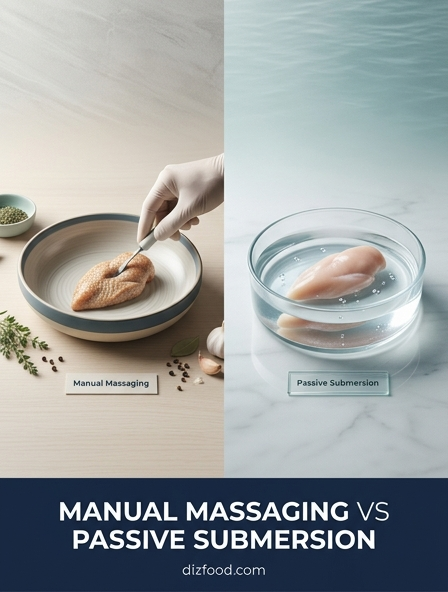
When you're aiming for that perfect, juicy bite, the way you apply your marinade matters just as much as the ingredients themselves. While passive submersion is the traditional "set it and forget it" method that relies on steady osmosis to flavor the surface, manual massaging is a culinary game-changer that uses kinetic energy to break down tough muscle fibers and force seasonings deep into the protein. Choosing between them depends entirely on your timeline and desired texture: do you have twelve hours for a slow soak, or do you need to accelerate protein denaturation and flavor absorption in a matter of minutes? Understanding how mechanical action stacks up against steady diffusion will transform your prep work from a chore into a strategic step for professional-grade grilling results.
| Feature | Manual Massaging | Passive Submersion |
|---|---|---|
| Prep Time | 5-15 Minutes (Rapid) | 4-24 Hours (Slow) |
| Flavor Depth | Deep core penetration | Primarily surface-level |
| Tenderization | Mechanical fiber breakdown | Chemical/Enzymatic only |
| Effort Level | High (Active labor) | Zero (Hands-off) |
| Liquid Volume | Minimal (High efficiency) | High (Must cover protein) |
| Best For | Dense meats (Beef, Pork) | Delicate items (Fish, Veg) |
Understanding the Science of Flavor Infusion
Flavor infusion in culinary preparation is a complex interaction between solutes and the protein matrix of the food item. At its core, the process relies on the movement of molecules-primarily salt, sugars, and aromatic compounds-from an area of high concentration in a marinade or brine to an area of lower concentration within the muscle tissue. This movement is governed by the principles of diffusion and osmosis, where water-soluble molecules navigate the interstitial spaces between muscle fibers. Salt plays a dual role, acting not only as a flavoring agent but also as a catalyst that alters the physical structure of proteins, allowing for deeper penetration of secondary flavors.
When flavor molecules encounter the surface of the meat, they must bypass the natural barriers of the cellular membranes. In a passive environment, this process is slow, as it relies entirely on the kinetic energy of the molecules and the concentration gradient. However, the chemical environment, such as the pH level of the infusion liquid, significantly impacts the rate of absorption. Acidic components like vinegar or citrus juice can partially denature surface proteins, creating a more porous exterior that facilitates the entry of larger aromatic molecules that would otherwise remain on the surface. Understanding these molecular dynamics is essential for chefs who aim to achieve a harmonious distribution of flavor throughout the entire cut of meat rather than just a seasoned exterior.
Manual Massage vs Passive Submersion Efficiency
Efficiency in the kitchen is often measured by the depth of flavor achieved relative to the time invested. Passive submersion is the traditional standard, requiring the product to sit undisturbed in a liquid medium. While effective for small or thin items, it often fails to reach the core of dense proteins within a reasonable timeframe. Manual massaging, conversely, introduces kinetic energy into the system, accelerating the transfer of liquids into the protein fibers through physical manipulation. This active approach ensures that the marinade is not just coating the exterior but is being forced into the internal structures of the meat.
| Feature | Passive Submersion | Manual Massaging |
|---|---|---|
| Primary Mechanism | Osmosis & Diffusion | Mechanical Pressure & Absorption |
| Distribution | Top-down gradient | Uniform and deep |
| Time Requirement | 12-24 Hours | 10-30 Minutes |
| Labor Intensity | Low (Set and forget) | High (Active labor) |
The choice between these methods often depends on the volume of production and the desired intensity. Manual massaging is superior when quick turnarounds are necessary, as the physical action of "working" the meat breaks down minor surface tensions and air pockets that typically inhibit liquid uptake. This leads to a more efficient use of ingredients, as less marinade is wasted on the surface, and a higher percentage is successfully integrated into the protein itself.
Impact on Protein Texture and Tenderness
The texture of cooked meat is largely determined by how the protein fibers are treated during the preparation phase. Passive submersion allows for a gentle breakdown of connective tissues, primarily through the slow action of salts and acids. This results in a classic tenderness that preserves the original integrity of the muscle grain. Because there is no mechanical stress, the meat retains its natural shape and density, making this method ideal for delicate proteins like fish or thin poultry cuts where structural fragility is a concern.
In contrast, manual massaging exerts physical force that actively disrupts the myofibrillar structure. This mechanical action helps to "relax" the muscle fibers, leading to a significantly softer bite in the final cooked product. By massaging the meat, the chef is essentially performing a form of pre-tenderization that allows heat to penetrate more evenly during the cooking process. This is particularly beneficial for tougher cuts of beef or pork, where the physical breakdown of collagen and tough fibers is necessary for a premium mouthfeel. However, excessive massaging can lead to a "mushy" texture if the protein structure is compromised too far, requiring a careful balance between force and duration to achieve the perfect gastronomic result.
The Role of Mechanical Action in Brining
Mechanical action in the context of brining involves more than just moving the meat around; it is a deliberate process of stretching and compressing the protein fibers. This action creates a vacuum-like effect within the muscle tissue. As the meat is compressed, air and internal fluids are expelled; as the pressure is released, the surrounding brine is sucked deep into the resulting voids. This cycle of expulsion and suction significantly outperforms the slow, one-way movement of passive brining.
- Disruption of Myofibrils: Physical manipulation helps separate the tightly packed muscle filaments, creating larger gaps for salt and water to inhabit.
- Exudation of Myosin: Massaging brings salt-soluble proteins like myosin to the surface, which creates a tacky "protein glue" that helps in binding and moisture retention.
- Even Salt Concentration: Mechanical action prevents "hot spots" of high salinity, ensuring every gram of the meat has an identical salt profile.
- Enhanced Surface Area: By stretching the fibers, the total surface area exposed to the brine increases exponentially.
This mechanical intervention is the secret behind high-quality deli meats and processed poultry. By utilizing active movement, kitchens can achieve a level of succulence that is physically impossible through soaking alone. The friction generated during massaging also slightly raises the temperature of the meat, which can further assist in the solubility of fats and seasonings, integrating them more deeply into the tissue.
Passive Submersion and Osmotic Equilibrium
Passive submersion operates on the biological law of equilibrium. When meat is placed in a saline or sugar-rich solution, the system naturally seeks to balance the concentration of solutes between the brine and the intracellular fluid. This process is inherently slow because it relies on the semi-permeable nature of cell membranes. Over several hours, the salt ions migrate inward, eventually drawing water with them. This "plumping" effect is the primary goal of the passive method, ensuring the meat is hydrated before it hits the heat of the oven or grill.
The limitation of this method is that it reaches a point of diminishing returns once equilibrium is achieved. Once the concentration of salt inside the meat matches the concentration of the brine, the movement of molecules stops. This means that passive submersion requires very precise calculations of brine strength to avoid over-salting the exterior while waiting for the interior to reach the desired levels. It is a game of patience and timing. In a kitchen setting, this necessitates significant refrigeration space and advance planning, as the meat must often soak for an entire day to see meaningful benefits. Despite the time, the lack of physical agitation ensures that the meat remains aesthetically pristine, with no bruising or tearing of the skin or delicate fibers.
Improving Moisture Retention in Meat Processing
Moisture retention, often referred to as Water Holding Capacity (WHC), is the ability of meat to retain its natural and added juices during the stress of cooking. Both manual massaging and passive submersion aim to increase this capacity, but they do so through different pathways. Passive submersion increases moisture by slowly hydrating the protein matrix through osmotic pressure. The salt enters the fibers, causing them to swell and hold onto water. However, this bond can be weak, and much of the added moisture may be lost as steam or runoff when the meat is subjected to high heat.
Manual massaging improves moisture retention more effectively by altering the protein structure to "lock in" the fluids. The mechanical action encourages the extraction of myofibrillar proteins, which form a gel-like substance when combined with salt and water. This gel acts as a barrier, trapping moisture within the muscle fibers even as they contract during cooking. Consequently, massaged meats typically show a lower percentage of "cook loss" compared to those that were merely submerged. For the chef, this results in a finished product that is noticeably juicier and has a higher perceived fat content, even in lean cuts. This improved retention is critical for maintaining quality under heat lamps or during extended service periods in a commercial kitchen.
Comparing Time Requirements for Both Methods
In a professional culinary environment, time is a finite resource that dictates the flow of the entire kitchen. Passive submersion is a "long-lead" technique. For a standard whole chicken or a heavy pork shoulder, a passive brine typically requires 12 to 24 hours to be effective. This requires the kitchen to maintain a rolling inventory and anticipate demand far in advance. If a sudden surge in customers occurs, passive submersion cannot be accelerated to meet the need, often leading to product shortages or the use of un-brined, inferior substitutes.
Manual massaging, or its industrial counterpart, vacuum tumbling, collapses these timelines from hours into minutes. A process that would take 18 hours of soaking can often be replicated in 20 to 30 minutes of vigorous manual massage. This allows for "on-demand" preparation, reducing the need for massive refrigerated storage and allowing the chef to react to the kitchen's needs in real-time. The time saved is not merely a convenience; it represents a fundamental shift in kitchen logistics, allowing for fresher preparation and reduced food waste. While massaging requires more immediate physical labor, the trade-off in speed and responsiveness is often deemed worth the effort in high-volume establishments.
Structural Changes in Muscle Fiber Development
The transformation of muscle into meat involves significant structural changes, which are accelerated or modified by the choice of infusion method. Muscle fibers are bundles of myofibrils held together by connective tissue. During passive submersion, the chemical environment slowly weakens the bonds between these bundles. The salt ions neutralize the electrical charges on the protein filaments, causing them to repel each other slightly. This creates space for water to enter, but the overall architecture of the muscle remains largely intact.
Active massaging introduces a level of physical trauma that fundamentally reorganizes these fibers. The shear forces applied during massaging cause the longitudinal splitting of some fibers and the destruction of the sarcolemma (the cell membrane). This sounds destructive, but in a culinary sense, it is highly beneficial. It creates a more homogenous texture where the distinctions between different muscle groups within a single cut become less pronounced. This process also facilitates the "binding" of different pieces of meat-a technique used in making terrines or restructured steaks. By physically working the meat, the chef is guiding the development of the protein structure toward a specific, desired consistency that cannot be achieved through the "static" environment of a submersion tank.
Optimizing Yield with Active Massaging Techniques
Yield optimization is a critical factor in the economic sustainability of any kitchen or food processing operation. Yield refers to the weight of the final cooked product relative to its raw starting weight. Passive submersion typically results in a weight gain of 5% to 8% due to water absorption, but a significant portion of this is lost during cooking. Active massaging, however, can result in a more stable weight gain of 10% to 15%, as the moisture is more securely integrated into the protein gel matrix.
- Higher Initial Absorption: Mechanical action forces more liquid into the tissue than osmosis alone.
- Reduced Purge: Massaged meat loses less fluid (purge) during storage and transport.
- Stable Cooked Weight: The "locked-in" moisture remains inside the meat during the roasting or searing process.
- Ingredient Efficiency: Less marinade is required to achieve the same flavor profile, reducing ingredient costs.
For a business, these percentages translate directly into profit. By utilizing active massaging techniques, a kitchen can produce more "servable" meat from the same raw input. This doesn't mean the meat is "watered down"; rather, it means the meat is optimized to stay succulent, preventing it from drying out and shrinking on the plate. In a high-stakes environment, the ability to control yield through mechanical action provides a significant competitive advantage.
Selecting the Right Method for Culinary Consistency
The decision to use manual massaging versus passive submersion ultimately depends on the specific goals of the dish and the nature of the ingredients. Consistency is the hallmark of a professional kitchen, and both methods offer distinct paths to achieving it. Passive submersion is the method of choice for "whole-muscle" presentations where the visual integrity of the meat is paramount. For example, a bone-in prime rib or a delicate crown roast benefits from the gentle, uniform seasoning of a passive brine, which preserves the majestic appearance of the cut without any risk of surface tearing or texture distortion.
Manual massaging is the preferred tool for high-intensity flavor profiles and items where tenderness is the primary objective. It is the gold standard for stir-fry meats, kabobs, and poultry breasts that are prone to drying out. When selecting a method, the chef must consider the thickness of the meat, the toughness of the fibers, and the available labor. While passive submersion is "easier" in terms of physical effort, manual massaging provides a level of control over the final texture and moisture that is unmatched. By mastering both, a culinary professional can ensure that every dish-whether it is a delicate fillet of sole or a robust slab of brisket-reaches the table with the exact flavor and mouthfeel intended by the recipe.


Comments