
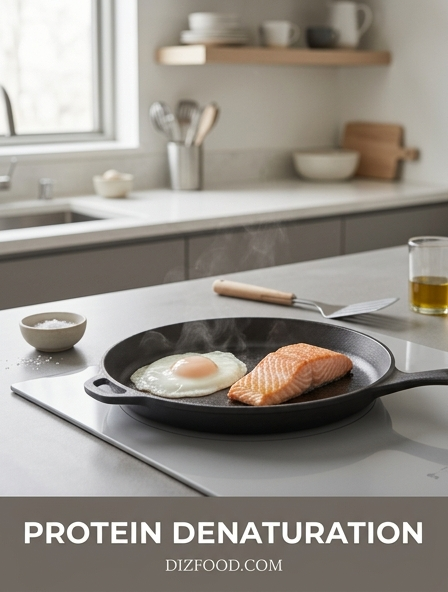
The Science of Protein Denaturation
Protein denaturation is a fundamental biochemical process in the kitchen where the complex, folded structures of protein molecules unfold into simpler chains. In their natural state, proteins exist as tightly coiled "globular" or "fibrous" structures held together by various chemical bonds. When these proteins are exposed to external stressors such as heat, acids, salts, or mechanical force, those delicate bonds break. This causes the proteins to lose their secondary and tertiary structures, effectively uncoiling.
Once uncoiled, these protein strands begin to bump into one another and form new, different bonds. This subsequent stage is known as coagulation. In culinary applications, this transformation is what changes a liquid egg white into a solid white mass or causes raw, translucent meat to become opaque and firm. Understanding the variables that trigger denaturation allows a chef to control the texture and moisture of the final dish.
- Thermal energy (Cooking)
- Chemical catalysts (Acids and Bases)
- Physical agitation (Whisking or Pounding)
- Dehydration and Salting
Acidic Marinades and Chemical Breakdown
Acidic marinades utilize ingredients like citrus juices, vinegars, and wines to alter the texture of meat through chemical denaturation. When the pH level of the meat's environment drops, the hydrogen bonds within the protein strands are disrupted. This causes the muscle fibers to loosen and expand, allowing the meat to absorb more moisture initially. However, prolonged exposure to high acidity can eventually lead to over-denaturation, resulting in a mushy or chalky texture as the proteins tighten too much and squeeze out liquid.
The effectiveness of an acidic marinade depends largely on the surface area and the type of protein. Because acids do not penetrate deeply into muscle tissue quickly, they are most effective on thinner cuts of meat or seafood. To achieve the best results with acids, follow these steps:
- Select an acid with a pH between 3.0 and 4.0 for moderate denaturation.
- Balance the acid with fats to prevent excessive surface breakdown.
- Limit marination time for delicate proteins like fish to under thirty minutes.
- Use glass or ceramic containers to avoid reactive metallic off-flavors.
Natural Enzyme Tenderizers in Fruit
Certain fruits contain powerful proteolytic enzymes that act as biological catalysts to break down proteins. Unlike acids, which primarily unfold protein strands, these enzymes actually digest the peptide bonds that hold the amino acids together. This results in a significant softening of the muscle fibers and connective tissues. If used correctly, these natural tenderizers can transform tough cuts of meat into succulent portions, but they require precision to avoid complete structural collapse.
Common fruits used in professional kitchens contain specific enzymes that target different protein structures. The table below outlines the most common enzymes and their sources:
| Enzyme | Fruit Source | Target Tissue |
|---|---|---|
| Bromelain | Pineapple | Collagen and Myofibrils |
| Papain | Papaya | Connective Tissue |
| Actinidin | Kiwi | Connective Tissue and Myosin |
| Ficin | Figs | Muscle Fiber and Elastin |
The Role of Salt and Osmosis
Salt plays a dual role in protein denaturation, acting both as a seasoning and a structural modifier. When salt is applied to meat, it initially draws moisture out through osmosis. However, as the salt dissolves into a concentrated brine on the surface, it eventually reabsorbs into the muscle fibers. Once inside, the salt ions disrupt the electrical charges that keep protein filaments, specifically myosin, tightly packed together. This process is known as solubilizing the proteins.
By breaking down these specific filaments, salt creates a more open structure that can hold onto more water during the cooking process. This is why brined meats often weigh more and remain juicier than their un-salted counterparts. The impact of salt is most visible in the following ways:
- Increased water-holding capacity (WHC) of the muscle.
- Dissolution of the "Z-disks" in muscle fibers.
- Prevention of excessive protein contraction during heating.
- Creation of a tacky surface (pellicle) that helps in smoke absorption.
Alkaline Methods for Velveting Meat
Velveting is a traditional Chinese culinary technique that uses alkaline substances, most notably baking soda (sodium bicarbonate), to alter the pH of the meat's surface. By raising the pH, the protein molecules become negatively charged, causing them to repel each other rather than bonding tightly when heated. This prevents the proteins from coagulating into a tough, dense mass, resulting in a "silky" or "velvety" texture that is highly prized in stir-fry dishes.
This method is exceptionally effective for lean cuts like chicken breast or flank steak. To properly velvet meat using the alkaline method, the following sequence is typically employed:
- Thinly slice the meat against the grain to shorten fibers.
- Coat the meat in a small amount of baking soda (approx. 1 tsp per pound).
- Let the meat rest for 15 to 20 minutes to allow pH shift.
- Rinse the meat thoroughly under cold water to remove the alkaline taste.
- Pat dry before searing or poaching in oil.
Temperature Control and Thermal Denaturation
Heat is the most common agent of protein denaturation in the kitchen. As temperature rises, kinetic energy increases, causing the atoms within protein molecules to vibrate violently until the internal bonds snap. Different proteins denature at specific temperatures, which is why precise temperature control is vital for achieving the desired doneness. For instance, myosin begins to denature and coagulate around 122°F (50°C), while actin denatures at higher temperatures, around 150°F (66°C).
When actin denatures, it squeezes the muscle fibers tightly, forcing out the majority of the cellular moisture. This explains why meat cooked to "well done" is significantly drier than "medium-rare" meat. The table below highlights the critical thermal thresholds for meat proteins:
| Temperature | Effect on Protein | Culinary Result |
|---|---|---|
| 120°F - 130°F | Myosin begins to coagulate | Rare; soft and juicy |
| 140°F - 150°F | Proteins contract; opacity increases | Medium; firming texture |
| 160°F+ | Actin denatures; collagen shrinks | Well done; moisture loss |
| 180°F - 200°F | Collagen converts to gelatin | Fork-tender (for tough cuts) |
Mechanical Pounding to Break Fibers
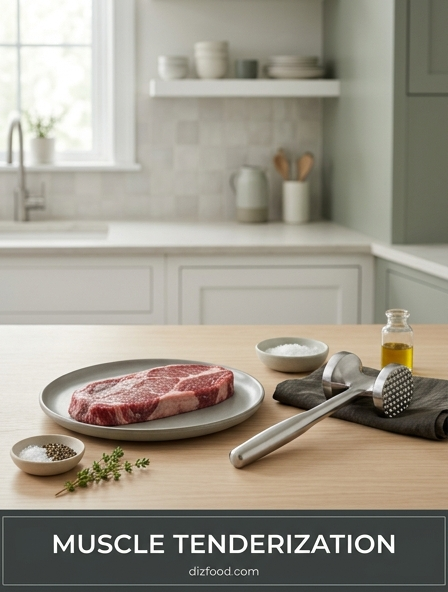
Mechanical denaturation involves the use of physical force to disrupt the structural integrity of protein fibers. By using a meat mallet, rolling pin, or specialized blade tenderizer, a cook can physically sever the long strands of muscle fiber and the surrounding connective tissue (collagen). This process does not rely on chemical or thermal changes but rather on the brute force required to destroy the secondary structural layers of the meat.
Pounding meat serves two primary purposes: it tenderizes the product and ensures a uniform thickness. Uniformity is crucial because it allows for even heat distribution, preventing the outer edges from over-denaturing and becoming dry before the center reaches the safe temperature. Mechanical methods are especially beneficial for:
- Breaking down tough silver skin and elastin.
- Increasing the surface area for marinades and seasonings.
- Shortening long muscle fibers in cuts like schnitzel or scallopini.
- Flattening uneven poultry breasts for faster cooking times.
Optimizing pH for Moisture Retention
The pH level of meat significantly influences its water-holding capacity due to the "isoelectric point" of proteins. Most meat proteins have an isoelectric point around a pH of 5.0 to 5.2. At this specific level, the net charge of the proteins is zero, meaning the positive and negative charges balance out. This causes the protein strands to attract each other and pack tightly together, leaving very little room for water molecules to reside between them.
To maximize moisture retention, chefs aim to move the pH away from this isoelectric point. By either increasing the acidity (lowering pH) or increasing the alkalinity (raising pH), the proteins develop a net charge. This charge causes the strands to repel one another, creating microscopic gaps that trap water. This is why a slightly acidic marinade or an alkaline velvetting solution can make meat appear much juicier. Understanding this relationship allows for the scientific manipulation of texture through simple pH adjustments in the preparation phase.
The Impact of Marinating Time
Timing is perhaps the most overlooked variable in the denaturation process. While it is tempting to believe that a longer soak results in more flavor and better texture, the law of diminishing returns applies heavily to marinades. Because the diffusion of large molecules into dense muscle tissue is slow, marinades rarely penetrate more than a few millimeters into the meat. Over time, the surface layer can become over-processed while the interior remains unchanged.
If meat is left in an acidic or enzymatic marinade for too long, the surface proteins will denature to the point of total degradation. This creates a grainy, mushy exterior that prevents a proper crust from forming during searing. To manage marinating time effectively, consider the following guidelines:
- Seafood: 15 to 30 minutes (extremely sensitive to acid).
- Chicken and Pork: 2 to 6 hours (moderate fiber density).
- Beef and Lamb: 4 to 12 hours (high density, tougher fibers).
- Avoid marinating any protein for over 24 hours to maintain structural integrity.
Essential Techniques for Juicier Results
Achieving the perfect balance of protein denaturation requires a combination of chemical, mechanical, and thermal techniques. The goal is to denature the proteins enough to make them safe and tender, without causing excessive coagulation that drives away moisture. Beyond the initial preparation, how the protein is treated during and after the application of heat determines the final succulence of the dish. Modern culinary science emphasizes gentle transitions and moisture preservation.
To ensure the highest quality results, incorporate these essential habits into your kitchen workflow:
- Resting: Allow meat to sit after cooking so the pressurized juices can redistribute as the protein structure relaxes.
- Carryover Cooking: Remove meat from the heat source 5 degrees early to account for continued denaturation from residual heat.
- Low and Slow: Use lower temperatures for tough cuts to allow collagen-to-gelatin conversion without toughening muscle fibers.
- Slicing: Always cut against the grain to ensure the consumer's teeth do not have to work against long, denatured protein strands.



Comments