
Choosing between fruit purees and chemical tenderizers can transform your culinary results from chewy to succulent, but the right choice depends on your timeline and taste preferences. Natural fruit purees, such as those derived from pineapple, papaya, or kiwi, utilize powerful proteolytic enzymes like bromelain and papain to gently dissolve tough connective tissues while infusing the meat with a subtle, bright acidity. In contrast, chemical tenderizers-often found in convenient powder forms-rely on refined enzymes and salts to achieve rapid results, making them a go-to for high-speed kitchen environments. While fruits offer a gourmet, whole-food approach that enhances flavor profiles, chemical alternatives provide unmatched precision and speed, though they carry a higher risk of turning your steak mushy if left for even a few minutes too long.
| Feature | Fruit Purees (Natural) | Chemical Tenderizers |
|---|---|---|
| Active Agent | Proteases (Bromelain, Papain, Actinidin) | Refined enzymes (Aspergillus oryzae) & salts |
| Action Speed | Slow to Moderate (2-6 hours) | Rapid (15-30 minutes) |
| Flavor Impact | Adds sweetness and mild acidity | Neutral to salty; may have metallic aftertaste |
| Texture Result | Silky, natural mouthfeel | Extremely soft; high risk of "mushiness" |
| Best For | Thick cuts, BBQ, and gourmet marinades | Thin steaks, quick stir-fries, and budget cuts |
| Ingredient Profile | 100% Whole food; vitamin-rich | Processed; often contains MSG or anti-caking agents |
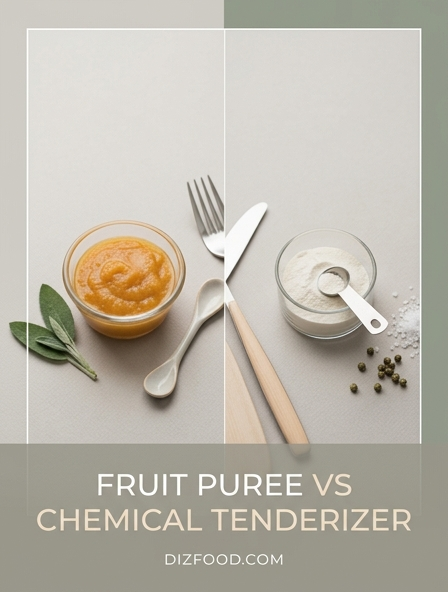
Natural Enzymes vs Synthetic Additives Meat Tenderization Compared
The culinary world is divided between two primary methods of softening tough muscle fibers: the use of natural fruit enzymes and the application of synthetic chemical additives. At the core of meat tenderization is the breakdown of collagen and myofibrillar proteins, which are responsible for the structural integrity and occasional toughness of beef, pork, and poultry. Natural tenderization relies on proteolytic enzymes found inherently in specific fruits. These enzymes act as biological catalysts, slicing through protein chains to create a more supple mouthfeel without relying on laboratory-engineered compounds.
In contrast, synthetic or commercial chemical tenderizers often utilize purified enzymes or salts to achieve similar results. While both methods aim to reduce the mechanical effort required to chew meat, their pathways differ significantly. Natural purees offer a holistic approach, often bringing moisture and complex sugars to the pan, whereas chemical additives are designed for precision and predictability. The choice between them often reflects a chef's philosophy regarding "clean label" cooking versus industrial efficiency.
- Natural Source: Derived from whole fruits like pineapple, papaya, and kiwi.
- Synthetic Source: Often contains MSG, refined salts, and isolated papain or fungal proteases.
- Reaction Style: Fruit enzymes are often more aggressive and time-sensitive.
- Additives: Chemical versions frequently include anti-caking agents and preservatives.
Understanding these differences is crucial for any home cook or professional chef looking to balance texture with ingredient transparency. While synthetic options provide a consistent baseline, natural enzymes offer a dynamic, albeit sometimes unpredictable, alternative that aligns with modern health-conscious trends.
The Science of Fruit Puree Bromelain and Papain
The efficacy of fruit-based tenderization is rooted in biochemistry, specifically the presence of proteolytic enzymes such as bromelain and papain. Bromelain is a complex mixture of sulfur-containing protein-digesting enzymes found in the fruit and stem of the pineapple. When applied to meat, bromelain works by hydrolyzing the connective tissues and the major muscle proteins. It is particularly effective at breaking down collagen, the primary culprit behind "chewy" steak. Because bromelain is highly active, it can transform a tough cut into a tender one within a very short window of time.
Papain, derived from the papaya fruit, functions similarly but exhibits different thermal stability. It is often extracted from the latex of the green, unripe papaya where the enzyme concentration is highest. Papain is unique because it remains active at higher temperatures than many other natural enzymes, continuing to tenderize the meat even during the initial stages of the cooking process. This makes it a staple in various tropical cuisines where tough, grass-fed meats are common.
Both enzymes operate by breaking the peptide bonds that hold protein molecules together. This process, known as proteolysis, essentially "pre-digests" the surface of the meat, making it easier for human teeth to separate the fibers. However, the science dictates that these enzymes are most active at specific pH levels and temperatures. If the environment is too acidic or too hot, the enzymes denature and lose their ability to tenderize, making the balance of a fruit puree marinade a delicate scientific endeavor.
How Chemical Tenderizers Affect Meat Texture and Health
Chemical tenderizers, typically found in the spice aisle as white powders, operate on a different physiological level than whole fruit purees. These products often combine a base of salt or dextrose with purified enzymes like fungal amylase or isolated papain. The primary goal of these chemicals is to provide a uniform texture across the entire surface of the meat. Because the enzymes are concentrated and purified, they lack the fiber and water content of fruit, allowing them to penetrate the microscopic crevices of the meat more rapidly. This often results in a "softened" texture that can feel more consistent than the somewhat irregular results of a fruit mash.
From a health perspective, the use of chemical tenderizers introduces several considerations. Many commercial powders contain high levels of sodium, which can be problematic for individuals monitoring their blood pressure. Additionally, some brands include Monosodium Glutamate (MSG) to enhance flavor alongside texture. While MSG is generally recognized as safe, some consumers prefer to avoid it due to personal sensitivities. Furthermore, chemical tenderizers may contain silicon dioxide or other anti-caking agents to prevent clumping in the jar, which adds non-food elements to the meal.
| Feature | Chemical Tenderizer | Impact on Meat |
|---|---|---|
| Sodium Content | Very High | Increased saltiness and water retention. |
| Consistency | Predictable | Uniform softness across the cut. |
| Processing | Highly Refined | May include preservatives and flow agents. |
| Texture | Soft/Spongy | Can lead to a loss of natural meat grain. |
The health trade-off is often one of convenience versus purity. While chemical agents offer a shelf-stable and quick solution, they lack the micronutrients and antioxidants found in fresh fruit marinades.
Flavor Profiles Fruit Infusion vs Neutral Chemical Bases
One of the most immediate differences between using fruit purees and chemical tenderizers is the impact on the final flavor profile of the dish. Fruit purees are never flavor-neutral; they bring a distinct palette of sugars, acids, and aromatics to the kitchen. For instance, a pineapple marinade introduces a tropical sweetness and a sharp acidity that pairs excellently with pork or chicken but might clash with a traditional beef roast. Kiwi provides a more subtle, slightly tart undertone that is often preferred by chefs who want the enzymatic benefits without a dominant fruit flavor. These natural infusions create a layered taste experience that can enhance the "umami" of the meat through the caramelization of natural fruit sugars during searing.
Conversely, chemical tenderizers are engineered to be as neutral as possible. Most are designed to disappear into the meat, providing texture without altering the base flavor of the protein. While some contain added "seasoned" profiles (like garlic or onion powder), the standard white tenderizer is essentially a functional additive. This neutrality is a significant advantage when the chef wants the natural flavor of a high-quality dry-aged steak to shine through without interference. However, the "neutrality" often comes with a metallic or overly salty aftertaste if the product is over-applied. Unlike fruit, which provides a fresh, bright finish, chemical bases can sometimes leave the meat tasting processed or "flat" if not balanced with fresh herbs and spices.
Comparing Proteolytic Enzymes in Kiwi Pineapple and Papaya
Not all fruit enzymes are created equal, and choosing the right fruit for tenderization requires an understanding of their specific proteolytic strengths. The three most common fruits used in the kitchen for this purpose are kiwi, pineapple, and papaya, each housing a unique enzyme: actinidin, bromelain, and papain, respectively. Actinidin, found in kiwi, is widely considered the most "gentle" of the trio. It breaks down proteins effectively but at a slower rate than its counterparts. This makes kiwi the ideal choice for thinner cuts of meat or delicate proteins like fish, as it is less likely to turn the meat into an unappealing mush.
Pineapple's bromelain is significantly more aggressive. It is highly effective at dissolving tough connective tissues, but it requires strict supervision. If left on the meat for too long, bromelain will completely digest the surface fibers, resulting in a mealy texture. Papaya's papain sits somewhere in the middle but is unique for its heat activation. While actinidin and bromelain do most of their work in the refrigerator during the marination phase, papain continues to work as the meat begins to heat up on the grill or in the oven.
- Kiwi (Actinidin): Best for subtle tenderization and maintaining meat structure.
- Pineapple (Bromelain): Best for very tough cuts and short marination times.
- Papaya (Papain): Best for high-temperature cooking and traditional tropical recipes.
Understanding these nuances allows a cook to match the enzyme to the specific cut of meat. A flank steak might require the power of pineapple, while a thick-cut pork chop might benefit more from the controlled action of a kiwi puree.
Pros and Cons of Commercial Powdered Meat Tenderizers
Commercial powdered tenderizers have been a kitchen staple for decades, primarily due to their extreme convenience and long shelf life. Unlike fresh fruit, which must be purchased, ripened, and pureed, a jar of tenderizer is always ready in the pantry. One of the primary advantages of these powders is their precision. Because the enzyme concentration is standardized, a cook can predict exactly how much tenderization will occur with a specific amount of powder. This eliminates the guesswork often associated with the varying ripeness levels of fresh fruit, where one pineapple might be more enzymatically active than another.
However, the drawbacks are significant for those focused on culinary excellence. The most notable "con" is the texture. Commercial powders can often lead to a "mushy" surface while the interior remains tough, as the dry powder lacks the liquid carrier needed to penetrate deep into the muscle. Furthermore, the high salt content acts as a curing agent, which can alter the color and moisture retention of the meat in ways that might not be desirable for a standard sear. From a labeling perspective, these products are often criticized for their "ultra-processed" nature. For those aiming for a farm-to-table aesthetic, a bottle of chemical white powder is often seen as a shortcut that sacrifices the integrity of the ingredients for the sake of speed.
Speed and Efficiency Fruit Marinades vs Chemical Solutions
When it comes to speed, chemical tenderizers generally win the race for surface-level softening. Because they are highly concentrated, they begin to break down protein structures almost immediately upon contact with moisture. This makes them the "emergency" solution for a cook who realizes at the last minute that their cut of meat is too tough. A simple dusting and a fifteen-minute rest are often enough to see results. However, this speed is often restricted to the exterior of the meat, as the powders do not naturally migrate into the center of thick cuts without the aid of a liquid brine.
Fruit marinades, while slower to start, are often more efficient at deep-tissue tenderization because they are applied as a liquid or semi-liquid puree. The water content in the fruit acts as a vehicle, allowing the enzymes to seep into the fibers over several hours. While a fruit marinade might require two to four hours to achieve the desired effect, the result is often a more thorough tenderization that extends beyond the surface. Furthermore, the sugars in the fruit can accelerate the Maillard reaction during cooking, providing a faster "char" or crust than many chemical alternatives. For the efficient kitchen, the "speed" of chemicals is a tactical advantage, while the "efficiency" of fruit marinades is a strategic one, providing better overall quality at the cost of time.
Avoiding Mushy Meat Timing Fruit Puree and Chemical Agents
The most common failure in meat tenderization is the dreaded "mushy" texture, a state where the protein fibers have been so thoroughly broken down that they lose all structural integrity. This occurs when enzymes are left to work for too long or in too high a concentration. With fruit purees, particularly pineapple and papaya, the window of perfection is narrow. Marinating a steak in fresh pineapple puree for more than four hours can result in a surface that feels like paste once cooked. To avoid this, chefs often recommend a "timed marination," usually ranging from thirty minutes to two hours depending on the acidity and enzyme strength of the fruit.
Chemical agents carry a similar risk but for different reasons. Because they are often salt-based, they can dehydrate the meat if left too long, even while the enzymes soften it, leading to a texture that is simultaneously dry and mushy. To prevent this, it is essential to rinse off excess chemical tenderizer or ensure the meat is cooked shortly after application. When using fruit, adding an oil to the puree can help slow down the enzymatic activity by coating the fibers, providing a larger window for error. Regardless of the method, the rule of thumb is: thinner cuts require less time, and stronger enzymes require more vigilance. Observing the color change in the meat can often provide a visual cue that the tenderization process has gone far enough.
The Health Benefits of Clean Label Natural Meat Softeners
In the modern era of "clean label" eating, the shift toward natural meat softeners is driven by both health and transparency. Using fruit purees as tenderizers allows the cook to eliminate artificial preservatives, anti-caking agents, and excessive sodium from their diet. This is particularly beneficial for individuals with dietary restrictions, such as those on low-sodium diets or people with sensitivities to MSG. Beyond what they lack, fruit purees offer what they *contain*: antioxidants, vitamins, and minerals. For example, a kiwi-based marinade provides Vitamin C and potassium, which, while minimal in the final cooked product, contribute to a more nutrient-dense preparation process.
Furthermore, natural enzymes like bromelain have been studied for their anti-inflammatory properties and digestive benefits. While the heat of cooking denatures many of these enzymes, the initial breakdown of meat proteins into smaller peptides makes the meat significantly easier for the human digestive system to process. This "pre-digestion" can reduce the feeling of heaviness or bloating often associated with consuming large amounts of red meat. Choosing a natural softener is not just a culinary preference; it is a holistic approach to cooking that prioritizes the body's ability to absorb nutrients without the interference of synthetic lab-created additives.
Ultimate Guide to Choosing Between Fruit and Chemical Tenderizers
Choosing the right tenderizing agent depends on three main factors: the cut of meat, the desired flavor profile, and the available time. If you are working with a high-end cut that merely needs a slight textural adjustment, a chemical tenderizer or a gentle kiwi puree is the best route. For incredibly tough, fibrous cuts like brisket or large flank steaks, the aggressive power of pineapple or papaya is often necessary to achieve a palatable result. If the dish is part of a cuisine that welcomes sweetness-such as Korean BBQ or Caribbean jerk-fruit purees are the superior choice as they contribute to the authentic flavor of the region.
For those in a rush, a commercial powder provides a level of speed that fresh fruit cannot match. However, for the health-conscious cook or the culinary purist, the extra effort of pureeing a piece of fruit is rewarded with a cleaner taste and a more natural ingredient list. It is also worth considering the "mush factor"; if you cannot monitor the meat closely, avoid the high-power fruit enzymes and stick to a mild chemical salt or a very short fruit soak. Ultimately, the best tool is the one that aligns with your specific goals for the meal, whether that be industrial-level consistency or artisanal, flavor-forward tenderness.
- Use Fruit When: You want added flavor, have 2+ hours, and prefer organic ingredients.
- Use Chemicals When: You are in a hurry, want a neutral flavor, or are cooking for a large crowd where consistency is key.
- Hybrid Approach: Use a small amount of fruit juice in a standard brine for a balance of both worlds.



Comments