
Ever wondered why your home stir-fry often lacks that restaurant-quality "breath of the wok"? When choosing between wok frying and skillet frying, the secret to achieving that ultimate high-heat texture lies in how each vessel manages thermal energy and moisture evaporation. While a heavy-bottomed skillet is the master of the Maillard reaction-creating a uniform, golden-brown crust on proteins through consistent contact-the wok is designed for "wok hei," a complex smoky aroma achieved through rapid tossing and high-velocity steam release. Whether you are chasing the perfect sear on a ribeye or the vibrant, tender-crisp snap of flash-cooked vegetables, understanding the mechanical differences in heat distribution will elevate your cooking from a simple meal to a professional-grade culinary experience.
| Feature | Wok Frying | Skillet Frying |
|---|---|---|
| Heat Profile | Concentrated bottom-heat with cooler sloping walls. | Uniform, consistent heat across a flat surface. |
| Texture Result | "Tender-crisp" with localized char and smokiness. | Deep, even browning and thick caramelized crusts. |
| Moisture Control | High-speed evaporation via wide, flared rim. | Potential for "steaming" if pan is overcrowded. |
| Oil Efficiency | Requires less oil; pool forms at the base. | Requires more oil to coat the entire flat surface. |
| Thermal Mass | Low; reacts instantly to flame adjustments. | High; retains heat longer for heavy searing. |
| Best Used For | Flash-cooking, tossing, and mixed textures. | Searing steaks, deglazing, and shallow frying. |
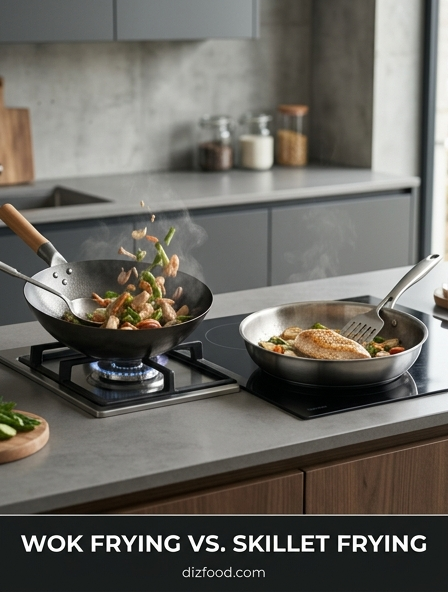
Wok vs Skillet Comparing Design and Function
The architectural differences between a wok and a skillet dictate the physics of how heat interacts with food. A traditional wok features a deep, concave bowl shape with high, sloping walls that merge into a small, concentrated base. This design is engineered for movement, allowing a cook to toss ingredients vigorously without them spilling over the edges. Because the surface area is predominantly curved, the wok creates a dynamic environment where food can be moved rapidly between a high-heat "hot zone" at the bottom and cooler zones along the sides. This geometry is essential for the rapid evaporation of moisture, ensuring that vegetables remain crisp rather than becoming soggy in their own juices.
In contrast, a skillet or frying pan is defined by its broad, flat bottom and relatively low sides, which may be flared or straight. This design maximizes the contact area between the cooking surface and the heat source, whether it be gas, electric, or induction. The flat base provides stability and a uniform cooking plane, which is necessary for tasks that require stillness, such as searing a steak or browning a fillet of fish. While a wok is built for agitation and aeration, the skillet is built for precision and surface-to-protein contact. Understanding these foundational differences is the first step in mastering the unique culinary outputs each vessel provides in the modern kitchen.
Understanding Heat Distribution and Thermal Mass
Thermal mass and heat distribution are the primary variables that distinguish the performance of woks and skillets. A skillet, particularly one made of cast iron or heavy-gauge stainless steel, is designed to have high thermal mass. This means it can absorb and retain a significant amount of heat energy. When a cold piece of meat is placed in a preheated skillet, the surface temperature does not drop drastically, allowing for a consistent and intense sear. The heat is distributed evenly across the wide, flat base, ensuring that every inch of the food in contact with the metal cooks at roughly the same rate.
| Feature | Wok Performance | Skillet Performance |
|---|---|---|
| Heat Retention | Low; cools and heats rapidly. | High; maintains steady temperature. |
| Temperature Gradient | High; hot bottom, cooler sides. | Low; uniform heat across the base. |
| Response Time | Excellent for quick adjustments. | Slower to react to flame changes. |
Woks, specifically those made of thin carbon steel, operate on the principle of thermal responsiveness rather than retention. The base becomes intensely hot almost instantly, but the temperature drops off rapidly as you move up the sides. This temperature gradient is a deliberate feature, allowing the chef to push ingredients up the walls to stop the cooking process temporarily while other items sear at the bottom. This responsiveness makes the wok an agile tool, capable of reacting to the slightest adjustment of the burner, which is vital for the fast-paced nature of stir-frying.
Why High Heat and Sloping Sides Matter
The sloping sides of a wok are not merely for aesthetics; they serve a critical functional role in managing steam and heat. In a shallow skillet, steam can easily become trapped underneath the food, leading to a "steaming" effect rather than a "frying" effect if the pan is overcrowded. The wide, flared opening of a wok allows for the immediate escape of moisture. As ingredients are tossed through the air, they undergo a process of rapid cooling and evaporation, which concentrates flavors and prevents the vegetables from losing their structural integrity. This verticality creates a three-dimensional cooking space where heat is managed through motion.
Furthermore, the high heat concentrated at the base of the wok facilitates the Maillard reaction at an accelerated pace. Because the surface area of the "hot zone" is small, the cook must constantly move the food to prevent burning. This constant motion, enabled by the curved sides, ensures that every piece of food is briefly exposed to extreme heat before being tossed back into the cooler air or moved to the periphery. This cycle is what produces the distinct textures found in professional stir-fries. Without the sloping sides, the "wok toss" technique would be impossible, and the unique interaction between the flame, the oil, and the aerated food particles would be lost.
The Skillet Advantage Flat Surface Searing and Even Browning
The skillet's primary advantage lies in its ability to provide a consistent, flat interface for heat transfer. When the goal is to achieve an even, golden-brown crust on a specific surface-such as the skin of a chicken breast or the face of a scallop-the skillet is the superior tool. Because the entire base of the pan is in direct contact with the heating element, there are no "cold spots" to contend with. This allows for the development of a deep fond, which is the caramelized residue left in the pan that serves as the flavorful base for pan sauces and gravies.
- Maximum Contact: Ideal for large proteins that require long-term contact to render fat.
- Uniformity: Essential for pancakes, omelets, and crepes where a flat shape is required.
- Deglazing: The flat surface makes it easier to scrape up browned bits with a spatula.
- Oven Compatibility: Skillets are generally more stable and fit better on oven racks for finishing dishes.
The skillet also excels in shallow frying where a consistent depth of oil is required across a wide area. In a wok, oil pools in the center, making it difficult to fry something flat like a breaded cutlet without using an excessive amount of oil. The skillet allows for a thin, even layer of fat that coats the entire bottom, ensuring that the edges of the food are cooked at the same speed as the center. For Western-style techniques like pan-roasting or braising, the skillet remains the indispensable workhorse of the kitchen.
Oil Consumption Differences in Woks and Skillets
The geometry of the cooking vessel significantly impacts how much oil is required and how that oil interacts with the food. In a wok, the conical shape causes oil to naturally gravitate toward the bottom center. This creates a small, deep pool of fat even with a relatively low volume of oil. This "pooling" effect is highly efficient for quick-searing aromatics like ginger, garlic, and scallions. As ingredients are tossed, they are momentarily submerged in this concentrated hot oil and then moved up the dry sides, which allows excess oil to drain back down to the center. This results in a dish that feels less greasy despite the high-heat frying process.
In a skillet, the same amount of oil is spread across a much larger surface area. This results in a very thin film of oil that can be absorbed more quickly by the food if the temperature isn't managed correctly. For tasks like pan-frying, a skillet requires enough oil to cover the entire flat base to ensure even heat transfer. If you were to try and shallow-fry a large piece of protein in a wok, you would need significantly more oil to reach the same depth as you would in a skillet, because the wok's volume expands so rapidly as you move upward. Therefore, the wok is more oil-efficient for small, chopped ingredients, while the skillet is more efficient for large, flat items.
Achieving Authentic Smoky Flavors and Wok Hei
One of the most elusive qualities in pan-cooking is "Wok Hei," translated as the "breath of the wok." This unique, smoky charred flavor is a hallmark of professional Chinese stir-frying and is almost exclusively achievable in a carbon steel wok over a high-output flame. Wok Hei is the result of a complex interaction between the caramelization of sugars, the smoking of oil, and the partial combustion of oil droplets that occur when food is tossed through the superheated air above the pan. The high, curved walls of the wok are essential for this, as they facilitate the "toss" that introduces oxygen into the mixture, causing the oil to atomize and catch fire momentarily.
Achieving this in a skillet is virtually impossible due to the vessel's design. A skillet's low sides do not allow for the same degree of aeration, and the flat bottom is designed to keep food in contact with the metal rather than in the air. While you can achieve a "char" in a skillet by letting food sit undisturbed, it lacks the complex, vaporized smokiness of Wok Hei. The skillet provides the flavor of the Maillard reaction-savory and toasted-but it cannot replicate the atmospheric combustion that gives wok-cooked food its signature "restaurant" taste. For those seeking authentic smoky notes in rapid-cook dishes, the wok's design is the only way to facilitate the necessary chemical reactions.
Stir Frying vs Sauteing Techniques Explained
While often used interchangeably in casual conversation, stir-frying and sautéing are distinct techniques that rely on different mechanical actions. Sautéing, derived from the French word for "jump," involves cooking food in a small amount of fat over medium-high heat. The goal is to brown the food while keeping it relatively still, with only occasional tossing or stirring to ensure evenness. Because a skillet has a flat bottom, the food stays in one layer, allowing for precise control over the browning process. Sautéing is often the precursor to adding liquid for a sauce, a process that benefits from the skillet's wide evaporation surface.
- Stir-Frying: Constant, high-speed motion; ingredients are added in stages based on cook time.
- Sautéing: Moderate motion; focuses on even browning and often involves "fond" development.
- Temperature: Stir-frying uses maximum heat; sautéing uses controlled medium-high heat.
- Equipment: Stir-frying requires a wok; sautéing is best suited for a skillet or sauté pan.
Stir-frying is a more aggressive and faster process. It requires the cook to constantly move the ingredients to prevent the intense heat of the wok's base from burning them. The technique involves a rhythmic "push and pull" motion of the wok itself, combined with a spatula that lifts and flips the food. This keeps the ingredients in a state of semi-suspension, where they are cooked by a combination of conductive heat from the metal, convective heat from the steam, and radiant heat from the flame. The result is food that is cooked incredibly quickly, preserving color, nutrients, and crunch.
Carbon Steel Woks vs Stainless Steel Skillets
The materials most commonly associated with these pans-carbon steel for woks and stainless steel for skillets-offer vastly different cooking experiences. Carbon steel is the gold standard for woks because it is lightweight, highly conductive, and capable of developing a natural non-stick patina known as "seasoning." Its ability to heat up and cool down rapidly is what allows the cook to manage the temperature gradients necessary for stir-frying. However, carbon steel requires maintenance, including regular seasoning and hand-washing to prevent rust. It is a reactive metal, meaning it is not ideal for simmering acidic foods like tomato sauce for long periods.
Stainless steel skillets, often featuring an aluminum or copper core, are designed for durability and evenness. Unlike carbon steel, stainless steel is non-reactive, making it the perfect vessel for deglazing with wine or cooking acidic ingredients. While it does not naturally become non-stick like a seasoned wok, it is prized for its ability to "grip" food initially, which helps in creating a superior crust or "fond." Stainless steel is also much heavier, which provides the stability needed for searing large roasts but makes the vigorous tossing motions of stir-frying difficult. Choosing between them often comes down to whether you value the "living" surface of carbon steel or the predictable, low-maintenance nature of stainless steel.
Best Dishes for Wok Frying and Skillet Frying
Selecting the right tool for the specific dish is essential for achieving the intended texture and flavor profile. Some recipes are intrinsically linked to the physics of the pan they were designed for. For instance, dishes that require high-speed evaporation and varied textures flourish in a wok. Conversely, dishes that require steady heat and a flat surface for uniform browning are best kept in a skillet. Understanding these strengths allows a cook to optimize their workflow and final results.
- Wok Frying:
- Fried Rice (for separated, toasted grains)
- Kung Pao Chicken (for seared meat and crisp peppers)
- Pad Thai (for rapid sauce reduction and noodle texture)
- Flash-fried leafy greens with garlic
- Skillet Frying:
- Ribeye Steak (for a thick, even crust)
- Pan-seared Salmon (for crispy skin)
- Potato Hash (for maximum flat-surface browning)
- Frittatas and Omelets (for shape and ease of release)
Attempting to cook a large steak in a wok often results in an uneven sear because the meat cannot lay flat against the heat source. Similarly, making fried rice in a shallow skillet often leads to a gummy mess, as the steam cannot escape quickly enough and the rice cannot be tossed effectively. By matching the dish to the vessel, you utilize the tool's inherent design to solve the specific culinary challenges of the recipe.
Choosing the Right Pan for Your Cooking Style
Ultimately, the choice between a wok and a skillet depends on your primary cooking style and the limitations of your kitchen equipment. If your diet consists largely of quick, vegetable-heavy meals, stir-fries, and grains, a carbon steel wok is an invaluable investment. However, woks perform best on gas ranges where the flames can lick up the sides of the bowl. For those with electric or induction stovetops, a flat-bottomed wok is necessary, though it still may not reach the extreme temperatures required for true Wok Hei. In these environments, the wok's advantages are slightly diminished, though the shape remains useful for tossing.
If your cooking style leans toward Western techniques, such as searing proteins, making pan sauces, or frying eggs, a high-quality skillet is the more versatile choice. A skillet's flat base is perfectly compatible with every type of stove, including glass-top induction ranges. Many home cooks find that a 12-inch stainless steel skillet is the most used item in their kitchen due to its multi-functional nature. However, for a truly complete kitchen, having both a wok and a skillet is ideal. This allows you to choose the vessel based on the specific "physics" required for a dish-using the wok for speed and aeration, and the skillet for stability and surface contact.

Comments