
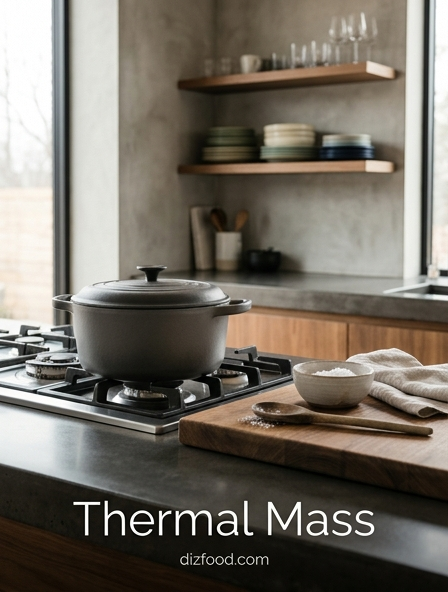
Defining Thermal Mass in the Kitchen
In culinary science, thermal mass refers to the ability of a material to absorb, store, and subsequently release heat energy. It is essentially the "heat battery" of a kitchen tool. When you use a heavy vessel, such as a Dutch oven or a pizza stone, you are utilizing a high thermal mass object that can hold a significant amount of energy before its temperature changes. This concept is fundamental to understanding how different cooking surfaces interact with food, especially when cold ingredients are introduced to a hot surface.
Several factors contribute to the total thermal mass of a kitchen implement:
- Density: Denser materials can store more energy in a smaller volume.
- Specific Heat Capacity: The amount of heat required to raise the temperature of one gram of a substance by one degree Celsius.
- Total Weight: A thicker, heavier pan will always have more thermal mass than a thin pan made of the same material.
By mastering thermal mass, cooks can ensure that their equipment provides a steady, unrelenting source of heat that resists the cooling effects of moisture and raw proteins.
Heat Retention Versus Thermal Conductivity
It is crucial to distinguish between heat retention, which is driven by thermal mass, and thermal conductivity, which describes how quickly heat moves through a material. A material like copper has high conductivity, meaning it heats up and cools down almost instantly. In contrast, cast iron has lower conductivity but exceptional heat retention. While copper is excellent for delicate sauces requiring precise control, cast iron is preferred for tasks where a massive reservoir of energy is needed.
| Material | Conductivity | Thermal Mass |
|---|---|---|
| Copper | Very High | Low |
| Aluminum | High | Moderate |
| Cast Iron | Low | High |
| Ceramic | Very Low | Very High |
The ideal piece of cookware often balances these two properties. For instance, high-end multi-clad pans use aluminum cores for even distribution (conductivity) and stainless steel exteriors for durability and heat storage. Understanding this balance allows a chef to choose the right tool based on whether they need responsiveness or stability during the cooking process.
Best Cookware Materials for Searing
The goal of searing is to create a profound crust through intense heat application. This requires a pan that won't drop in temperature the moment a cold steak touches it. Materials with high thermal mass are the gold standard for this application because they provide a "heat buffer" that maintains surface temperatures even as moisture evaporates from the food. Without sufficient thermal mass, the pan's temperature would plummet, causing the meat to steam in its own juices rather than sear.
Common materials favored for their high thermal mass include:
- Cast Iron: The quintessential choice for searing due to its incredible density and weight.
- Carbon Steel: Lighter than cast iron but still offers excellent retention once fully heated.
- Thick-Gauge Stainless Steel: Provides a durable surface with enough mass to hold energy for consistent browning.
Using these materials ensures that the energy stored in the metal is transferred directly and forcefully into the food, leading to the rapid dehydration of the surface necessary for a perfect crust.
The Importance of Preheating Heavy Pans
A heavy pan with high thermal mass is only effective if it is properly preheated. Because these materials store so much energy, they also take longer to reach the desired cooking temperature. If a cook adds food to a cast iron skillet that hasn't been fully saturated with heat, the pan will lack the energy reserves to cook efficiently. This results in uneven cooking and sticking, as the proteins bond to the metal before a sear can form.
- Gradual Heating: Start on medium heat to allow the energy to spread evenly through the dense material.
- Energy Saturation: Wait until the entire vessel, including the sides, radiates heat.
- The Water Test: A drop of water should bead and dance across the surface (the Leidenfrost effect), indicating the "heat battery" is full.
Proper preheating transforms the pan into a stable cooking environment. Once the thermal mass is "charged," it becomes far more forgiving, allowing for multiple batches of food to be cooked with minimal waiting time between them.
Minimizing Temperature Drops During Frying
Thermal mass is a critical factor in deep frying, where maintaining a constant oil temperature is the difference between crispy food and greasy food. When cold ingredients are submerged in hot oil, the oil's temperature naturally drops. If the pot has high thermal mass, it acts as a secondary heat reservoir that helps the oil recover its temperature quickly. Conversely, a thin, lightweight pot will lose heat rapidly and struggle to return to the target temperature.
To optimize frying stability, consider these factors:
- Vessel Choice: Use a heavy Dutch oven made of enameled cast iron to hold heat.
- Oil Volume: A larger volume of oil has more thermal mass than a small amount, making it more resistant to temperature swings.
- Batch Size: Small batches ensure that the thermal mass of the system is not overwhelmed by the cold mass of the food.
By leveraging the thermal mass of both the cooking vessel and the oil, you ensure that the exterior of the food dehydrates and crisps instantly, preventing excess oil absorption.
Why Material Thickness Matters for Crust
Thickness is a direct contributor to the total thermal mass of a pan. A thin sheet of metal has very little "depth" to store energy; it relies entirely on the burner's flame for heat. If the flame is uneven, the cooking surface will be uneven. A thick-bottomed pan, however, creates a uniform heat zone. The thickness allows heat to spread laterally through the material before it reaches the food, which is essential for creating an even, edge-to-edge crust on items like scallops or grilled cheese.
In baking, thickness is equally vital. A heavy-gauge baking sheet or a thick pizza stone provides a massive burst of initial heat to the bottom of the dough. This is known as "oven spring." The high thermal mass of a thick stone transfers energy much faster than the hot air of the oven can, causing gases in the dough to expand rapidly. This results in a superior crust and a light, airy internal crumb that thin pans simply cannot replicate.
How Thermal Mass Enhances Maillard Reaction
The Maillard reaction is the chemical process between amino acids and reducing sugars that gives browned food its distinctive flavor. This reaction typically accelerates at temperatures between 285°F and 330°F. If a pan lacks sufficient thermal mass, the introduction of food-which often contains significant water-will drop the surface temperature below this critical threshold. The energy is instead spent on evaporating surface moisture rather than browning the proteins.
High thermal mass ensures that the temperature remains in the Maillard zone by providing a continuous flow of energy. Even as moisture is released and turned into steam, the heavy pan has enough stored heat to keep the interface between the food and the metal hot. This allows for:
- Development of complex savory flavors.
- Deep, rich golden-brown coloration.
- The creation of "fond," the caramelized bits left in the pan that form the base for sauces.
Without the stability provided by thermal mass, food often turns grey and boiled rather than brown and roasted.
Recovery Time and Temperature Stability
Recovery time is the duration it takes for a cooking surface to return to its original temperature after food has been added. In a professional kitchen, minimizing recovery time is essential for efficiency and consistency. Cookware with high thermal mass has a much shorter recovery time because it has a deep reservoir of energy to draw upon. While the surface temperature might dip slightly, the heat stored within the core of the metal quickly migrates to the surface to restore equilibrium.
Temperature stability is the other side of this coin. It refers to the pan's ability to maintain a set temperature despite fluctuations in the heat source or the addition of ingredients. This is particularly beneficial for:
- Braising: Keeping a low, steady simmer over hours.
- Stir-frying: Maintaining high heat even when tossing vegetables.
- Candy Making: Ensuring sugar syrups reach precise stages without scorching.
Tools like heavy copper-core pans or thick cast iron skillets provide the thermal inertia needed to smooth out these fluctuations, leading to predictable and professional results.
Optimizing Heat Storage for Thick Cuts
Cooking thick cuts of meat, such as a two-inch ribeye or a pork loin, presents a unique challenge: the exterior must be seared without overcooking the interior, or conversely, the interior must reach the target temperature without the exterior burning. Thermal mass plays a vital role here by providing a "slow-release" of heat. When using a heavy pan, the heat is not just coming from the bottom burner; the pan itself becomes a radiant heat source that envelops the bottom of the meat.
To optimize results for thick cuts, many chefs utilize the following strategy:
- Sear: Use the high thermal mass to create an initial crust.
- Transfer: Move the heavy pan into the oven.
- Radiant Soak: The pan's thermal mass continues to cook the meat gently and evenly from the bottom up, while the oven air cooks from the top down.
This combination ensures that the heat penetrates the center of the thick cut efficiently. Because the pan stays hot for so long, it prevents the meat from cooling down during the transition from stovetop to oven.
Achieving Consistent Results with Thermal Mass
Consistency is the hallmark of a great cook, and thermal mass is one of the most reliable ways to achieve it. Inconsistent heat is the primary cause of kitchen failures, such as burnt edges with raw centers. By using materials that store heat effectively, you remove the "jitter" of the stove's heating element. Whether you are using an electric coil that cycles on and off or an uneven gas flame, a high thermal mass pan acts as a low-pass filter, delivering a smooth, constant stream of energy to your food.
This reliability allows for better timing and repeatable recipes. When your equipment behaves the same way every time you use it, you can accurately predict how long a sear will take or when a roast will be finished. Investing in high-quality, heavy-bottomed cookware is essentially an investment in thermal stability. By understanding and respecting the physics of thermal mass, you can elevate your cooking from a series of guesses to a controlled, scientific process that yields perfect results every time.

Comments