
When it comes to achieving precision temperature accuracy, the debate between an infrared thermometer and a probe thermometer usually boils down to whether you need to measure the surface or the core. Infrared thermometers are the speed demons of the kitchen and workshop, offering instant, non-contact readings of surface temperatures-perfect for checking pizza stones or cooling engines without getting your hands dirty. However, if you are aiming for food safety or deep-tissue accuracy in a thick roast, the probe thermometer is your essential companion, providing a direct, internal reading that laser technology simply can't reach. Choosing the right tool depends entirely on your application: use infrared for rapid environmental scans and safety, but rely on a probe for the definitive internal data required for culinary perfection and scientific consistency.
| Feature | Infrared Thermometer | Probe Thermometer |
|---|---|---|
| Measurement Type | Surface / Non-contact | Internal / Immersion |
| Response Time | Instant (<1 second) | 2 to 10 seconds |
| Best Used For | Griddles, HVAC, moving parts | Meat, liquids, internal fryers |
| Accuracy Focus | High for surface emissivity | Superior for core temperature |
| Hygiene | Zero risk of contamination | Requires cleaning after use |
| Limitation | Cannot read through glass/water | Requires physical insertion |
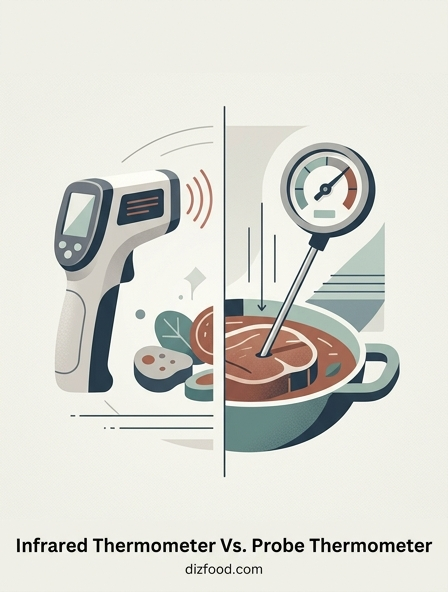
Infrared vs Probe Thermometer Key Differences
Understanding the fundamental distinctions between infrared and probe thermometers is essential for any professional chef or home cook. The primary difference lies in the method of heat detection. Infrared thermometers are non-contact devices that utilize optics and sensors to measure the thermal radiation emitted from a surface. This allows for instantaneous readings from a distance, which is ideal for scanning multiple items quickly. In contrast, probe thermometers require physical contact, typically involving a metal stem or needle that must be inserted directly into the food or liquid to register heat through conduction.
These two tools serve distinct roles within the kitchen workflow. While an infrared device excels at identifying "hot spots" on a grill or checking the temperature of a pizza stone, it cannot penetrate the surface of a roast or a thick steak. The probe thermometer is designed specifically for this internal monitoring. Furthermore, the technology behind them dictates their environmental limitations. Infrared units can be affected by external factors like steam, smoke, or the reflectivity of the material being measured, whereas probe thermometers are largely immune to atmospheric conditions once the sensor is submerged or inserted.
- Detection Method: Infrared uses light/radiation; Probe uses physical conduction.
- Contact Requirement: Infrared is non-contact; Probe requires insertion or surface touch.
- Read Speed: Infrared is near-instant; Probes take between 1 to 10 seconds depending on the sensor type.
- Primary Use: Infrared is for equipment and surfaces; Probe is for internal food safety and doneness.
Surface Temperature vs Internal Core Heat
In culinary science, the temperature of the exterior of a food item rarely matches the temperature of its center. This thermal gradient is why choosing the right thermometer is critical for safety and quality. Infrared thermometers measure the "skin" of the object. When you point a laser at a loaf of bread or a chicken breast, the device captures the energy of the outermost molecules. This is incredibly useful for ensuring a pan is hot enough to sear meat or that a refrigerator's cooling coils are functioning. However, the surface temperature can be misleadingly high or low compared to the core heat.
Internal core heat refers to the temperature at the geometric center of the food, which is the slowest part to cook. A probe thermometer is the only reliable way to measure this. For instance, a steak may have a surface temperature of 400°F from the cast iron skillet, but the internal core might still be a dangerous 100°F. Relying solely on surface readings can lead to undercooked proteins or unevenly baked goods. Conversely, using a probe to check a pizza stone is inefficient and potentially damaging to the probe if the heat exceeds its rating. Effective kitchen management requires recognizing that surface readings are for process control, while internal readings are for consumption safety.
| Feature | Surface Measurement (IR) | Internal Measurement (Probe) |
|---|---|---|
| Ideal For | Griddles, pizza stones, oil surfaces | Meat, poultry, bread, casseroles |
| Risk Factor | False sense of safety for thick items | Cross-contamination if not cleaned |
| Depth | Top 0.1mm of surface | Adjustable to center of mass |
Accuracy Comparison for Cooking and Industry
Accuracy requirements vary significantly between casual home cooking and industrial food production. Probe thermometers are generally considered the gold standard for high-precision accuracy in the food industry. High-quality thermocouples can provide readings accurate to within ±0.7°F. This precision is vital when pasteurizing eggs or making delicate confections where a single degree determines success or failure. Because the probe is physically surrounded by the medium it is measuring, it provides a stable and direct reading of the thermal energy present in the food.
Infrared thermometers, while technologically advanced, are prone to specific types of error that can compromise accuracy. The most significant factor is "emissivity," which refers to how effectively a surface emits thermal energy. Most kitchen IR thermometers are calibrated for an emissivity of 0.95, which covers many organic materials but fails on shiny stainless steel or aluminum. This can cause the thermometer to under-read the actual temperature by dozens of degrees. In industrial settings, IR thermometers are often used for "screening"-quickly identifying pallets of food that are clearly out of the safe temperature range-while probes are used for "verification" to confirm the exact temperature of the products inside the packaging.
In a commercial kitchen, the probe is the legally recognized tool for health inspections and HACCP (Hazard Analysis and Critical Control Points) logs. While an IR thermometer is faster, it lacks the legal standing of a calibrated probe because it cannot prove that the bacteria-killing temperatures were reached in the thickest part of the food. For industrial fryers or large-scale ovens, digital probes connected to constant monitoring systems provide a level of data integrity that handheld non-contact devices simply cannot match.
Pros and Cons of Non Contact Thermometers
Non-contact infrared thermometers have revolutionized the speed of kitchen operations. One of the greatest advantages is hygiene. Since the device never touches the food, there is zero risk of cross-contamination. This eliminates the need for constant sanitizing between readings, saving time during busy service hours. They are also incredibly safe for the user, allowing for the measurement of extremely hot surfaces, such as wood-fired pizza ovens or boiling sugar, from a comfortable distance. The speed is another "pro"; they provide readings in less than half a second, making them perfect for checking the temperature of incoming deliveries on a loading dock.
However, the "cons" are significant and often misunderstood by amateur cooks. The inability to see through glass, steam, or transparent liquids is a major limitation. If you try to measure the temperature of water in a pot, the IR thermometer might actually be reading the steam rising off the water or the reflection of the ceiling. Furthermore, the laser is only a guide; the actual sensor is measuring a wider circle than the red dot indicates, which can lead to inaccurate readings if the user is too far away. The most dangerous con remains the "surface-only" limitation, which can lead to foodborne illness if users assume the outside temperature reflects the internal doneness of the meat.
- Pro: Instantaneous results for high-volume scanning.
- Pro: No physical contact prevents bacterial transfer.
- Con: Highly sensitive to emissivity and surface reflections.
- Con: Environmental interference from smoke, steam, and dust.
- Con: Cannot measure internal temperatures of solids.
When to Use a Digital Probe Thermometer
A digital probe thermometer is an indispensable tool for tasks where precision and food safety are the top priorities. The most common use case is for roasting large cuts of meat, such as whole turkeys, prime ribs, or pork shoulders. In these scenarios, the exterior of the meat will reach a safe temperature hours before the center does. A probe thermometer allows the cook to monitor the slow climb of the internal temperature, ensuring the meat is pulled from the heat at the exact moment it reaches the desired doneness, such as 135°F for medium-rare beef.
Beyond meat, probes are essential in the world of pastry and baking. When making caramels, toffees, or tempered chocolate, the temperature of the liquid must be exact. An infrared thermometer would only measure the surface, which is cooled by the air, whereas a probe measures the body of the syrup. Similarly, for yeast-based breads, the internal temperature is the only definitive way to know if the crumb has set. A probe is also the tool of choice for deep-frying if the fryer does not have a built-in thermostat; the probe must be submerged in the oil to provide a continuous reading of the liquid's temperature as cold food is added, which causes the heat to fluctuate.
- Roasting Poultry: Ensuring the thickest part of the thigh reaches 165°F.
- Baking Bread: Checking for a core temperature of 190°F to 210°F depending on the dough type.
- Candy Making: Monitoring stages like "soft ball" or "hard crack" in sugar syrups.
- Sous Vide: Verifying the water bath temperature and the internal bag temperature.
- Reheating: Ensuring leftovers reach a safe 165°F throughout.
Speed and Precision Comparison Guide
When comparing speed, the infrared thermometer is the undisputed champion. These devices utilize a thermopile sensor that converts infrared radiation into an electrical signal almost instantly. In a fast-paced commercial environment, being able to scan twenty refrigerator units in sixty seconds is a feat only possible with non-contact technology. This "point-and-shoot" capability is vital for logistical efficiency. However, speed does not always equate to precision. While the reading appears instantly, it is an average of the area seen by the lens, which can be influenced by the ambient temperature of the room or the temperature of the thermometer's own housing.
Digital probe thermometers offer a different balance of speed and precision based on their internal sensor type. Thermistor-based probes are common in home kitchens; they are highly accurate but can take 5 to 10 seconds to stabilize. For professional precision and speed, thermocouple probes are used. These can provide a reading in 2 to 3 seconds with extreme accuracy. While slower than infrared, the precision of a thermocouple is more "true" because it is measuring the kinetic energy of the food's molecules directly. In culinary applications, the 2-second wait for a thermocouple is usually acceptable because the precision it provides is necessary for the safety and quality of the final dish.
In summary, the choice between speed and precision often depends on the "cost of error." If the cost of error is low-such as checking if a pan is roughly hot enough for sautéing-the speed of infrared is the winner. If the cost of error is high-such as serving undercooked chicken or overcooking an expensive wagyu steak-the precision of a probe is worth the extra seconds of measurement time.
Food Safety Standards for Temperature Monitoring
Food safety regulations, such as those established by the FDA and USDA, are very specific about how temperatures should be recorded. For "Time/Temperature Control for Safety" (TCS) foods, the primary requirement is the internal temperature. This is because pathogens like Salmonella and E. coli can survive on the surface if the interior does not reach the required lethal temperature. Consequently, a probe thermometer is the only tool that can officially satisfy the requirements of a food safety audit during the cooking process. Standard safety thresholds, such as 165°F for poultry and 145°F for fish, are strictly internal metrics.
Infrared thermometers do have a place in food safety protocols, particularly during the receiving and storage phases. When a delivery truck arrives at a restaurant, the receiver can use an infrared thermometer to quickly scan the surface of milk cartons or produce crates. If the surface is above 41°F, it serves as a "red flag" to perform a more invasive check with a probe thermometer. This two-step process protects the integrity of the food by not breaking the packaging unless a problem is suspected. However, for the purposes of "logging" for health departments, the probe reading is the data point that must be recorded in the HACCP book.
| Food Category | Required Internal Temp | Verification Tool |
|---|---|---|
| Poultry | 165°F (74°C) | Probe (Internal) |
| Ground Meats | 160°F (71°C) | Probe (Internal) |
| Refrigerated Storage | 41°F (5°C) or below | IR (Scanning) / Probe (Validation) |
| Hot Holding | 135°F (57°C) or above | Probe (Internal) |
Limitations of Infrared Laser Technology
The most common misconception about infrared thermometers is that the laser "measures" the heat. In reality, the laser is simply a visual guide to help the user aim the sensor. The actual measurement is performed by a lens that gathers infrared energy. This leads to a limitation known as the "Distance-to-Spot" ratio (D:S). If a thermometer has a 12:1 ratio, it means that at 12 inches away, the device is measuring a circle with a 1-inch diameter. If you stand too far back, you may inadvertently measure the temperature of the food and the surrounding grill grates simultaneously, resulting in an inaccurate average.
Another significant hurdle is atmospheric interference. In a busy kitchen, steam, smoke, and even high humidity can scatter the infrared radiation before it reaches the sensor lens. This typically results in a reading that is lower than the actual surface temperature. Furthermore, the "Emissivity" issue cannot be overstated. Highly reflective surfaces, like a polished stainless steel stockpot, have low emissivity. This means they do not emit much infrared energy and instead reflect the energy of the objects around them. Trying to measure the temperature of a shiny pan with an IR thermometer will often give a reading that reflects the temperature of the ceiling or the person holding the thermometer rather than the pan itself.
Lastly, infrared technology cannot measure the temperature of transparent materials effectively. If you aim an IR thermometer at a bowl of clear water or a sheet of glass, the sensor will likely measure the temperature of the bottom of the bowl or whatever is behind the glass. This makes it unsuitable for monitoring the progress of clarifying butter, simmering stocks, or checking the temperature of items inside a closed glass-front oven.
How to Choose the Right Digital Thermometer
Choosing the right thermometer depends on your specific kitchen needs and the volume of food you prepare. For most home cooks, a high-quality "Instant-Read" digital probe thermometer is the first priority. Look for a model with a thin tip (often called a reduced-tip probe), which allows for faster heat transfer and leaves smaller holes in the meat, preserving juices. Water resistance (IP65 or higher rating) is also a valuable feature, as it allows for easy cleaning under the tap and protects the electronics from steam and accidental splashes.
If you frequently bake pizza, grill on cast iron, or manage a commercial kitchen, adding an infrared thermometer to your toolkit is highly beneficial. When selecting an IR thermometer, check the temperature range to ensure it can handle the high heat of a grill (often up to 1000°F). Additionally, consider a model with "Adjustable Emissivity" if you plan to measure shiny metal surfaces. For those who want the best of both worlds, "Hybrid" thermometers exist, which feature a non-contact infrared sensor on one end and a folding probe on the other. This dual-functionality is particularly popular with food safety inspectors and sous-chefs.
- Check the Accuracy Rating: Look for ±1.0°F or better for probes.
- Response Time: Professionals should aim for under 3 seconds.
- Display: A backlit, rotating display is helpful for reading at awkward angles.
- Durability: Ensure the housing can withstand drops on hard kitchen floors.
- Calibration: Choose a device that allows for manual calibration to maintain accuracy over time.
Maintaining Accuracy in Temperature Readings
All thermometers, regardless of their technology, can drift out of calibration over time due to mechanical shock, extreme temperature changes, or battery depletion. Maintaining accuracy is vital for food safety. For probe thermometers, the "Ice Bath Method" is the standard for calibration. By filling a glass with crushed ice and just enough water to fill the gaps, you create a stable 32°F environment. Inserting the probe into this mixture (without touching the sides of the glass) should result in a 32.0°F reading. If it does not, most professional probes have a "Cal" button to reset the baseline.
Maintaining an infrared thermometer is more about physical care. The lens is the most sensitive part of the device; even a small amount of grease or a fingerprint can distort the infrared energy reaching the sensor. The lens should be cleaned regularly with a soft cloth or a cotton swab dipped in medical alcohol. Unlike probes, infrared thermometers are difficult for the user to calibrate manually. Instead, they should be checked against a "reference" surface of known temperature. If an IR thermometer consistently provides incorrect readings compared to a calibrated probe on a matte black surface, it may need to be returned to the manufacturer for service.
Battery health also plays a surprising role in accuracy. As batteries die, the voltage drop can cause the digital processing unit to provide erratic or "frozen" readings. Always replace batteries at the first sign of a fading display. Finally, always allow your thermometer to reach "room temperature" before using it. If a thermometer is stored in a cold walk-in freezer and then immediately used in a hot kitchen, the internal components may experience thermal shock, leading to temporary inaccuracies in the digital output.

Comments