
Whether you are plunging golden fritters into bubbling oil or blanching vibrant spring vegetables, choosing between a spider skimmer and a slotted spoon can significantly impact your food's final texture. A spider skimmer features a wide, wire-mesh basket inspired by a spider's web, allowing liquid to pass through almost instantly, which prevents oily buildup and stops the cooking process immediately. On the other hand, the classic slotted spoon utilizes a solid base with drilled holes or slots; while it offers more precision for small tasks like scooping peas or poached eggs, it often retains a thin film of liquid due to higher surface tension. For high-heat frying and large-batch boiling, the spider's superior drainage speed and heat-resistant long handle make it the ultimate tool for achieving that professional-grade crunch without the grease.
| Feature | Spider Skimmer | Slotted Spoon |
|---|---|---|
| Construction | Open-weave wire mesh basket. | Solid metal/plastic with perforations. |
| Drainage Speed | Instant; minimal surface tension. | Moderate; can trap oil/water in the bowl. |
| Best Application | Deep frying, pasta, blanching. | Poaching, browning meat, small items. |
| Heat Tolerance | Very High (typically all stainless steel). | Variable (Silicone/Nylon versions melt). |
| Fragility Care | Large surface prevents food breakage. | Narrow bowl can crush delicate items. |
| Maintenance | Harder to clean (bits stick in wire). | Easy (smooth surface wipes clean). |
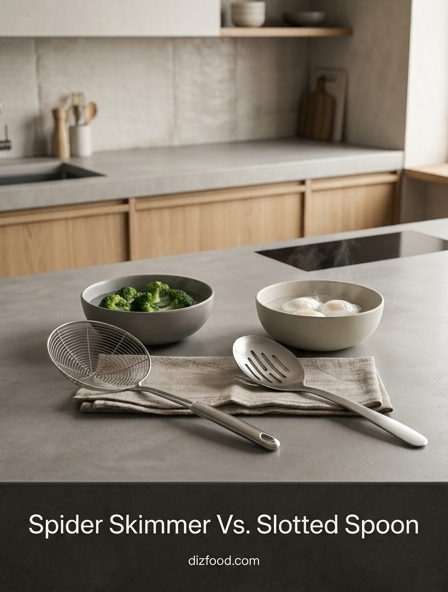
Spider Skimmer vs Slotted Spoon Main Differences
The primary distinction between a spider skimmer and a slotted spoon lies in their structural design and intended fluid dynamics. A spider skimmer features a wide, shallow wire-mesh basket that resembles a spider's web, typically attached to a long handle made of wood, bamboo, or stainless steel. Its open-weave construction allows for instantaneous drainage of liquids, making it a specialized tool for high-volume retrieval. In contrast, a slotted spoon is designed with a solid, slightly cupped head containing specific perforations, slots, or holes. This design retains a small amount of liquid while supporting the food item, offering more control during stirring and serving.
Functionally, the spider skimmer is built for speed and safety in high-heat environments. Because the wire mesh offers minimal resistance, it can be plunged into boiling oil or water without causing significant displacement or splashing. The slotted spoon, while capable of lifting items, often creates more turbulence in the liquid due to its more solid surface area. Furthermore, the handle length differs significantly; spiders often feature extra-long handles to keep the cook's hands far away from splattering grease, whereas slotted spoons are usually sized for standard stovetop pots and serving bowls. These tools serve complementary roles, with the spider acting as a heavy-duty retrieval device and the slotted spoon functioning as an all-purpose stirring and portioning utility.
Key Design Features of the Spider Skimmer
The spider skimmer is an iconic tool in Asian cuisine that has become a global kitchen essential due to its unique engineering. The most prominent feature is the hand-woven or machine-pressed wire basket. This basket is intentionally shallow and broad, providing a large surface area that can scoop up multiple items-such as several dumplings or a large nest of noodles-in a single motion. The wide gaps between the wires ensure that oil or water falls away immediately, preventing the food from becoming soggy or overcooked by residual heat.
Another defining characteristic is the handle construction. Traditional spider skimmers utilize bamboo handles because bamboo is a natural insulator that remains cool to the touch even when the basket is submerged in hot oil. Modern versions often use hollow stainless steel or heat-resistant plastics. The angle at which the handle meets the basket is also critical; it is typically set at a slight upward tilt, allowing the user to reach deep into a wok or stockpot while keeping their wrist in a neutral, ergonomic position. This geometry is specifically optimized for "fishing" items out of deep vessels. Because the basket is usually made of thin gauge wire, the tool is surprisingly lightweight, reducing hand fatigue during long cooking sessions involving batch frying or blanching vegetables.
When to Use a Classic Slotted Spoon
While the spider skimmer excels at bulk retrieval, the classic slotted spoon is the superior choice for precision and versatility in everyday cooking tasks. Its cupped shape allows the cook to cradle individual items, such as a single soft-boiled egg or a specific piece of meat in a stew, with greater stability. Because the surface is more solid than a wire mesh, it is also useful for stirring thick sauces or gravies where you want to incorporate ingredients without catching them in a web. The slotted spoon is the go-to tool for removing small aromatics, such as peppercorns, bay leaves, or garlic cloves, from a braising liquid where a spider might let them slip through the gaps.
In addition to cooking, the slotted spoon transitions perfectly to the dining table. Its polished appearance and refined design make it suitable for serving side dishes like peas, corn, or roasted potatoes directly from a serving bowl. It allows just enough flavorful juice or melted butter to pass through while delivering a clean portion to the plate. Furthermore, the slotted spoon is often more compatible with smaller cookware. In a 2-quart saucepan, a large spider skimmer would be cumbersome and oversized, whereas a standard slotted spoon fits easily within the narrow diameter to lift out blanched almonds or small pasta shapes. For home cooks who prioritize multi-functional tools that handle both preparation and presentation, the slotted spoon is an indispensable asset.
Best Tool for Deep Frying and Boiling
When it comes to deep frying, the spider skimmer is the undisputed champion. The safety of the cook is the primary concern when dealing with oil heated to 375 degrees Fahrenheit. The spider's long handle provides the necessary distance to avoid oil pops, and its wire-thin profile prevents "bridging," a phenomenon where a tool carries a film of oil that can drip onto a burner. Because the drainage is nearly instantaneous, fried foods like tempura, calamari, or donuts spend less time sitting in a pool of grease, resulting in a crispier texture and a less oily mouthfeel.
For boiling large quantities of pasta or vegetables, the spider skimmer acts as a handheld colander. Rather than lifting a heavy, steam-filled pot of boiling water to the sink, a cook can use the spider to transfer the food directly into a waiting sauce or an ice bath. However, the slotted spoon remains useful for boiling tasks involving smaller, delicate items. For example, when poaching an egg, a slotted spoon is essential for gently guiding the whites around the yolk and lifting the fragile result out of the simmering water without tearing the membrane. While the spider is built for volume and speed in deep vessels, the slotted spoon provides the delicate touch required for low-simmering techniques. Ultimately, for the heavy lifting of frying and blanching, the spider is the most efficient choice.
Material Comparison Stainless Steel vs Silicone
The performance of these kitchen tools is heavily influenced by the materials used in their construction. Stainless steel is the industry standard for both spider skimmers and slotted spoons due to its high heat tolerance and durability. However, the rise of non-stick cookware has made silicone alternatives increasingly popular. Each material offers distinct advantages and limitations depending on the cooking environment.
| Feature | Stainless Steel | Silicone |
|---|---|---|
| Heat Resistance | Extremely high; ideal for deep frying. | High, but can melt at extreme temperatures. |
| Cookware Safety | Can scratch non-stick and ceramic surfaces. | Safe for all surfaces, including non-stick. |
| Durability | Will last a lifetime; rust-resistant. | May tear or degrade over several years. |
| Cleaning | Dishwasher safe; may require scrubbing. | Naturally non-stick; very easy to wipe clean. |
For spider skimmers, stainless steel is almost always preferred because the thin wires must maintain their rigidity under the weight of food. Silicone spider skimmers exist but often have thicker "wires" to maintain structural integrity, which can actually impede drainage. For slotted spoons, silicone is an excellent choice for daily use in non-stick skillets, preventing damage to the coating while providing enough flexibility to scrape the bottom of the pan.
Drainage Efficiency and Liquid Retention
Drainage efficiency is perhaps the most significant functional difference between these two tools. A spider skimmer is designed for maximum liquid bypass. The ratio of open space to solid material in a wire basket is extremely high, often exceeding 90%. This means that as soon as the tool is lifted, the liquid is gone. This is vital when moving food from a boiling pot to a hot sauté pan, as excess water can cause the oil to splatter violently or turn a sear into a steam. The spider ensures that only the food is moved, preserving the temperature and chemistry of the next cooking stage.
The slotted spoon, by design, retains a small amount of liquid within its bowl and around its perforations. While this might seem like a disadvantage, it is often intentional. When serving a dish like beans or a hearty stew, a small amount of the cooking liquid helps keep the food moist and flavorful on the plate. The size of the slots or holes determines the rate of drainage; some spoons have large elongated slots for fast pouring, while others have tiny pinholes meant for skimming foam or scum off the top of a stock. If the goal is to "skim" fats or impurities, the slotted spoon's tighter design is more effective than the wide-open mesh of a spider, which would allow the fine particles to pass right through.
Handling Delicate Foods Without Damage
Handling delicate foods requires a tool that distributes pressure evenly and prevents tearing. The spider skimmer is exceptionally gentle because its wide basket supports the food from multiple points across a broad surface area. When lifting fragile items like silken tofu, oversized ravioli, or fish fillets, the spider acts like a supportive cradle. Because it is so thin, it can slide underneath food with minimal disturbance, much like a spatula. This is particularly helpful for delicate fried items that have a soft, wet batter that hasn't fully set yet.
However, the slotted spoon offers a different kind of protection. Its smooth, continuous surface (interrupted only by slots) is less likely to "snag" on certain textures. A wire spider can occasionally trap small edges of dough or thin noodles in its mesh, leading to minor tearing when the food is released. A high-quality, polished slotted spoon provides a slick surface that allows delicate foods to slide off effortlessly. For something like a poached egg or a fragile fruit compote, the solid support of a spoon head provides a sense of security that a wire basket cannot. The choice between the two often comes down to the size of the item: the larger and more buoyant the food, the more it benefits from the spider's wide cradle; the smaller and more precarious the item, the more it benefits from the spoon's solid backing.
Pros and Cons of the Spider Skimmer
The spider skimmer is a specialized tool that excels in specific scenarios but may not be the right fit for every kitchen task. Understanding its strengths and weaknesses can help a cook decide when to reach for it and when to leave it in the drawer. Its primary advantage is its efficiency in high-volume environments, but its specialized design brings certain logistical challenges.
- Pro: Superior Drainage - The open wire design allows for the fastest liquid removal of any handheld kitchen tool.
- Pro: Safety - Long handles keep the user's hands away from heat, steam, and hot oil splatters.
- Pro: Lightweight - Even large models are easy to maneuver with one hand.
- Con: Storage Bulk - The large, rounded basket takes up significant space in kitchen drawers or utensil crocks.
- Con: Cleaning Difficulty - Small bits of food, such as egg ribbons or pasta starch, can get trapped in the wire intersections, requiring a brush to clean thoroughly.
- Con: Not for Small Items - Tiny ingredients like peas or minced aromatics will fall through the mesh gaps.
Ultimately, the spider is a power tool for the kitchen. While it may be overkill for a simple soup, it is the only tool that can safely and effectively manage a large batch of homemade french fries or a family-sized portion of tortellini. Its drawbacks are mostly related to maintenance and storage rather than performance.
Versatility of the Slotted Spoon in Everyday Cooking
The slotted spoon is a workhorse that finds its way into almost every meal preparation. Unlike the spider, which is often reserved for specific techniques like frying or blanching, the slotted spoon is useful from the first step of sautéing to the final step of plating. Its versatility stems from its hybrid nature; it is part stirrer, part strainer, and part server. You can use it to stir a thick bolognese, ensuring the meat breaks up properly, and then use the same tool to serve the sauce while leaving excess fat in the pan.
Beyond the stovetop, the slotted spoon is essential for food preservation and prep. It is the ideal tool for lifting olives, pickles, or marinated artichokes out of jars, allowing the brine to drain back into the container. It is also perfect for "shocking" small batches of vegetables; its compact size allows for quick movements in and out of small bowls. Because slotted spoons come in a wide variety of materials-including nylon, wood, and silicone-they can be matched to any type of cookware. This adaptability makes it a more frequent "first-reach" tool for the average home cook. While it may not have the specialized flair of the spider, its ability to perform multiple roles with ease ensures its status as a foundational piece of culinary equipment.
Choosing the Right Essential for Your Kitchen
Deciding between a spider skimmer and a slotted spoon-or deciding to own both-depends largely on your personal cooking style and the types of dishes you prepare most frequently. If your culinary repertoire includes a lot of deep-frying, stir-frying, or making fresh pasta from scratch, a spider skimmer is an essential investment. Its ability to handle high heat and large volumes will make your cooking process safer and your food quality better. It is a tool that transforms a difficult task into a simple one by providing the right scale and drainage for the job.
On the other hand, if your cooking consists mostly of stews, sautés, and simple boiled vegetables, a high-quality slotted spoon may be all you need. It offers a level of precision and "table-readiness" that the spider lacks. For those with limited storage space, the slotted spoon is the more practical choice due to its slim profile. However, many enthusiasts find that these tools are not mutually exclusive. Having a stainless steel spider for heavy lifting and a silicone slotted spoon for delicate non-stick work covers all possible bases. When choosing, look for a tool with a comfortable weight, a sturdy connection between the head and the handle, and a material that matches your existing pots and pans. Investing in both ensures that whether you are poaching a single egg or frying a dozen spring rolls, you have the perfect instrument for the task.

Comments