
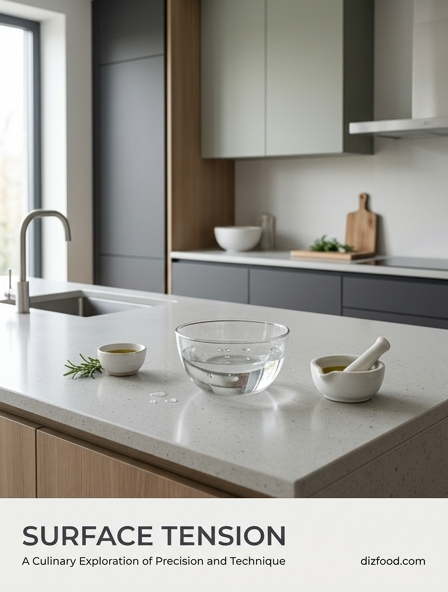
Molecular Physics of Frying Oil
In the culinary environment, the behavior of frying oil is dictated by the complex molecular physics of triglycerides. At the molecular level, oil consists of long-chain fatty acids that exert cohesive forces upon one another. These intermolecular attractions, primarily Van der Waals forces, create a "skin" at the liquid-air interface, known as surface tension. When oil is heated, the kinetic energy of these molecules increases, leading to a decrease in the strength of these cohesive bonds. This physical transition is crucial for cooking as it determines how oil interacts with the cellular structure of food.
- Cohesive Forces: The internal attraction between oil molecules that resists external separation.
- Surface Energy: The work required to increase the surface area of the liquid interface.
- Molecular Orientation: The way fatty acid chains align at the boundary of a kitchen tool.
- Thermal Expansion: The increase in volume that weakens the liquid's internal tension.
Understanding these physics allows chefs to predict how oil will behave when submerged or poured. As the oil temperature rises, the surface tension drops, allowing the liquid to flow more freely into the microscopic crevices of the food, ensuring even heat distribution and the desired Maillard reaction.
Surface Tension and Liquid Clinging
Liquid clinging, or the tendency of oils and sauces to adhere to kitchen surfaces, is a direct result of the competition between cohesive and adhesive forces. Cohesion holds the liquid together, while adhesion attracts the liquid to the surface of a tool, such as a stainless steel spatula or a glass bowl. When the adhesive force between the oil and the tool is stronger than the oil's internal surface tension, a thin film remains on the tool even after it is removed from the heat. This phenomenon is often observed when lifting fried foods, where the oil "bridges" the gap between the food and the utensil.
- Initial Contact: The liquid makes contact and spreads based on the surface energy of the tool.
- Film Formation: A stable layer of liquid adheres to the material through molecular attraction.
- Retraction Resistance: Surface tension attempts to pull the liquid back, but adhesion maintains the cling.
- Droplet Stabilization: Small beads of oil form on the edges where tension is highest.
The degree of clinging is influenced by the "wettability" of the kitchen tool. Materials with high surface energy attract liquids more aggressively, making drainage more difficult and requiring mechanical intervention to break the liquid bond.
Impact of Tool Material Textures
The microscopic texture of kitchen tools plays a definitive role in how surface tension manifests during food preparation. Smooth, non-porous surfaces like polished stainless steel allow for a uniform distribution of liquid films, which can actually increase the surface area available for oil to cling to. In contrast, textured or matte surfaces introduce air pockets between the liquid and the tool, effectively reducing the contact area and allowing surface tension to pull the liquid into discrete droplets rather than a continuous sheet.
| Material Type | Surface Profile | Drainage Efficiency |
|---|---|---|
| Polished Steel | Highly Smooth | Low - High Adhesion |
| Cast Iron | Micro-Porous | Moderate - Oil Retention |
| Silicone | Low Energy | High - Beading Effect |
| Etched Metal | Engineered Roughness | Superior - Rapid Runoff |
By selecting tools with specific topographic profiles, cooks can manipulate the Marangoni effect and capillary action. A textured surface disrupts the laminar flow of oil, encouraging it to break away from the tool and return to the pan, resulting in less greasy final products.
Temperature Influence on Oil Drainage
Temperature is perhaps the most significant variable affecting the surface tension of lipids in the kitchen. As the temperature of oil increases, the intermolecular bonds weaken, causing a sharp decline in viscosity and surface tension. This relationship is vital for efficient drainage; hot oil flows like water, whereas cooling oil becomes thick and stubborn. If food is removed from a fryer and allowed to cool while still in contact with a pool of oil, the increasing surface tension will cause the oil to "lock" onto the food's surface.
- High Heat (180°C+): Minimal surface tension allows for rapid gravitational drainage.
- Intermediate Cooling: Tension increases, causing the oil to coat the food more thickly.
- Room Temperature: Maximum clinging occurs as the oil nears a semi-solid state.
To optimize drainage, tools and food should be handled while the oil is at its peak temperature. Utilizing pre-heated slotted spoons can prevent the localized cooling of oil, which would otherwise trigger an immediate increase in surface tension and cause the oil to seize onto the metal surface, hindering the cleaning and serving process.
Geometry of Slotted Spoon Efficiency
The design of a slotted spoon or a "spider" strainer is an exercise in managing surface tension through geometry. The size, shape, and frequency of the holes determine how effectively the liquid can break its own surface tension to pass through the tool. If the holes are too small, the surface tension of the oil creates a "membrane" across the opening, preventing drainage through capillary bridging. Larger apertures or wire mesh designs reduce this effect by increasing the perimeter-to-area ratio of the openings.
- Perimeter Impact: Larger perimeters break the liquid film more easily.
- Void Ratio: A higher percentage of open space reduces the surface area for adhesion.
- Edge Sharpness: Sharper edges help shear the liquid film, encouraging separation.
Efficient kitchen tools utilize a geometry that maximizes the gravitational pull on the liquid while minimizing the surface area that supports a meniscus. A spherical wire mesh is often superior to a flat punched metal plate because the rounded wires provide less flat surface for the oil to adhere to, allowing gravity to overcome the cohesive forces of the liquid more effectively.
Hydrophobic versus Lipophobic Surfaces
In modern kitchenware, coatings are often engineered to interact specifically with water or oils. Hydrophobic surfaces repel water, causing it to bead up and roll off due to high surface tension within the droplet and low adhesion to the surface. However, many hydrophobic materials, like traditional plastics, are actually lipophilic (oil-attracting). This means that while water bounces off, oil spreads out and clings tightly. The advancement of lipophobic coatings has changed this dynamic, creating surfaces that resist both water and oil.
- Hydrophobic: High contact angle for water; prevents steaming and sogginess.
- Lipophobic: High contact angle for fats; ensures oil slides off tools effortlessly.
- Omniphobic: Repels all liquid types, maintaining the cleanest tool surfaces.
When a tool is lipophobic, the surface tension of the oil remains the dominant force, causing the oil to pull into spherical shapes that cannot maintain a grip on the material. This technology is increasingly found in high-end bakeware and frying equipment to reduce the need for excess fats and to simplify the post-cooking cleaning process by preventing the formation of stubborn oil films.
Viscosity and Meniscus Formation
Viscosity and surface tension work in tandem to create the meniscus, the curve seen at the edge of a liquid where it meets a container or tool. In the kitchen, a "clinging meniscus" occurs whenever a spoon is dipped into a thick sauce or oil. The viscosity resists the flow, while the surface tension shapes the curve. This is particularly problematic in narrow slots or small holes, where the meniscus can become so strong that it supports the entire weight of the liquid remaining in the tool, a phenomenon known as capillary action.
| Liquid Type | Viscosity Level | Meniscus Strength |
|---|---|---|
| Water | Low | Moderate - Fast Breaking |
| Vegetable Oil | Medium | High - Persistent Cling |
| Honey/Syrup | Very High | Extreme - Mechanical Bond |
To combat meniscus formation, the kitchen tool must be designed to disrupt the contact angle. A wider vessel or a tool with tapered edges reduces the ability of the liquid to "climb" the walls. By understanding the relationship between the thickness of the liquid and its surface energy, manufacturers can create utensils that minimize the amount of ingredient wasted by sticking to the sides.
Optimizing Tool Design for Airflow
Effective drainage in the kitchen is not just about liquid physics; it is also about the displacement of air. When oil tries to drain through a slotted spoon, air must move upward to take its place. If the tool design restricts this airflow, a partial vacuum can form, effectively "holding" the oil in place despite the pull of gravity and the presence of surface tension. This is why many professional kitchen tools feature ventilated handles or specific hole patterns that facilitate a dual-directional flow of air and liquid.
- Venting: Allowing air to bypass the liquid film to equalize pressure.
- Turbulence Induction: Small design features that prevent a perfect seal of oil.
- Pressure Balancing: Ensuring the atmosphere can push the oil through the holes.
By optimizing for airflow, the surface tension barrier is more easily overcome. When air can freely circulate around the droplets, the oil is encouraged to detach from the substrate. This principle is applied in high-speed industrial fryers and is equally relevant in the design of home colanders and steam baskets where rapid liquid separation is required.
Breaking the Surface Tension Barrier
Breaking the surface tension barrier is often a mechanical process in the kitchen. When a liquid film refuses to drain due to strong cohesive forces, physical agitation is required. Shaking a frying basket or tapping a spoon against the side of a pan provides the kinetic energy necessary to overcome the surface energy of the oil. This mechanical "shock" elongates the oil droplets until they reach a breaking point, allowing gravity to finally pull them away from the tool's surface.
- Vertical Agitation: Using gravity to stretch the liquid film until it snaps.
- Lateral Tapping: Shifting the contact angle to encourage droplet merging.
- Vibrational Drainage: Micro-vibrations that prevent a stable meniscus from forming.
Beyond mechanical force, the introduction of surfactants can also break the barrier. Natural surfactants found in certain ingredients, like lecithin in egg yolks, can lower the surface tension of oils, making them "wetter" and more prone to spreading or draining. In professional settings, understanding when to use physical force versus chemical properties is key to managing oil retention on fried foods and kitchen equipment.
Maintaining Clean Tools for Better Drainage
The cleanliness of a kitchen tool significantly impacts its interaction with surface tension. Over time, oils can undergo polymerization, creating a sticky, resinous coating on stainless steel and silicone. This "seasoning" or "gunk" dramatically increases the surface energy of the tool, causing fresh oil to cling with much higher affinity than it would to a clean, smooth surface. A dirty tool effectively "grabs" the oil, making drainage nearly impossible and resulting in greasy food.
- Degreasing: Removing polymerized oils to restore the original surface energy.
- Polishing: Eliminating micro-scratches where oil can "anchor" via surface tension.
- Inspection: Checking for carbon buildup that creates high-friction zones.
To ensure optimal performance, tools used for frying or straining should be stripped of all residual lipids. Using high-alkaline cleaners or abrasive pads removes the organic layers that facilitate oil clinging. Once the base material is exposed, the tool returns to its engineered state, allowing surface tension to work in favor of the cook by encouraging the oil to bead and drop away rather than spreading and sticking.

Comments