
Navigating a formal table setting doesn't have to be intimidating once you understand the functional design behind your flatware. In the classic matchup of the salad fork vs. dinner fork, the primary differences lie in their size, tine structure, and strategic placement to guide you through a multi-course meal. While the salad fork is crafted with a shorter handle and a reinforced edge to tackle crisp greens and appetizers, the dinner fork is the heavy hitter of the ensemble, boasting a larger frame designed for the main entree. By following the "outside-in" rule of etiquette, you'll find that these utensils are perfectly synchronized with the rhythm of your dinner, ensuring you always have the right tool in hand for every bite from the starter to the final course.
| Feature | Salad Fork | Dinner Fork |
|---|---|---|
| Average Length | Approx. 6 inches | Approx. 7-8 inches |
| Tine Design | Short, wide, often notched | Long, slender, uniform |
| Table Position | Far left (outermost) | Immediate left of the plate |
| Primary Use | Salads, fruits, and appetizers | Main course meats and starches |
| Leverage | High (for cutting leaves/veg) | Low (designed for piercing) |
| Usage Order | First (used before the main) | Second (the primary utensil) |
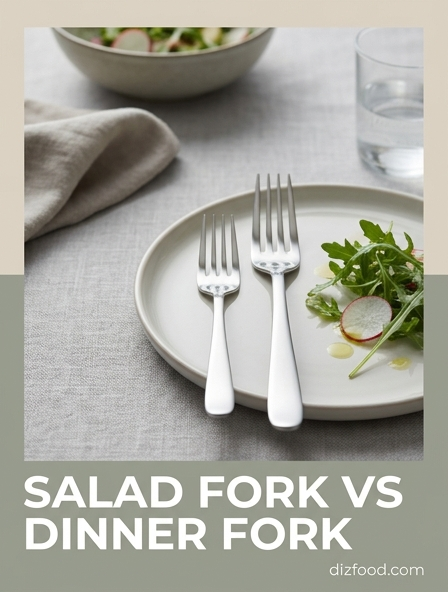
Size and Tine Length Differences
The most immediate distinction between a salad fork and a dinner fork lies in their physical dimensions. A standard dinner fork typically measures between 7 and 8 inches in length, designed to provide a substantial grip and leverage for various main course textures. In contrast, the salad fork is noticeably shorter, usually measuring approximately 6 inches. This reduced scale makes it more nimble for handling smaller, lighter components found in a typical green salad.
The tines, or the prongs of the fork, also exhibit significant differences in length and proportion. Because the dinner fork is intended for the heavy lifting of proteins and complex sides, its tines are longer and spaced to accommodate larger bites. The salad fork features shorter tines, which provide more control when maneuvering through leafy greens or delicate vegetables. Below is a comparison of typical dimensions found in standard stainless steel flatware sets:
| Feature | Dinner Fork | Salad Fork |
|---|---|---|
| Overall Length | 7.5 - 8.25 inches | 6 - 6.5 inches |
| Tine Length | Approximately 2 inches | Approximately 1.25 - 1.5 inches |
| Weight | Heavier / Balanced for grip | Lighter / Agile in hand |
When held side-by-side, the dinner fork looks like the "standard" size for an adult hand, while the salad fork appears as a scaled-down version. This size differential is not merely aesthetic; it is a functional requirement that ensures the user does not feel overwhelmed by the tool when consuming lighter fare, nor under-equipped when tackling a thick steak or a dense starch.
Proper Table Placement Etiquette
Table etiquette follows a logical progression based on the order in which food is served. In a standard multi-course meal setting, the general rule is to work from the "outside-in." This means the utensils located furthest from the plate are intended for the earliest courses. Because salad is traditionally served before the main course in American dining, the salad fork is usually placed to the far left of the dinner fork.
However, the placement shifts depending on regional customs or specific menu structures. If the salad is served after the entrée, which is common in many European traditions, the salad fork will be placed closer to the plate than the dinner fork. To ensure a professional and inviting table setting, follow these specific placement steps:
- Place the dinner plate in the center of the setting as the primary anchor point.
- Locate the dinner fork directly to the left of the plate, leaving about an inch of space.
- Place the salad fork to the left of the dinner fork if the salad arrives first.
- Ensure the bottom handles of both forks are aligned perfectly with the bottom rim of the dinner plate.
- Maintain equal spacing between each utensil to prevent a cluttered appearance.
It is important to remember that the forks should always be placed on the left side of the plate. The only exception to the left-side rule in formal dining is the oyster fork, which is placed on the right. By adhering to these placement standards, a host ensures that guests can navigate the meal intuitively without having to ask which utensil belongs to which course.
Visual Identification Guide
Identifying the difference between these two forks goes beyond measuring their length with a ruler. Manufacturers often incorporate specific design cues to help diners distinguish them at a glance. The most iconic visual marker of a salad fork is the reinforced or "notched" left tine. This specific tine is often slightly wider than the others and may feature a small groove or cutout near the tip, which originally served a structural purpose for cutting through tough lettuce stems.
In modern flatware designs, the differences may be more subtle, focusing on the silhouette and the curve of the tines. The dinner fork typically maintains a sleek, symmetrical profile with four uniform tines that curve upward in a gentle arc. The salad fork, while also usually possessing four tines, often has a flatter "head" or a more pronounced flare at the base of the tines. This broader base allows the user to push small morsels onto the fork more effectively.
- The Handle: The dinner fork features a longer, often thicker handle to balance the weight of the larger head.
- The Tine Width: Look at the leftmost tine; if it is wider than the others, it is almost certainly a salad fork.
- Proportionality: The salad fork looks "squat" compared to the elongated, elegant appearance of the dinner fork.
Even in contemporary or minimalist flatware sets where the notch might be absent, the ratio of the handle to the head remains a reliable indicator. The salad fork's head occupies a larger percentage of its total length compared to the dinner fork, which favors a long, tapering handle for a more formal aesthetic.
Functional Purpose of Each Fork
While it may seem that any fork can pierce a leaf of lettuce, the specific engineering behind each utensil enhances the dining experience. The salad fork is designed for "cutting and gathering." In the era before pre-cut bagged salads, diners often had to use the edge of their fork to break down large pieces of iceberg or romaine. The extra-wide outer tine provides the necessary strength to snap through a stem without the need for a knife, which is considered improper for salad consumption.
The dinner fork is the "workhorse" of the kitchen. Its primary function is to pierce, hold, and lift heavy or dense foods. Whether it is a piece of roasted chicken, a slice of lasagna, or a portion of steak, the dinner fork requires long, sharp tines to penetrate deeply and securely. Its length also provides the necessary leverage to handle side dishes like mashed potatoes or peas, which may require a "scooping" motion using the back of the fork in certain formal styles.
Consider the following functional scenarios:
- Salad Fork: Ideal for cherry tomatoes, cucumber slices, and leafy greens where precision is required to avoid "sprung" vegetables flying off the plate.
- Dinner Fork: Essential for meats and starches that require a firm grip to stabilize the food while a knife is used.
- Hybrid Use: Using a dinner fork for salad often results in awkwardness, as the long tines can make it difficult to navigate the smaller bowl or plate usually reserved for appetizers.
By using the correct tool, the diner maintains better control over their food, leading to a cleaner and more efficient eating process. This functional separation also prevents the transfer of heavy sauces from the main course back into the lighter, often acidic dressings of the salad.
Anatomy of the Salad Fork
The anatomy of a salad fork is specialized to deal with the unique challenges of raw vegetables and leafy greens. It consists of four main parts: the handle, the neck (or bridge), the back, and the tines. The most distinctive anatomical feature is the "cutting tine." On high-quality or traditional salad forks, the tine on the far left is significantly broader than its three counterparts. This widening provides a rigid edge that acts as a blunt blade for shearing through vegetable fibers.
Another subtle anatomical detail is the "well" or the curve of the fork's head. Salad forks tend to have a flatter profile than dinner forks. This flatness makes it easier to slide the fork under small, loose ingredients like corn, peas, or crumbled cheese that might be part of a complex salad composition. The neck of the salad fork is also typically reinforced to prevent bending when pressure is applied to the side of the fork during the cutting motion.
Key anatomical characteristics include:
- Shortened Shank: The distance between the handle and the tines is reduced for better fingertip control.
- Notched Tine: A small indentation on the side of the leftmost tine, historically used to help "catch" and cut leaves.
- Broad Points: The tips of the tines are often slightly blunter than those of a dinner fork to prevent scratching delicate salad plates.
Understanding these anatomical nuances helps one appreciate that the salad fork is not just a "small fork," but a tool specifically modified for a particular culinary task. This design has remained largely unchanged for over a century, proving its efficiency in the traditional dining sequence.
The Dinner Fork Design Explained
The dinner fork is the centerpiece of any flatware collection, designed with a focus on ergonomics and versatility. Its design is characterized by an elongated frame and four long, tapering tines. These tines are engineered with sharp, pointed tips to ensure they can easily pierce through the crust of a roast or the skin of a baked potato. The spacing between the tines is carefully calculated to allow juices to drain while retaining enough surface area to hold various food textures.
Ergonomically, the dinner fork features a "heavier" balance point. This weight is usually concentrated where the handle meets the neck, allowing the fork to sit comfortably in the palm of the hand. This is crucial for the main course, which typically takes the longest to consume and requires the most physical interaction with the food. A well-designed dinner fork feels like an extension of the hand, providing stability when the user is cutting meat with a knife in the opposite hand.
The design also considers the "scoop" factor. Because the dinner fork is often used for side dishes like rice or mashed vegetables, the tines have a pronounced upward curve. This creates a shallow cradle that can hold semi-solid foods securely. Unlike the salad fork, which may have one specialized tine, the dinner fork is perfectly symmetrical. This symmetry ensures that the pressure is distributed evenly across all four points, preventing the fork from twisting when it is inserted into a dense piece of protein.
Formal vs Informal Dining Rules
In the realm of dining, the number of forks on the table serves as an immediate indicator of the meal's formality. In an informal or "casual" setting, such as a family dinner or a quick bistro meal, a single fork is often used for all courses. This "all-purpose" fork is almost always the size of a dinner fork. In these settings, the emphasis is on utility and minimizing cleanup rather than adhering to rigid culinary transitions.
Formal dining, however, operates on a strict set of rules where every course is accompanied by its own specific tool. The presence of both a salad fork and a dinner fork is a hallmark of a multi-course service. In a truly formal setting, the table might also include a fish fork, a dessert fork, and even an oyster fork. The rule of thumb for guests is to never reuse a fork from a previous course; once a course is finished, the fork is removed by the server along with the plate.
Differences in service style also dictate fork usage:
- American Style: The diner switches the fork from the left hand to the right hand after cutting meat. The salad fork is used first if the salad is an appetizer.
- Continental (European) Style: The fork remains in the left hand throughout the meal. The salad is often served last, meaning the salad fork is placed closest to the plate.
- Casual Setting: A salad fork might be omitted entirely, with the diner expected to use their main fork for a side salad served on the same plate as the entrée.
Understanding these rules prevents social awkwardness and ensures that the functional benefits of each fork are utilized at the correct time during the meal.
Common Mistakes When Choosing Forks
Even for those familiar with kitchen basics, it is easy to confuse specialized utensils. One of the most common mistakes is using the salad fork for the main course. While this might seem harmless, the shorter handle and smaller tines of a salad fork make it difficult to cut and lift heavy meats. This often results in the diner struggling to maintain a grip, which can lead to spills or an ungraceful dining experience.
Another frequent error is confusing the salad fork with the dessert fork. While they are similar in size, they serve different purposes and are placed in different locations. The dessert fork is often found above the dinner plate, laying horizontally, or is brought out specifically with the final course. Using a salad fork for cake-or worse, a dessert fork for salad-can be problematic, as dessert forks often have even more specialized shapes (like a single wide tine for cutting through crusts) that aren't suited for oily vinaigrettes.
Common errors include:
- Misplacement: Putting the dinner fork on the outside because it "looks more important."
- The "One-Fork" Fallacy: Using the same fork for a vinegar-heavy salad and then a creamy pasta, which ruins the flavor profile of the second dish.
- Storage Confusion: Grouping all small forks together in a kitchen drawer, leading to a mismatched table setting where some guests have salad forks and others have dessert forks.
Avoiding these mistakes starts with visual recognition. By remembering that "smaller and notched" equals salad, and "larger and symmetrical" equals dinner, most household dining errors can be eliminated.
Restaurant Flatware Standards
In the hospitality industry, flatware selection is a critical component of the brand's identity and operational efficiency. Restaurants typically use 18/10 stainless steel for both salad and dinner forks. This notation refers to a composition of 18% chromium and 10% nickel, which provides the highest level of corrosion resistance and a long-lasting shine. In high-volume environments, forks must withstand hundreds of industrial dishwashing cycles without pitting or bending.
Standardization is key for front-of-house staff. Servers are trained to identify forks instantly during "polishing," where utensils are wiped with hot water and lemon to remove water spots. A restaurant's "par level" usually dictates that they stock roughly 2.5 to 3 forks per seat to account for forks currently in use, those in the wash, and those ready for the next seating. This ensures that a guest never has to wait for a clean salad fork if their course arrives ahead of schedule.
Table setting standards in restaurants usually follow a checklist:
- Consistency: Every setting must have identical spacing, usually measured by the width of a thumb from the table's edge.
- Inspection: Tines must be perfectly straight; any fork with "splayed" tines is immediately retired from service.
- The "Drop": In many fine-dining establishments, forks are not pre-set but are "dropped" (placed) only when the specific course is about to be served.
By maintaining these standards, restaurants ensure that the flatware contributes to the overall perception of cleanliness and attention to detail that defines a quality dining experience.
History of Specialized Utensils
The distinction between different types of forks is a relatively modern phenomenon. For centuries, most people used a single knife and their fingers to eat. When forks were first introduced to Western Europe-gaining popularity in Italy during the Renaissance-they were general-purpose tools with only two tines. It wasn't until the Victorian era in the 19th century that the proliferation of specialized flatware reached its peak, driven by a rising middle class obsessed with social status and elaborate dining rituals.
During this period, silver manufacturers created hundreds of specialized utensils to signify the sophistication of the host. There were forks for berries, sardines, pastries, and, of course, salads. The salad fork became a necessity as raw vegetables became a standard part of the formal meal. Because salad was often served with acidic dressings containing vinegar or lemon juice, these forks were frequently made of high-quality silver or plated metals to prevent the acid from corroding the utensil or imparting a metallic taste to the food.
The evolution of the "notched" salad fork tine is particularly interesting. Historically, salads were served as whole leaves or large chunks that required cutting. Since using a knife on salad was considered a sign of poor upbringing, the fork had to do the job. The reinforced, sharpened outer tine allowed the diner to "cut" their lettuce with a single tool. Today, while most salads are served pre-cut, the design remains a nostalgic nod to Victorian social codes and a functional tool for the modern kitchen.




Comments