
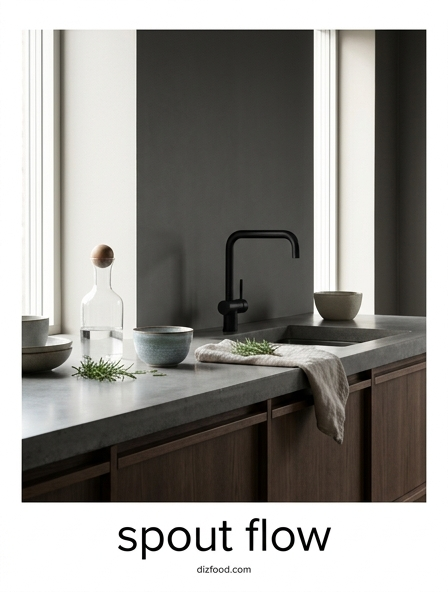
Mastering Fluid Motion for Visual Impact
In the culinary arts, the movement of liquids from a vessel to a plate is more than a simple transfer; it is a calculated performance of fluid dynamics. Achieving a consistent flow requires an understanding of how gravity interacts with the specific aperture of a spout. When a chef tilts a container, the liquid must break away from the lip with enough velocity to overcome the vessel's surface adhesion. This ensures that the stream remains unbroken and lands exactly where intended, creating a professional finish that distinguishes high-end plating from casual service.
- Consistent tilt angle for uniform stream diameter.
- Calculated distance from the plate to control splash.
- Smooth acceleration to prevent air bubbles in the stream.
- Controlled deceleration to avoid the "final drip" phenomenon.
By mastering these motions, a cook can transform a simple balsamic glaze or a herb oil into a striking visual element. The kinetic energy of the pour must be balanced against the resistance of the receiving surface, ensuring that the fluid spreads or pools according to the chef's specific artistic vision.
The Physics of the Perfect Drizzle
The perfect drizzle is governed by the Coanda effect and the principles of gravitational acceleration. As a liquid exits a spout, it tends to follow the curve of the vessel unless the edge is sufficiently sharp to facilitate a clean break. This physical behavior determines whether a sauce will glide gracefully onto a dish or run down the side of the container. For oils and thin reductions, the height from which the liquid is poured plays a critical role in the final aesthetic; a higher pour results in a narrower, more pressurized stream that can create intricate patterns.
Momentum also dictates the behavior of the fluid upon impact. A drizzle that is too fast may cause cratering in a soft puree, while a drizzle that is too slow may result in jagged, uneven lines. Professionals often practice the "pendulum motion," where the hand moves in a steady arc while the vessel remains at a constant angle. This synchronicity between the movement of the chef and the gravitational pull on the liquid ensures that every line of sauce is uniform in both width and volume across the entire plate surface.
Essential Spout Geometry for Precise Plating
The architecture of a spout is the primary factor in determining the precision of a pour. Engineers and culinary designers focus on the taper, the curvature of the lip, and the diameter of the orifice to dictate how a fluid behaves at various flow rates. A spout with a sharp, outward-turned lip is essential for preventing back-flow, as it encourages the liquid to detach immediately rather than clinging to the exterior surface of the vessel.
| Spout Type | Primary Feature | Best Use Case |
|---|---|---|
| Gooseneck | Long, narrow curve | Micro-precision oil dotting |
| V-Shaped | Sharp angular notch | High-volume, rapid pouring |
| Truncated | Short, wide aperture | Chunky or textured sauces |
Selecting the correct geometry allows for the manipulation of the flow's cross-sectional area. A narrow gooseneck provides high resistance, allowing for a slow, meditative stream ideal for delicate garnishes. Conversely, a wide V-shaped spout provides low resistance, which is necessary when flooding a plate with a base sauce or broth where speed and volume are prioritized over minute detail.
Managing Viscosity and Laminar Flow in Sauces
Viscosity is the internal friction of a fluid, and it dictates how easily a sauce will flow through a spout. Thin liquids, like infused oils or vinegars, transition quickly into turbulent flow if poured too aggressively, leading to splattering. Thicker liquids, such as demi-glace or fruit coulis, are more likely to exhibit laminar flow, where the liquid moves in smooth, parallel layers. Maintaining this laminar state is crucial for achieving a glass-like finish on the plate.
To manage these properties, chefs must adjust the temperature of the sauce, as heat typically reduces viscosity and increases flowability. A sauce that is too cold may "stutter" as it exits the spout, creating an uneven, stepped appearance. Conversely, a sauce that is too hot may become too fluid, making it difficult to maintain a defined shape. By understanding the Reynolds number-a dimensionless value that predicts flow patterns-culinary professionals can anticipate whether a sauce will pour in a steady, predictable stream or break into chaotic droplets, allowing for pre-emptive adjustments to the pouring technique or the sauce's consistency.
Enhancing Plate Aesthetics Through Controlled Pouring
The transition from a kitchen tool to a plating instrument depends entirely on the control the user exerts over the spout. Controlled pouring allows for the creation of negative space and focal points that draw the eye toward the primary protein or vegetable. By varying the speed and height of the pour, a chef can create a sense of movement on the plate, ranging from static, perfect circles to dynamic, sweeping arcs that suggest energy and freshness.
- Anchor the arm against the body to stabilize the pour.
- Start the flow off-plate to ensure the initial burst is discarded.
- Move the vessel at a constant velocity to maintain line thickness.
- Lift the spout vertically at the end of the motion to snap the stream.
These techniques ensure that the sauce acts as a frame for the food rather than a distraction. The goal is to achieve a level of consistency where every plate in a service looks identical, a feat only possible through the rigorous application of fluid control. Precise pouring minimizes the need for corrective wiping, preserving the integrity of the plate's surface and the temperature of the dish.
Choosing the Right Vessels for Superior Flow
Not all pouring vessels are created equal, and the choice of hardware significantly impacts the final result. In high-pressure kitchen environments, the ergonomic design of the handle and the vent of the container are just as important as the spout itself. A vessel must allow for air to enter as liquid exits; without proper venting, the flow will "glug," caused by the intermittent equalization of pressure, which ruins the continuity of the pour.
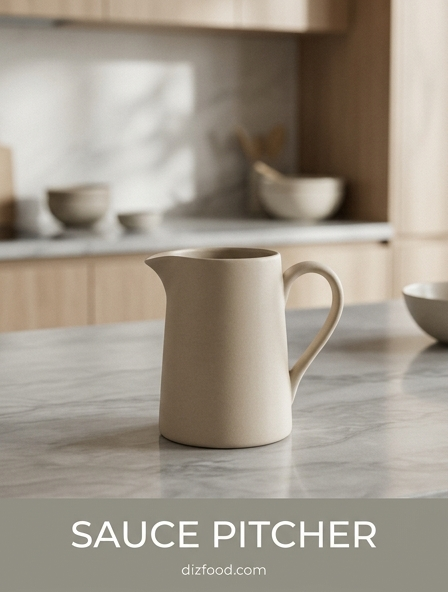
Stainless steel carafes are favored for their heat retention and sharp edges, which provide excellent flow cut-off. Squeeze bottles, while less elegant, offer the advantage of manual pressure control, allowing the chef to "pump" the flow for specific textures or patterns. For tabletop service, ceramic or glass pitchers are often chosen for their aesthetic value, but they must be evaluated for their drip-free performance. A well-designed vessel feels like an extension of the hand, providing intuitive feedback on the volume and speed of the liquid remaining inside, which is essential for timed pours during multi-course service.
Impact of Surface Tension on Culinary Precision
Surface tension is the cohesive force that holds a liquid together at its interface with the air. In the kitchen, this force is what causes a sauce to form a bead rather than spreading thin. The material of the spout-whether it be plastic, metal, or silicone-interacts with the surface tension of the liquid in different ways. Hydrophobic coatings on modern spouts can drastically reduce the "clinging" effect, allowing even the stickiest syrups to pour with remarkable clean-out.
- High surface tension creates spherical droplets for "dotting."
- Low surface tension allows for broad, even washes of color.
- Surfactants in sauces can be used to manipulate flow behavior.
- Spout material affects the "break-off" point of the liquid.
When a liquid has high surface tension, it resists breaking into a stream, which can lead to "dribbling" down the spout. Chefs often compensate for this by using a decisive, quick tilt to force the liquid past its tension threshold. Understanding these molecular interactions allows for the development of sauces that behave predictably under the unique conditions of a busy service line.
Elevating Guest Experience with Tabletop Pouring
Tabletop pouring is a hallmark of fine dining, turning the final assembly of a dish into a sensory experience for the guest. The sound of a clear broth hitting a shallow bowl and the aroma released as the liquid makes contact with the warm ingredients are vital components of the meal. To execute this perfectly, the server must maintain a steady hand and a slow, consistent flow rate that allows the guest to appreciate the transformation of the dish.
The spout used in tabletop service is often more elongated to provide a clear line of sight for the guest and the server. This visibility is crucial for stopping the pour at the exact moment the liquid reaches the desired level. Furthermore, the vessel must be designed to prevent any splashing, which would be seen as a lapse in professional technique. The grace of the pour reflects the quality of the kitchen, signaling a level of attention to detail that extends from the initial preparation to the final interaction at the table.
Minimizing Drip and Waste with Optimized Spouts
Efficiency in a professional kitchen is often measured in milliliters. A spout that drips not only creates a mess that requires cleaning but also represents a loss of expensive ingredients over time. Optimized spouts utilize sharp angles and specialized coatings to ensure that 100% of the liquid intended for the plate actually reaches it. This is particularly important for high-cost items like truffle oils, saffron infusions, or reduced balsamic glazes.
| Waste Factor | Cause | Mitigation Strategy |
|---|---|---|
| Trailing Drip | Rounded spout lip | Switch to sharp-edged apertures |
| Over-Pouring | Wide spout diameter | Use flow-restrictor inserts |
| Side-Leakage | Poor lid seal | Gasket-lined spout bases |
By implementing vessels with superior flow control, kitchens can maintain a cleaner environment and reduce food waste. The "cut-off" must be instantaneous; a well-engineered spout uses the liquid's own momentum to break the surface tension at the end of the pour, ensuring the exterior of the bottle remains pristine throughout the service period.
The Science of Steady Streams in Fine Dining
The pursuit of a perfectly steady stream involves a deep understanding of fluid mechanics and the Bernoulli principle. As liquid moves through a narrow spout, its velocity increases while its internal pressure decreases. This relationship is what allows for the creation of a stable, "glass-like" stream that does not waver or break into droplets. In fine dining, this stability is essential for pouring thin consommés over delicate garnishes without dislodging them from their placement.
Achieving this level of stability requires the vessel to be filled to an optimal level; too much liquid creates excessive head pressure, making the flow difficult to throttle, while too little liquid can lead to air being drawn into the spout, causing the stream to sputter. The chef must also consider the "approach angle"-the specific tilt required to initiate flow without a sudden surge. When these scientific principles are applied with precision, the resulting pour is silent, smooth, and perfectly controlled, embodying the technical excellence that defines modern culinary mastery.

Comments