
Third Rack Tray Vs Lower Basket: The Ultimate Cutlery Showdown
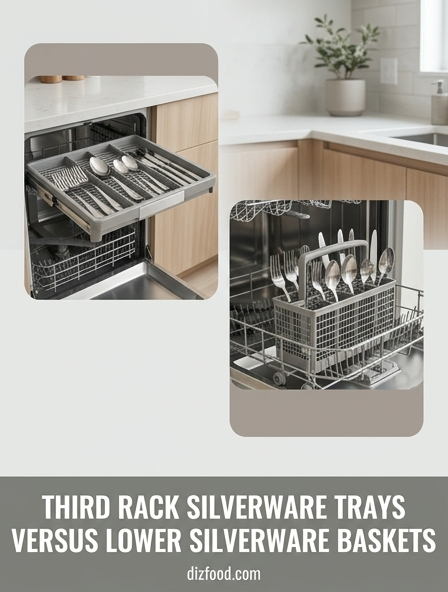
Deciding where to stash your cutlery shouldn't be a headache, yet the debate between the modern third rack tray and the classic lower basket continues to divide homeowners. While the lower basket offers a familiar, "drop-and-go" convenience that speeds up the loading process, it often leads to "nesting" spoons and uneven cleaning results. On the other hand, the third rack tray provides a dedicated, organized slot for every individual piece of silverware, ensuring maximum water exposure and freeing up valuable real estate in the bottom rack for bulky pots and pans. Whether you prioritize lightning-fast cleanup or a meticulously sanitized, spot-free shine, understanding how these two configurations impact your dishwasher's efficiency is the first step toward a more seamless kitchen routine.
| Feature | Third Rack Tray | Lower Silverware Basket |
|---|---|---|
| Cleaning Efficacy | Superior; individual slots prevent nesting/shielding. | Moderate; prone to spots if items touch. |
| Loading Speed | Slower; requires precise manual placement. | Fast; allows for quick "drop-in" loading. |
| Tub Capacity | Increases bottom rack space by ~15-20%. | Consumes bulky space on the lower rack. |
| Drying Performance | High; positioned for optimal steam exposure. | Lower; water often pools in the basket floor. |
| Versatility | Great for spatulas, lids, and long knives. | Best for thick-handled or heavy utensils. |
| Ergonomics | Easier; less bending to reach top level. | Standard; requires deep bending to access. |
Maximizing Dishwasher Capacity With A Third Rack
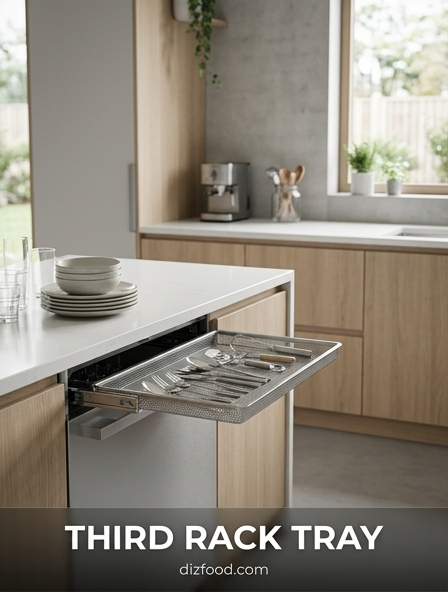
The introduction of the third rack has revolutionized how homeowners perceive dishwasher capacity. Traditionally, the lower rack was forced to accommodate a bulky silverware basket, which often consumed up to twenty percent of the available floor space. By migrating cutlery to a dedicated slim tray at the very top of the machine, manufacturers have effectively unlocked a new tier of organization. This design choice allows the lower rack to be fully dedicated to oversized plates, platters, and mixing bowls that would otherwise require hand-washing or a second cycle.
Beyond just silverare, the third rack serves as a versatile zone for items that are too small for the main racks but too large for a standard basket. This maximizes the cubic footage of the appliance without increasing its exterior footprint. Utilizing this top-level space ensures that every inch of the dishwasher is engaged in the cleaning process. Common items that benefit from this extra capacity include:
- Large serving spoons and soup ladles that traditionally block spray arms.
- Plastic storage container lids that often flip over and fill with dirty water.
- Chef's knives and long carving tools that are too tall for the middle rack.
- Small espresso cups or silicone baking molds.
- Whisks, spatulas, and tongs that clutter the utensil jar.
By effectively layering the load, a third rack dishwasher can often hold several additional place settings compared to a two-rack model. This efficiency is particularly valuable for large families or those who enjoy hosting dinner parties, as it reduces the frequency of daily cycles and saves both water and energy over the lifespan of the appliance.
Cleaning Performance Comparison Of Trays Versus Baskets
The cleaning efficacy of a dishwasher depends heavily on the "line of sight" between the spray arms and the soiled surfaces. Silverware baskets and third racks utilize different mechanical approaches to achieve hygiene. In a traditional basket, spoons and forks are often crowded together, which can lead to "masking," where the water spray is blocked by adjacent pieces. Conversely, third rack trays lay each piece of cutlery flat and separate, ensuring that water and detergent can reach every contour of the item.
Many modern dishwashers feature a dedicated spray nozzle located at the very top of the tub specifically to target the third rack. This provides a direct, high-pressure stream that effectively peels away stubborn food particles. In contrast, silverware baskets rely on the lower spray arm, which must push water through the dense mesh of the basket and past any large plates positioned nearby. The following table summarizes the key performance differences:
| Feature | Third Rack Tray | Lower Silverware Basket |
|---|---|---|
| Water Exposure | Uniform across all surfaces | Varies by density of the load |
| Food Particle Removal | High due to separation | Moderate; prone to nesting |
| Spray Source | Dedicated top nozzle | Main lower spray arm |
| Detergent Contact | Immediate and direct | Often filtered through other dishes |
While baskets offer high-pressure cleaning for items placed on the outer edges, the center of a full basket often suffers from reduced agitation. The tray system eliminates this variable by providing a consistent environment for every fork, knife, and spoon regardless of how many items are loaded.
Solving Cutlery Nesting Problems With Dedicated Slots
One of the most frustrating aspects of dishwasher maintenance is finding "nested" spoons that remain dirty after a full cycle. Nesting occurs when the concave surfaces of spoons or the tines of forks align so closely that water cannot penetrate the gap. Lower silverware baskets are notorious for this issue, as gravity naturally pulls items together into clusters. To combat this, users must be meticulous about alternating the orientation of their cutlery, a task that is often neglected during a hurried cleanup.
Third rack trays solve this problem through the use of integrated tines and dedicated slots. These dividers force a physical distance between each piece of silverware, making it impossible for them to stick together. The systematic approach to loading ensures a perfect clean every time. To maximize the effectiveness of these slots, users should follow a specific loading logic:
- Place spoons with the concave side facing downward or slightly angled to prevent water pooling.
- Group identical items in adjacent slots to make unloading into the kitchen drawer faster.
- Ensure that knife blades are securely fitted into the slots to prevent them from sliding or rattling.
- Avoid overlapping the handles of larger utensils over smaller silverware.
- Check that no long handles have fallen through the tray to obstruct the rotation of the middle spray arm.
By enforcing separation, the third rack guarantees that the mechanical action of the water is applied to the entire surface area of the utensil. This eliminates the need for re-washing and ensures that silverware emerges from the cycle spot-free and hygienically clean.
Ergonomic Advantages Of Top Level Silverware Loading
Ergonomics play a critical role in kitchen appliance design, particularly for users with mobility issues or chronic back pain. Traditional silverware baskets are located in the bottom rack, requiring the user to bend deeply or crouch every time a fork or spoon is added to the load. Over the course of a day, these repetitive movements can lead to physical strain. The third rack moves the most frequently handled items-silverware-to the highest point in the dishwasher, allowing for a more upright posture during the loading and unloading process.
Standing at a natural height while organizing the cutlery tray reduces the stress on the lumbar spine and knees. Furthermore, because the third rack is usually at waist or chest height, it provides better visibility. Users can easily see where slots are open without having to peer into a dark, crowded basket at floor level. This accessibility makes the dishwasher easier to use for a wider demographic, including the elderly and those with physical disabilities. The tray also simplifies the transition from dishwasher to drawer, as the height of the rack is often similar to the height of the kitchen counter where the silverware is stored. This alignment creates a seamless, lateral workflow that minimizes unnecessary reaching and twisting, turning a chore into a more comfortable experience.
Freeing Up Lower Rack Space For Pots And Pans
The primary benefit of relocating silverware to a third rack is the reclamation of "real estate" in the lower section of the dishwasher. In standard two-rack models, the silverware basket occupies a significant portion of the perimeter or the center of the bottom rack. This often prevents the placement of wide items like cookie sheets, oversized skillets, or Dutch ovens. By removing the basket entirely, the lower rack becomes an open floor plan capable of handling the bulkiest cookware in the kitchen.
This increased flexibility is essential for "power users" who cook frequently from scratch. When the basket is out of the way, the tines of the lower rack can often be folded down to create a flat surface for large vessels. The benefits of this space management include:
- Accommodating full-sized 12-inch frying pans without blocking water flow.
- Allowing space for tall stockpots that would otherwise hit the silverware basket.
- Providing room for roasting pans and baking dishes used for family meals.
- Creating a clearer path for the lower spray arm to reach the upper rack.
- Enabling the dishwasher to hold a larger volume of heavy-duty items in a single load.
Without the bulky basket, the lower rack can be optimized for the items that actually need the most intensive cleaning. This ensures that the high-pressure jets at the bottom of the machine are focused on greasy pots and pans rather than being partially blocked by a dense collection of spoons and forks.
Drying Efficiency Differences Between Trays And Baskets
Drying performance is a common point of contention between tray and basket designs. Because third racks are located at the top of the tub, they are in the zone where steam naturally rises and lingers. If the dishwasher uses a traditional heating element, the third rack is the furthest point from the heat source, which can sometimes result in lingering moisture on plastic-handled utensils. However, the horizontal orientation of the tray allows for excellent airflow around each individual piece of metal.
Baskets, on the other hand, hold silverware vertically. This allows water to run down the length of the utensil and drip off the bottom. While this vertical drainage is efficient, the close proximity of items in a basket can trap moisture in the gaps, leading to spots or dampness. Most high-end dishwashers now include a "dry" cycle specifically optimized for third racks, often utilizing zeolite minerals or auto-opening doors to vent steam. The differences in drying mechanics are detailed below:
| Drying Factor | Third Rack Tray | Silverware Basket |
|---|---|---|
| Water Drainage | Horizontal (requires slight angling) | Vertical (gravity-assisted) |
| Airflow | High; items are fully separated | Lower; items are bunched together |
| Evaporation Speed | Slower due to height from heater | Faster due to proximity to heater |
| Spotting Risk | Minimal if loaded correctly | Higher where items touch |
To improve drying in a third rack, it is helpful to use a rinse aid, which lowers the surface tension of the water and encourages it to sheet off the flat surfaces of the cutlery before the drying cycle begins.
The Speed Of Loading And Unloading Silverware Baskets
When it comes to pure speed, the traditional silverware basket often wins the favor of busy households. Loading a basket is a low-precision task; users can simply drop handfuls of forks and spoons into the compartments without much thought. This "grab and go" approach is ideal for families who want to clear the sink as quickly as possible. While some care is needed to avoid nesting, the overall time investment during the loading phase is significantly lower than that of a third rack.
Unloading a basket is similarly expedited because the entire unit is usually removable. A user can lift the full basket out of the dishwasher and carry it directly to the silverware drawer. This eliminates the need to walk back and forth between the machine and the storage area. The unloading process generally follows these steps:
- Wait for the cycle to end and the silverware to cool.
- Grasp the basket handle and lift the entire assembly out.
- Place the basket on the counter next to the cutlery drawer.
- Sort the clean items directly into their respective drawer dividers.
- Return the empty basket to its designated spot in the lower rack.
In contrast, the third rack requires a piece-by-piece loading method where each item must be fitted into a specific slot. While this takes more time upfront, it saves time during unloading because the items are already sorted by type. However, for those who value a quick kitchen reset, the "bulk" nature of the basket remains a compelling feature.
Protecting Fine Cutlery In Third Rack Trays
For owners of high-quality stainless steel or silver-plated flatware, protection against scratches and "clinking" is a priority. In a lower silverware basket, items are free to vibrate and rub against one another during the wash cycle. This metal-on-metal contact can lead to micro-scratches that dull the finish over time. Additionally, the forceful movement of water can cause knives to rattle against forks, potentially chipping delicate edges or damaging the tines of expensive forks.
Third rack trays offer a much safer environment for fine cutlery. Because each piece is locked into its own silicone-coated or plastic slot, there is zero movement during the cycle. The items remain stationary while the water moves around them. This isolation prevents the "pitting" that often occurs when different types of metal (such as stainless steel and silver) touch in a wet, chemically active environment. Furthermore, the third rack is an ideal place for long steak knives or delicate serving pieces that might be too fragile for the chaotic environment of a crowded basket. By providing a stable, organized platform, the third rack helps preserve the aesthetic integrity and longevity of a household's flatware collection, ensuring it remains as shiny and unblemished as the day it was purchased.
Versatility Of Removable Baskets Versus Fixed Trays
Versatility is the hallmark of the traditional silverware basket. Most baskets are designed with modularity in mind; they can be split into two smaller sections or moved to different positions within the lower rack. Some models even allow the basket to be hung on the dishwasher door, completely freeing up the rack space. This flexibility is particularly useful when dealing with an unusual load, such as a large stockpot that requires the basket to be shifted to the opposite side of the tub.
Fixed third racks, while highly organized, offer less flexibility in terms of placement. They are always at the top, which can sometimes limit the height of items placed in the middle rack (though many middle racks are adjustable to compensate for this). The removable nature of the basket also provides a secondary utility: it can be used to transport clean silverware to an outdoor patio for a barbecue or to a dining room for setting a large table. Key versatility features include:
- Split-basket designs that fit into small gaps.
- Fold-down covers on baskets that act as slot-dividers when needed.
- Removable third rack inserts that allow for deeper items like cereal bowls.
- Adjustable height settings for the middle rack to accommodate the third rack.
- The ability to remove the third rack entirely for washing very tall wine glasses below.
Ultimately, the choice between the two depends on whether the user prefers the structured, permanent organization of a tray or the "moveable feast" convenience of a portable basket.
Choosing The Best Silverware Configuration For Your Household
Deciding between a third rack tray and a lower silverware basket depends on your specific kitchen habits, the size of your family, and your physical comfort. A third rack is often the superior choice for those who prioritize cleaning precision and ergonomic ease. It is ideal for households that frequently use specialized tools like spatulas, whisks, and chef's knives, as these items are much easier to place in a flat tray. On the other hand, the traditional basket is better suited for high-volume households where speed and convenience are the primary goals.
The following table can help you determine which configuration fits your lifestyle based on common kitchen priorities:
| Priority | Recommended Choice | Why? |
|---|---|---|
| Ease of Loading | Silverware Basket | Quick "drop-in" method saves time. |
| Cleaning Power | Third Rack Tray | Prevents nesting for a better wash. | Back Health | Third Rack Tray | No bending required to load cutlery. |
| Large Cookware | Third Rack Tray | Clears out the bottom rack for pots. |
| Portability | Silverware Basket | Can be carried to the drawer or table. |
Many modern dishwashers now offer a "best of both worlds" approach by including a slim third rack for large utensils while still providing a small, removable basket in the lower rack. This hybrid configuration allows users to choose the best spot for each item, providing maximum flexibility for everything from a quick Tuesday night dinner to a complex holiday feast.




Comments