
If you're tired of the tedious knife work that stands between you and a healthy dinner, finding the right manual food processor is a total game-changer for your kitchen routine. The debate between the classic Slap Chop and the modern Pull String Chopper boils down to how you prefer to handle your prep: through rhythmic plunging or a smooth, rotary pull. While the Slap Chop is famous for its "slap-and-go" efficiency on a cutting board, the pull string variety offers a self-contained bowl system that excels at creating uniform textures for salsas and pestos. Both tools promise to save your fingers and your time, but depending on whether you value portable versatility or high-capacity containment, one will definitely make your meal prep feel more effortless than the other.
| Feature | Slap Chop (Plunger Style) | Pull String Chopper |
|---|---|---|
| Mechanism | Spring-loaded downward "slap" motion. | Rotary pull-cord (lawnmower style). |
| Containment | Open-bottom; chops on board or small cup. | Fully enclosed bowl; keeps juices contained. |
| Blade Design | Wavy, singular stainless steel blade. | Multi-tiered curved rotating blades. |
| Texture Control | Variable; relies on frequency of hits. | High precision; controlled by number of pulls. |
| Best For | Nuts, garlic, and quick salad toppings. | Salsas, hummus, and dicing onions/carrots. |
| Cleanup | Butterfly pops open; dishwasher safe. | Removable blade/bowl; lid needs hand wash. |
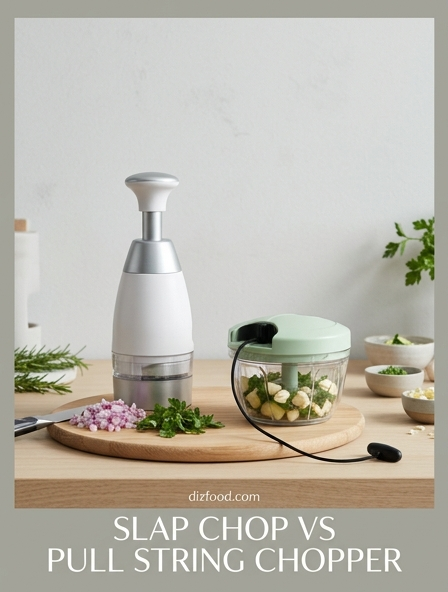
Slap Chop vs Pull String Chopper Comparison
The manual food chopper market is largely dominated by two distinct designs: the plunger-style Slap Chop and the rotary pull-string chopper. Both tools aim to eliminate the tedious knife work associated with prepping vegetables, nuts, and herbs, yet they approach the task with fundamentally different engineering. The Slap Chop, popularized by high-energy infomercials, relies on vertical force and a reciprocating blade system. In contrast, the pull-string chopper utilizes a mechanism similar to a lawnmower pull-start, spinning internal blades at high speeds within a self-contained bowl.
Choosing between these two depends heavily on your typical batch size and the specific textures you wish to achieve. While the Slap Chop is often marketed as a versatile tool for everything from onions to chocolate, it excels in smaller, quick tasks where you might not want to dirty a full-sized processor. The pull-string chopper is generally viewed as a more robust solution for creating salsas, pestos, or finely minced aromatics. Below is a high-level comparison of their primary attributes:
- Slap Chop: Best for dry ingredients, nuts, and single-serving vegetable prep.
- Pull String Chopper: Excels at high-volume dicing, emulsifying small amounts of liquid, and achieving a very fine mince.
- Form Factor: The Slap Chop is tall and narrow; the pull-string chopper is typically squat and bowl-shaped.
Ultimately, the "better" tool is defined by the user's physical comfort with the chopping motion and the volume of food processed daily. Both tools represent an affordable entry point into kitchen automation without the need for electricity or bulky storage requirements.
Mechanism and Ease of Use
The Slap Chop operates on a simple spring-loaded plunger system. When the user strikes the top button with their palm, a W-shaped blade descends into the food. A built-in mechanism rotates the blade slightly with every stroke, ensuring the food is hit from different angles. This "slapping" motion is intuitive but can become physically taxing on the wrist and palm if used for large quantities of firm vegetables like carrots or potatoes. It requires a stable, flat surface, as the impact force can cause the unit to shift if not held firmly.
The pull-string chopper uses a horizontal rotational mechanism. By pulling a handle attached to a nylon cord, the user engages a gear system that spins two or three tiered blades at a high RPM. One pull typically equates to several full rotations of the blades. This mechanism is generally considered easier on the joints, as it uses a pulling motion involving the larger muscles of the arm rather than the repetitive impact required by the Slap Chop. However, the pull-string requires two hands at all times-one to hold the bowl steady and one to pull the cord.
| Feature | Slap Chop | Pull String Chopper |
|---|---|---|
| Primary Action | Vertical Plunging | Horizontal Pulling |
| Hand Requirement | One-handed (usually) | Two-handed |
| Motion Intensity | High Impact | Low Impact/Fluid |
| Noise Level | Loud (Banging) | Moderate (Whirring) |
For users with arthritis or limited hand strength, the pull-string model is often the superior choice due to the lack of impact. Conversely, for those who want to "slap" out a handful of nuts quickly, the Slap Chop offers a faster setup-to-action ratio.
Chopping Speed and Efficiency
Efficiency in a manual chopper is measured by how many cuts are made per movement. The Slap Chop follows a 1:1 ratio-one slap equals one downward cut. Because the blade must travel up and down, there is a physical limit to how fast a human can operate the device. To achieve a fine mince with a Slap Chop, one must provide dozens of rapid strikes. While it is faster than a novice with a knife, it is significantly slower than its mechanical counterparts when dealing with dense ingredients that resist the blade's downward path.
The pull-string chopper is significantly more efficient per movement. A single pull of the cord usually results in five to seven full rotations of the blade assembly. If the device has three tiered blades, a single pull can result in over twenty individual cuts through the produce. This mechanical advantage allows the user to turn a whole onion into a fine dice in roughly three to five pulls, taking less than ten seconds. The enclosed bowl also ensures that food stays in contact with the blades, whereas in a Slap Chop, food can sometimes stick to the sides or the blades, requiring the user to stop and shake the unit.
In terms of consistency, the pull-string chopper tends to produce a more uniform result. Because the blades spin rapidly in a contained space, the food is constantly recirculated. The Slap Chop can sometimes leave larger "stray" pieces at the bottom or corners of its base, necessitating more slaps to catch every piece, which can lead to over-processing the food that was already cut correctly.
Blade Design and Cutting Performance
The blade design is where these two tools diverge most sharply. The Slap Chop features a single, continuous zig-zag or W-shaped stainless steel blade. This design is intended to cover a wide surface area within the circular housing. The blade is blunt-force oriented; it relies on the speed and weight of the user's hand to push through the skin of vegetables like tomatoes or bell peppers. Over time, the intricate folds of the zig-zag blade can be difficult to sharpen, meaning the tool's performance may degrade after a year of heavy use.
Pull-string choppers typically utilize two or three independent, curved blades stacked vertically on a center spindle. These blades are often razor-sharp and designed to slice through food rather than crush it. The tiered arrangement is crucial; the bottom blade picks up larger chunks, while the upper blades catch pieces tossed upward by the centrifugal force. This design is far more effective at handling soft, slippery skins. While the Slap Chop might crush a tomato and leak juice, a high-quality pull-string chopper can often produce a clean dicing of the same fruit.
- Slap Chop Blade: Stationary, reciprocating, zig-zag pattern, focuses on crushing/chopping.
- Pull String Blade: Rotating, multi-level, curved edges, focuses on slicing/mincing.
- Material: Both generally use stainless steel, but pull-string blades are often thinner and sharper.
A notable performance difference occurs with leafy herbs. The Slap Chop's vertical motion tends to bruise delicate herbs like cilantro or parsley. The spinning action of the pull-string chopper, provided the blades are sharp, results in a cleaner cut that preserves the color and texture of the herbs for a longer period.
Versatility Across Different Ingredients
The Slap Chop is frequently marketed as the ultimate tool for hard ingredients. It is exceptionally good at crushing nuts for ice cream toppings, dicing hard-boiled eggs for salad, or mincing garlic cloves. Because the blade hits the cutting board directly, it handles hard, dry items with ease. However, it struggles with "wet" ingredients or high volumes. If you try to chop a large amount of celery, the fibers can occasionally wrap around the zig-zag blade, clogging the rotation mechanism and requiring manual intervention.
Pull-string choppers are the kings of "wet" prep. They are ideal for making quick guacamole, salsa, or hummus. Because the bowl is sealed, you can add liquid ingredients like lime juice or olive oil directly into the mix to emulsify while you chop. This makes the pull-string chopper a hybrid between a knife and a food processor. It is less effective, however, for very small quantities of dry goods. If you put two almonds in a large pull-string chopper, the blades might simply spin over them without making contact. The Slap Chop, with its smaller footprint, handles those tiny tasks better.
When considering ingredients, think about your most common tasks:
- Nuts and Hard Candy: Slap Chop wins for its direct impact.
- Onions and Mirepoix: Pull-string wins for speed and volume.
- Soft Fruits/Berries: Pull-string wins for its slicing action.
- Garlic and Ginger: Slap Chop wins for small-batch processing.
The pull-string chopper essentially acts as a mini-manual blender, whereas the Slap Chop acts as a manual replacement for a chef's knife on a small cutting board.
Cleaning and Maintenance Requirements
Cleaning the Slap Chop is a mixed experience. One of its primary selling points is the "butterfly" opening, where the outer housing hinges open to expose the zig-zag blade. This is intended to make it dishwasher safe and easy to rinse. However, the spring mechanism inside the plunger can eventually trap moisture, leading to rust or a "squeak" over time if not dried thoroughly. Food particles also tend to get stuck in the crevices of the zig-zag blade, sometimes requiring a dedicated brush to remove fibers from onions or celery.
Pull-string choppers are generally easier to clean in terms of the bowl and the blades, but they have a major Achilles' heel: the lid. The lid contains the pull-string and the gear mechanism. Most manufacturers recommend against submerging the lid in water or placing it in the dishwasher. If water enters the internal gear housing, the nylon string can mold, or the metal spring can rust and eventually snap. Users must be careful to wipe the lid with a damp cloth rather than soaking it. The blades are extremely sharp and must be handled with caution during hand-washing to avoid injury.
In terms of maintenance, the Slap Chop is more "set and forget." There are no strings to fray and no gears to slip. The pull-string chopper requires the user to pull the cord straight out; pulling at an angle can cause the cord to rub against the plastic housing, eventually sawing through the casing or fraying the string. While both are generally low-maintenance, the Slap Chop's all-mechanical plunger is often more resilient to water exposure than the cord-driven system of its competitor.
Durability and Build Quality
The durability of these tools often comes down to the quality of the plastics used. The Slap Chop, especially generic "as seen on TV" versions, can suffer from brittle plastic in the butterfly hinges. If the hinge snaps, the unit becomes difficult to hold together during the high-impact slapping motion. The internal spring is usually robust, but the plastic plunger cap can crack under heavy use. Because the Slap Chop is designed for impact, the material fatigue is often higher than in other manual tools.
The pull-string chopper's longevity is tied almost entirely to the cord and the spring return. High-end models use reinforced nylon cords and heavy-duty internal springs. If the user over-extends the cord or pulls with excessive force, the spring can lose its tension, preventing the cord from retracting. Once the string fails, the tool is generally unrepairable. However, the bowl and the blade spindle are usually quite durable, as they do not experience the same "banging" force that the Slap Chop must endure daily.
Generally, the pull-string chopper feels like a more precise instrument, whereas the Slap Chop feels like a rugged, heavy-duty tool. If you are prone to being "heavy-handed" in the kitchen, the Slap Chop might actually withstand your usage better, provided you buy a genuine model with high-quality hinges. If you prefer a smoother, more mechanical feel and can treat the cord with care, the pull-string chopper often provides a more premium user experience over the long term.
Safety Features and Handling
Safety is a significant concern when dealing with exposed blades. The Slap Chop is inherently quite safe because the blade is recessed within the housing at all times. Unless you are intentionally opening the butterfly hinges for cleaning, your fingers never come near the cutting edge. The base of the Slap Chop usually serves as a small cup, further isolating the blade from the user's hands. However, the "slapping" motion can be loud and startling, and if the unit isn't held correctly, it can tip over, though this rarely leads to injury.
Pull-string choppers require more caution, particularly during assembly and cleaning. The blades are often loose and must be dropped onto a center pin within the bowl. Because they are curved and multi-tiered, there are many sharp surfaces to navigate. Handling the blade spindle requires focus. On the positive side, once the lid is locked on, the system is completely enclosed. Most pull-string choppers feature a non-slip silicone base to prevent the bowl from sliding across the counter while you pull the cord, which is a critical safety feature given the lateral force applied during use.
From a handling perspective, the Slap Chop is better for "on-the-fly" chopping directly on a cutting board. You can remove the base and slap directly on the board, which is convenient but exposes the blades more than using the cup. The pull-string chopper is a more controlled environment; everything happens inside the bowl. This keeps the kitchen cleaner and keeps fingers away from the action, but it adds the extra step of transferring the food from the bowl to the pan or plate once finished.
Size and Storage Portability
Storage space is at a premium in most kitchens, and these two tools offer different footprints. The Slap Chop is tall and narrow, roughly the size of a large cocktail shaker. Its vertical orientation makes it easy to tuck into a corner of a cabinet or even a deep drawer. Because it is a single self-contained unit (especially if the base cap is attached), there are no loose parts to lose. However, its height can be an issue for shallow drawers, forcing it to be stored on its side where it might roll around.
The pull-string chopper is usually wider and shorter, resembling a small food processor bowl. It takes up more "floor space" in a cabinet but fits much better into standard kitchen drawers. The main drawback for storage is that the blade spindle is often a separate, loose piece. If you store the unit disassembled to allow it to dry, you run the risk of losing the blades or accidentally cutting yourself when reaching into a drawer. Most users store it fully assembled to avoid this issue.
- Slap Chop: Tall and thin; fits in narrow gaps; height ~9-10 inches.
- Pull String: Short and wide; fits in drawers; diameter ~5-6 inches.
- Portability: Both are excellent for camping or RVs as they require no electricity.
If you are looking for a tool to keep on the countertop, the Slap Chop has a smaller footprint. If you want something that disappears into a drawer when not in use, the pull-string chopper is the more likely candidate. Both are lightweight and made of plastic, making them highly portable for outdoor cooking or small apartment kitchens where a full-sized electric processor is impractical.
Final Verdict and Best Value
Determining the winner between the Slap Chop and the pull-string chopper depends on your specific culinary habits. The Slap Chop is the "sprinter" of the kitchen-ideal for quick, high-impact tasks like topping a sundae with crushed peanuts or dicing a single clove of garlic. It is fun to use and very fast for tiny jobs. However, it lacks the finesse and volume capacity required for serious meal prep. For most casual cooks, the Slap Chop is a helpful accessory but rarely a primary tool.
The pull-string chopper is the "marathon runner." It is a significantly more capable tool that can replace a knife for the vast majority of vegetable prep. Its ability to create emulsions, handle larger volumes, and produce a more consistent dice makes it the superior choice for those who cook from scratch frequently. While it requires a bit more care regarding the pull-cord and lid cleaning, the efficiency gained per pull far outweighs the repetitive effort of the Slap Chop. In terms of value, pull-string choppers are often priced similarly to the Slap Chop, yet they offer a wider range of uses.
Recommendation: Buy the Slap Chop if you mainly want to chop nuts, herbs, and small garnishes with minimal cleanup. Buy the pull-string chopper if you want to prep entire meals, make homemade salsas, or need a tool that is easy on the joints. For the average kitchen, the pull-string chopper provides the best overall value and performance.

Comments