
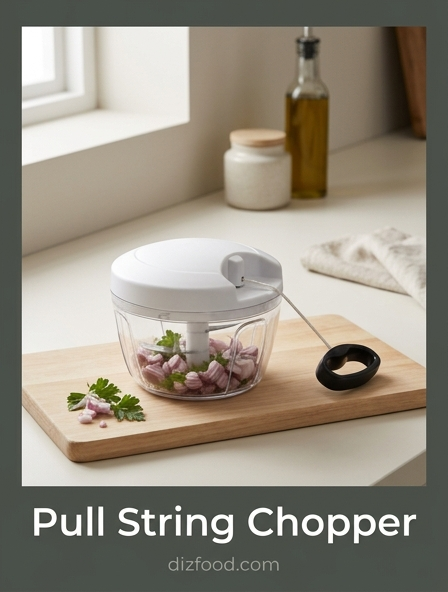
Precision Control Over Manual Dicing
Precision in the kitchen often separates a mediocre dish from a culinary masterpiece. The pull string chopper offers a level of manual dicing control that electric food processors frequently lack. Because the user provides the mechanical power, they can dictate the exact velocity and frequency of the blade rotations. This granular control allows for a meticulous approach to ingredient preparation, ensuring that each piece of onion or garlic is cut to the specific dimensions required for the recipe.
- Immediate stops prevent over-cutting delicate herbs.
- Variable pull strength accommodates different ingredient densities.
- Short, quick pulls create a rough chop for stews.
- Longer, sustained pulls produce a finer dice for garnishes.
By eliminating the lag time associated with electric switches, the manual pull mechanism creates a direct feedback loop between the cook and the food. This responsiveness ensures that ingredients are handled with the care they deserve, maintaining their structural integrity while achieving the desired size for optimal cooking and flavor release.
Achieving Custom Consistency with Pull Strings
The beauty of a pull string chopper lies in its ability to deliver custom consistency tailored to individual preferences. Unlike pre-programmed settings on an electric appliance, the pull string allows the user to feel the resistance of the food against the blades. This physical connection provides a sensory guide for when to stop. Whether you are preparing a chunky salsa that requires distinct pieces of tomato and onion or a smooth pesto where ingredients need to be thoroughly integrated, the manual action makes it possible.
To achieve the best results, one should consider the number of pulls as a metric for coarseness. A few pulls will yield large, rustic chunks, while additional pulls will gradually reduce the ingredients to a finer state. This adaptability makes the tool indispensable for recipes that demand a specific mouthfeel. By mastering the rhythm and force of the pull, cooks can replicate professional knife skills without the steep learning curve, ensuring every meal has a consistent and appealing texture.
Slap Chopping for Uniform Texture
While the pull string chopper uses a rotational mechanism, the rapid nature of the movement mimics the benefits of traditional slap chopping. The high-speed revolution of the blades ensures that ingredients are tossed and hit multiple times in a short duration, leading to a surprisingly uniform texture. This uniformity is vital for even cooking; when all pieces of an aromatic base are the same size, they soften at the same rate, preventing some bits from burning while others remain raw.
- Load the container halfway to allow for air circulation.
- Give three to five sharp pulls for a coarse, uniform base.
- Shake the container between pulls to redistribute larger pieces.
- Perform final rapid pulls to reach the desired uniformity.
The internal geometry of the chopper is designed to guide food back toward the blades after every impact. This continuous movement ensures that no large chunks remain hidden at the bottom or stuck to the sides, resulting in a cohesive blend that enhances the presentation and taste of the final dish.
Avoiding Overprocessing and Food Mush
One of the primary frustrations with high-powered electric blenders is the fine line between a fine dice and a watery puree. Pull string choppers mitigate this risk significantly. Because the blades only move when you pull the cord, there is no risk of the motor "running away" with the ingredients. This is particularly important for high-moisture vegetables like cucumbers or tomatoes, which can quickly turn into mush if processed too aggressively.
| Ingredient | Electric Risk | Manual Benefit |
|---|---|---|
| Onions | Liquefication | Crisp fragments |
| Tomatoes | Pureed juice | Defined chunks |
| Herbs | Bruising/Browning | Clean, sharp cuts |
The tactile nature of the device allows the cook to monitor the moisture release of the ingredients. If the food begins to look too wet, the chopping can be halted instantly. This preservation of texture ensures that salads remain crunchy and dips maintain their body, providing a much higher quality end product than automated alternatives.
Real Time Visual Texture Monitoring
Transparency is a key feature of the pull string chopper that facilitates real-time visual monitoring. Most models feature a clear plastic bowl, which acts as a window into the chopping process. This eliminates the guesswork involved in kitchen preparation. Instead of stopping a machine, removing a lid, and checking the progress, the user can simply look through the side of the container while actively pulling the string.
- Monitor color changes as ingredients blend.
- Identify and target any missed large pieces.
- Gauge the volume reduction as ingredients are broken down.
- Stop the process the exact second the visual target is met.
This visual feedback loop is essential for achieving the perfect "crumb" for toppings or the ideal "fineness" for a mirepoix. By seeing the transformation occur in real-time, the cook gains a better understanding of how different ingredients react to the blades, leading to more confident and successful kitchen outcomes over time.
Impact Driven Chopping for Crisp Cuts
The physics behind a pull string chopper relies on the momentum generated by the user's arm. This impact-driven approach is highly effective at creating crisp, clean cuts. When the cord is pulled sharply, the blades accelerate rapidly, slicing through cell walls of vegetables with minimal bruising. Clean cuts are not just about aesthetics; they are crucial for preserving the flavor and shelf life of the ingredients. Bruised herbs, for instance, oxidize and turn bitter quickly, whereas cleanly sliced herbs retain their bright, aromatic oils.
Because the blades are sharp and the speed is controlled by the user, the "crushing" effect common in dull electric units is avoided. This results in ingredients that look vibrant and taste fresh. The ability to generate high torque manually means that even harder vegetables like carrots or radishes can be processed with ease, resulting in sharp-edged pieces that provide a delightful crunch in salads or stir-fries. This precision ensures that the structural integrity of the produce is respected throughout the preparation process.
Controlling Particle Size with Manual Pulses
Achieving the perfect particle size is a matter of counting and force. The manual pulse method provided by a pull string is the most intuitive way to manage this. Unlike a button that may have a slight delay, the string retracts and engages instantly. This allows for a rhythmic approach to chopping that can be adjusted on the fly based on the resistance felt through the handle. Fine-tuning the size of your ingredients has never been easier or more satisfying.
- Start with slow, steady pulls to break down large items.
- Transition to short, quick pulses for medium sizing.
- Increase the frequency of pulses for a fine mince.
- Finalize with very light tugs to incorporate small additions like salt or oil.
This graduated approach prevents the "bottom-heavy" problem where the ingredients at the bottom of the container are obliterated while the top remains intact. By controlling the pulses manually, you ensure a vertical mix that exposes all ingredients to the blades equally, leading to a professional-grade uniformity across the entire batch.
Versatile Textures for Different Ingredients
A pull string chopper is a versatile powerhouse capable of handling a wide variety of textures. From the fibrous nature of celery to the hard shells of nuts, the manual adjustment of pull speed allows for specialized treatment of each ingredient. The device is not limited to vegetables; it can easily transition between different food groups while maintaining the specific texture required for each. This makes it an all-in-one tool for complex recipes that involve multiple prep steps.
| Food Category | Technique | Resulting Texture |
|---|---|---|
| Nuts | Strong, fast pulls | Evenly crushed meal |
| Soft Fruits | Gentle, slow pulls | Fruit compote chunks |
| Root Veggies | Consistent, firm pulls | Fine dicing |
By understanding how to vary the tension on the cord, the user can switch from making a coarse nut topping for a dessert to a fine garlic paste for a savory marinade in seconds. This versatility reduces the need for multiple specialized gadgets, streamlining the kitchen workflow and allowing for creative experimentation with different textures and flavor profiles.
The Advantage of Tactile Blade Control
Tactile feedback is a significant advantage that is often overlooked in modern kitchen appliances. When using a pull string chopper, the hand pulling the cord receives immediate information about what is happening inside the bowl. If the blade hits a particularly tough knot in a ginger root or a hard seed, the user feels that resistance instantly. This allows for an immediate adjustment in technique, such as a quick shake of the unit or a change in pull angle, to resolve the blockage.
- Prevents blade damage from unexpectedly hard objects.
- Allows for the "feeling" of the food's transition from solid to chopped.
- Reduces hand fatigue by using larger muscle groups.
- Encourages a more mindful and engaged cooking experience.
This physical connection creates a sense of mastery over the tool. Instead of being a passive observer of a machine's performance, the cook is an active participant in the preparation. This tactile engagement not only improves the quality of the food but also makes the process of chopping more intuitive and less of a chore.
Perfecting Mince and Dice Results
The ultimate goal of any chopping tool is to achieve the perfect mince or dice every time. The pull string chopper empowers the user to reach this level of perfection through its combination of speed, control, and visibility. To perfect your results, it is important to practice the "load and pull" balance. Overloading the container will result in uneven cuts, whereas the right amount of space allows the ingredients to tumble through the blades for a more comprehensive and even mince.
For a perfect dice, keep the pulls consistent in length and speed. For a fine mince, especially for items like garlic or shallots, continue pulling until the resistance significantly drops, signaling that the particles have become small and light. By paying attention to these subtle cues and utilizing the manual nature of the tool, you can produce results that rival the most expensive electric processors. The pull string chopper proves that sometimes the most effective way to achieve culinary precision is through a simple, human-powered design that puts the cook back in control.



Comments