
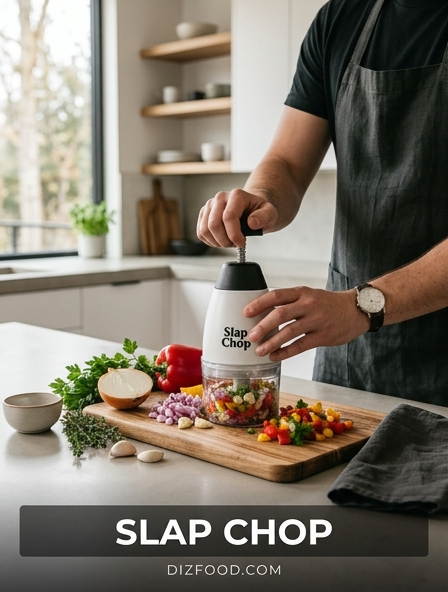
Slap Chop vs Pull String Chopper
The debate between the Slap Chop and the pull string chopper centers on the physical interaction between the user and the device. The Slap Chop utilizes a vertical plunging motion, where the user presses down on a spring-loaded plunger to drive blades through food. In contrast, a pull string chopper relies on a horizontal rotational force, similar to starting a lawnmower, which spins a blade assembly inside a bowl. While both tools aim to eliminate manual knife work, their operational dynamics differ significantly in terms of speed and mechanical resistance.
| Feature | Slap Chop | Pull String Chopper |
|---|---|---|
| Motion Type | Vertical Plunge | Horizontal Pull |
| Blade Action | Zig-zag Strike | Rotational Spin |
| Capacity | Small to Medium | Medium to Large |
| Primary Strength | Speed for small items | Consistency for salsa |
Choosing between them often depends on the specific volume of ingredients. The Slap Chop excels at processing individual cloves of garlic or half an onion directly on a cutting board, whereas the pull string model is often preferred for creating larger batches of dips or dressings due to its enclosed bowl design and high-velocity rotations.
Manual Dicing Mechanism Comparison
The engineering behind these two manual tools dictates how effectively they can dice tough or soft vegetables. The Slap Chop utilizes a unique W-shaped stainless steel blade that rotates slightly with every downward stroke. This rotation ensures that the blade never hits the exact same spot twice, theoretically creating a uniform dice over several repetitions. The spring-loaded mechanism provides tactile feedback, allowing the user to feel the resistance of the food and adjust the force of the "slap" accordingly.
- Slap Chop Components: High-tension internal spring, rotating piston, and stainless steel zig-zag blades.
- Pull String Components: Nylon cord, recoil pulley, and tiered curved blades.
- Impact Style: The Slap Chop relies on blunt force impact, whereas the pull string utilizes centrifugal slicing.
The mechanical simplicity of the Slap Chop makes it highly intuitive, but it requires more physical strikes to achieve a fine mince. Conversely, the pull string mechanism achieves multiple rotations per pull, meaning three or four pulls can result in dozens of blade passes. This makes the pull string chopper more efficient for high-volume dicing, while the Slap Chop remains the king of quick, single-ingredient tasks that require minimal setup.
Precision and Uniformity in Chopping
Precision is a critical factor for home cooks who want their food to cook evenly. The Slap Chop offers a "randomized" precision; because the blade rotates at a fixed angle with each slap, the user has significant control over the final texture by simply counting the number of strikes. A few slaps result in a coarse chop, while continuous slapping produces a fine mince. This is particularly useful for nuts, where over-processing can quickly lead to an oily paste instead of a dry crumble.
The pull string chopper, however, tends to offer better uniformity for wet ingredients like tomatoes or peppers. Because the blades are fixed at different heights on a central spindle, they sweep through the entire volume of the bowl simultaneously. This prevents the bottom layer from being pulverized while the top remains intact. In the Slap Chop, users must sometimes pause to redistribute ingredients if they are not using the included base cup, as the blades only strike the area directly beneath the plunger. Ultimately, the Slap Chop provides better precision for dry, hard ingredients, whereas the pull string model is superior for maintaining the integrity of softer, high-moisture produce.
Effort and Ergonomics for Home Cooks
Ergonomics play a vital role in how often a kitchen tool is actually used. The Slap Chop requires a downward percussive force, which can be taxing on the palm or wrist if used for extended periods. It is designed for short bursts of energy, making it ideal for a quick garnish or a single onion. For individuals with joint sensitivity in their hands, the "slapping" motion might be less comfortable than the smooth, lateral pulling motion required by a cord-based chopper. The pull string distributes the effort across the larger muscles of the arm and shoulder, which generally feels less fatiguing during prep-heavy meals.
However, the Slap Chop's design allows it to be used with one hand, provided the unit is stable. This can be a benefit for multi-tasking in the kitchen. The grip on the plunger is usually contoured to fit the palm, reducing the risk of slipping. When comparing the two, the Slap Chop feels more aggressive and immediate, while the pull string feels more fluid. For those who prefer a rhythmic, fast-paced prep style, the Slap Chop's tactile response is often more satisfying than the mechanical resistance of a cord.
Cleaning and Dishwasher Safety
Hygiene is paramount in food preparation, and both devices offer distinct advantages in their cleaning protocols. The Slap Chop is famous for its "butterfly" opening design. This allows the outer housing to swing open, exposing the blades and the internal tracks for easy rinsing under a faucet. This design prevents food particles from getting trapped in hard-to-reach crevices, which is a common complaint with traditional boxed choppers. Most authentic Slap Chop units are marketed as top-rack dishwasher safe, though hand-washing is often recommended to maintain blade sharpness over time.
- Unsnap the base or remove the protective cup.
- Trigger the butterfly latch to expand the housing.
- Rinse the stainless steel blades under hot water to remove acids.
- Place on the top rack of the dishwasher for a deep clean.
Pull string choppers are slightly more complex to clean because of the lid. The mechanical cord housing cannot be submerged in water, as moisture inside the spring mechanism can lead to mold or cord degradation. This gives the Slap Chop a clear edge in terms of sanitation and ease of maintenance, as the entire unit can be thoroughly scrubbed without worrying about compromising an internal pulley system.
Versatility with Onions and Garlic
Onions and garlic are the primary reasons many consumers purchase a manual chopper. The Slap Chop excels here because it allows the user to chop with the skin on; the impact of the blade often helps separate the skin from the flesh, which can then be easily picked out. Furthermore, because the Slap Chop can be used directly on a cutting board, the user can quickly move from one ingredient to the next without washing a bowl in between. This "open-ended" use case makes it highly versatile for aromatics.
The enclosed nature of the Slap Chop is also a significant benefit for onion prep, as it traps the volatile oils that cause eye irritation. You can pulverize a whole onion into a fine dice in seconds without shedding a single tear. For garlic, the Slap Chop can take several cloves at once, turning them into a paste or a mince far faster than a traditional garlic press. While a pull string chopper can handle these ingredients, it often requires them to be pre-cut into smaller chunks to fit around the blade spindle, whereas the Slap Chop can simply be placed over a large wedge and operated immediately.
Durability and Build Quality Analysis
Durability in manual kitchen tools is often determined by the quality of the moving parts. In a Slap Chop, the primary failure point is the internal spring or the plastic tabs that hold the butterfly housing together. High-quality versions use reinforced plastics and high-carbon stainless steel to ensure the blades do not bend when striking harder vegetables like carrots or potatoes. The simplicity of the plunger design means there are fewer parts to snap, provided the user does not apply excessive lateral force.
Pull string choppers face a different set of durability challenges. The nylon cord is the most common point of failure, as it can fray or snap over hundreds of uses. Additionally, if the cord is pulled too hard or at an improper angle, the recoil spring can become dislodged. When comparing the two, the Slap Chop generally feels more robust in a "heavy-duty" sense because it is built to withstand impact. As long as the blades are kept sharp and the hinges are handled with care, a Slap Chop can survive years of daily use in a busy kitchen, whereas a pull string's lifespan is often limited by the integrity of its cord.
Speed and Efficiency in Meal Prep
In the context of meal prep, speed is measured by the time it takes from taking the tool out of the drawer to finishing the chop. The Slap Chop is the faster option for "on-the-fly" cooking. Because it does not require a bowl, you can simply place it over your ingredients on a board and start slapping. This saves the time usually spent assembling a bowl and lid. For a single meal consisting of a few vegetables, the Slap Chop reduces prep time by roughly 50% compared to traditional knife work.
Efficiency also includes the cleanup time. Since the Slap Chop can be rinsed in seconds, it doesn't interrupt the flow of cooking. However, if the goal is to meal prep for an entire week-such as chopping five large bell peppers and three onions-the Slap Chop's small surface area becomes a bottleneck. In these high-volume scenarios, the pull string chopper wins because of its capacity. But for the average daily dinner prep, the Slap Chop's ability to transition quickly between ingredients like celery, nuts, and garlic makes it the more efficient tool for the home cook who values a streamlined workflow.
Compact Storage and Portability
Kitchen real estate is valuable, and the Slap Chop is designed with a vertical profile that maximizes drawer space. Its cylindrical shape allows it to stand upright in a corner or lie flat in a utensil drawer without taking up much room. Many models also feature a clicking mechanism that locks the plunger in the "down" position, reducing the overall height of the unit for even more compact storage. This makes it a favorite for those living in apartments or tiny homes where counter and cabinet space are limited.
Portability is another area where the Slap Chop shines. Because it is a self-contained unit that doesn't strictly require its own base, it is an excellent tool for camping or outdoor grilling. You can pack it in a bag without worrying about losing a specific bowl or lid. While pull string choppers are also portable, they are generally bulkier due to their bowl-based design. The Slap Chop's slender frame and lightweight construction make it the superior choice for cooks who need a versatile dicing tool that can easily be transported to a potluck or used in a compact RV kitchen.
Final Verdict for Kitchen Efficiency
After evaluating both tools, the final verdict depends on your specific cooking habits. The Slap Chop is the undisputed winner for speed, small-batch versatility, and ease of cleaning. Its ability to work directly on a cutting board and its innovative butterfly opening make it a practical tool for the "quick-fix" cook who wants to minimize mess. It is particularly effective for aromatics, nuts, and garnishes where a fine mince is required with minimal effort.
On the other hand, if you frequently prepare large quantities of salsa, pesto, or salads, the pull string chopper's capacity might be more beneficial. However, for the majority of daily kitchen tasks-chopping an onion for a stew, mincing garlic for pasta, or crushing nuts for a dessert-the Slap Chop offers a more visceral and immediate experience. It eliminates the need for complex assembly and provides a durable, dishwasher-safe solution for manual food processing. For overall kitchen efficiency, the Slap Chop remains a staple gadget that balances mechanical simplicity with effective, time-saving performance for the modern home chef.

Comments