
When you're tackling daily meal prep, choosing between a serrated utility knife and a straight edge paring knife can be the difference between effortless slicing and a frustrating kitchen struggle. While the serrated utility knife acts as a versatile powerhouse for "sawing" through tough-skinned fruits like tomatoes or crusty rolls without crushing their delicate interiors, the straight edge paring knife is your go-to tool for high-precision tasks like peeling, coring, and intricate garnishing. Both are essential kitchen staples, but understanding their specific strengths-matching the toothy grip of a utility blade to waxy textures and the razor-sharp finesse of a paring knife to detail work-will significantly elevate your efficiency and the professional look of your ingredients.
| Feature | Serrated Utility Knife | Straight Edge Paring Knife |
|---|---|---|
| Blade Profile | 4-7" scalloped or toothed edge | 2.5-4" smooth, straight edge |
| Primary Action | Sawing motion (horizontal) | Pressure/Push cuts (vertical) |
| Best Use Case | Waxy skins and soft interiors | Peeling, coring, and de-veining |
| Ideal Ingredients | Tomatoes, citrus, small breads | Garlic, strawberries, small potatoes |
| Precision Level | Moderate; focuses on grip | High; focuses on intricate control |
| Maintenance | Requires specialized sharpening | Easily honed with a standard rod |
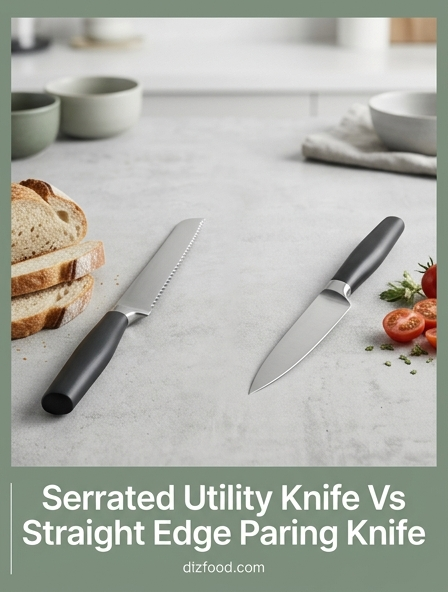
Serrated Utility Knife vs Paring Knife Comparison
When navigating the landscape of kitchen cutlery, the distinction between a serrated utility knife and a straight-edge paring knife is fundamental for culinary efficiency. While both are considered small-to-medium blades, their functional designs cater to vastly different textures and techniques. The paring knife, typically featuring a blade length between 2.5 and 4 inches, is the surgeon's scalpel of the kitchen, designed for intricate work and peeling. In contrast, the serrated utility knife, often measuring 4 to 7 inches, acts as a bridge between the paring knife and the chef's knife, utilizing a tooth-like edge to saw through resistant surfaces.
| Feature | Paring Knife | Serrated Utility Knife |
|---|---|---|
| Blade Length | 2.5 to 4 inches | 4 to 7 inches |
| Edge Type | Straight (Smooth) | Serrated (Toothed) | Cutting Motion | Push/Draw Cut | Sawing Motion |
| Primary Use | Detailing and Peeling | Slicing Soft/Waxy Skins |
Understanding these differences prevents common kitchen frustrations, such as crushing a delicate tomato with a dull straight edge or struggling to achieve a smooth julienne with a serrated blade. The choice often comes down to the resistance of the food's exterior versus the delicacy of its interior. While the paring knife excels in "in-hand" tasks away from the cutting board, the utility knife usually requires the stability of a surface to maximize its sawing potential.
Understanding the Serrated Blade Mechanics
The mechanics of a serrated blade are rooted in the physics of pressure distribution. A serrated utility knife features a series of sharp teeth, or gullets, along the cutting edge. When these teeth make contact with a food item, the entire force of the user's hand is concentrated on the tiny tips of the serrations. This incredibly high pressure allows the blade to puncture hard or waxy crusts that would otherwise cause a smooth blade to slide or wander. This is why a serrated edge is the superior choice for "slippery" foods.
- Point Loading: The individual teeth exert higher PSI (pounds per square inch) than a flat surface.
- Sawing Action: The reciprocating motion allows the teeth to tear through fibers rather than just parting them.
- Edge Longevity: Because the recessed gullets rarely touch the cutting board, they stay sharp significantly longer than straight edges.
- Friction Reduction: The gaps between teeth reduce the surface area contact, preventing sticky foods from clinging to the metal.
Because of these mechanics, the serrated utility knife does not require the same level of downward force as a paring knife. However, the trade-off is the quality of the finish. A serrated blade inherently leaves a slightly ragged or "toothed" surface on the food. While this is irrelevant for a baguette or a tomato slice, it makes the serrated blade unsuitable for tasks requiring a polished, glassy surface, such as fine garnishes or delicate herbs where bruising must be avoided.
The Precision of Straight Edge Paring Knives
The straight-edge paring knife is defined by its simplicity and uncompromising precision. Unlike the serrated blade, which tears, the straight edge parts fibers cleanly by wedging through the material. This results in a smooth, surgical finish that preserves the structural integrity of delicate ingredients. The geometry of a paring knife is usually a "V" shape or a slight taper, allowing for maximum control when the thumb is used as a guide during off-board tasks like peeling an apple or coring a strawberry.
- Clean Slicing: The continuous edge ensures no tearing, which is vital for preventing oxidation in fruits like apples.
- Detailed Tip Work: The fine point is designed for removing potato eyes, deveining shrimp, or scoring intricate patterns.
- Ease of Control: The shorter blade length allows the user to treat the knife as an extension of their index finger.
- Versatile Sharpening: The flat edge can be honed to a mirror-like finish using standard whetstones.
Precision is the hallmark of this tool. When a chef needs to turn vegetables (tournée) or create uniform dice (brunoise) from small aromatics like shallots or garlic, the straight edge provides a level of accuracy that a serrated blade cannot match. The lack of teeth means the knife moves in a perfectly straight line through the medium, provided the blade is sufficiently sharp. However, if the blade becomes dull, it loses its ability to bite into skins, often leading to dangerous slips.
Cutting Performance on Soft vs Firm Foods
The performance disparity between these two knives is most evident when comparing how they interact with different food textures. The serrated utility knife is the undisputed champion of "soft-interior, firm-exterior" foods. Consider a ripe plum or a sourdough roll; the serrations grab the skin or crust and break the surface tension immediately. Without these teeth, a straight edge would require a "draw" motion that might crush the soft interior before the skin is breached. The utility knife preserves the internal structure by bypassing the external resistance with minimal downward pressure.
Conversely, firm foods with consistent density, such as carrots, potatoes, or firm cheeses, are better handled by the straight-edge paring knife. On these items, the teeth of a serrated knife can catch and chatter, creating an uneven and difficult-to-control cut. A smooth blade glides through dense starch with a single, fluid motion. This distinction is critical for safety; using a serrated knife on a hard carrot can cause the blade to "jump" out of the cut, whereas a sharp paring knife stays seated in the material. For soft herbs or leafy greens, the straight edge is also preferred to prevent the "chewing" effect that serrations can have on thin cell walls, which leads to rapid browning and loss of flavor.
When to Reach for a Serrated Utility Knife
The serrated utility knife is often nicknamed the "sandwich knife" or the "tomato knife" because of its specific niche in food preparation. You should reach for this tool whenever you encounter a texture that is either too waxy, too crusty, or too fibrous for a standard blade to grip. It is the ideal tool for high-acid fruits and vegetables that tend to dull straight edges quickly, such as lemons, limes, and oranges. The serrations remain functional even when the tips of the teeth have lost their factory edge, making it a reliable "workhorse" for quick tasks.
- Citrus Slicing: Effortlessly cuts through the bitter pith and oily skin of lemons and grapefruit.
- Small Breads: Perfect for bagels, dinner rolls, or small baguettes where a full-sized bread knife is overkill.
- Cured Meats: Ideal for slicing through the tough casings of salami or pepperoni.
- Waxy Vegetables: Best for peppers and tomatoes, where the skin is slick and resistant.
- Sandwich Assembly: Capable of cutting through layers of bread, meat, and vegetables without compressing the sandwich.
In many busy kitchens, the serrated utility knife is the go-to for prep cooks handling "wet" stations. Because the sawing action does not rely on a razor-sharp apex to the same degree as a paring knife, it is more forgiving of poor technique or neglected maintenance. If you are in a rush and need to slice a baguette for bruschetta or prep lemons for a bar, the serrated utility knife is the most efficient choice for the job.
Top Culinary Tasks for Paring Knives
The paring knife is indispensable for tasks that happen in the air rather than on a board. Its small size and lightweight nature make it perfect for "hand-to-object" work where the thumb acts as a fulcrum. One of the most common uses is peeling round fruits and vegetables. By holding the item in one hand and the knife in the other, the cook can follow the contours of the produce with extreme accuracy, minimizing waste by removing only the thinnest layer of skin.
- Hulling and Pitting: Removing the green tops of strawberries or the pits from cherries and small stone fruits.
- Deveining Shellfish: The sharp tip is used to delicately remove the intestinal tract of shrimp.
- Segmenting Fruit: Also known as "supreming," this involves cutting citrus segments away from the membrane.
- Garlic and Ginger Prep: Mincing small aromatics where a chef's knife feels too cumbersome.
- Decorative Garnishes: Creating radish roses, fluting mushrooms, or carving intricate shapes for food presentation.
Beyond these tasks, the paring knife is also the tool of choice for testing the tenderness of boiling vegetables. A quick poke with a thin paring knife provides immediate tactile feedback on whether a potato or beet is "fork-tender." Because it lacks the aggressive teeth of the utility knife, it enters and exits the food cleanly, leaving no visible mark and allowing the cook to check doneness without damaging the aesthetic of the final dish.
Blade Sharpening and Maintenance Differences
Maintenance is where these two knives diverge most sharply. A straight-edge paring knife requires frequent attention to remain effective. Because it relies on a clean "push" cut, even minor rolls or nicks in the edge will be felt immediately. Most users will hone their paring knife on a ceramic or steel rod before every use and sharpen it on a whetstone every few months. The process is straightforward: maintaining a consistent angle (usually 15 to 20 degrees) and working the metal until a new burr is formed. This allows the knife to be kept at a hair-shaving level of sharpness for years.
Maintaining a serrated utility knife is more complex and less frequent. Because the recessed gullets are protected from the cutting board, the knife can stay "sharp" for a year or more without any maintenance. However, when it does dull, you cannot use a standard flat whetstone. Instead, you must use a specialized tapered sharpening rod to hone each individual serration one by one. Many home cooks choose to treat serrated utility knives as semi-disposable or send them to professional sharpeners, as the process is tedious. However, a well-maintained serrated edge is a formidable tool that can outlast several sharpenings of a straight-edged counterpart if treated with care and kept out of the dishwasher.
Ergonomics and Hand Control Comparisons
The ergonomic profile of these knives dictates how they are held and the amount of leverage the user can apply. Paring knives are designed with a handle-to-blade ratio that favors the handle, providing a comfortable grip for the palm while allowing the fingers to manipulate the blade. The "choke grip," where the thumb and forefinger pinch the blade, is common for paring knives to achieve maximum precision. This makes the knife feel like a natural extension of the hand, which is vital for delicate work that requires high tactile sensitivity.
Serrated utility knives usually feature a slightly longer handle and a more substantial blade to accommodate the sawing motion. Because the user must move the knife back and forth, the handle needs to provide more grip security to prevent the hand from slipping toward the blade. The balance point is often shifted slightly forward compared to a paring knife to help the teeth bite into the food. While a paring knife is often used with the food held in the hand, a utility knife is almost exclusively used on a cutting board, meaning the handle design often includes more clearance for the knuckles. Understanding these ergonomic differences is key to preventing hand fatigue during long prep sessions, especially when working with repetitive motions like slicing dozens of cherry tomatoes or lemons.
Choosing Between Serrated and Straight Edges
The decision to reach for a serrated utility knife or a straight-edge paring knife should be dictated by the physical properties of the ingredient. If the food has a surface that "deflects" a blade-such as the skin of a bell pepper or the crust of a baguette-serrations are the logical choice. The teeth provide the mechanical advantage necessary to break the surface without the risk of the blade sliding and causing injury. For beginners, the serrated utility knife is often the safer option for slippery vegetables because it "locks" into the food.
On the other hand, if the goal is a clean, aesthetic cut or if you are working with an ingredient that has a consistent texture throughout, the paring knife is superior. The straight edge is also the only choice for "in-hand" peeling; attempting to peel an apple with a serrated blade is not only inefficient but dangerous, as the teeth can easily catch on the skin and jerk the blade toward the user's thumb. A simple rule of thumb for the kitchen is: if you have to saw, go serrated; if you have to peel or core, go straight. Matching the edge to the task not only produces better culinary results but also preserves the life of your cutlery by ensuring the tools are used for their intended purpose.
Why Your Kitchen Needs Both Essential Tools
A well-equipped kitchen cannot rely on a single small knife because no single edge geometry can master every ingredient. The paring knife and the serrated utility knife are complementary rather than redundant. Having both allows a cook to transition seamlessly between tasks without compromising on safety or quality. For example, when preparing a fruit salad, you would use the paring knife to peel the apples and peaches, then switch to the serrated utility knife to slice through the waxy skins of grapes or the fibrous flesh of a pineapple.
Furthermore, owning both tools extends the lifespan of your knife set. Using a paring knife to cut through crusty bread or acidic citrus will dull the edge prematurely, requiring more frequent sharpening. By delegating those "harsh" tasks to the serrated utility knife, you keep your paring knife in peak condition for the delicate work where it is truly needed. In the context of a busy kitchen, these two knives fill the critical gap between the heavy-duty chef's knife and specialized carving tools. They are the versatile "middle management" of the knife block, handling the myriad of small tasks that comprise the bulk of meal preparation. Investing in a high-quality version of each ensures that you are prepared for any texture or technique that a recipe might require.


Comments