
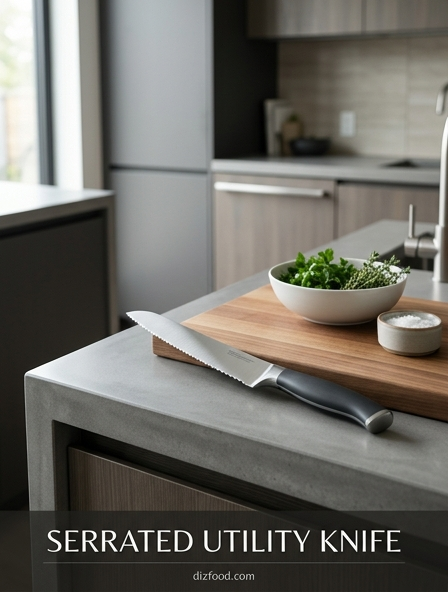
Mastering Waxy Skin Textures
Working with waxy-skinned produce like bell peppers, heirloom tomatoes, and plums often presents a unique challenge for home cooks. The smooth, hydrophobic surface of these ingredients is designed by nature to repel moisture, which unfortunately also causes standard straight-edged blades to glide or skids across the surface. Mastering these textures requires a tool that can pierce the outer membrane without requiring excessive downward force, which often leads to crushing the delicate interior.
The serrated utility knife is the primary solution for these slippery ingredients. By utilizing a series of sharp, pointed teeth, the blade catches the waxy skin immediately upon contact. This mechanical advantage allows for a clean entry point, ensuring that the knife does not veer off course and cause potential injury. When using this tool, focus on a light, rhythmic sawing motion rather than a hard press. This technique preserves the structural integrity of the vegetable while ensuring every slice is uniform and clean.
- Bell Peppers: The serrations bite into the skin, preventing the blade from slipping toward fingers.
- Tomatoes: Allows for paper-thin slices without squeezing out the seeds and juice.
- Plums and Nectarines: Easily cuts through the taught, waxy exterior without bruising the soft flesh.
- Eggplants: Navigates the thick, glossy skin with minimal resistance.
The Science of Serrated Edges
The effectiveness of a serrated utility knife lies in the physics of pressure distribution. While a straight edge distributes the force of a cut along the entire length of the blade contact point, a serrated edge concentrates that same force onto the tips of its individual teeth. This results in significantly higher pounds-per-square-inch at the points of contact, allowing the knife to "puncture" through tough or slick materials that would otherwise resist a smooth edge. This makes the utility knife an essential hybrid between a chef's knife and a bread knife.
In addition to pressure concentration, the scalloped valleys between the teeth reduce the overall surface area of the blade that touches the food. This reduction in friction is vital when cutting through moist or sticky interiors, as it prevents the "suction" effect that often causes slices to stick to the side of the blade. The following table highlights the mechanical differences between edge types:
| Feature | Straight Edge | Serrated Edge |
|---|---|---|
| Contact Points | Continuous line | Multiple discrete points |
| Primary Action | Push and slice | Sawing and tearing |
| Friction Level | High on slick surfaces | Low due to recessed scallops |
Precision Slicing for Slick Produce
Achieving precision when dealing with slick produce is a matter of both tool selection and hand positioning. Slick produce, such as cucumbers or damp zucchini, can be treacherous if the knife lacks the necessary "bite." The serrated utility knife provides a level of topographical engagement that a straight blade cannot match. This engagement is crucial for maintaining the intended line of the cut, especially when attempting advanced maneuvers like julienne strips or bias-cut medallions. Without the teeth to anchor the blade, the knife is prone to lateral movement.
To maximize precision, the cook should employ the "claw grip" for the guiding hand while using the serrated blade to initiate the cut. Because the teeth do the work of breaking the surface, the cook can focus entirely on the thickness and angle of the slice. This results in professional-grade consistency that enhances both the cooking time and the visual appeal of the final dish. Follow these steps for the best results:
- Secure the produce on a stable, non-slip cutting board.
- Place the tip of the serrated blade at a slight angle against the skin.
- Draw the knife back slowly to allow the teeth to "score" the surface.
- Complete the cut with a fluid forward-and-down motion.
Why Straight Blades Fail on Wax
The failure of straight blades on waxy surfaces is primarily due to the lack of "tooth" or mechanical grip. A straight edge relies on a microscopic level of roughness to catch the surface of what it is cutting. When a blade becomes even slightly dull, or when the surface it is cutting is exceptionally smooth-like the skin of a chili pepper-the blade simply cannot find an anchor point. This leads to a dangerous phenomenon where the knife slides laterally, often toward the user's knuckles, rather than penetrating the ingredient.
Furthermore, straight blades often require significant downward pressure to break through a waxy barrier. This pressure is the enemy of delicate produce. For example, when cutting a ripe tomato with a straight blade, the force required to break the skin often exceeds the structural strength of the tomato's internal walls, leading to a crushed, messy result. The serrated utility knife bypasses this requirement by using its pointed geometry to breach the wax with almost zero downward force.
- Surface Tension: Waxy skins create a high-tension barrier that resists smooth edges.
- Dullness Sensitivity: Straight edges require constant honing to remain effective on wax.
- Compression: The force needed for a straight cut often deforms the ingredient.
- Safety Risks: Uncontrolled sliding is the leading cause of minor kitchen nicks.
Serrated Utility Knife Dicing Techniques
Dicing with a serrated utility knife requires a departure from the traditional rock-chop method used with a chef's knife. Because the serrations are designed to saw, the motion must be more horizontal. This is particularly useful for small-to-medium ingredients where a large knife feels cumbersome. When dicing a tomato or a small onion, the utility knife's shorter length-typically between four and seven inches-provides superior maneuverability, allowing for tighter turns and more intricate control during the dicing process.
To produce perfect cubes, the user should first create stable flat surfaces on the ingredient. Once the ingredient is stabilized, the serrated blade can be used to create vertical planks, then strips, and finally the dice. The sawing action should be light and rapid. This ensures that even the most fragile items, like a very soft avocado or a roasted red pepper, maintain their shape throughout the process. Consistency in dicing is not just about aesthetics; it ensures that every piece of food cooks at the same rate in the pan.
- Slice off the top and bottom of the produce to create a stable base.
- Cut the ingredient into uniform vertical slices using a gentle sawing motion.
- Stack the slices and cut them into long, even batons.
- Rotate the batons 90 degrees and cut across them to create final cubes.
Preserving Ingredient Integrity and Shape
Maintaining the visual and structural integrity of ingredients is a hallmark of high-level cooking. When ingredients are squashed or bruised during prep, they lose essential juices and undergo rapid oxidation, which can affect both flavor and color. The serrated utility knife is specifically designed to preserve these qualities. By cutting through fibers with a "micro-tearing" action rather than a "crushing" action, the blade leaves the internal cell structure of the produce relatively undisturbed. This is especially important for ingredients served raw, such as in salads or garnishes.
Consider the difference in a citrus slice cut with a dull straight blade versus a sharp serrated one. The serrated blade zips through the pith and the delicate juice membranes without squeezing the fruit, leaving the segments plump and intact. This preservation of shape is vital for presentation. Whether you are preparing a carpaccio of vegetables or a fruit tart, the tool you use determines if the edges of your ingredients look clean or ragged. Using a serrated utility blade ensures that the "face" of every slice remains smooth and vibrant.
- Cellular Retention: Keeps moisture inside the produce instead of on the cutting board.
- Clean Margins: Prevents the "frayed" look on the edges of soft fruits.
- Volume Preservation: Prevents bread or soft vegetables from collapsing under the knife.
- Aesthetic Consistency: Produces professional-looking results for home-cooked meals.
Improving Kitchen Safety with Grip
Safety in the kitchen is often a matter of friction and control. A knife that slips is a knife that causes injury. The serrated utility knife is inherently safer for many tasks because its teeth provide an immediate "lock" onto the surface of the food. This mechanical connection reduces the likelihood of the blade skipping off a round or wet surface. Additionally, the utility knife is generally lighter and more balanced for smaller hands or tasks that require fine motor skills, reducing hand fatigue which can lead to mistakes.
Proper grip is essential to maximize this safety. The user should hold the handle firmly with the thumb and index finger "pinching" the base of the blade for maximum leverage. This grip, combined with the serrated edge, allows for total control over the depth and direction of the cut. Because the blade requires less downward pressure, the cook is less likely to lose their balance or over-extend a movement if the knife finally breaks through a tough spot. Safety is a combination of the right tool and the right technique.
| Safety Aspect | Serrated Advantage |
|---|---|
| Lateral Stability | Teeth anchor the blade to prevent side-to-side slipping. |
| Force Requirement | Minimal downward pressure reduces the risk of over-travel. |
| Control | Smaller blade size offers better visibility and precision. |
Efficient Slicing for Slippery Skins
Efficiency in the kitchen is measured by how quickly and cleanly one can move through a "mise en place." Slippery-skinned ingredients like cherry tomatoes, grapes, and citrus fruits can be time-consuming if the knife requires constant repositioning. The serrated utility knife excels at high-volume, repetitive slicing of these items. Because the blade catches the skin instantly, the cook can develop a rapid, fluid cadence. This is why the serrated utility knife is often referred to as a "sandwich knife" or "tomato knife" in professional environments; it handles the high-speed demands of prep work with ease.
To increase efficiency, use the full length of the blade. Many cooks make the mistake of using only the middle of the knife. By starting the cut at the heel and pulling through to the tip, you utilize every serration, making the work even faster. This is particularly useful for slicing through a whole stack of small items at once or quickly processing a bag of peppers for a stir-fry. The serrated edge stays sharp longer than a straight edge, meaning less time spent on maintenance and more time on active preparation.
- Cherry Tomatoes: Can be sliced in halves or quarters in seconds without mess.
- Grapes: Perfectly halved for salads without losing their circular shape.
- Small Citrus: Quick wedges for drinks or garnishes with no pith resistance.
- Chilies: Fast rings for heat and decoration without the blade sliding on the wax.
The Versatility of the Utility Blade
While often pigeonholed as a vegetable tool, the serrated utility blade is one of the most versatile instruments in the kitchen. Its unique size-larger than a paring knife but smaller than a chef's knife-makes it the "goldilocks" tool for a variety of tasks. It is just as capable of slicing through a crusty baguette roll as it is at de-boning a small piece of poultry or trimming fat from a steak. The serrations allow it to tackle hard materials, like the tough skin of a winter squash, while its slender profile allows for delicate work like coring an apple.
This versatility makes it the ideal "grab-and-go" knife for quick kitchen tasks. If you need to slice a sandwich, cut a lemon, and then dice an onion, the serrated utility knife can perform all three duties without requiring a tool change. This adaptability is especially valuable in smaller kitchens or for outdoor cooking where space and equipment are limited. It bridges the gap between specialized tools, offering a multi-functional edge that handles both soft and hard textures with equal proficiency.
- Small Breads: Perfect for bagels, croissants, and hard-crusted dinner rolls.
- Cooked Meats: Slices through seared surfaces of chicken or steak cleanly.
- Hard Cheeses: The teeth help break through aged rinds without the blade sticking.
- Fibrous Veggies: Easily cuts through celery, ginger, and lemongrass.
Optimizing Prep for Thin Skinned Fruit
Delicate fruits with thin skins, such as peaches, figs, and kiwis, require a gentle touch that most heavy kitchen knives cannot provide. The goal with these ingredients is to remove the skin or create slices without bruising the flesh, which is often very soft and high in sugar. A serrated utility knife is the optimal choice here because it "shaves" through the thin skin. The small serrations act like a micro-saw, allowing the cook to follow the contours of the fruit with extreme accuracy, minimizing waste and keeping the fruit's shape perfect for plating.
When preparing these fruits, it is best to use the tip of the knife for detail work. For instance, when hulling a strawberry or removing the stem of a fig, the sharp point combined with the serrated edge allows for a clean rotation that pops the unwanted parts out without tearing the surrounding fruit. For larger thin-skinned fruits like mangoes, the utility knife can navigate around the large central pit with more agility than a bulky chef's knife. This precision ensures that the most flavor-dense parts of the fruit are preserved for the dish.
- Hold the fruit lightly to avoid bruising the soft interior.
- Use long, shallow strokes to peel the skin away in thin strips.
- Follow the natural curve of the fruit with the blade's tip.
- Slice with a continuous motion to ensure the smoothest possible surface.

Comments