
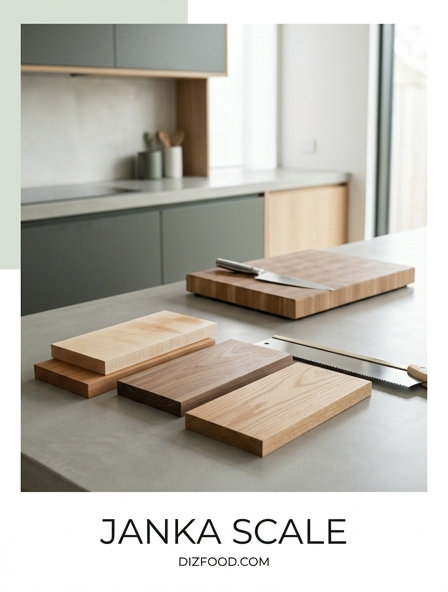
Understanding Janka Hardness Ratings
The Janka hardness scale is a fundamental metric used in the culinary industry to determine the suitability of wood species for cutting surfaces. Originally developed by Gabriel Janka in 1906, the test measures the amount of force, typically recorded in pounds-force (lbf), required to embed a 0.444-inch steel ball halfway into a sample of wood. In the context of a kitchen, this rating serves as a definitive guide for balancing durability against tool maintenance. A high Janka rating indicates a dense, resistant material, while a lower rating suggests a softer, more forgiving surface.
Understanding these values is crucial because the hardness of a work surface directly dictates how a knife interacts with the board. If a wood is too soft, the blade will create deep furrows, which harbor bacteria and compromise food safety. Conversely, if the wood is excessively hard, the surface will not yield, causing the delicate edge of a high-carbon steel knife to roll or chip upon impact. Therefore, selecting a material based on its Janka score is the first step in optimizing a kitchen's workflow and equipment lifespan.
Impact of Wood Density on Blade Longevity
Wood density, as quantified by the Janka scale, plays a pivotal role in determining how often a chef must hone or sharpen their cutlery. When a knife edge strikes a cutting surface, the wood fibers must provide enough resistance to support the cut without being so rigid that they act as an abrasive. High-density woods, such as Ipe or certain types of Bamboo, possess Janka ratings that exceed the threshold for safe cutting. These materials do not allow the blade to "sink" slightly, resulting in an immediate dulling of the apex through friction and impact shock.
The relationship between density and blade longevity can be summarized by the following mechanical interactions:
- Edge Rolling: Hard surfaces force the thin steel at the edge to bend over, requiring frequent use of a honing rod.
- Micro-chipping: Dense, brittle fibers can cause microscopic pieces of the blade to break off, necessitating professional regrinding.
- Fiber Displacement: Moderate density allows fibers to move aside, preserving the sharpness of the steel for longer periods.
By selecting woods with appropriate density, users can significantly extend the time between sharpening sessions, preserving the geometry of expensive kitchen tools.
The Ideal Janka Range for Cutting Boards
For most kitchen applications, there is a "Goldilocks zone" on the Janka scale where the wood is hard enough to resist significant scarring but soft enough to protect the knife's edge. Professional woodworkers and culinary experts generally agree that this ideal range falls between 900 and 1,500 lbf. Woods within this window offer the perfect structural integrity for heavy dicing, slicing, and chopping while maintaining a sanitary, easy-to-clean surface.
When a board falls below 900 lbf, it is often considered too soft for daily use. Such woods, like Cedar or Pine, suffer from "fuzzing" where the fibers tear away, creating a shaggy texture that is difficult to disinfect. On the upper end, woods exceeding 1,500 lbf, such as Cumaru or Ebony, behave more like stone or glass. These ultra-hard materials are better suited for flooring or furniture rather than food preparation. Staying within the 900 to 1,500 range ensures that the board remains a functional tool rather than a hindrance to the chef's precision and the knife's health.
Softwood vs Hardwood for Precision Dicing
The distinction between softwoods and hardwoods is often misunderstood as a simple measure of density, but it actually refers to the seed structure of the tree. However, in the kitchen, these categories often align with specific Janka ranges that affect precision. Hardwoods, coming from deciduous trees, typically have a complex cellular structure with smaller pores, making them ideal for dicing. Softwoods, from coniferous trees, are generally too porous and lack the "spring-back" required for clean cuts.
- Hardwood Performance: Provides a stable, non-slip surface that allows for consistent blade contact. The tight grain prevents the blade from slipping into natural grooves.
- Softwood Limitations: Often too resinous and soft, leading to "grabbing" where the blade gets stuck in the wood, ruining the fluidity of a dice.
- Precision Factors: Hardwoods maintain a flat plane over time, whereas softwoods can develop uneven dips that prevent the knife from making full contact with the board.
For tasks requiring high accuracy, such as julienne or brunoise cuts, a reliable hardwood with a mid-range Janka rating is essential for professional results.
How Surface Resistance Affects Knife Edges
Surface resistance is the physical manifestation of a wood's Janka rating during the actual cutting motion. When a blade descends, it encounters the surface tension of the wood fibers. This resistance determines the amount of energy reflected back into the knife. A surface with high resistance absorbs very little energy, forcing the steel to bear the brunt of the kinetic force. This is particularly damaging to Japanese knives, which are hardened to a high Rockwell degree and are consequently more brittle than their Western counterparts.
A surface with low to moderate resistance acts as a shock absorber. This "give" allows the edge to penetrate the very top layer of the wood, which stabilizes the blade during the cut. This stabilization prevents lateral movement, which is a leading cause of edge damage. If the surface resistance is too low, however, the knife may sink too deep, requiring more effort to pull the blade back out and slowing down the rhythm of the prep work. Balancing this resistance is key to ergonomic comfort and tool preservation.
Janka Ratings for Popular Wood Species
When selecting a species for a kitchen cutting board, comparing Janka ratings is the most efficient way to narrow down choices. The following table illustrates common woods used in culinary environments and their respective hardness ratings. These values help in predicting how the wood will perform under constant daily use and how it will treat your cutlery over several years of service.
| Wood Species | Janka Rating (lbf) | Suitability Level |
|---|---|---|
| Black Walnut | 1,010 | Excellent (Gentle on Knives) |
| Black Cherry | 950 | Excellent (Soft/Self-healing) |
| Hard Maple | 1,450 | Industry Standard (Durable) |
| Teak | 1,070 | Good (High Oil Content) |
| White Oak | 1,360 | Fair (Open Grain concerns) |
| Bamboo | 1,380 - 1,600 | Variable (Can be Hard) |
Hard Maple remains the benchmark for commercial kitchens due to its high Janka rating and tight grain structure, while Walnut is favored by enthusiasts for its aesthetic appeal and slightly softer touch.
End Grain Construction and Tool Protection
The orientation of wood fibers significantly modifies how the Janka hardness affects a knife. In edge-grain or face-grain boards, the knife cuts across the long fibers of the wood, essentially severing them. This requires the blade to fight the full Janka resistance of the wood's lateral structure. However, end-grain construction orients the wood fibers vertically, like the bristles of a brush. When the knife strikes an end-grain board, the edge slides between the fibers rather than cutting through them.
This construction method offers superior tool protection because the "apparent hardness" of the board is lower than the actual Janka rating suggests. The fibers pull apart to accommodate the blade and then spring back into place once the pressure is released, a property known as "self-healing." This not only keeps the board looking new for longer by hiding knife marks but also ensures that the knife remains sharp for significantly longer periods compared to an edge-grain board of the same wood species. It is the preferred choice for high-end professional environments.
Finding the Balance Between Durability and Sharpness
Choosing a kitchen surface is an exercise in finding the equilibrium between the durability of the board and the sharpness of the knife. A board that is indestructible, like those made of granite, glass, or extremely high-Janka woods, will destroy a knife edge in a single session. Conversely, a board that is perfectly gentle on a knife might require replacement every few months due to deep scarring and warping. The goal is to select a material that provides a multi-year lifespan without requiring weekly knife sharpening.
Hard Maple and Black Walnut are often cited as the ultimate compromise. They possess enough Janka hardness to withstand the rigors of heavy cleaver work and high-volume prep while remaining soft enough to maintain a razor-sharp edge on delicate paring knives. This balance also affects user fatigue; a board with the right amount of "spring" reduces the impact felt in the chef's wrist and forearm. Investing in a board within the 1,000-1,200 Janka range typically yields the best long-term results for both the wood and the steel.
Why Board Hardness Dictates Cutting Technique
The hardness of a cutting surface should influence the specific technique a cook employs. On a softer board with a lower Janka rating, a "rocking" motion is highly effective because the board provides enough grip to act as a pivot point. The blade can safely press into the wood without fear of slipping. However, on harder surfaces like Bamboo or Acacia, a "push-cut" or "draw-cut" is often safer. These techniques minimize the impact force, which is critical when the board offers high resistance that could otherwise deflect the blade.
Furthermore, board hardness dictates the amount of downward pressure required. On a dense surface, applying excessive pressure can cause the edge to "skate" across the wood, leading to potential accidents. A lighter touch is necessary to maintain control. Conversely, a soft board allows for more aggressive chopping. Understanding where your board sits on the Janka scale allows you to adjust your physical mechanics, ensuring that your cutting style is synchronized with the material's properties for maximum safety and efficiency.
Long Term Knife Care and Surface Selection
Long-term maintenance of kitchen knives is inseparable from the selection of the cutting surface. Even the most expensive steel will fail if paired with an inappropriate Janka-rated material. To ensure the longevity of a professional kit, the surface must be maintained alongside the blades. This involves regular oiling with food-grade mineral oil to keep the fibers supple. When fibers become dry and brittle, their effective hardness increases, making them more abrasive to knife edges regardless of their original Janka score.
When the surface becomes heavily scarred, it should be sanded down to restore a flat, smooth plane. A rough surface creates uneven resistance, which can catch the knife edge and cause micro-torsion, leading to chips. By choosing a wood with a proven Janka rating-such as Cherry or Maple-and following a strict maintenance regimen, you create a symbiotic relationship between your tools and your workspace. This holistic approach reduces the cost of professional sharpening and ensures that your knives perform at their peak for decades, rather than months.


Comments