
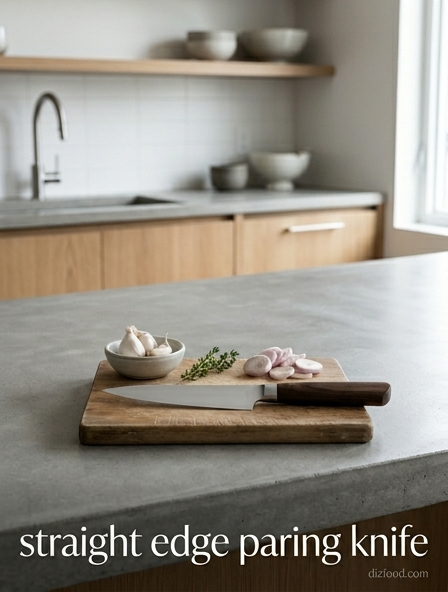
Understanding Straight Edge Paring Knives
A straight edge paring knife is an indispensable tool in the culinary world, characterized by its short, nimble blade typically measuring between two and four inches. Unlike its serrated counterparts, the straight edge provides a clean, smooth cut that is essential for tasks requiring extreme precision. This blade profile allows for full contact with the cutting surface, making it ideal for downward pressure cuts and intricate hand-held work. Professional chefs often rely on the straight edge for its versatility in handling delicate tasks that a larger chef's knife cannot manage efficiently.
- Blade Length: 2.5 to 4 inches for optimal leverage.
- Edge Type: Non-serrated for uniform, smooth slices.
- Handle Design: Ergonomically shaped to fit the palm during air-cutting.
- Steel Quality: Usually high-carbon stainless steel for edge retention.
The utility of this knife extends beyond mere cutting; it is the primary instrument for peeling, trimming, and coring. Because the blade is short, the user gains a high degree of control over the tip, which is vital when removing seeds or eyes from vegetables. Understanding the geometry of the straight edge helps in maintaining the correct sharpening angle, ensuring the tool remains a reliable extension of the cook's hand during rigorous meal preparation.
Essential Grips for Maximum Precision
Mastering the grip on a paring knife is the first step toward achieving professional-grade results in the kitchen. Unlike larger knives that require a full-fisted grip, the paring knife demands a more nuanced approach, often involving the fingertips to guide the blade. The most common technique is the "choke grip," where the thumb and index finger pinch the base of the blade while the remaining fingers wrap around the handle. This provides a pivot point that allows for micro-adjustments during delicate slicing or dicing tasks.
- The Paring Grip: Hold the handle in your palm and use your thumb as a guide against the ingredient.
- The Pinch Grip: Thumb and forefinger rest on the blade spine for stability on a cutting board.
- The Reverse Grip: Used primarily for peeling toward the body with controlled tension.
Choosing the right grip depends heavily on whether the work is being done against a cutting board or in the air. For air-cutting, such as peeling an apple, the thumb acts as a crucial stabilizer and safety guard. Maintaining a relaxed but firm hold prevents hand fatigue and reduces the risk of the blade slipping, especially when working with slippery or high-moisture produce like citrus or tomatoes.
Techniques for Seamless Produce Peeling
Peeling with a straight edge paring knife offers a level of control that mechanical peelers simply cannot match, especially with irregularly shaped produce. The secret to a seamless peel lies in the synchronization between the hand holding the knife and the hand holding the ingredient. Instead of moving only the knife, the cook should rotate the fruit or vegetable into the blade, allowing the straight edge to glide just beneath the skin. This minimizes waste by ensuring that only the outermost layer is removed while preserving the nutrient-dense flesh underneath.
- Start at the poles of the fruit to create a flat entry point.
- Use a thumb-guided motion to regulate the depth of the cut.
- Maintain a consistent blade angle to prevent gouging the produce.
- Follow the natural contour of the item for a uniform appearance.
This technique is particularly effective for thick-skinned items like citrus or root vegetables like parsnips. A sharp straight edge ensures that the knife doesn't "catch" on the skin, which can lead to jagged edges or accidental cuts. By mastering the rotational peel, a chef can prepare ingredients faster and with a much more aesthetic finish, suitable for high-end culinary presentations.
Mastering Curved Surface Blade Control
Navigating the curves of round ingredients requires a sophisticated understanding of blade contact points. A straight edge paring knife, while flat, must be manipulated with subtle wrist movements to follow the arc of an onion, potato, or apple. The key is to use the belly of the blade-the slightly curved portion near the tip-to maintain constant contact. This prevents the "flat-spotting" effect where a straight blade accidentally creates facets on a rounded surface instead of a smooth, continuous curve.
| Ingredient | Control Strategy | Expected Outcome |
|---|---|---|
| Shallots | Tip-centric slicing | Translucent, uniform rings |
| New Potatoes | Rotational wrist flick | Cleanly removed skins |
| Radishes | Short, sweeping arcs | Decorative rounded slices |
When working on curved surfaces, the user must often adjust the angle of the blade mid-stroke. This requires a tactile sensitivity that comes from practice. By focusing on the point where the metal meets the skin, you can feel the resistance and adjust the pressure accordingly. This mastery is essential for advanced tasks like "turning" vegetables (tourné), where the knife is used to create consistent, barrel-shaped pieces from irregular roots.
Intricate Dicing and Small Scale Prep
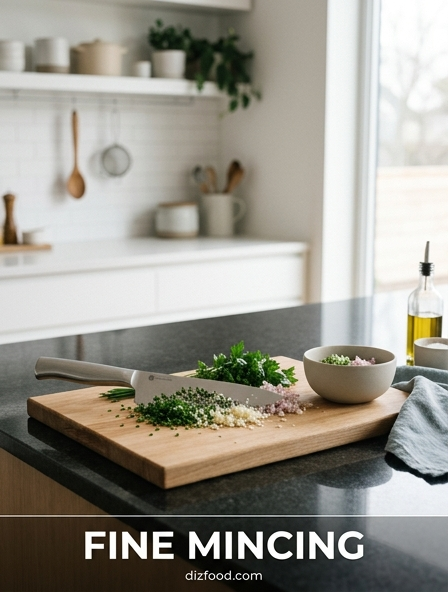
Small-scale preparation is where the straight edge paring knife truly outshines all other cutlery. When dealing with aromatics like garlic, ginger, or shallots, the precision of a small blade allows for incredibly fine dicing that would be cumbersome with a chef's knife. The straight edge ensures that every millimeter of the blade makes contact with the board, preventing "accordion" cuts where pieces remain attached at the bottom. This uniformity is vital for even cooking and flavor distribution in delicate sauces or vinaigrettes.
- Horizontal incisions: Make parallel cuts into the ingredient while keeping it intact.
- Vertical longitudinal cuts: Slice through the ingredient toward the root.
- Crosswise dicing: Cut across the previous slices to create perfect cubes.
Beyond aromatics, this knife is the preferred tool for segmenting stone fruits or dicing berries for garnishes. The compact size allows the cook to work close to the ingredient, providing a better line of sight for intricate work. Because the movements are smaller and more controlled, the risk of crushing delicate tissues-like those in a ripe strawberry or a soft mushroom-is significantly reduced, resulting in a cleaner and more professional presentation.
Safety Protocols for Handheld Cutting
Because the paring knife is frequently used for "in-the-air" cutting, safety protocols must be strictly observed to prevent injury. The primary rule is to always be mindful of the thumb's position. When peeling or slicing toward the body, the thumb should be placed on the ingredient in a way that acts as a stopper for the blade's handle, not its edge. This creates a controlled "pinch" motion where the knife moves toward the thumb but is halted by the anatomy of the hand or the resistance of the food before contact is made.
- Always cut on a stable surface when possible; reserve hand-cutting for peeling.
- Ensure hands and the knife handle are completely dry to prevent slipping.
- Keep the blade pointed away from the palm at all times.
- Pass the knife to others by placing it on a surface, never hand-to-hand.
A common misconception is that a dull knife is safer; in reality, a dull paring knife requires more force, which increases the likelihood of a slip. Keeping the blade razor-sharp allows it to bite into the produce immediately, requiring less physical exertion and offering more predictable control. Additionally, always work in a well-lit area to maintain clear visibility of the blade's tip during intricate tasks.
Creative Garnishing with Straight Blades
The straight edge paring knife is the primary instrument for culinary artistry and garnishing. Its ability to make sharp, angular incisions makes it perfect for creating V-shaped cuts, intricate patterns, and decorative flourishes. From radish roses to cucumber fans, the straight blade provides the geometric precision needed for symmetrical designs. Unlike a curved bird's beak knife, the straight paring knife is better for creating long, flat planes and precise decorative notches in firm vegetables.
- Citrus Zesting: Remove long, wide strips of pith-free peel for cocktails.
- Strawberry Fans: Make multiple parallel cuts through the berry while keeping the hull intact.
- Tomato Roses: Peel the skin in one continuous strip to roll into a flower shape.
- Chocolate Shaving: Drag the blade across a block for delicate curls.
Garnishing is as much about the tool as it is about the technique. The straight edge allows for "stop-cuts," where the blade is inserted to a specific depth and then stopped abruptly to create clean geometric patterns. This precision is essential for professional plating, where the visual appeal of a dish is enhanced by the meticulous detail of the garnishes. Mastering these techniques elevates a standard meal into a gourmet experience.
Sharpening for Intricate Detail Work
To maintain the high performance required for detail work, a straight edge paring knife must be sharpened with a focus on the apex and the tip. Because these knives are small, they can be challenging to hold at a consistent angle on a whetstone. A 15 to 20-degree angle is generally recommended to balance sharpness with edge durability. Because the blade is short, it is easier to apply uneven pressure, so users must be careful to sharpen the entire length of the edge, from the heel to the very point.
| Grit Level | Purpose | Frequency |
|---|---|---|
| 400 to 800 | Repairing nicks and resetting the bevel | Rarely (as needed) |
| 1000 to 3000 | General sharpening and edge refinement | Monthly |
| 5000+ | Polishing for razor-like precision | Weekly for pros |
After sharpening, honing with a ceramic rod can help maintain the edge between sessions. Since paring knives are often used for acidic fruits, the steel can undergo microscopic corrosion; regular cleaning and drying are essential. A well-maintained, polished edge reduces the friction during cutting, which is particularly important when performing delicate tasks like deveining shrimp or removing the silver skin from a small tenderloin.
Efficient Hulling and Blemish Removal
Efficiency in the kitchen often comes down to how quickly one can process raw ingredients. The straight edge paring knife excels at hulling strawberries, coring tomatoes, and removing blemishes from potatoes or apples. The sharp, pointed tip is designed to be inserted into the produce and rotated to pop out unwanted sections with minimal loss of the surrounding fruit. This "surgical" approach is much faster and cleaner than using a larger knife or a specialized coring tool that may not fit the specific size of the ingredient.
- Insert the tip at a 45-degree angle near the stem or blemish.
- Rotate the ingredient 360 degrees while keeping the knife stationary.
- Lever the tip upward to remove the core or spot.
This method is also ideal for "eyeing" pineapples or removing the woody ends of asparagus. By utilizing the tip as a pivot, you can work through a large volume of produce in a fraction of the time. The straight edge ensures that once the blemish is removed, the remaining surface is smooth and ready for further prep or immediate serving, maintaining the integrity of the food's appearance.
Optimizing Workflow with Paring Knives
Integrating a paring knife effectively into your workflow can significantly reduce prep time and cleanup. While a chef's knife is the workhorse for bulk chopping, the paring knife should be kept within reach for the "in-between" tasks that arise during a recipe. For example, if you are chopping onions with a large knife but notice a blemish or need to quickly peel a clove of garlic, switching to a paring knife is often more efficient and safer than trying to use the heel of a ten-inch blade.
- Keep the paring knife in a dedicated spot on the cutting board.
- Use it for opening packaging to preserve the edge of your larger knives.
- Employ it for "checking" the tenderness of boiling vegetables.
- Clean it immediately; its small size makes it prone to getting lost in soapy water.
Optimizing workflow also involves knowing when the paring knife is *not* the right tool. It should never be used for heavy-duty tasks like cutting through bone or hard squashes, as the thin blade can snap or slip. By respecting the tool's limitations and utilizing its strengths for precision, detail, and hand-held prep, you create a more fluid and professional kitchen environment that prioritizes both speed and culinary excellence.


Comments