
Mastering the art of the dice is a fundamental skill that elevates your cooking from basic to professional, yet the approach differs significantly depending on your choice of allium. While onions offer a robust, multi-layered structure ideal for high-volume prep and uniform cubes, shallots present a more delicate challenge with their asymmetrical, garlic-like lobes and thinner membranes. Choosing the right dicing technique isn't just about aesthetics; it's about controlling flavor release and ensuring even cooking. Whether you are aiming for the microscopic precision required for a classic French mignonette or the hearty texture of a rustic mirepoix, understanding the structural nuances between these two bulbs will help you achieve the perfect cut for your specific culinary needs.
| Feature | Onion Dicing | Shallot Dicing |
|---|---|---|
| Precision Level | Standard; 1/4" to 1/2" cubes typical. | High; "Brunoise" (1/8") is easily achievable. |
| Cell Structure | Thick, juicy rings; prone to slipping. | Tight, thin layers; allows for finer cuts. |
| Flavor Profile | Pungent and sharp; mellows with heat. | Subtle, sweet, with hints of garlic. |
| Knife Choice | 8" Chef's knife for leverage/volume. | 3.5" Paring or Petty knife for control. |
| Best Application | Soups, stews, and sautéed bases. | Raw dressings, garnishes, and pan sauces. |
| Waste Factor | Low; uniform shape minimizes scraps. | Moderate; irregular lobes require trimming. |
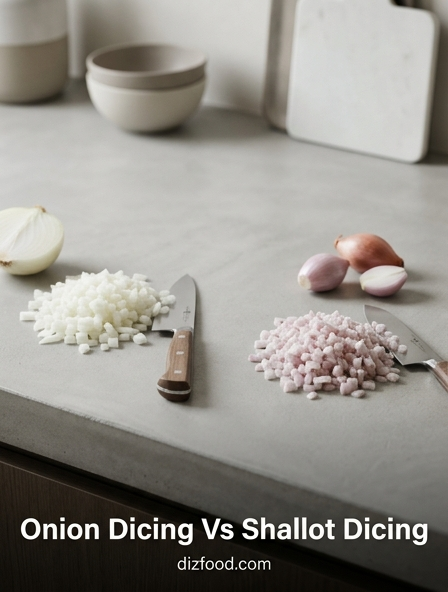
Mastering Onion and Shallot Dicing Techniques
Achieving a professional-grade dice begins with understanding the physical structure of the vegetable. For both onions and shallots, the root end is your most important tool for stability. By keeping the basal plate intact, the layers remain connected during the cutting process, preventing the slippery layers from sliding apart. To begin, slice off the stem end and peel back the papery skin. For shallots, which often contain multiple bulbs within a single skin, separate these cloves first to ensure each has a flat surface for contact with the cutting board.
Once prepped, the dicing sequence follows a specific geometric pattern to ensure efficiency and safety. This systematic approach reduces the amount of handling required, which keeps the produce fresher and your fingers safer. Follow these steps for a perfect result:
- Halve the allium through the root and place the flat side down.
- Make a series of vertical incisions toward the root, but do not cut all the way through the base.
- For larger onions, perform one or two horizontal cuts parallel to the board to create a grid within the layers.
- Slice crosswise to release the uniform cubes.
- Discard the remaining root nub or save it for stocks.
The primary difference between the two lies in the scale of the cuts. Shallots require a much finer touch due to their smaller diameter and tighter layers. While a standard onion dice might be a quarter-inch, a shallot is frequently minced to a sixteenth of an inch to allow it to dissolve into delicate sauces and vinaigrettes.
Understanding Allium Anatomy for Better Prep
To master the art of the dice, one must look closely at the biological construction of these bulbs. Both onions and shallots are modified leaves that store energy for the plant. These fleshy leaves grow in concentric circles around a central apical bud. This "layer-within-layer" structure is what allows cooks to create a grid-like dice without needing to cut every individual piece manually. By making vertical and horizontal incisions, you are essentially pre-segmenting the naturally occurring rings before the final cross-cut releases them.
However, shallots differ significantly in their internal geometry. Unlike the single-centered globe of a standard yellow onion, a shallot often resembles garlic in its tendency to form clusters. A single shallot skin may house two or three distinct bulbs, each with its own root system. Understanding this is crucial because attempting to dice a double-lobed shallot as a single unit will result in irregular, uneven pieces. You must separate these lobes and treat each as a miniature onion to maintain control over the blade.
- Epidermis: The thin, papery outer layer that must be removed entirely to avoid a "woody" texture.
- Tunic: The outermost fleshy layer, which is often tougher and may need to be discarded if it is overly fibrous.
- Basal Plate: The root end that holds all layers together; the anchor of your dicing technique.
- Vascular Bundles: The internal grains that dictate the direction of your vertical slices.
The Importance of Uniform Dice Size
Uniformity in dicing is not merely a matter of visual aesthetics; it is a fundamental requirement for consistent cooking. When pieces of onion or shallot are of varying sizes, they respond to heat at different rates. Small fragments will caramelize or burn before larger chunks have even begun to soften. This leads to a dish with "hot spots" of bitter, overcooked alliums and "cold spots" of raw, pungent centers. In professional kitchens, this precision is the hallmark of a skilled line cook.
In addition to even cooking, the size of the dice determines the rate at which flavors are released into the surrounding fat or liquid. A fine brunoise offers more surface area relative to its volume than a large dice, meaning it will sweat and release its sugars much faster. This is why shallots, which are prized for their subtle sweetness, are almost always diced finer than onions. They are intended to provide a background note rather than a chunky texture. The following table outlines standard dimensions for common allium cuts:
| Cut Name | Dimensions | Common Use |
|---|---|---|
| Fine Brunoise | 1/16" x 1/16" x 1/16" | Shallot vinaigrettes and garnishes |
| Small Dice | 1/4" x 1/4" x 1/4" | Sautéed onions for soups and stews |
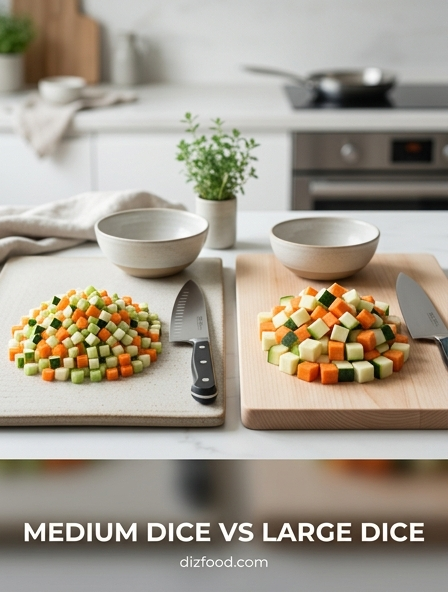
| Medium Dice | 1/2" x 1/2" x 1/2" | Mirepoix for stocks and braises |
Best Knives for Slicing and Dicing
The choice of cutlery can make the difference between a clean, crisp dice and a mangled, bruised mess. For onions, a standard 8-inch chef's knife is the industry workhorse. The length of the blade provides the necessary leverage to cut through the dense layers of a large onion in a single, fluid motion. The weight of the knife does most of the work, allowing for a rocking motion that is efficient for high-volume prep. A sharp edge is non-negotiable; a dull blade crushes the cell walls of the onion, releasing the enzymes that cause eye irritation.
Shallots, due to their diminutive size and delicate nature, often require a different tool. While a chef's knife can be used, many professionals prefer a paring knife or a smaller utility knife for the initial peeling and separating of the lobes. For the actual dicing, a Japanese Santoku or a smaller 6-inch petty knife is often ideal. These blades are typically thinner and have a shallower bevel, allowing for extreme precision when creating a microscopic brunoise. A thinner blade also experiences less friction as it passes through the tight, compact layers of the shallot, preventing the vegetable from splitting prematurely.
- Chef's Knife: Best for large yellow, white, or red onions where volume and speed are priorities.
- Paring Knife: Essential for peeling shallots and removing the tough root ends with precision.
- Santoku: Excellent for shallots due to the thin blade and straight edge which facilitates clean vertical cuts.
- Honing Rod: Necessary to maintain the edge alignment during long prep sessions to ensure clean cells.
Flavor Profiles of Onions versus Shallots
While onions and shallots both belong to the genus Allium, their chemical compositions and flavor profiles are distinct. Onions are known for their high sulfur content, which provides that characteristic "bite" and pungent aroma when raw. As they cook, these sulfur compounds break down, and the natural sugars caramelize, resulting in a deep, savory sweetness. Yellow onions are the all-purpose choice for their balanced sugar-to-sulfur ratio, while white onions are sharper and red onions offer a more peppery, floral note that is ideal for raw applications.
Shallots offer a more sophisticated and nuanced flavor palette. They are often described as a cross between a red onion and a mild garlic bulb. Shallots lack the aggressive acidity of an onion, providing a subtle sweetness that does not overpower delicate ingredients like scallops, butter, or white wine. This refinement makes them the preferred choice for French cuisine, particularly in sauces like Béarnaise or Beurre Blanc. Because their flavor is less "loud," they can be used in higher concentrations without masking the primary protein of a dish.
- Sulfur Intensity: Onions have a high concentration; shallots have a much lower, more manageable level.
- Sugar Content: Shallots are denser in natural sugars, leading to faster caramelization.
- Aroma: Onions are pungent and pervasive; shallots are aromatic and slightly garlicky.
- Raw Usage: Shallots are milder when raw; onions often require soaking in water to mellow their intensity.
How Dicing Affects Cooking Time
The size of your dice is the primary variable in the thermodynamics of the sauté pan. When you dice an onion or shallot, you are increasing the total surface area exposed to the cooking fat and heat. A finely diced shallot has a massive surface-area-to-volume ratio, which means the heat penetrates the center of each piece almost instantly. Consequently, shallots can turn from translucent to golden brown in under sixty seconds. If you are substituting diced onions for shallots in a recipe, you must adjust your heat levels or timing to prevent the smaller pieces from scorching.
Onions, being larger and containing more water, require a longer duration to undergo the Maillard reaction. A medium dice is suitable for long-simmering dishes like stews or ragus where the onion has time to break down and melt into the liquid. However, if you are making a quick stir-fry, a finer dice or thin slice is required to ensure the onion is cooked through before the other vegetables become mushy. Understanding the "sweating" phase-where the allium releases its moisture without browning-is easier with a uniform dice, as every piece will reach transparency simultaneously.
| Allium Type | Dice Size | Est. Sweating Time | Est. Browning Time |
|---|---|---|---|
| Shallot | Fine Brunoise | 1-2 Minutes | 3 Minutes |
| Yellow Onion | Small Dice | 4-5 Minutes | 8-10 Minutes |
| Yellow Onion | Medium Dice | 7-8 Minutes | 15+ Minutes |
Professional Tips for Fine Shallot Mincing
Mincing a shallot to a near-paste consistency is a skill that separates home cooks from professional chefs. Because shallots are small, the margin for error is slim. The first tip is to keep the root end as long as possible. This gives you a "handle" to hold onto as you reach the end of the bulb. Another professional secret is the "radial cut." Instead of making parallel vertical cuts, angle your knife toward the center of the shallot as you move around the curve of the bulb. This ensures that every piece is roughly the same size despite the round shape of the vegetable.
Furthermore, avoid the temptation to "chop" back and forth over a pile of shallots once they have been diced. This action, known as "bruising," crushes the cells and forces out the moisture, leading to a bitter, metallic taste and a soggy texture. Instead, aim for a clean, single-pass dice. If the shallot isn't fine enough, use a sharper knife rather than more force. If the recipe calls for a truly microscopic mince, some chefs will use a mandoline to create paper-thin rings first, then stack those rings and julienne them into tiny points.
- Use a razor-sharp, thin-bladed knife to prevent cell damage.
- Keep the shallot lobes cold; chilled alliums are firmer and easier to cut precisely.
- Maintain a "claw" grip with your non-cutting hand to guide the blade safely.
- Wipe the blade frequently to remove sticky sugars that cause dragging.
Managing Tear Free Onion Dicing
The dreaded "onion cry" is caused by a chemical reaction that occurs when the onion's cell walls are ruptured. An enzyme called alliinase reacts with amino acid sulfoxides to produce syn-propanethial-S-oxide, a volatile gas. When this gas reaches the moisture in your eyes, it turns into a mild form of sulfuric acid. To minimize this, the most effective strategy is to use an exceptionally sharp knife. A sharp blade glides through cells like a scalpel, while a dull blade smashes them, releasing significantly more gas into the air.
Another effective method is to control the temperature and airflow of your workspace. Chilling onions in the refrigerator for 30 minutes before dicing slows down the enzymatic reaction, making the gas less volatile. Additionally, working near a stovetop vent or a small fan can help pull the gas away from your face before it reaches your eyes. While many "folk remedies" exist, such as holding a piece of bread in your mouth or wearing goggles, the scientific consensus focuses on blade sharpness and temperature control as the most reliable defenses.
- Blade Sharpness: The primary factor in reducing gas release.
- Refrigeration: Lowers the kinetic energy of the volatile compounds.
- Root Integrity: Leave the root for last, as it contains the highest concentration of sulfur.
- Airflow: Position yourself so a breeze carries the vapors away from your eyes.
Texture Differences in Finished Dishes
The structural integrity of onions and shallots leads to different outcomes in the finished texture of a dish. Onions have thick, robust cell walls that can withstand prolonged heat. Even after being sautéed for ten minutes, a diced onion will retain a certain "pop" or crunch unless it is caramelized for an hour or braised in liquid. This makes diced onions an excellent choice for adding bulk and a distinct structural component to salsas, relishes, and chunky pasta sauces.
Shallots, by contrast, possess much thinner layers and a higher concentration of water and sugar. When diced finely and subjected to heat, shallots undergo a process often described as "melting." They lose their physical form rapidly, integrating into the liquid phase of a sauce to create a velvety, thickened consistency. This is why you will rarely find large chunks of shallot in a finished dish; they are meant to be felt as a subtle silkiness on the tongue rather than a discrete bite. In raw applications, like a mignonette for oysters, the fine dice of a shallot provides a delicate crispness that disappears quickly, allowing the flavor of the seafood to remain the star.
- Onions: Provide "heft" and a fibrous bite that survives medium cooking times.
- Shallots: Dissolve into emulsions, contributing to a smoother mouthfeel.
- Caramelization: Onions become jammy; shallots become almost candy-like and crisp.
- Liquid Absorption: Shallots absorb fats and vinegars more readily due to their thinness.
Culinary Applications for Diced Alliums
The choice between dicing an onion or a shallot often dictates the entire direction of a recipe. Diced onions are the foundation of the "holy trinity" and "mirepoix," forming the aromatic base for everything from Cajun gumbo to French pot-au-feu. Their ability to provide a consistent, savory backbone makes them indispensable for high-volume cooking. Because they are inexpensive and hearty, they are used where bulk is required. A large dice is perfect for roasting alongside root vegetables, while a small dice is the standard for a classic soffritto used in Italian sauces.
Diced shallots are reserved for more precision-oriented culinary tasks. They are the essential component of a classic vinaigrette, where their mildness allows them to be used raw without the harsh aftertaste of a raw onion. In the world of pan sauces, shallots are used for "deglazing." After searing a piece of meat, finely diced shallots are tossed into the pan to pick up the browned bits (fond) before being doused with wine or stock. Their rapid softening ensures the sauce is ready in minutes. Additionally, fried shallots-diced and quickly crisped in oil-serve as a high-impact garnish in many Southeast Asian cuisines, providing a concentrated burst of flavor and crunch.
- Onion Applications: Burger toppings, soup bases, chutneys, and stuffing.
- Shallot Applications: Pan-sauce reductions, salad dressings, herb butters, and tartare.
- Raw Use: Use onions for "bite" in tacos; use shallots for "elegance" in fine salads.
- Substitution: If substituting onion for shallot, use the white part of a leek or a very small amount of red onion.


Comments