
Selecting Professional Grade Chef Knives
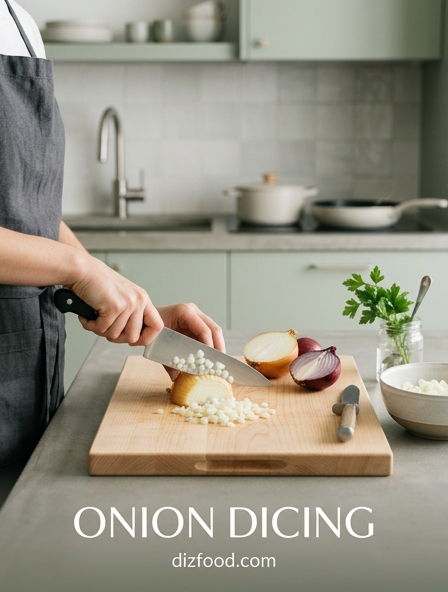
The foundation of efficient onion dicing begins with the selection of a high-quality chef knife. For most culinary tasks involving aromatics, an eight-inch blade crafted from high-carbon stainless steel is the industry standard. This material offers a balance between edge retention and ease of sharpening, ensuring the blade glides through the onion's layers rather than crushing them. A full-tang construction, where the metal extends through the entire handle, provides the necessary durability and weight distribution for repetitive dicing motions. When evaluating a knife, consider the following key components:
- The Bolster: Provides a smooth transition between the blade and handle for a comfortable grip.
- The Spine: Should be thick enough to offer stability without being overly heavy.
- The Edge: A fine, factory-honed edge is essential for precision work.
Ultimately, the knife should feel like an extension of your hand. A well-balanced tool reduces fatigue during high-volume prep sessions, allowing for consistent results throughout the dicing process. Proper maintenance, including regular honing and professional sharpening, is required to preserve the tool's integrity and performance over time.
Proper Grip and Finger Positioning
Safety and control during onion dicing are dictated by how you hold the knife and position your guiding hand. Professional chefs utilize the "pinch grip," where the thumb and index finger grip the base of the blade just past the bolster. This allows for superior leverage and steering compared to holding the handle alone. Your guiding hand must adopt the "claw grip" to protect your fingertips and provide a stable guide for the blade's side. Follow these steps for optimal positioning:
- Tuck your fingertips inward, away from the blade's edge.
- Use your middle knuckle as a vertical guide for the side of the knife.
- Rest your thumb and pinky behind the other fingers to anchor the onion.
By maintaining this configuration, you ensure that the sharp edge remains a safe distance from your skin while maintaining constant contact with the vegetable. This tactile feedback allows you to judge the thickness of each cut by feel rather than sight, which significantly increases dicing speed and accuracy. Constant practice of these hand positions is the most effective way to prevent kitchen injuries and improve technical proficiency.
Creating Stable Flat Bases
A rolling onion is a significant safety hazard in any kitchen environment. The first step in any dicing procedure is to transform the round, unstable vegetable into a stationary object. This is achieved by removing the stem end and bisecting the onion from the pole to the root. By leaving the root end partially intact, you provide a natural anchor that holds the layers together during subsequent cuts. Once the onion is halved, the flat, cut surface is placed directly against the cutting board. This creates a secure foundation that prevents the onion from shifting under the pressure of the knife.
Removing the papery outer skin is also more efficient once a flat base is established. You can easily peel back the layers without the vegetable sliding across the board. If the onion is particularly large, some chefs prefer to take a thin slice off one side before halving it to further enhance stability. A stable base not only ensures safety but also facilitates the precise, vertical cuts required for a uniform dice. This preparation phase is the most critical step for maintaining control throughout the entire dicing sequence.
Mastering the Plank and Stick Method
To achieve a professional dice, one must master the systematic breakdown of the onion half into manageable "sticks" before the final cross-cut. After establishing a flat base, the knife is used to make a series of vertical longitudinal cuts. These cuts should run from the stem end toward the root, stopping just short of the root itself to ensure the onion stays connected. For many years, horizontal cuts were also recommended; however, many modern techniques suggest that the natural radial structure of the onion makes horizontal slices redundant for standard dicing. To execute this method effectively:
- Space your vertical cuts according to your desired dice size.
- Maintain a consistent angle with the knife to ensure even spacing.
- Rotate the onion 90 degrees once the longitudinal sticks are formed.
This method transforms the onion into a grid-like structure. When you finally cut across these "sticks" perpendicularly, the result is a pile of uniform cubes. This systematic approach is far more efficient and safer than attempting to chop the vegetable randomly, as it minimizes the number of passes the blade must make through the product.
Standard Dimensions for Uniform Cubes
In culinary arts, the size of a dice is not merely an aesthetic choice but a technical requirement for specific recipes. Consistency in dimensions ensures that every piece of onion softens at the same rate, preventing a mixture of raw and overcooked fragments. Standard kitchen measurements define these sizes to allow for clear communication between chefs during preparation. Using a ruler can help beginners internalize these dimensions until they become second nature. The following table outlines the common dicing sizes used in professional environments:
| Dice Style | Dimensions (Inches) | Primary Use |
|---|---|---|
| Fine Brunoise | 1/16 x 1/16 x 1/16 | Garnish, Vinaigrettes |
| Small Dice | 1/4 x 1/4 x 1/4 | Sautés, Omelets |
| Medium Dice | 1/2 x 1/2 x 1/2 | Stews, Mirepoix |
| Large Dice | 3/4 x 3/4 x 3/4 | Roasting, Stocks |
Mastering these specific dimensions allows a cook to adapt to various culinary traditions and heat applications, ensuring the final dish has a professional texture and appearance.
Techniques for Large Hearty Textures
While fine dicing is essential for delicate sauces, many rustic dishes require a larger, more hearty texture. Large-format dicing is often used in long-simmering braises, pot roasts, or chunky vegetable soups where the onion needs to withstand extended cooking times without disintegrating. To achieve this, the vertical and horizontal cuts are spaced significantly wider, typically around three-quarters of an inch apart. This technique emphasizes structural integrity over precision. Consider these factors when preparing hearty textures:
- Cooking Time: Larger pieces take longer to translucent and caramelize.
- Mouthfeel: Hearty cuts provide a more substantial presence in the finished dish.
- Visual Appeal: Large dices contribute to a rustic, "home-cooked" aesthetic.
When working with large textures, it is still vital to maintain uniformity. Even if the pieces are big, they must all be roughly the same size to ensure they cook through at the same time. This prevents the frustration of biting into a crunchy piece of onion in an otherwise soft and savory stew. Large dicing is often faster than fine dicing but requires the same level of attention to the initial setup and base stability.
The Impact of Blade Sharpness
A sharp blade is the most important safety feature in any kitchen. When dicing onions, the sharpness of the knife directly impacts both the quality of the cut and the comfort of the cook. Onions contain cells filled with enzymes and amino acid sulfoxides. When a dull knife is used, it crushes these cells rather than slicing through them, releasing a concentrated mist of syn-propanethial-S-oxide. This gas reacts with the moisture in your eyes to form a mild sulfuric acid, causing the stinging sensation and tears commonly associated with onion prep. A razor-sharp edge minimizes cell damage, significantly reducing the release of these irritants.
Furthermore, a sharp knife requires less downward pressure to penetrate the onion's slick outer skin. When you have to force a dull blade, the risk of the knife slipping and causing an injury increases exponentially. A sharp knife bites into the surface immediately, following the intended path with minimal resistance. Maintaining your blade through regular honing on a ceramic rod and periodic sharpening on whetstones is not just about professional results; it is about creating a safer, more pleasant environment for the culinary process.
Consistent Sizing for Even Cooking
Consistency in dicing is the hallmark of a skilled cook because it directly influences the chemistry of the pan. When onions are added to hot fat, the Maillard reaction begins, creating complex flavors and browning. If the pieces vary in size, the smaller bits will brown and potentially burn before the larger pieces have even begun to soften. This leads to an uneven flavor profile characterized by both bitterness and raw acridity. Achieving uniform surface area across all diced pieces ensures that heat distribution is equal throughout the batch.
- Predictability: Uniformity allows the chef to accurately time the addition of other ingredients.
- Texture: A consistent dice results in a smooth, cohesive mouthfeel in sauces and soups.
- Deglazing: Evenly cooked onions release sugars uniformly, making for a better fond.
Whether you are preparing a French Onion soup or a basic soffritto, the goal is total control over the moisture evaporation and sugar concentration. Small deviations in size might seem negligible on the cutting board, but they become amplified once the onions hit the high heat of a skillet or Dutch oven.
Advanced Circular Vegetable Dicing
While the standard grid method is most common, advanced circular dicing techniques can be employed for specific stylistic or efficiency needs. This method involves making radial cuts toward the center of the onion half, similar to the spokes of a wheel, rather than parallel vertical lines. Because an onion is naturally spherical, radial cuts ensure that each piece has a more uniform thickness from the outer skin to the inner core. This is particularly useful when working with very large onions where parallel cuts might result in wedge-shaped pieces at the edges. To execute this technique:
- Place the onion half flat on the board.
- Angle the knife tip toward the center of the root as you move around the curve.
- Slice across the resulting segments to create the dice.
This approach requires more advanced knife control and a keen spatial awareness of the blade's angle. It is often favored by high-end chefs who demand absolute perfection in the geometry of their brunoise. While it takes longer to master, the radial method respects the natural anatomy of the vegetable, leading to superior consistency in the final product.
Optimizing Your Prep Station Workflow
Efficiency in dicing is often determined by the organization of the workspace, a concept known as "mise en place." A cluttered cutting board slows down the dicing process and increases the risk of accidents. To optimize your workflow, ensure your cutting board is secured with a damp paper towel underneath to prevent sliding. Position a large bowl for scraps to your left or right, and a clean container for the finished dice on the opposite side. This "assembly line" mentality prevents the buildup of waste on the board, leaving you more room to maneuver the knife.
- Scrap Management: Keep onion skins and root ends separate for stock or compost.
- Board Clearance: Periodically sweep diced onions into their container using the spine of the knife.
- Tool Placement: Keep your honing rod and towel within reach but out of the immediate cutting zone.
By minimizing unnecessary movements and keeping the workspace clear, you can maintain a steady rhythm. This focus on organization allows you to process large quantities of onions quickly and safely, transforming a tedious chore into a streamlined professional operation. A clean station leads to a clear mind and better technical execution.

Comments