
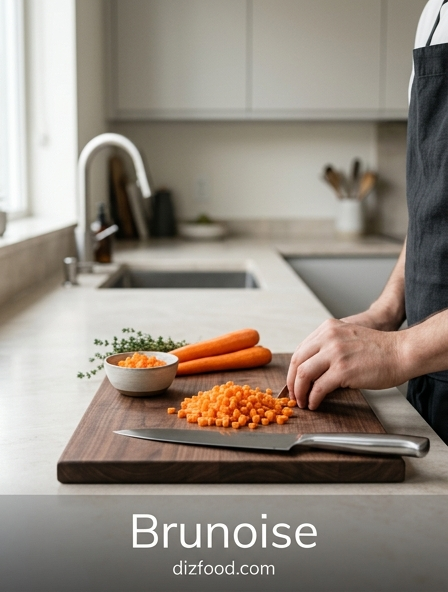
Essential Blade Selection for Precision
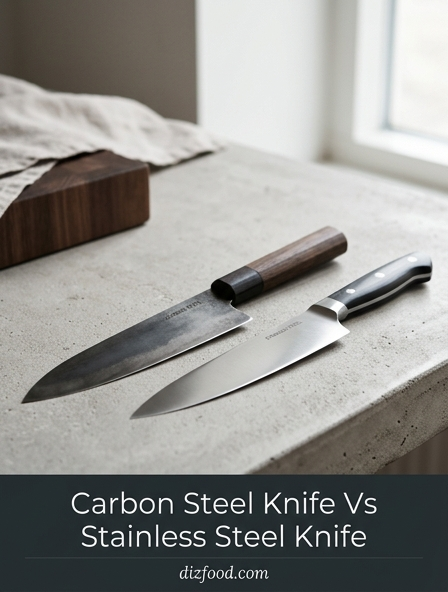
To achieve the microscopic precision required for a true brunoise, the selection of cutlery is the most critical first step. A professional chef typically relies on an 8-inch chef's knife or a Japanese Santoku, which offers a flatter edge profile conducive to the repetitive vertical strokes needed for fine dicing. The blade must be made of high-carbon stainless steel to ensure it retains a razor-sharp edge throughout a high-volume shift. A thinner spine is often preferred, as it reduces the resistance felt when moving through dense root vegetables like carrots or celeriac.
- Chef's Knife: Ideal for its rocking motion and weight, providing momentum for long prep sessions.
- Santoku: Features a "Grantone" edge that prevents starchy vegetables from sticking to the blade.
- Nakiri: A rectangular vegetable knife designed specifically for straight, clean cuts without a rocking motion.
Beyond the blade type, the balance between the bolster and the handle must feel natural in the hand. A knife that is too heavy toward the handle can cause the tip to wander, leading to inconsistent cubes that fail to meet professional standards. Conversely, a blade-heavy knife may fatigue the wrist during the intensive labor of producing several quarts of brunoise.
Mastering the Fine Brunoise Cut
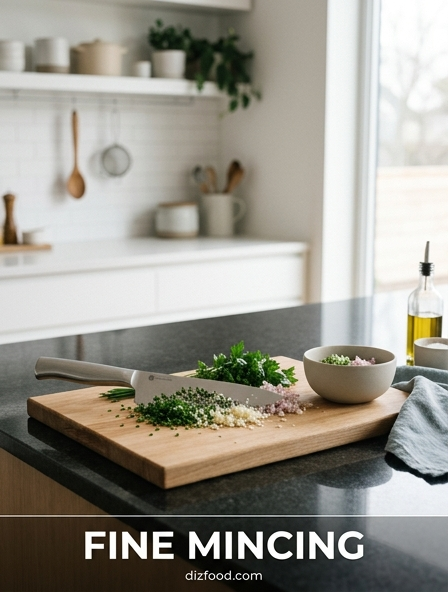
The brunoise is arguably the most technical cut in the culinary arts, measuring precisely 1.5mm to 3mm on all sides. This technique is not merely about dicing; it is about the geometric transformation of a whole ingredient into identical tiny cubes. The process begins with the "fine julienne," which requires the chef to create thin matchsticks of uniform thickness. Once the julienne is achieved, the strips are bundled tightly and cut crosswise to produce the final cubes.
- Stabilize the ingredient by slicing a thin piece off one side to create a flat base.
- Square off the vegetable into a rectangular block to ensure every subsequent cut is uniform.
- Slice the block into longitudinal planks of approximately 2 millimeters in thickness.
- Stack the planks and cut them into 2-millimeter matchsticks (fine julienne).
- Turn the matchsticks 90 degrees and cut across them to create perfect 2-millimeter cubes.
The speed at which a chef performs these steps is secondary to the accuracy of the dimensions. In a professional setting, any deviation from these measurements can lead to uneven cooking or a loss of aesthetic appeal in the final dish, particularly when the brunoise is used as a garnish or in clear consommé.
Blade Sharpness and Cutting Accuracy
A dull blade is the primary enemy of the brunoise cut. When a knife lacks a refined edge, it tends to crush the cell walls of the vegetable rather than slicing through them cleanly. This not only results in a jagged, uneven cube but also causes the ingredient to lose moisture and flavor prematurely. For high-precision tasks, the blade must be sharp enough to shave hair or slice through a tomato with zero downward pressure.
| Blade Condition | Effect on Vegetable | Culinary Outcome |
|---|---|---|
| Razor Sharp | Clean cell separation | Vibrant color and crisp texture |
| Moderately Dull | Slight bruising | Soggy texture and oxidation |
| Dull/Blunt | Crushing and tearing | Loss of juice and rapid spoilage |
Precision cutting requires the blade to track perfectly straight. If the edge is rolled or has microscopic nicks, the knife will "steer" away from the intended path, resulting in trapezoids rather than squares. Maintaining this level of sharpness requires a combination of daily honing and frequent whetstone sharpening to ensure the bevel remains at a consistent 15 to 20-degree angle for maximum efficiency.
Prepping Ingredients for Micro Slices
Proper preparation of the raw material is the foundation upon which precision is built. Before the knife even touches the vegetable for the final cut, the ingredient must be prepared to a state of geometric perfection. This involves "squaring off" the vegetable-removing the rounded exterior surfaces to create a perfect cuboid. While this leads to significant trim, these scraps are often repurposed for stocks, purees, or sauces to minimize waste in the kitchen.
- Peeling: Remove all skins and fibrous outer layers to ensure a smooth texture.
- Squaring: Cut the vegetable into a rectangular prism to remove the natural curves.
- Chilling: Some chefs prefer slightly chilling root vegetables to firm up the sugars, making them easier to slice cleanly.
- Sizing: Ensure the initial block length is manageable, typically no longer than three inches.
By creating a stable, flat-sided block, the chef eliminates the risk of the vegetable rolling during the high-precision slicing phase. This stability is essential for maintaining the sub-millimeter accuracy required for the fine brunoise. Once the block is secured, the chef can focus entirely on the thickness of each slice, ensuring that the first plank is identical to the last.
Hand Positioning and Grip Control
The mechanics of the hands are what translate a sharp knife into a precise cut. The "pinch grip" is the standard for professional chefs: the thumb and forefinger grip the base of the blade (the heel) while the other three fingers wrap around the handle. This provides maximum leverage and prevents the knife from wobbling. Simultaneously, the non-cutting hand must utilize the "claw grip" to guide the blade safely and accurately.
- Tuck the fingertips inward, away from the blade's edge.
- Use the middle knuckle as a vertical guide for the side of the knife.
- Move the hand backward in tiny, incremental steps to control the thickness of each slice.
- Maintain a light but firm pressure on the ingredient to prevent sliding.
The coordination between the rhythmic movement of the knife and the steady retreat of the guide hand determines the consistency of the brunoise. If the guide hand moves inconsistently, the resulting cubes will vary in size, ruining the uniformity of the prep. Mastery of this hand-eye coordination is what separates an amateur from a professional, allowing for high-speed production without sacrificing the strict dimensional requirements of the kitchen.
Uniformity in Professional Sauce Bases
In the world of high-end sauces and soups, the brunoise cut serves a functional purpose beyond aesthetics. When creating a classic soffritto or a delicate aromatics base, the uniform size of the vegetables ensures that they release their flavors at the same rate. If the pieces are of varying sizes, the smaller cubes may burn and turn bitter while the larger pieces remain raw and crunchy, leading to an unbalanced flavor profile.
- Surface Area: Smaller cuts increase the total surface area, allowing for rapid caramelization.
- Texture: A fine brunoise disappears into a thick sauce, providing flavor without distracting chunks.
- Consistency: Ensures every spoonful of a consommé contains perfectly identical garnishes.
For sauces like a Bordelaise or a refined velouté, the vegetables are often strained out after cooking. However, the precision of the initial cut remains vital because it dictates the rate of infusion. In dishes where the vegetables remain, such as a traditional minestrone or a clarified broth, the uniformity of the brunoise is a hallmark of the chef's technical discipline and attention to detail.
Micro Cuts for Visual Plating
Visual presentation is where the brunoise truly shines as a decorative element. In modern fine dining, the "micro-brunoise" is often used to add vibrant color and geometric contrast to a plate. Whether it is a sprinkling of red bell pepper over a seared scallop or a precise mound of cucumber atop a tartare, the tiny cubes provide a sense of refinement that larger, rustic cuts cannot achieve.
| Ingredient | Plating Application | Visual Impact |
|---|---|---|
| Carrot | Garnish for dark sauces | Bright orange pops of color |
| Shallot | Topping for oysters | Translucent, delicate texture |
| Chives | Finishing touch on soups | Uniform green symmetry |
The precision of these cuts reflects the kitchen's commitment to excellence. When a diner sees thousands of perfectly identical 1.5mm cubes, it signals a level of labor-intensive craftsmanship that justifies a premium dining experience. This visual perfection must be consistent across every plate sent from the pass, requiring the garde manger station to maintain rigorous standards throughout the service.
Honing Techniques for Razor Edges
Maintaining a razor-sharp edge throughout the day is essential for consistent brunoise work. Honing is the process of realigning the microscopic "teeth" of the blade that become bent during use. Unlike sharpening, which removes metal to create a new edge, honing simply straightens the existing edge to maintain its bite. A ceramic or diamond-coated honing rod is often preferred for the hard steel found in high-end kitchen knives.
- Hold the honing rod vertically with the tip resting on a secure, non-slip surface.
- Place the heel of the knife against the top of the rod at a 15-degree angle.
- Pull the knife downward and toward you in a sweeping arc, ensuring the entire edge touches the rod.
- Repeat the motion on the opposite side of the rod to ensure a centered edge.
For a chef performing precision cuts, honing should occur every 15 to 30 minutes of active cutting. If the blade begins to "slide" on the skin of a pepper or requires more pressure to initiate a cut, it is a clear sign that the edge has rolled. Regular maintenance ensures that the knife remains an extension of the hand, providing the effortless slicing necessary for micro-geometry.
Safety Protocols for High Precision
High-precision cutting involves keeping the fingers in close proximity to an exceptionally sharp blade, making safety protocols paramount. The most dangerous knife is a dull one, as it requires more force and is more likely to slip. However, even with a sharp knife, focus and proper technique are the only things preventing injury. A professional kitchen environment is fast-paced, but precision prep requires a controlled, rhythmic pace.
- Board Stability: Always place a damp paper towel or a rubber mat under the cutting board to prevent sliding.
- Knuckle Guide: Never lift the edge of the knife above the height of the guide knuckle.
- Clear Workspace: Keep the cutting area free of scraps and clutter to maintain a clear line of sight.
- Focus: Avoid distractions; precision work requires total mental engagement with the blade's path.
In the event of a slip, the claw grip is designed to ensure the blade hits the fingernail or the knuckle rather than the soft fingertip. By adhering to these strict safety standards, a chef can maintain high-speed production of brunoise while minimizing the risk of downtime due to injury. Safety and precision are fundamentally linked in the professional culinary workflow.
Consistency Standards in Professional Kitchens
In a professional brigade system, consistency is the metric by which all work is measured. A brunoise cut by a commis chef must be indistinguishable from one cut by the sous chef. This uniformity ensures that the restaurant's signature dishes remain identical regardless of who is on the prep station. Standards are often enforced through the use of "templates" or by checking the work against a ruler during training.
| Standard Level | Tolerance Range | Application |
|---|---|---|
| Mastery | +/- 0.1mm | Michelin-star garnish |
| Professional | +/- 0.5mm | Upscale bistro service |
| Acceptable | +/- 1.0mm | High-volume catering |
Consistency also extends to the management of waste. A skilled chef produces the maximum amount of brunoise from a single vegetable while maintaining the required dimensions. If the cubes are inconsistent, they must be discarded or relegated to the stock pot, which increases food costs. Therefore, mastering the brunoise is not just a test of artistic skill, but also a critical component of a kitchen's financial efficiency and operational success.

Comments