
When you're streamlining your meal prep, the choice between kitchen shears and a utility knife often dictates your speed and safety in the kitchen. While a sharp utility knife is the ultimate specialist for precise tasks like coring tomatoes or slicing mid-sized fruits, heavy-duty kitchen shears have emerged as a versatile powerhouse capable of tackling everything from spatchcocking poultry to snipping delicate herbs directly into a pan. Choosing the right tool isn't about finding a replacement, but understanding that shears offer superior leverage and safety for tough or slippery items, whereas the utility knife provides the nimble control required for clean, aesthetic cuts. By mastering the strengths of both, you can transform your workflow from a tedious chore into a professional-grade culinary operation.
| Feature | Kitchen Shears | Utility Knife |
|---|---|---|
| Primary Function | Leverage-based cutting & snipping | Precision slicing & dicing |
| Best For | Poultry bones, herbs, packaging | Small fruits, cheeses, sandwiches |
| Blade Length | 3 - 5 inches (pivoting) | 4 - 7 inches (fixed) |
| Safety Profile | High; controlled grip, less slip risk | Moderate; requires proper technique |
| Maintenance | Often detachable for deep cleaning | Requires regular honing/sharpening |
| Cutting Surface | Can be used mid-air/without board | Requires a stable cutting board |
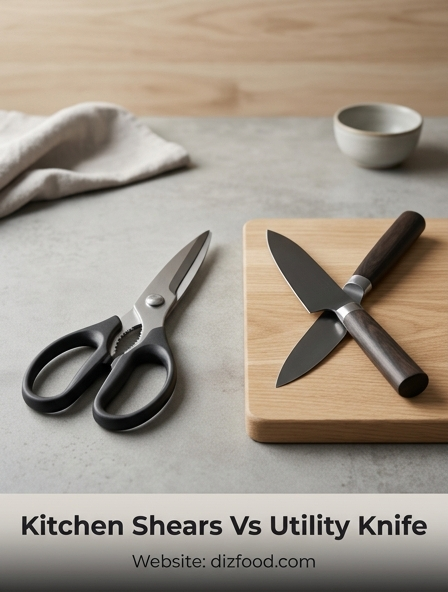
Defining the Roles of Kitchen Shears and Utility Knives
In the hierarchy of culinary tools, kitchen shears and utility knives represent two distinct philosophies of food preparation. A utility knife is often described as the "bridge" between a paring knife and a chef's knife. It typically features a blade between four and seven inches, designed for tasks that require more finesse than a heavy blade but more reach than a miniature one. It is the primary tool for clean, linear slicing and intricate hand-held work. Because of its slim profile, it excels at navigating around bones or making clean cuts through sandwiches and medium-sized fruits.
Conversely, kitchen shears are essentially heavy-duty scissors designed specifically for the rigors of the kitchen. Unlike standard stationary scissors, kitchen shears are built with thick, stainless steel blades and reinforced handles to withstand significant pressure. Their role is defined by leverage and stability rather than the rhythmic rocking motion of a knife. While a knife relies on a cutting board for resistance, shears use their own opposing blades to pinch and sever materials, making them indispensable for tasks where the food is slippery or irregularly shaped.
- Utility Knife: Ideal for slicing shallots, trimming small proteins, and precise fruit segments.
- Kitchen Shears: Essential for opening packaging, spatchcocking poultry, and cutting twine.
- Hybrid Tasks: Trimming pastry dough or cutting fresh pasta can often be done with either tool depending on the user's preference.
Precision Cutting vs Versatile Sniping in the Kitchen
The choice between precision cutting and versatile sniping often dictates the speed and aesthetic quality of a dish. Precision cutting, the hallmark of the utility knife, allows for consistent thickness and straight edges. This is vital when the visual presentation of ingredients, such as julienned peppers or sliced citrus garnishes, is a priority. The utility knife allows the chef to maintain a high level of control over the tip and the heel of the blade, facilitating delicate movements that shears simply cannot replicate.
Sniping, however, offers a level of versatility and speed that is hard to match during a busy prep session. Kitchen shears allow you to cut ingredients directly into a bowl or pot, bypassing the need for a cutting board entirely. This "in-air" cutting technique is perfect for breaking down canned whole tomatoes or snipping green onions. While the cuts might not be as surgically precise as those from a utility knife, the efficiency gained is often a fair trade-off in a home kitchen environment.
| Feature | Utility Knife (Precision) | Kitchen Shears (Sniping) |
|---|---|---|
| Primary Motion | Slicing/Drawing | Squeezing/Pinching |
| Work Surface | Requires a cutting board | Can be used mid-air |
| Edge Shape | Straight or Serrated | Double-beveled blades |
| Best For | Thin, uniform slices | Quick, irregular pieces |
The Best Tool for Trimming Poultry and Fat
When it comes to processing raw poultry, kitchen shears are frequently the superior choice for both safety and efficiency. The mechanics of shears allow the user to apply significant force through the pivot point, making it easy to cut through cartilage and small bones. This is particularly useful for "spatchcocking"-the process of removing the backbone of a chicken to flatten it for roasting. The serrations often found on one blade of the shears help grip the slippery skin, preventing the tool from sliding off the target, which is a common hazard when using a knife on fatty surfaces.
However, the utility knife remains the champion for delicate fat trimming and silver skin removal. If you are working with a beef tenderloin or a pork loin, the slim, agile blade of a utility knife can slide beneath the connective tissue with surgical precision. While shears might crush or tear the meat during such delicate work, a sharp utility knife allows for a clean separation that preserves the integrity of the muscle. For most home cooks, a combination approach is best: shears for the heavy structural breakdown and the utility knife for the refined finishing touches.
- Use shears to remove the wing tips and neck of the bird.
- Switch to the utility knife to score the skin and remove excess subcutaneous fat.
- Use shears to quickly cut the poultry into smaller, manageable portions for frying or braising.
When to Use a Utility Knife for Small Produce
Small produce items often fall into a "dead zone" where a chef's knife feels too cumbersome and a paring knife feels too short. This is where the utility knife shines. When working with items like Roma tomatoes, large shallots, or small cucumbers, the utility knife provides the perfect blade length to traverse the ingredient in a single stroke. This results in cleaner cuts and less bruising of the produce. For acidic fruits like lemons or limes, a serrated utility knife is especially effective, as the teeth catch the waxy skin and saw through without requiring the downward pressure that might squirt juice everywhere.
The utility knife also excels at "off-the-board" tasks, such as peeling a piece of ginger or coring an apple, though it requires a steady hand. Because the blade is light, it reduces hand fatigue during repetitive tasks like slicing a pint of cherry tomatoes or prepping a bowl of radishes. While shears can be used to snip the ends off green beans, the utility knife is the better tool for any produce that requires a flat, uniform surface for even cooking, such as slicing garlic cloves into paper-thin rounds for a sauce.
- Citrus: Serrated utility knives prevent crushing the fruit.
- Stone Fruits: Ideal for slicing around the pit of plums or apricots.
- Alliums: Perfect for dicing shallots where a paring knife lacks the necessary leverage.
Safety and Control Comparing Blades and Handles
Safety in the kitchen is often a matter of choosing the tool that offers the most stability for the specific material being cut. Kitchen shears are inherently safer for certain tasks because the fingers are looped inside the handles, providing a secure grip that is difficult to lose. Because the blades are joined at a pivot, there is no risk of the blade "rolling" or "slipping" off a round object, such as a carrot or a bone. This makes shears an excellent choice for beginners or those with limited grip strength, as the mechanical advantage of the lever does most of the heavy lifting.
Utility knives, on the other hand, require more developed technique to use safely. Because they are smaller and lighter than chef's knives, they can sometimes feel "flighty" in the hand. To maintain control, it is essential to use a proper pinch grip on the blade. However, the utility knife offers a level of directional control that shears cannot match. You can change the angle of the cut mid-stroke, which is vital for deboning or carving around irregularities. The risk with a utility knife usually stems from applying too much pressure to a dull blade, whereas the risk with shears is mostly related to catching skin between the handles or the blades during a fast snipping motion.
| Safety Factor | Kitchen Shears | Utility Knife |
|---|---|---|
| Grip Security | High (Enclosed loops) | Medium (Open handle) |
| Slip Risk | Low (Blades pinch the target) | Higher (Requires board contact) |
| Force Required | Low (Leverage-assisted) | Variable (Manual pressure) |
| Best Safety Use | Slippery or hard materials | Stable, soft materials |
Effortless Herb Preparation Shears or Utility Knife
Herb preparation is perhaps the most debated territory between these two tools. For soft, leafy herbs like parsley, cilantro, or basil, many chefs prefer a utility knife to perform a "chiffonade." By stacking the leaves, rolling them tightly, and using a sharp utility knife, you can create beautiful, hair-thin ribbons that elevate the presentation of a dish. The knife allows for a rhythmic, consistent cut that maintains the delicate cell structure of the herb, preventing the edges from turning brown as quickly as they might if crushed.
For woody herbs or tubular herbs like chives, kitchen shears are often the faster and more efficient option. Snipping chives with shears allows for incredibly fast, uniform rings directly over the garnish plate. Shears are also excellent for rosemary and thyme, as you can use the notch often found near the pivot of the blades to strip the leaves from the woody stems. If you are preparing a large quantity of herbs for a marinade or soup where visual perfection is secondary to flavor, shears can reduce your prep time by more than half.
- Bundle your soft herbs into a tight "cigar" shape.
- Use a utility knife for fine ribbons (chiffonade).
- Use shears for quick, rustic chops of dill or cilantro.
- Snip chives directly over the finished dish for maximum freshness.
Cleaning and Sharpening Your Primary Cutting Tools
Maintenance for these two tools differs significantly due to their construction. A utility knife is generally straightforward: it requires regular honing with a steel rod and occasional sharpening on a whetstone. Because it has a single, continuous edge, it is easy to maintain a consistent angle. Cleaning is also simple, as there are no hidden nooks or crannies, though it should always be hand-washed to prevent the edge from banging against other items in a dishwasher. Professional chefs recommend drying the blade immediately to prevent spotting or corrosion, especially for high-carbon steel blades.
Kitchen shears require a bit more attention. The best models are "take-apart" shears, which allow the two blades to be separated at the pivot. This feature is crucial for food safety, as it allows you to thoroughly clean the hinge area where bacteria and food particles can become trapped. Sharpening shears is also more complex than sharpening a knife; you must maintain the specific bevel of each blade, and often a specialized sharpener or a professional service is required. If your shears have a serrated edge, they should never be sharpened on a standard flat stone, as this will grind away the teeth that provide the tool's signature grip.
- Knife Cleaning: Hand wash only; wipe from spine to edge.
- Shear Cleaning: Disassemble after every use involving raw meat.
- Sharpening: Use a whetstone for knives; use a specialized pull-through or professional for shears.
Why Your Kitchen Needs Both Shears and Utility Knives
While some minimalist cooks argue for a single "do-it-all" knife, the reality of modern meal prep makes a compelling case for owning both kitchen shears and a utility knife. These tools are complementary rather than redundant. The shears take the "dirty" jobs-opening plastic bags of frozen vegetables, cutting through messy chicken bones, or snipping parchment paper to fit a cake pan. By delegating these high-impact or non-food tasks to the shears, you preserve the razor-sharp edge of your utility knife for the delicate tasks that truly require it.
Furthermore, having both tools available improves kitchen hygiene. You can use your shears to process a raw chicken and then immediately switch to your utility knife to slice lemons for the same dish without having to stop and perform a deep-clean of your primary blade mid-task. This workflow efficiency is a hallmark of an organized kitchen. The utility knife provides the finesse needed for the "art" of cooking, while the shears provide the brute strength and utility needed for the "labor" of cooking.
| Task Type | Preferred Tool | Reason |
|---|---|---|
| Opening Packages | Kitchen Shears | Prevents dulling knife edges |
| Slicing Sandwiches | Utility Knife | Clean, vertical compression |
| Breaking Down Lobster | Kitchen Shears | Cuts through hard shells easily |
| Coring Tomatoes | Utility Knife | Tip precision and maneuverability |
Ergonomic Benefits for Intensive Meal Prep Sessions
Ergonomics play a vital role during long hours of holiday cooking or weekly meal prep. Using the same tool for every task can lead to repetitive strain in the wrist and fingers. The utility knife employs a "power grip" or "pinch grip," which utilizes the muscles of the forearm and shoulder. This is excellent for slicing motions but can become tiring if the task requires constant vertical pressure. Swapping to kitchen shears for a portion of the work shifts the physical load to the larger muscles of the hand and thumb, providing a necessary break for the muscles used in knife work.
Modern kitchen shears often feature oversized, soft-grip handles that accommodate multiple fingers, distributing pressure more evenly than the thin handle of a utility knife. This is especially beneficial for cooks with arthritis or those who find it difficult to maintain the fine motor control required for a knife. Additionally, shears allow you to work in a more upright position when snipping herbs or greens over a bowl, reducing the need to hunch over a cutting board. Alternating between these tools not only speeds up the process but also protects the long-term health of your joints.
- Knife Ergonomics: Focuses on wrist alignment and fluid motion.
- Shear Ergonomics: Focuses on grip strength and leverage.
- Pro-Tip: Use shears for tasks that require "crushing" force to save your knife-arm from fatigue.
Choosing the Right Blade for Specific Culinary Tasks
In the final analysis, choosing the right blade is about matching the tool to the resistance and the desired outcome. A utility knife is a precision instrument. It should be your first choice whenever the path of the cut needs to be perfectly flat or whenever the ingredient is soft enough to be damaged by the "crushing" action of scissors. Think of the utility knife as your primary tool for "shaping" food. Whether you are removing the peel from an orange in a single spiral or slicing a baguette for crostini, the knife offers a level of elegance and clean geometry that defines high-quality cooking.
Kitchen shears are the "workhorse" of the drawer. They should be reached for whenever a task involves high resistance, slippery textures, or non-food materials. They are the ideal tool for "disassembling" food. From cutting a pizza into slices to trimming the fins off a whole fish, shears provide a level of safety and raw power that a utility knife cannot. By understanding the mechanical differences-linear slicing versus pivoting leverage-you can make faster, safer, and more effective decisions in the kitchen every time you prep a meal.
- Select the Utility Knife for dicing, peeling, and decorative slicing.
- Select the Kitchen Shears for poultry breakdown, herb snipping, and tough packaging.
- Keep both tools sharp and accessible to maximize your kitchen's efficiency.


Comments