
Dicing Disc Vs Slicing Disc: Choosing The Best Precision For Your Meal Prep
Achieving restaurant-quality results in your home kitchen hinges on choosing the right tool for the job, especially when comparing the specialized dicing disc to the versatile slicing disc. While a slicing disc excels at creating uniform rounds or ribbons for salads and gratins with lightning speed, a dicing disc elevates your meal prep by transforming whole vegetables into perfect, three-dimensional cubes for hearty stews and salsas. Understanding the distinction between these two food processor attachments allows you to optimize your culinary efficiency, ensuring that whether you need paper-thin cucumber slices or consistent carrot cubes, your prep remains precise, professional, and perfectly suited to your recipe's texture requirements.
| Feature | Slicing Disc | Dicing Disc |
|---|---|---|
| Resulting Shape | Flat rounds, ovals, or long strips | Uniform three-dimensional cubes |
| Cutting Mechanism | Single rotating blade | Two-step blade and vertical grid system |
| Thickness Control | Often adjustable (e.g., 1mm to 8mm) | Fixed sizes (e.g., 8mm, 10mm, or 12mm) |
| Best For | Salads, chips, stir-fry, and gratins | Soups, stews, salsas, and mirepoix |
| Processing Speed | Rapid; handles high-volume bulk easily | Moderate; requires controlled feed-tube pressure |
| Maintenance | Simple rinse; single cutting surface | Requires grid-cleaner tool for trapped bits |
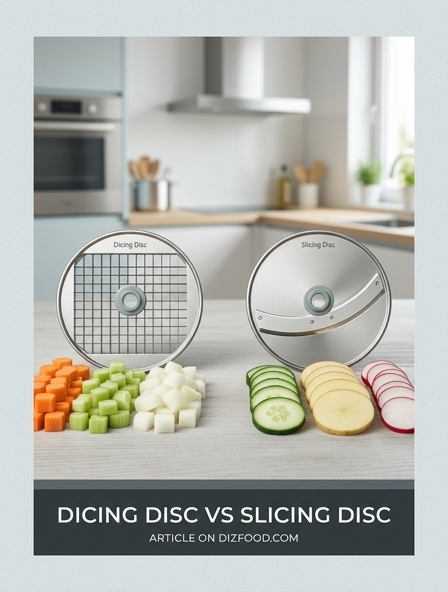
Dicing Disc vs Slicing Disc Main Differences
The fundamental distinction between a dicing disc and a slicing disc lies in the dimensionality of the final cut. A slicing disc is a single-action component designed to produce flat, uniform sheets of food. It operates on a single horizontal plane, where the blade rotates and shears off layers from the ingredient as it is pushed through the feed tube. The result is a two-dimensional shape, such as a round potato chip or a thin onion ring, where the thickness is the only adjustable variable. This tool is standard in almost every food processor kit because of its mechanical simplicity and broad utility in daily meal preparation.
In contrast, a dicing disc is part of a more complex multi-stage assembly. To achieve a cube, the food processor must cut the ingredient in three dimensions. This usually involves a slicing blade that cuts the food horizontally, followed immediately by a stationary dicing grid that shears the slice vertically into squares. While a slicing disc is a standalone plate, dicing functionality often requires a dedicated kit including a geared housing and a specific grid. The physical footprint of a dicing assembly is much larger, and it requires significantly more torque from the motor to push dense vegetables through a fixed metal mesh compared to the spinning motion of a slicing blade.
- Slicing: Produces flat, thin or thick pieces; single blade operation.
- Dicing: Produces six-sided cubes; requires a blade and a grid.
- Hardware: Slicing is usually a single disc; dicing is often a three-part kit.
How to Choose a Dicing vs Slicing Disc
Choosing between dicing and slicing attachments depends heavily on the intended texture and cooking method of the recipe. If the goal is a uniform appearance for soups, stews, or salsas, the dicing disc is the superior choice. Dicing ensures that every piece of vegetable has the same surface area, which leads to even heat distribution and consistent doneness. When preparing bulky items like root vegetables for roasting, a dicing kit eliminates the tedious labor of manual knife work, providing a professional look that is difficult to achieve by hand at high volumes. This is particularly important for commercial environments or large family gatherings where presentation matters.
On the other hand, the slicing disc should be the primary choice for tasks involving layering, frying, or raw garnishes. If the recipe calls for potatoes au gratin, cucumber salads, or shredded-style slaw, the slicing disc provides the necessary thinness that a dicing grid cannot. Slicing is also preferred for fruits that are too delicate for a dicing grid, which might crush soft items like strawberries or overripe tomatoes. When selecting which tool to use, consider the desired "mouthfeel" of the dish. Slices offer a delicate, overlapping texture, whereas cubes provide a chunky, robust bite that holds its shape during long simmering processes in slow cookers or Dutch ovens.
| Factor | Slicing Disc | Dicing Disc |
|---|---|---|
| Best For | Salads, Gratins, Chips | Soups, Salsas, Mirepoix |
| Food Texture | Delicate to Firm | Firm and Semi-Firm |
| Complexity | Low (Single Disc) | High (Multi-piece Kit) |
Dicing Disc Mechanics for Uniform Cubes
The mechanics of a dicing disc system are a marvel of culinary engineering, transforming the circular motion of a food processor into a three-dimensional geometric output. Most modern dicing kits function through a "slice-then-push" sequence. As the motor turns, a dedicated slicing blade cuts a horizontal layer from the vegetable. Gravity and the pressure from the food pusher then force this horizontal slice through a secondary, stationary dicing grid located directly beneath the blade. This grid consists of razor-sharp squares that shear the slice into vertical columns, effectively creating cubes as the next rotation of the blade passes through to terminate the cut.
Precision is maintained through the synchronization of the blade speed and the grid alignment. Because the grid is fixed while the blade rotates at high speeds, the thickness of the cube is determined by the distance between the blade and the grid, while the width and length are determined by the dimensions of the grid squares. This process requires a powerful motor with consistent torque, as pushing firm vegetables like carrots or sweet potatoes through a fixed metal grid creates significant resistance. High-end dicing systems often include a geared reduction system to increase the force applied to the food, ensuring that the cubes do not become ragged or smashed during the compression phase of the cut.
Slicing Disc Versatility and Thickness Options
The slicing disc is arguably the most versatile accessory in the kitchen due to its ability to handle a vast range of ingredient densities and sizes. Manufacturers typically offer two types of slicing discs: fixed-thickness and adjustable. Fixed discs are often double-sided, offering two specific thicknesses, such as 2mm and 4mm, by simply flipping the plate over. These are highly durable and easy to store. However, the modern adjustable slicing disc has revolutionized food prep by allowing the user to select from up to 15 different thickness settings-ranging from paper-thin 1mm shavings to thick 8mm slabs-without ever removing the disc from the machine.
This versatility allows for specialized culinary techniques that would otherwise require a mandoline. For example, a 1mm setting is perfect for making homemade potato chips or shaving fennel for a salad. A mid-range 4mm setting is ideal for slicing onions for stir-fry or bell peppers for fajitas. The widest settings are used for hearty vegetables like zucchini for grilling or eggplant for parmigiana. Because the slicing disc uses a continuous centrifugal motion, it can process large quantities of food in seconds, maintaining a level of consistency that ensures all slices cook at the same rate. This predictability is essential for baking, where uneven fruit slices in a galette or tart could result in some pieces being mushy while others remain raw.
Best Applications for Food Processor Dicing
A dicing disc is most effectively utilized when preparing "mirepoix" or "soffritto," the foundational vegetable bases for countless French and Italian dishes. By dicing onions, carrots, and celery simultaneously, the cook ensures that these aromatics release their flavors at the same rate. Beyond the basics, dicing kits are invaluable for making fresh pico de gallo or fruit salsas. Manual dicing of tomatoes and onions for a large party can take thirty minutes, but a food processor dicing attachment can complete the task in under two minutes with superior uniformity. This consistency not only looks professional but also prevents any single bite from being overwhelmed by a large chunk of raw onion.
Other excellent applications include dicing potatoes for hash browns or potato salad. When potatoes are cut into perfect cubes, they develop a crispy exterior on all six sides when fried, which is nearly impossible to achieve with irregular hand-cut pieces. Dicing is also ideal for preparing firm cheeses for salads or snack trays. Harder fruits like apples and pears can be diced for chutneys or pie fillings, where the cubic shape provides a pleasant structural integrity that resists collapsing into a purée during the baking process. For meal prep enthusiasts, dicing large batches of squash, bell peppers, and beets allows for quick assembly of roasted vegetable bowls throughout the week.
Why Slicing Discs Are Essential for Prep
While dicing is a specialized task, slicing is a universal kitchen requirement. The slicing disc is essential because it bridges the gap between high-speed processing and delicate presentation. In many cuisines, the surface area of a slice is used to maximize flavor absorption or to provide a specific structural role in a dish. For instance, thin slices of radishes or cucumbers are staples in garnishing because they provide a crisp texture without adding bulk. A slicing disc allows a home cook to produce these elements in bulk, making it feasible to host large dinners without spending hours on decorative knife work.
Furthermore, the slicing disc is an essential safety tool. Attempting to slice small, round, or slippery ingredients like Brussels sprouts or shallots by hand can be dangerous. The food processor's feed tube and pusher assembly keep fingers away from the blade, while the spinning disc handles the unstable ingredients with ease. It is also the primary tool for preserving and pickling; uniform slices of cucumbers, beets, or jalapeños ensure that the brine penetrates each piece equally, resulting in a consistent flavor profile across the entire jar. Without a slicing disc, achieving the necessary precision for professional-grade charcuterie boards or layered vegetable terrines would be an exhausting endeavor for most amateur cooks.
Comparing Dicing and Slicing Cut Outcomes
The visual and structural outcomes of dicing versus slicing are diametrically opposed, influencing both the aesthetics and the physics of a dish. Slicing creates a "shingled" or "layered" effect. When ingredients are sliced, they tend to nestle against one another, creating a dense stack. This is why slicing is preferred for dishes that need to be compact, like a potato tian or a sandwich topping. The outcome is characterized by its flatness and its ability to drape over other ingredients. In terms of cooking, slices have a high surface-area-to-volume ratio on their flat sides, which allows for rapid browning or "searing" when placed in a pan.
Dicing, conversely, produces "discrete" units. Each cube remains a separate entity, allowing air or liquid to circulate around all six sides. This makes diced ingredients ideal for chunky textures where each component should remain distinct, such as in a pasta primavera or a hearty minestrone. The outcome is a three-dimensional block that retains moisture better than a thin slice, as the interior of the cube is protected from direct heat longer. Visually, dicing provides a "mosaic" look that is synonymous with high-end culinary prep. The choice between these outcomes often dictates the soul of the dish: a sliced carrot feels elegant and light, whereas a diced carrot feels rustic and substantial.
Dicing Kit Compatibility with Slicing Blades
A common point of confusion for users is the interplay between the dicing grid and the slicing blade. In most high-end food processors, the dicing kit is not a standalone item but a system that requires a specific "dicing-compatible" slicing blade to function. Standard slicing discs often cannot be used for dicing because they lack the specific clearance or the keyed drive shaft required to lock into the dicing grid assembly. The dicing blade must be perfectly synchronized with the grid below it so that the downward pressure of the slice does not jam the mechanism. Many manufacturers sell these as a matched set to ensure the timing of the cut is perfect.
When upgrading a kitchen setup, it is vital to check the model number of the food processor to ensure compatibility. Some mid-range processors do not have a motor powerful enough to handle a dicing grid, even if an aftermarket disc appears to fit. Furthermore, dicing kits often come with their own specialized "work bowl" covers or internal geared plates that are taller than the standard slicing discs. This additional height is necessary to house the grid and allow the diced cubes to fall freely into the bowl without clogging. Understanding this compatibility is crucial for maintenance; using a slicing blade not designed for the dicing grid can lead to stripped gears or bent grids, as the resistance levels are significantly higher during the dicing operation.
Speed and Efficiency of Dicing vs Slicing
Both dicing and slicing discs offer astronomical speed advantages over manual knife work, but their efficiency profiles differ based on the volume of food. Slicing is the fastest operation a food processor can perform. Because it requires minimal force to shear a thin layer, the motor can maintain high RPMs, allowing a user to slice an entire bag of potatoes in under thirty seconds. The efficiency here is found in the "throughput"-the sheer weight of food processed per minute. For prep tasks that involve bulk quantities of a single ingredient, the slicing disc is the undisputed champion of the kitchen.
Dicing efficiency is measured more by the "complexity reduction." While the actual dicing process is slightly slower than slicing-due to the resistance of the grid and the need for a more controlled feed speed-the amount of time saved compared to hand-dicing is much greater. Dicing a single onion by hand takes a skilled cook about 45 seconds; the machine does it in three. When multiplied by ten onions, the machine saves nearly ten minutes of labor. However, dicing requires more setup and cleanup time. For a single small onion, the time spent assembling the dicing kit and cleaning the grid afterward might exceed the time saved. Therefore, dicing discs reach their peak efficiency in "bulk prep" scenarios, whereas slicing discs are efficient even for small, everyday tasks.
Cleaning and Care for Specialized Cutting Discs
Maintenance is where the dicing and slicing discs diverge significantly in terms of effort. Slicing discs are relatively simple to clean; they are flat plates with a single blade edge. A quick rinse under hot water or a cycle in the dishwasher (if permitted by the manufacturer) is usually sufficient. The main care requirement for slicing discs is protecting the edge from dulling. Users should avoid storing them loose in a drawer where they can bang against other metal tools. Many slicing discs are made of stainless steel, but the central hubs may be plastic, so avoiding extreme heat in the dishwasher can prevent warping that would cause the disc to wobble during use.
Dicing discs, specifically the grids, require much more meticulous care. The small squares of the grid are prone to trapping fibrous bits of food, such as onion skins or celery strings. Most dicing kits include a specialized "cleaning tool" or "pusher" that has plastic teeth matching the grid pattern. This tool is essential for punching out stuck food particles immediately after use. If food is allowed to dry inside the dicing grid, it becomes extremely difficult to remove and can harbor bacteria. Additionally, because the dicing grid has many more cutting edges than a slicing disc, it should be hand-washed with a brush to ensure every corner is clear. Regular inspection of the grid for bent wires is important, as a single misaligned square can cause the entire assembly to jam during the next use.
- Use the dedicated cleaning tool immediately after dicing.
- Hand-wash dicing grids to preserve sharpness.
- Store discs in a protective case to avoid blade nicks.
- Check the central hub for cracks or wear periodically.



Comments