
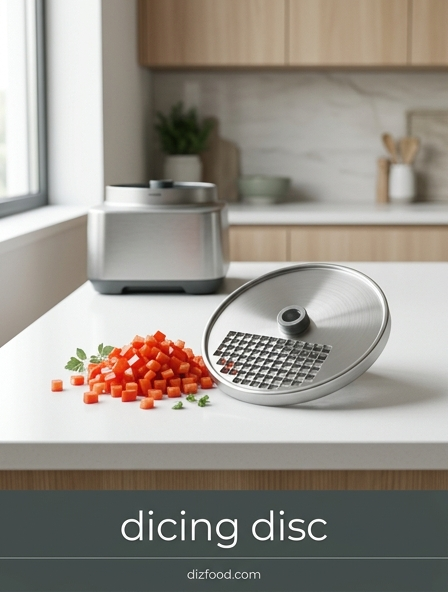
Understanding the Dicing Disc Mechanism
The dicing disc is a sophisticated food processor attachment designed to transform whole vegetables into uniform cubes with mechanical precision. Unlike a standard slicing blade that produces flat rounds, the dicing mechanism relies on a dual-action system. It typically consists of a sharp, rotating slicing blade positioned directly above a stationary dicing grid. As the motor turns, the slicing blade cuts a horizontal layer of food, which is then immediately pressed through the sharp vertical blades of the grid by the continuous downward force of the plunger.
To operate effectively, the assembly requires several specific components to work in unison:
- Slicing Blade: Adjusts the thickness of the cube's horizontal dimension.
- Dicing Grid: A stainless steel mesh that determines the square dimensions of the dice.
- Gear Assembly: Ensures the timing between the slice and the push is perfectly synchronized.
- Cleaning Tool: A specialized mold designed to push food remnants out of the tight grid spaces.
Understanding this spatial relationship is key to mastering the tool. When the food enters the feed tube, the rotation speed and the pressure applied determine the integrity of the cube, preventing the "mush" often associated with lower-quality kitchen gadgets.
Precision Engineering Behind Uniform Cubes
The engineering of a high-quality dicing disc involves advanced metallurgy and tight manufacturing tolerances. Most professional-grade discs are constructed from high-carbon stainless steel, ensuring the blades retain their razor-sharp edge even when processing dense root vegetables like carrots or sweet potatoes. The geometry of the grid is particularly impressive; each square is beveled to minimize resistance, allowing food to pass through without being crushed. This precision ensures that every cube-whether 8mm, 10mm, or 12mm-is identical in volume and shape.
Furthermore, the spacing between the slicing blade and the grid is calibrated to a fraction of a millimeter. If this gap is too wide, the cubes will have ragged edges; if it is too narrow, the motor may strain under the friction. The rotational balance of the disc is also critical. An unbalanced disc would vibrate at high speeds, leading to uneven cuts and potential damage to the food processor's drive shaft. This focus on industrial-grade design allows home cooks to achieve results that were previously only possible for professional chefs with elite knife skills, bringing a level of mathematical consistency to the domestic kitchen.
Why Consistent Sizing Matters for Soups
In the culinary world, consistency is not just about aesthetics; it is fundamentally about thermal dynamics. When preparing a complex soup or chowder, the size of the vegetable pieces directly dictates the cooking rate. If a carrot is diced by hand into varying sizes, the smaller pieces will turn to mush while the larger pieces remain crunchy and undercooked. By using a dicing disc, every piece of mirepoix-onion, celery, and carrot-shares the same surface-area-to-volume ratio.
Consistent sizing offers several advantages for liquid-based dishes:
- Even Heat Distribution: Every cube reaches the desired tenderness at the exact same moment.
- Predictable Texture: The mouthfeel of the soup remains uniform, preventing unpleasant surprises.
- Flavor Infusion: Uniformly cut aromatics release their essential oils and juices at a steady rate.
- Visual Professionalism: A bowl of soup where every ingredient is a perfect cube looks more appetizing and high-end.
For hearty stews where potatoes are the star, the dicing disc ensures that the starch is released evenly, thickening the broth naturally without leaving some potatoes raw and others dissolved into the liquid.
The Two-Step Cutting Process Explained
The magic of the dicing disc lies in its ability to perform two distinct cutting movements in a single, fluid motion. While it appears to happen instantly, the process is actually a sequential operation that mimics professional knife techniques. First, the horizontal slicing blade passes under the feed tube. This blade determines the height of the cube. As the motor spins, this blade cuts a flat disc from the bottom of the vegetable. The thickness of this slice is usually fixed by the distance between the blade and the disc platform.
- Horizontal Shearing: The top blade rotates and shears a flat layer off the ingredient.
- Vertical Compression: As the vegetable is pushed further down by the user, the sliced layer is forced through the sharp grid below.
This "slice then dice" sequence is much gentler on the cellular structure of the food than a single-impact chop. By slicing first, the disc reduces the pressure needed to move the food through the grid, which prevents delicate items like tomatoes or boiled eggs from being squashed. This mechanical sequence ensures that the resulting cubes have clean, flat faces and sharp corners, characteristic of a "brunoise" or "macédoine" cut.
Achieving the Perfect Salsa Texture
Salsa is a dish that relies heavily on texture. A traditional pico de gallo requires distinct pieces of tomato, onion, and jalapeño, each contributing its own crunch and flavor without bleeding into a watery mess. Using a dicing disc is the most efficient way to achieve this. The high-speed action of the processor allows the blades to slice through the slippery skin of a tomato and the fibrous layers of an onion before the vegetable has a chance to deform under pressure. This results in cubes that hold their juice inside rather than losing it to the cutting board.
When making salsa, the order of ingredients and the pulse of the machine are important. Harder ingredients like onions and peppers should be processed first, followed by the softer tomatoes. Because the dicing disc works so quickly, it prevents the over-oxidation of the ingredients, which can happen during slow manual chopping. The result is a vibrant, colorful salsa where each ingredient is clearly defined. This texture allows the salsa to "cling" to a chip effectively, providing a balanced bite of every component in the recipe, rather than a thin, soupy sauce that lacks substance.
Saving Time with Food Processor Dicing
For any cook preparing a meal for a large family or an event, time is the most valuable resource. Manual dicing is one of the most labor-intensive tasks in the kitchen, often taking up fifty percent of the prep time. A dicing disc dramatically compresses this timeline. What would take a skilled chef twenty minutes to dice-such as a five-pound bag of potatoes-can be completed by a food processor in less than sixty seconds. This efficiency allows the cook to focus on the more creative aspects of the dish, like seasoning and flavor balancing.
| Ingredient (2 lbs) | Manual Dice Time | Dicing Disc Time |
|---|---|---|
| Yellow Onions | 8 Minutes | 15 Seconds |
| Russet Potatoes | 12 Minutes | 30 Seconds |
| Zucchini | 6 Minutes | 10 Seconds |
| Firm Tomatoes | 10 Minutes | 20 Seconds |
The speed of the dicing disc is particularly beneficial when handling "tear-inducing" vegetables like onions. Since the process is so fast, the volatile sulfur compounds have less time to reach the eyes, making the experience far more comfortable. For meal prepping, this tool is indispensable, allowing for a week's worth of vegetables to be prepped in a single short session.
Best Vegetables for Dicing Disc Use
While the dicing disc is a versatile powerhouse, it performs best with specific types of produce. Vegetables with a firm internal structure and consistent density respond most favorably to the high-speed grid system. These ingredients maintain their shape as they are forced through the blades, resulting in those sought-after perfect cubes. Conversely, very soft or leafy vegetables may not fare as well, as they lack the structural integrity to be pushed through a grid without tearing.
Ideal candidates for the dicing disc include:
- Root Vegetables: Carrots, parsnips, turnips, and beets are perfect due to their density.
- Firm Fruits: Apples, pears, and firm melons are great for fruit salads.
- Cucurbits: Zucchini, cucumbers, and butternut squash produce very clean results.
- Solanaceous: Firm bell peppers and Roma tomatoes (which have thicker walls).
When selecting vegetables, always look for specimens that are fresh and "snappy." A soft or wilted carrot will bend rather than cut, which can lead to jams in the grid. For the best results, ensure the vegetables are sized to fit comfortably in the feed tube without excessive force.
Optimizing Results with Proper Prep
To get the most out of a dicing disc, the preparation of the raw ingredients is just as important as the machine itself. You cannot simply throw a whole, unpeeled onion into the feed tube and expect perfection. The first step is "squaring off" the ends of the vegetables. Removing the stem and root ends creates a flat surface for the slicing blade to grab, which prevents the vegetable from wobbling and creating slanted cuts. Furthermore, if a vegetable is significantly wider than the feed tube, it should be halved or quartered lengthwise to ensure a smooth passage.
Temperature also plays a significant role in dicing success. Many professional chefs recommend "tempering" certain foods in the refrigerator before dicing. For example, slightly chilled onions or firm cheeses are much easier for the blades to penetrate cleanly. When feeding the machine, the user should apply steady, moderate pressure. Pushing too hard can crush the food against the grid, while pushing too lightly might cause the slicing blade to "shave" the vegetable instead of cutting a clean slice. Proper alignment of the disc on the drive pin is also vital; a loose disc will result in inconsistent sizes and potentially damage the plastic housing of the processor.
Maintenance for Sharp and Clean Cuts
Like any precision instrument, a dicing disc requires regular maintenance to remain effective. The stainless steel blades are incredibly sharp, but they can become dull over time if they are not cared for properly. After every use, it is imperative to clean the grid immediately. If food particles are allowed to dry inside the small squares, they become extremely difficult to remove and can harbor bacteria. Most manufacturers provide a specific cleaning tool that matches the grid pattern; using this tool is the safest and most efficient way to clear the disc.
Follow these maintenance tips to prolong the life of your disc:
- Hand Wash Recommended: While many are dishwasher safe, the high heat and harsh detergents of a dishwasher can dull the edges over time.
- Dry Thoroughly: To prevent any chance of spotting or corrosion, dry the disc with a soft cloth immediately after washing.
- Store Separately: Avoid tossing the disc into a drawer with other metal tools where the blades might get nicked.
- Inspect the Grid: Occasionally check for any bent wires or misaligned teeth in the dicing mesh.
Regularly checking the sharpness of the slicing blade is also important. If you notice the machine is struggling with tomatoes or soft fruits, it may be time to have the blade professionally sharpened or to replace the disc entirely to maintain culinary standards.
Elevating Culinary Presentation with Dicing
The visual appeal of a dish is the first thing a diner notices, and nothing says "professional" like perfect geometric uniformity. In fine dining, the "brunoise"-a tiny dice of roughly 2mm-is the gold standard for garnishes and refined sauces. While most home dicing discs produce a slightly larger "macédoine" cut (around 10mm), the principle remains the same. When every piece of a potato salad or a fruit medley is exactly the same size, the dish looks intentional and polished. It elevates home cooking from "rustic" to "gourmet."
Beyond aesthetics, uniform dicing allows for creative plating opportunities. You can stack diced vegetables into molds to create towers, or scatter them across a plate to create a colorful, mosaic effect. In a clear consommé, perfectly cubed vegetables float like jewels, showing off the cook's attention to detail. This level of precision also ensures that every spoonful contains a representative sample of all the recipe's ingredients, providing a balanced flavor profile in every bite. By mastering the dicing disc, you aren't just saving time; you are adopting the rigorous standards of professional culinary arts, making every meal look as good as it tastes.


Comments