
When you're aiming to elevate your culinary game, understanding the nuance between kosher salt and sea salt is a total game-changer for your palate. Kosher salt is the professional chef's best friend because its large, craggy crystals provide an easy-to-grip texture that makes seasoning meat evenly a breeze, all while offering a pure, clean saltiness without the metallic aftertaste of additives. On the other hand, sea salt is harvested directly from evaporated seawater, bringing a complex profile of trace minerals and a distinct crunch that makes it the ultimate finishing touch for everything from roasted vegetables to gourmet desserts. Choosing the "best" salt isn't about picking a winner, but rather about matching the right crystal structure and mineral depth to the specific stage of cooking-whether you're building foundational flavor or adding a final, briny pop.
| Feature | Kosher Salt | Sea Salt |
|---|---|---|
| Source | Land-based salt mines | Evaporated ocean/sea water |
| Texture | Large, coarse, flaky grains | Varies (fine, coarse, or pyramid flakes) |
| Flavor | Pure, clean, neutral salinity | Complex, briny, mineral-rich |
| Best Use | Dry brining, seasoning pasta water | Finishing dishes, table seasoning |
| Mineral Content | Minimal to none | High (potassium, iron, zinc) |
| Dissolving Rate | Fast and uniform | Slow (adds textural crunch) |
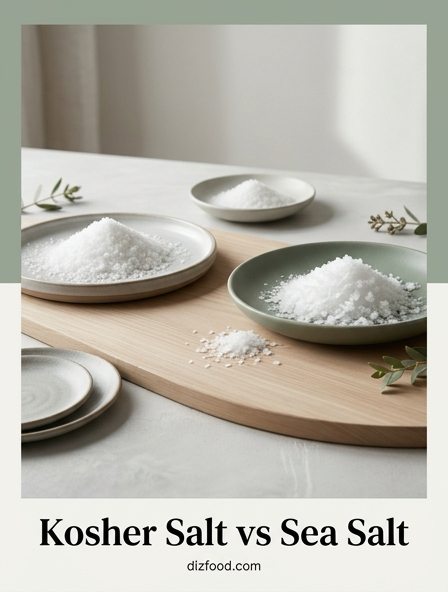
Key Differences Between Kosher Salt and Sea Salt
At a fundamental level, all salt is sodium chloride, yet the distinctions between kosher salt and sea salt are significant enough to change the outcome of a dish. The primary difference lies in their origin and physical structure. Kosher salt is typically mined from underground salt deposits and is refined to remove most minerals and impurities. It is named not because it is inherently more "kosher" than other salts, but because its large, jagged crystals are ideal for the process of koshering meat, where the salt draws out blood from the surface. In contrast, sea salt is harvested directly from evaporated seawater, resulting in a more complex profile depending on its source.
Beyond their physical origins, the two salts differ in how they interact with food. Kosher salt is the workhorse of the professional kitchen due to its ease of handling and "clean" flavor profile. Sea salt is often viewed as a specialty ingredient, prized for its trace minerals and varying textures that can range from fine grains to delicate, pyramid-shaped flakes. Understanding these differences is crucial for any home cook looking to master seasoning techniques.
- Source: Kosher salt comes from land mines; sea salt comes from evaporated ocean or salt lake water.
- Additives: Kosher salt rarely contains anti-caking agents, whereas some sea salts might include them, and neither usually contains iodine.
- Solubility: Kosher salt dissolves relatively quickly in moist environments, while coarse sea salt may linger longer on the tongue.
Understanding Salt Texture Coarse Grains vs Flaky Crystals
Texture is perhaps the most defining characteristic when comparing these two staples. Kosher salt is famous for its coarse, light, and hollow structure. Because the grains are large and irregular, they do not pack together tightly. This makes kosher salt easy to pinch between the fingers, allowing a cook to feel exactly how much salt they are applying to a piece of meat or a pot of soup. This tactile feedback is why professional chefs almost exclusively use kosher salt for seasoning throughout the cooking process.
Sea salt offers a much broader spectrum of textures. It can be found in fine grinds that mimic table salt, or in exquisite, paper-thin flakes often referred to as "fleur de sel" or "Maldon." These flaky crystals provide a unique "crunch" that kosher salt cannot replicate. Because sea salt flakes have more surface area, they provide a burst of salinity that hits the palate immediately before dissolving. Coarse sea salt, on the other hand, consists of hard, dense cubes that require a grinder or significant moisture to break down. This variety in texture means that while kosher salt is consistent, sea salt can be used strategically to add structural interest to a dish.
When selecting a salt based on texture, consider the density. A tablespoon of fine sea salt contains much more actual salt than a tablespoon of flaky kosher salt. This discrepancy in volume and weight is a common pitfall in recipes, often leading to over-seasoning if the cook is not mindful of the grain's physical properties.
Mineral Content and Purity of Sea Salt vs Kosher Salt
The purity of salt is a topic of much debate among culinary enthusiasts. Kosher salt is prized for its high purity, consisting almost entirely of sodium chloride. During its processing, it is stripped of trace minerals to ensure a neutral, consistent flavor. This lack of "noise" allows the natural flavors of the ingredients to shine through without any metallic or bitter aftertaste. For many, this purity is the gold standard for foundational seasoning.
Sea salt is the opposite; its charm lies in its "impurities." Because it is harvested from the ocean, it retains trace amounts of minerals like magnesium, calcium, potassium, and iron. These minerals can influence the color-ranging from pink and grey to black-and contribute to a more complex, earthy flavor profile. Some sea salts even contain traces of algae or sediment that add to their unique terroir. While these minerals are present in amounts too small to provide significant nutritional benefit, they are definitely perceptible to the palate.
| Feature | Kosher Salt | Sea Salt |
|---|---|---|
| Sodium Chloride Purity | Very High (99%+) | Variable (95-98%) |
| Trace Minerals | Minimal to None | Magnesium, Potassium, Calcium |
| Common Colors | Opaque White | White, Grey, Pink, Red |
| Additives | Rarely Anti-caking | Often None |
Traditional Harvesting and Production Processes Explained
The journey from the source to the kitchen table is vastly different for these two salts. Kosher salt is produced through a process called solution mining. Water is pumped into underground salt deposits to dissolve the salt, creating a brine. This brine is then evaporated using a vacuum-pressure process. By manipulating the evaporation conditions, manufacturers can control the shape of the crystals, creating the flat or hollow flakes that define brands like Diamond Crystal or Morton. This industrial process ensures a high level of consistency and purity across every box produced.
Sea salt production is often much more artisanal and weather-dependent. In solar evaporation, seawater is channeled into large, shallow ponds. The sun and wind slowly evaporate the water, leaving behind salt crystals that are harvested by hand or machine. In some regions, like the coast of France, the "flower of salt" (fleur de sel) is delicately skimmed from the surface of the water using traditional wooden rakes. This method is labor-intensive and results in a lower yield, which explains why high-quality sea salts are significantly more expensive than mass-produced kosher salt. The environment of the harvest-the salinity of the water and the local climate-acts as a "terroir," giving each batch of sea salt a distinct geographical identity.
Taste Comparison Flavor Profiles and Culinary Impact
When tasted in isolation, the flavor profiles of kosher and sea salt are distinct. Kosher salt offers a straightforward, clean saltiness. It does not linger, nor does it bring any secondary flavors to the dish. This makes it an ideal "blank canvas" salt. It enhances the savoriness of beef, the sweetness of roasted carrots, or the acidity of a vinaigrette without introducing any competing notes. Because it dissolves predictably, it is easy to build layers of flavor during the cooking process without fear of unexpected mineral bitterness.
Sea salt, by contrast, is often described as "briny" or "bright." Depending on its mineral content, it can have subtle metallic, sweet, or even smoky undertones. For example, Grey sea salt (Sel Gris) from Brittany has a high moisture content and a mineral-rich taste that pairs excellently with hearty meats. Because sea salt crystals are often denser or more varied in size, they create "flavor spikes" on the tongue. Instead of a uniform saltiness, you get a dynamic experience where the salt hits the taste buds at different intervals. This complexity can elevate a simple dish, but it can also be distracting if used in excess during the early stages of cooking where a neutral profile is usually preferred.
Best Uses for Kosher Salt in Brining and Seasoning
Kosher salt is widely considered the best choice for the "heavy lifting" of kitchen tasks. Its unique crystal structure makes it the champion of dry brining. When applied to the surface of poultry or steak, the large grains stay in place and slowly draw out moisture, which then dissolves the salt into a concentrated brine that is reabsorbed into the meat, seasoning it deeply and improving moisture retention. Because it is inexpensive and easy to measure by hand, it is also the go-to salt for seasoning pasta water or blanching vegetables.
- Dry Brining: Rub generously on meats 12-24 hours before cooking to tenderize and season.
- Vegetable Preparation: Use to draw out excess moisture from eggplant or cabbage for slaw.
- General Seasoning: Use throughout the cooking process to build a consistent base of salinity.
- Rimmed Glasses: Its coarse texture makes it perfect for margaritas or bloody marys.
Another advantage of kosher salt is its visibility. On a piece of raw protein, you can easily see where you have seasoned and where you have missed, ensuring an even distribution. Its lack of additives also means it won't cloud liquids, making it the preferred choice for clear stocks and pickles.
Why Sea Salt Excels as a Finishing Ingredient
If kosher salt is the foundation, sea salt is the decorative crown molding. Sea salt is rarely used for boiling water or bulk seasoning because its subtle nuances are lost in high-heat or high-liquid environments. Instead, it shines as a "finishing salt"-added just before the dish is served. When you sprinkle a few flakes of Maldon or a pinch of Himalayan pink salt over a finished chocolate tart or a sliced ribeye, you are adding more than just salt; you are adding texture, visual appeal, and a final punch of flavor.
The visual aspect of sea salt cannot be understated. The delicate pyramids or colorful grains act as a garnish, signaling to the diner that the dish has been prepared with care. Moreover, because sea salt is often harvested in larger flakes, it doesn't dissolve immediately upon contact with the food. This creates a delightful contrast between the soft texture of the food and the sharp, clean crunch of the salt. Using sea salt as a finisher allows the cook to use less salt overall, as the flavor is concentrated on the surface where it hits the tongue directly, providing maximum impact with minimum sodium.
Nutritional Breakdown Sodium and Iodine Content
From a nutritional standpoint, kosher salt and sea salt are remarkably similar, but there are nuances regarding volume and fortification. By weight, both salts contain roughly the same amount of sodium-about 40% sodium and 60% chloride. However, because kosher salt is less dense, a teaspoon of kosher salt will contain significantly less sodium than a teaspoon of fine sea salt. This is a critical distinction for those monitoring their sodium intake; you must measure by weight (grams) rather than volume (teaspoons) to get an accurate reading of salt consumption.
One of the most important nutritional differences is the absence of iodine. Most table salt in the United States is "iodized" to prevent iodine deficiency, which can lead to thyroid issues. Both kosher salt and most sea salts are naturally non-iodized. While most people in developed nations get enough iodine from other dietary sources like dairy, seafood, and eggs, those who rely solely on specialty salts should ensure they are getting iodine elsewhere. Additionally, while sea salt contains trace minerals like magnesium and potassium, the quantities are far too low to contribute to your daily recommended intake. You would have to consume lethal amounts of salt to gain a significant nutritional boost from these minerals.
Conversion Guide Swapping Kosher Salt for Sea Salt
Converting between different types of salt is one of the most confusing aspects of following a recipe. Because different brands and types of salt have different grain sizes, they do not weigh the same by volume. If a recipe calls for "one tablespoon of salt," the actual amount of sodium can vary by up to 100% depending on whether you use Morton Kosher, Diamond Crystal Kosher, or Fine Sea Salt. As a general rule, fine sea salt is the densest, while Diamond Crystal Kosher is the lightest.
| Salt Type | Volume for 10g of Weight | Notes |
|---|---|---|
| Fine Sea Salt | ~1.5 Teaspoons | Very dense; easy to over-salt. |
| Morton Kosher | ~2 Teaspoons | Coarse and dense. |
| Diamond Crystal Kosher | ~1 Tablespoon | Very light, hollow flakes. |
| Flaky Sea Salt | Variable | Best measured by weight only. |
When swapping, it is safest to start with less than the recipe calls for, especially if you are replacing kosher salt with fine sea salt. A common conversion ratio is to use 3/4 teaspoon of fine sea salt for every 1 teaspoon of Morton Kosher salt, or 1/2 teaspoon of fine sea salt for every 1 teaspoon of Diamond Crystal.
Choosing the Best Salt for Your Kitchen Needs
Selecting the right salt depends on your cooking style and the specific task at hand. For the vast majority of your kitchen needs-salting pasta water, seasoning meats, and baking-a large box of kosher salt is the most practical and economical choice. Its ease of use and consistent results make it an essential tool for every home cook. Within the world of kosher salt, many chefs prefer Diamond Crystal because its lower density makes it harder to over-season a dish accidentally.
However, no kitchen is truly complete without at least one high-quality sea salt. A flaky sea salt is an investment in your "finishing" game, perfect for adding that professional touch to desserts, salads, and proteins. If you enjoy experimenting with international cuisines, you might also consider a specialty sea salt, such as a smoky Hawaiian black salt or a moist French grey salt, to add authentic regional character to your dishes. Ultimately, the best approach is a dual-salt system: use kosher salt for the process and sea salt for the presentation. By mastering the timing and application of both, you can significantly elevate the quality of your home cooking.





Comments