
Choosing between a French Press and a Pour Over isn't just about the ritual; it's about how you unlock the volatile oils and nuanced aromatic compounds hidden within your favorite beans. While the French Press uses full immersion to deliver a robust, full-bodied cup rich in texture and depth, the Pour Over relies on precise percolation and paper filtration to highlight bright acidity and clean, complex flavor notes. Whether you crave the heavy mouthfeel of a classic press or the sparkling clarity of a manual drip, understanding how each method extracts flavor will completely transform your morning caffeine experience.
| Feature | French Press | Pour Over |
|---|---|---|
| Brew Method | Full Immersion (Steeping) | Percolation (Gravity Flow) |
| Flavor Profile | Bold, earthy, heavy body | Clean, bright, vibrant acidity |
| Grind Size | Coarse (Sea salt texture) | Medium-Fine (Table salt texture) |
| Filtration | Metal Mesh (Retains oils/sediment) | Paper Filter (Removes oils/fines) |
| Brew Time | 4 Minutes (Consistent) | 2-3 Minutes (Variable) |
| Skill Level | Low (Set and forget) | High (Requires technique/precision) |
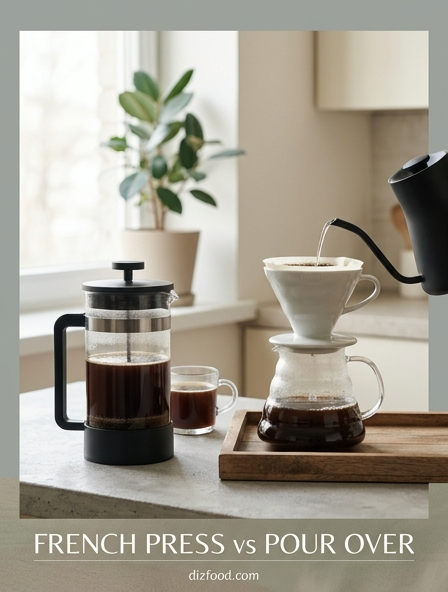
French Press vs Pour Over Key Differences
The fundamental distinction between French Press and Pour Over brewing lies in the method of extraction: immersion versus percolation. In a French Press, coffee grounds are completely submerged in hot water for the entire duration of the brew. This immersion technique ensures that every particle of coffee is in constant contact with the solvent, leading to a uniform extraction that is generally more forgiving of slight inconsistencies in technique or timing. Because the water and coffee sit together in a static environment, the extraction relies primarily on time and temperature rather than the movement of water through the bed of grounds.
Conversely, the Pour Over method utilizes percolation, where fresh water continuously flows through a bed of coffee grounds and a filter. This process is dynamic; as the water passes through, it washes away the extracted solubles and exits through the bottom of the device. This constant introduction of fresh water allows for a highly efficient extraction of delicate compounds but requires precise control over the flow rate and distribution. While the French Press is a "set and forget" style of brewing, the Pour Over is an active, manual process that demands the brewer's full attention to maintain the balance of flavor.
- Extraction Type: Immersion (French Press) vs. Percolation (Pour Over).
- Interaction: Static soaking vs. dynamic flowing.
- User Involvement: Passive after initial stir vs. active continuous pouring.
- Resulting Texture: Heavy and textured vs. light and crystalline.
In the kitchen environment, these differences translate to how you manage your morning routine. The French Press allows you to multi-task, perhaps preparing breakfast while the coffee steeps. The Pour Over requires you to stand over the carafe, carefully guiding the kettle to ensure every gram of coffee is treated equally. Choosing between them often comes down to whether you prioritize the ritual of the craft or the convenience of a hands-off brewing cycle.
Flavor Profiles Body and Clarity
The sensory experience of these two methods represents opposite ends of the coffee spectrum. French Press coffee is renowned for its heavy body and "chewy" mouthfeel. Because it uses a coarse metal mesh filter, the natural oils and fine micro-silts of the coffee bean are preserved in the final cup. These oils contribute to a rich, savory, and often earthy flavor profile. The presence of suspended solids increases the perceived weight of the liquid on the tongue, creating a robust experience that lingers long after the sip is finished. It is the ideal method for those who enjoy deep, chocolatey, or nutty notes in their darker roasts.
Pour Over coffee, however, is celebrated for its clarity and brightness. The use of a paper filter is the defining factor here, as it traps the majority of the coffee's oils and nearly all the fine sediment. The result is a cup that is visually translucent and chemically "cleaner." This lack of interference from oils allows the delicate, acidic, and floral notes of a coffee bean to shine through. Enthusiasts often prefer this method for light-to-medium roast single-origin beans, as it highlights the specific terroir and complex fruity nuances that would otherwise be masked by the heavy body of an immersion brew.
| Attribute | French Press | Pour Over |
|---|---|---|
| Body | Full, heavy, and oily | Light, tea-like, and clean |
| Clarity | Low (muddier profile) | High (distinct flavors) |
| Acidity | Muted and soft | Bright and pronounced |
| Mouthfeel | Textured and coating | Crystalline and crisp |
Ultimately, the choice is between intensity and transparency. The French Press provides a blunt, powerful expression of the coffee's base characteristics, while the Pour Over offers a high-definition view of its most intricate and volatile aromatic compounds.
Brewing Technique and Skill Level
The skill ceiling for these two methods varies significantly, making one more approachable for beginners and the other a playground for enthusiasts. The French Press is arguably the most user-friendly manual brewer available. The process involves adding grounds, pouring in water, stirring, and waiting. While variables like water temperature and steep time matter, the immersion method is incredibly stable. Even if your pour is shaky or your timing is off by thirty seconds, the resulting cup will likely still be palatable. It is a forgiving partner for the sleepy-eyed home cook who wants consistent results without a steep learning curve.
Pour Over brewing is a discipline that rewards-and requires-precision. The technique involves a "bloom" phase to degas the beans, followed by a series of controlled pours designed to keep the water level consistent and the coffee bed flat. If you pour too quickly, the water may bypass the grounds (channeling), leading to a weak and sour cup. If you pour too slowly, the water may over-extract the coffee, resulting in bitterness. Achieving the perfect "flat bed" of grounds at the end of the brew is often seen as a badge of honor among specialty coffee fans.
- French Press Steps: Add coarse grounds, pour water, wait 4 minutes, plunge slowly, and serve immediately.
- Pour Over Steps: Wet filter, add medium grounds, bloom for 30 seconds, pour in concentric circles, maintain flow, and monitor drawdown.
- Variables to Manage: French Press focuses on time; Pour Over focuses on agitation, flow rate, and temperature stability.
For those who enjoy the "Zen" of the process, the Pour Over is a rewarding morning ritual. For those who want a reliable caffeine delivery system with minimal room for error, the French Press is the superior choice for the kitchen counter.
Required Coffee Grind Sizes
Grind size is the most critical technical variable in distinguishing these two methods, as it dictates the surface area available for extraction. Because the French Press involves a long immersion time (usually four to five minutes), it requires a very coarse grind, often compared to the texture of sea salt or cracked peppercorns. If the grind is too fine, the coffee will over-extract and become unpleasantly bitter, and the fine particles will clog the metal mesh filter, making it difficult-and potentially dangerous-to press the plunger down due to built-up pressure.
In contrast, the Pour Over method relies on a much finer grind, typically categorized as medium-fine to medium, similar in texture to table salt or granulated sugar. Since the water is only in contact with the coffee for a short period as it passes through, a larger surface area is needed to extract flavor quickly. If the grind is too coarse in a Pour Over, the water will rush through the gaps too fast, resulting in an under-extracted, watery brew. If it is too fine, the water will pool on top, leading to a stalled brew that tastes harsh and astringent.
- French Press Grind: Coarse (chunky, distinct visible grains).
- Pour Over Grind: Medium to Medium-Fine (uniform, sandy texture).
- Impact of Burr Grinder: A high-quality burr grinder is essential for Pour Over to ensure uniform particles for an even flow.
- Silt Management: Coarser grinds in French Press help minimize the "sludge" at the bottom of the cup.
Matching the grind to the method is non-negotiable. A French Press user can often get away with a cheaper blade grinder because the coarse consistency is easier to achieve, whereas a Pour Over enthusiast usually invests in a precision burr grinder to avoid "fines" that would clog the paper filter and ruin the flow dynamics.
Metal Filter vs Paper Filter Impact
The filtration medium is the physical barrier that defines the chemistry of your coffee. The French Press utilizes a stainless steel mesh filter. This mesh is designed to keep the large grounds out of your mug while allowing almost everything else to pass through. Specifically, it allows the coffee's natural oils (diterpenes like cafestol and kahweol) and microscopic particles to enter the final brew. This is why French Press coffee has a shimmering surface and a cloudy appearance. From a health perspective, it is worth noting that these oils can raise LDL cholesterol levels if consumed in high quantities, which is a consideration for some daily drinkers.
The Pour Over method typically employs a disposable paper filter, though reusable cloth and metal versions exist. Paper filters are highly efficient at absorbing oils and trapping even the smallest micro-fines. This results in a chemically "clean" cup. By removing the diterpenes, the paper filter clarifies the flavor, allowing the bright acidity to take center stage without the muting effect of the fats. The paper also ensures there is zero sediment at the bottom of the cup, providing a smooth, tea-like drinking experience from the first sip to the last.
The environmental and maintenance impact also differs. The French Press filter is permanent, meaning no recurring costs or paper waste, though it requires thorough scrubbing. Paper filters generate waste but make cleanup as simple as tossing the used filter into the compost bin. For those who prefer a "velvety" mouthfeel, the metal mesh is king; for those who want a "sharp" and "bright" cup, the paper filter is an essential tool in the kitchen arsenal.
Brewing Time and Efficiency
When evaluating brewing time, it is important to distinguish between "active time" and "total time." The French Press typically requires a total of about six to eight minutes from start to finish. This includes two minutes to boil water and prep the grounds, followed by a strictly timed four-minute steep. However, the active involvement is very low. Once the water is poured, the brewer is free to do other tasks. It is an efficient method for making large batches, as a standard 34-ounce press can serve three to four people with the same amount of effort as a single cup.
The Pour Over is a more time-intensive process in terms of attention. While the actual brewing time is often shorter-usually between three and four minutes-the brewer must be present and active for every second of that window. You cannot walk away from a Pour Over; you must carefully pulse the water to keep the extraction moving. For a single cup, the Pour Over might be faster than a French Press, but as the volume increases, the efficiency drops. Making coffee for a group of four using a Pour Over requires a large vessel and a significant amount of manual labor and concentration.
- French Press: High total time, low active time. Best for multitasking.
- Pour Over: Moderate total time, 100% active time. Best for focused ritual.
- Batching: French Press scales easily; Pour Over becomes more difficult as volume increases.
In a busy kitchen, the French Press is often the winner for efficiency during the morning rush. The Pour Over is better suited for a slow weekend morning where the process of making the coffee is just as important as the act of drinking it.
Maintenance and Cleaning Comparison
Cleaning is the often-overlooked reality of home brewing. The French Press is notoriously more difficult to clean than its counterparts. Because the grounds are submerged in a beaker, they form a wet, heavy sludge at the bottom that must be scooped out or rinsed. You cannot simply pour them down the sink, as coffee grounds can clog plumbing. Furthermore, the plunger assembly consists of several parts-the lid, the rod, the spring, and the mesh-which trap oils and fine particles. If not disassembled and washed with soap regularly, these oils turn rancid, ruining the flavor of future brews.
The Pour Over offers the pinnacle of cleaning convenience. Because the grounds are contained within a paper filter, cleanup involves simply lifting the filter out of the dripper and discarding it. The dripper itself usually only requires a quick rinse with hot water, as it rarely comes into contact with the oils for long enough to create buildup. There are no moving parts, no springs, and no hidden crevices. This makes the Pour Over an attractive option for those who want to enjoy high-quality coffee without the chore of a deep-clean after every use.
For those using a glass French Press, there is also the risk of thermal shock or breakage during cleaning, whereas many Pour Over drippers are made of durable plastic, ceramic, or metal. If you value a "zero-mess" kitchen, the Pour Over is the clear winner. If you don't mind a bit of "wet work" at the sink in exchange for a permanent filter, the French Press remains a viable, eco-friendly choice.
Equipment and Setup Costs
The financial entry point for both methods is relatively low compared to espresso, but the "hidden" costs of Pour Over can add up. A basic French Press is a self-contained unit; you buy the beaker and plunger once, and your only recurring cost is the coffee beans themselves. You don't need a specialized kettle, as any vessel that can boil water will suffice. While a burr grinder is recommended, the French Press is forgiving enough that you can get by with pre-ground coffee or a cheap blade grinder if necessary.
A Pour Over setup, while appearing simple, often requires a higher initial investment to get "pro-level" results. In addition to the dripper (which can be very inexpensive), you generally need a gooseneck kettle to control the flow of water. Trying to do a Pour Over with a standard wide-spout kitchen kettle is difficult and often results in poor extraction. You also have the recurring cost of paper filters, which can add up over years of daily use. Finally, because the method is so sensitive, a digital scale becomes almost mandatory to measure the water-to-coffee ratio and the timing of the pours.
| Equipment | French Press Requirement | Pour Over Requirement |
|---|---|---|
| Main Vessel | Essential (All-in-one) | Essential (Dripper + Carafe) |
| Kettle | Any standard kettle | Gooseneck recommended |
| Filters | None (Included) | Recurring (Paper) |
| Scale | Optional but helpful | Highly recommended |
If you are on a strict budget and want the lowest cost per cup over time, the French Press is the more economical kitchen tool. If you are willing to invest in a "kit" for the sake of flavor precision, the Pour Over setup is a worthy investment.
Caffeine Content and Strength
There is a common misconception that French Press coffee is "stronger" in terms of caffeine than Pour Over. In reality, caffeine extraction is primarily a function of the coffee-to-water ratio and the water temperature, rather than the brewing method itself. However, because French Press coffee contains more dissolved solids and oils, it has a higher "TDS" (Total Dissolved Solids) and a more intense mouthfeel, which many people perceive as strength. The long immersion time also ensures that the caffeine, which is highly water-soluble, is thoroughly extracted from the grounds.
Pour Over coffee can be just as caffeinated as French Press if the same ratio of coffee to water is used. However, because the Pour Over method is often used to highlight subtle flavors, people tend to drink it at a slightly lower concentration or use lighter roasts. Light roasts are denser and can actually contain more caffeine by volume than dark roasts. The perception of "strength" in Pour Over is usually tied to its acidity and "brightness" rather than the heavy, bitter punch associated with the French Press.
- French Press: High perceived strength due to body and oils.
- Pour Over: High clarity; caffeine level depends on brewing ratio.
- Extraction: Immersion is slower but thorough; percolation is faster and efficient.
If you want a cup that feels like a "kick in the morning," the French Press provides that sensory impact. If you want a high-caffeine cup that tastes light and refreshing-almost like a juice or tea-the Pour Over is the way to achieve that balance without the heavy "coffee breath" that often follows a thick immersion brew.
Choosing the Best Method for You
Deciding between a French Press and a Pour Over ultimately depends on your palate, your morning schedule, and your willingness to engage with the science of brewing. If you crave a rich, bold cup of coffee that can stand up to a splash of cream and sugar, the French Press is your best ally. Its simplicity makes it a staple for households that prioritize reliability and ease of use. It is the quintessential "comfort" coffee method, delivering a warm, textured experience that has remained unchanged for decades.
On the other hand, if you view coffee as an agricultural product with diverse flavor notes like blueberry, jasmine, or lemon, the Pour Over is the tool you need to unlock that potential. It is a method for the curious and the patient. While it requires more gear and a more disciplined technique, the reward is a sophisticated cup that is unmatched in its complexity and cleanliness. It is less about "fuel" and more about the appreciation of the craft.
Consider the following when making your choice:
- Do you drink coffee black? Choose Pour Over for its clarity.
- Do you add milk? Choose French Press for its body.
- Are you in a rush? Choose French Press for its passive brewing.
- Do you enjoy the process? Choose Pour Over for its meditative ritual.
Many kitchen enthusiasts eventually find room for both. The French Press serves the busy workweek, while the Pour Over provides a rewarding experience for slow weekend mornings. Regardless of which you choose, both methods offer a significant upgrade over automatic drip machines, putting the control of the perfect cup back into your hands.

Comments