
Deciding between an immersion blender and a traditional countertop powerhouse often comes down to your daily culinary rhythm and the specific textures you crave. If you're a fan of velvety soups, homemade mayo, or quick sauces, the handheld "wand" style immersion blender offers incredible convenience by letting you blend directly in your pot, saving you from extra cleanup. On the other hand, if your morning routine demands frost-heavy smoothies, DIY nut butters, or crushing ice for a crowd, the raw motor wattage and enclosed jar of a countertop blender are simply irreplaceable. While both tools aim to emulsify and pulverize, the right choice depends on whether you prioritize the portable agility of a handheld tool or the high-octane, high-capacity performance of a stationary kitchen staple.
| Feature | Immersion Blender | Countertop Blender |
|---|---|---|
| Primary Strengths | Hot soups, sauces, small-batch dressings. | Frozen smoothies, ice crushing, nut butters. |
| Motor Power | 200W - 600W; Variable speed triggers. | 600W - 1500W+; High torque & presets. |
| Cleanup | Effortless; Detachable, dishwasher-safe wand. | Moderate; Bulky jars; Many have "Self-Clean." |
| Storage/Footprint | Compact; Fits easily into a utility drawer. | Permanent counter space or tall cabinet required. |
| Batch Capacity | Unlimited (works in any size pot or bowl). | Fixed (limited to jar size, usually 48-72 oz). |
| Price Range | Budget-friendly ($30 - $150). | Investment tier ($50 - $600+). |
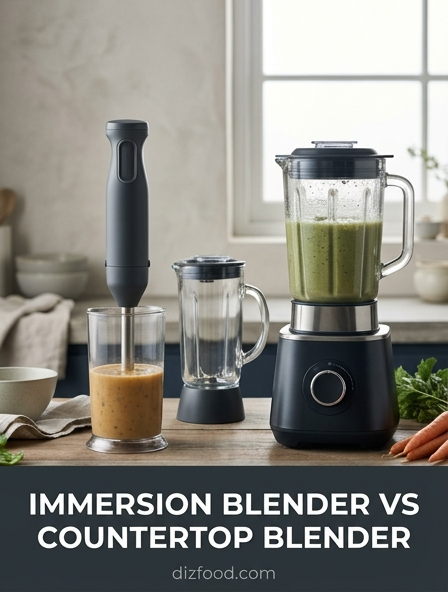
Immersion Blender vs Countertop Blender Key Differences
The primary distinction between an immersion blender and a countertop blender lies in their fundamental design and operational philosophy. An immersion blender, often referred to as a stick or handheld blender, features a long shaft with rotating blades at the end. It is designed to be submerged directly into a container, such as a pot, bowl, or beaker, allowing the user to bring the tool to the food. In contrast, a countertop blender is a stationary appliance consisting of a heavy motorized base and a removable jar or pitcher. In this setup, the food is brought to the tool, relying on gravity and a created vortex to pull ingredients down toward the blades at the bottom of the vessel.
Beyond their physical form, these two appliances differ significantly in terms of capacity and power. Countertop blenders are generally more robust, featuring high-wattage motors capable of sustained heavy-duty tasks. Immersion blenders are designed for maneuverability and convenience, making them ideal for smaller tasks or hot liquids. The following table highlights the core mechanical differences:
| Feature | Immersion Blender | Countertop Blender |
|---|---|---|
| Portability | High; handheld and lightweight. | Low; stationary and heavy. |
| Standard Capacity | Variable (limited by container). | Fixed (usually 48-72 oz). |
| Blade Position | Exposed at the bottom of a wand. | Enclosed at the base of a jar. |
| Typical Wattage | 150W - 600W | 500W - 1500W+ |
Benefits of Using a Handheld Immersion Blender
The most significant advantage of an immersion blender is its unparalleled convenience, particularly when working with hot liquids. Because the device can be placed directly into a pot on the stove, it eliminates the dangerous and messy step of transferring boiling soup into a blender jar in batches. This "one-pot" functionality saves time and reduces the number of dishes required for a single recipe. It is the ultimate tool for cooks who prioritize efficiency and kitchen workflow, as it allows for immediate texture adjustments during the cooking process.
In addition to safety and speed, immersion blenders offer several specific benefits for modern kitchens:
- Direct Control: The user can manually guide the blades to specific chunks of food, ensuring even consistency in a way that stationary blenders cannot.
- Minimal Cleanup: Most models feature a detachable blending arm that is dishwasher safe, requiring far less space in the rack than a bulky blender pitcher.
- Compact Footprint: Their slim profile allows them to be stored in a standard kitchen drawer, keeping countertops clear for other tasks.
- Small Batch Versatility: They excel at emulsifying small amounts of liquid, such as a single cup of mayonnaise or a small jar of vinaigrette, which might get lost under the blades of a large countertop model.
For those who frequently prepare pureed vegetables, creamy sauces, or quick protein shakes, the handheld blender offers a level of accessibility that makes it a daily-use tool rather than an appliance reserved for special occasions.
Power and Performance of Countertop Blenders
When it comes to raw power and the ability to process tough ingredients, the countertop blender remains the undisputed champion of the kitchen. These machines are engineered with high-torque motors and precision-hardened blades designed to pulverize everything from frozen fruit to fibrous kale. While an immersion blender might struggle or overheat when faced with ice, a high-performance countertop blender can transform ice cubes into snow-like consistency in seconds. This makes them indispensable for those who consume daily smoothies, frozen cocktails, or homemade nut butters.
The performance of a countertop blender is also defined by its specialized jar geometry. The shape of the pitcher is specifically designed to create a powerful vortex, circulating the entire contents through the blades repeatedly. This ensures a level of homogenization and aeration that handheld models simply cannot achieve. Professional-grade countertop units often include pre-programmed settings for tasks like "Pulse," "Smoothie," or "Ice Crush," providing consistent results with a single button press. Furthermore, the sheer wattage-often exceeding 1,000 watts-allows these machines to run for longer durations without the risk of motor burnout, making them the preferred choice for heavy-duty kitchen prep and high-volume cooking.
Best Kitchen Tasks for Immersion Blenders
Immersion blenders are highly specialized tools that excel in tasks where precision and containment are more important than sheer force. One of the most common uses for a stick blender is the preparation of silky smooth soups. By immersing the wand directly into a Dutch oven or stockpot, you can puree leeks, potatoes, or squash into a velvety liquid without the risk of steam pressure blowing a lid off a traditional blender. It is also the superior tool for making homemade emulsions, such as aioli or mayonnaise, where the slow integration of oil is critical to the chemical bond of the sauce.
Consider the following tasks as the "sweet spot" for immersion blender usage:
- Emulsifying Sauces: Perfect for Hollandaise, Béarnaise, or Caesar dressing where a stable emulsion is required.
- Whipped Cream: Using the whisk attachment found on many models to quickly fluff cream for desserts.
- Frothing Milk: Creating a lattes-style foam for coffee without needing a dedicated milk frother.
- Pancakes and Crepes: Mixing thin batters directly in a mixing bowl to remove all lumps instantly.
- Baby Food: Pureeing small portions of cooked vegetables or fruits directly in a serving bowl.
Because these tasks often involve small volumes or heat sensitivity, the immersion blender provides a level of intimacy and control that prevents over-processing or unnecessary splashing.
When to Use a Traditional Stand Blender
A traditional stand blender should be your go-to appliance whenever the recipe calls for structural breakdown of hard solids or high-volume liquid processing. If you are planning to make a round of frozen margaritas for a party or a large batch of green smoothies for the family, the stand blender is the only tool for the job. Its enclosed environment allows for high-speed rotation that would otherwise cause significant splashing if attempted with an open-vessel immersion blender. Furthermore, stand blenders are superior for creating "completely smooth" textures in fibrous foods like celery, ginger, or leafy greens.
The stand blender is also essential for tasks that require "set it and forget it" convenience. Many modern models feature timers and automatic shut-off functions, allowing the cook to walk away while the machine handles the intensive labor. You should opt for the stand blender when making nut milks, as the high-speed motor is necessary to break down the cell walls of soaked almonds or cashews to release their fats. It is also the safer choice for crushing large quantities of ice, as the heavy base provides the stability needed to counteract the vibration of the blades hitting hard frozen objects, a task that could easily strain the wrist of someone using a handheld unit.
Space Saving and Storage Comparison
In smaller kitchens or urban apartments where counter space is at a premium, the storage requirements of an appliance can be just as important as its performance. The immersion blender is the clear winner in the space-saving category. Most models are designed to be modular, with the motor handle detaching from the blending wand. This allows the entire kit to fit into a standard utility drawer or a small corner of a cabinet. Some premium immersion blenders even come with wall-mount brackets, allowing them to be stored vertically on the wall like a kitchen utensil, completely freeing up cabinet and counter real estate.
Countertop blenders, by contrast, demand a permanent or semi-permanent home on the kitchen counter. Due to their height-often ranging from 15 to 20 inches-they may not fit under standard kitchen cabinets, forcing owners to store the base and pitcher separately. They are also significantly heavier, often weighing between 7 and 15 pounds, making them less convenient to "tuck away" after every use. For those who value a minimalist kitchen aesthetic and rarely perform heavy-duty blending, the presence of a large stand blender can feel like a spatial burden. However, for the power user, the dedicated counter space is an investment in culinary capability that an immersion blender simply cannot replace.
Cleaning and Maintenance Requirements
The cleaning process is often the deciding factor for home cooks when choosing which blender to pull out of the cupboard. Immersion blenders are prized for their simplicity; once the blending task is finished, the wand is unclicked from the motor and rinsed under a hot tap. Many are dishwasher safe, and because the blades are small and accessible, food particles rarely get trapped in hard-to-reach crevices. A common trick for cleaning a stick blender is to run it for ten seconds in a glass of warm soapy water immediately after use, effectively self-cleaning the blades and the bell guard.
Countertop blenders require a bit more effort but offer their own "self-cleaning" advantages. While the pitchers can be bulky and difficult to fit in a dishwasher, most can be cleaned by filling the jar halfway with warm water and a drop of dish soap, then running the machine on high speed. This utilizes the motor's power to scrub the interior and the underside of the blades. However, if the blender does not have a removable blade assembly, cleaning thick substances like peanut butter or hummus from the bottom of the jar can be a tedious and potentially hazardous task for your fingers. Over time, the gaskets and seals in a countertop blender may also require replacement to prevent leaks, whereas immersion blenders have fewer mechanical failure points related to fluid containment.
Texture and Consistency Results per Model
Texture is where the mechanical differences between these two tools become most apparent. A countertop blender is designed for total homogenization. Because the jar funnels ingredients back into the blades, it produces an incredibly fine, consistent texture. This is why professional chefs use high-speed stand blenders for coulis, ultra-smooth purees, and silky soups. If your goal is a texture that feels like silk on the tongue, the stand blender is the necessary tool. It also excels at aeration; if you want a frothy, light consistency for a fruit whip or a smoothie, the high RPMs of a stand blender will incorporate more air into the mixture.
Immersion blenders, while capable, often yield a more "rustic" or textured result. Because the blades are smaller and the user must manually move the wand around the pot, it is easy to miss small chunks of food. While this is often desirable for a hearty farmhouse vegetable soup or a chunky salsa, it may fall short when a recipe demands a perfectly smooth finish. Additionally, immersion blenders do not aerate as effectively as stand blenders unless the whisk attachment is used. In terms of consistency, the immersion blender provides "good enough" results for most home cooking, but it cannot compete with the laboratory-grade smoothness provided by the high-velocity vortex of a quality countertop unit.
Price Comparison and Long Term Value
The financial investment required for these two appliances varies wildly, reflecting their differences in power and complexity. Immersion blenders are generally the more affordable option, with entry-level models starting as low as $30. Even high-end, professional-grade cordless immersion blenders rarely exceed $150 to $200. For the average home cook, a $50 immersion blender provides exceptional value, lasting many years with minimal maintenance. Their simplicity makes them durable; without complex electronic interfaces or heavy-duty cooling systems, there is simply less that can go wrong with the internal hardware over time.
Countertop blenders represent a much broader price spectrum. Budget models can be found for $40, but these often lack the power to crush ice or survive frequent use. Mid-range models typically cost between $100 and $200, while professional-grade machines from brands like Vitamix or Blendtec can range from $400 to over $700. While the upfront cost is higher, these premium machines often come with 7-to-10-year warranties and are designed to be the last blender you ever buy. The long-term value of a countertop blender is tied to its versatility; it can replace a food processor, a spice grinder, and a juicer in some contexts. However, for someone who only blends occasionally, the high price tag may not be justified compared to the utility of a cheaper handheld unit.
Choosing the Best Blender for Your Cooking Style
The choice between an immersion blender and a countertop blender ultimately depends on your culinary habits and the specific recipes you prepare most often. To make the best decision, you must evaluate your kitchen priorities. If you are a soup enthusiast who enjoys making large batches of butternut squash or tomato basil soup, or if you frequently make your own dressings and mayonnaise, the immersion blender is an essential tool. Its ease of use and rapid cleanup make it the perfect companion for daily "from-scratch" cooking where convenience is paramount. It is the best choice for those with limited storage or those who prefer to cook everything in a single pot.
On the other hand, if your morning routine revolves around a nutrient-dense green smoothie with frozen fruit and seeds, or if you enjoy hosting and need to crush ice for cocktails, the countertop blender is non-negotiable. Its power is required for the heavy lifting that an immersion blender simply cannot handle. For many serious home cooks, the ideal solution is not "either/or" but rather "both." Having a small, inexpensive immersion blender for sauces and hot soups alongside a powerful countertop blender for smoothies and heavy-duty tasks provides the ultimate flexibility. If you must choose only one, consider the hardest ingredient you plan to blend; if it's ice or frozen fruit, go with the countertop model. If it's cooked vegetables and liquids, the immersion blender will serve you best.

Comments