
Choosing between copper and clad stainless steel is the ultimate culinary crossroads where lightning-fast responsiveness meets rugged, modern reliability. Copper remains the undisputed gold standard for thermal conductivity, reacting almost instantly to flame adjustments-making it the "Formula 1" of cookware for delicate tasks like tempering chocolate or reducing complex sauces. However, high-quality multi-clad stainless steel has closed the gap significantly, offering a "set-it-and-forget-it" durability that is induction-ready and dishwasher-safe. While copper offers surgical precision for the professional artisan, clad stainless steel provides the heavy-duty heat retention and effortless maintenance required for the high-performance home kitchen.
| Feature | Solid Copper (Tin/SS Lined) | Clad Stainless Steel (3-Ply/5-Ply) |
|---|---|---|
| Thermal Conductivity | Elite (approx. 390 W/m·K); instant response. | High (Aluminium core); steady heat spread. |
| Precision Control | Unmatched; cools down the second heat is cut. | Moderate; retains heat longer after turning off. |
| Induction Ready | No (unless it has a specialized base). | Yes (standard for most modern brands). |
| Maintenance | High; requires polishing and hand-washing. | Low; dishwasher safe and non-reactive. |
| Durability | Soft metal; prone to dents and patina. | Extremely rugged; resists scratching/warping. |
| Best For... | Sugar work, delicate sauces, and flambé. | Searing, braising, and everyday high-heat cooking. |
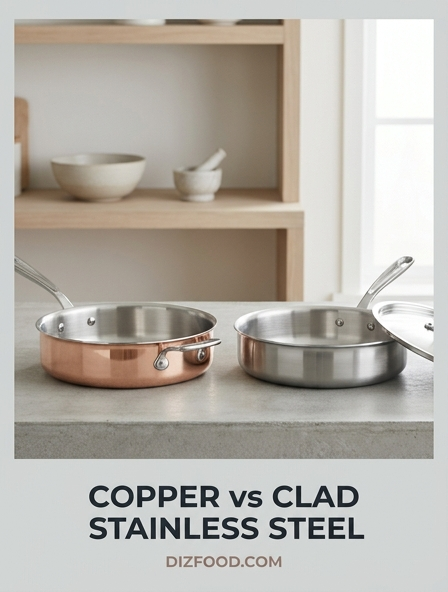
Thermal Conductivity and Heat Response Compared
In the realm of culinary thermodynamics, copper remains the undisputed champion of thermal conductivity. Its molecular structure allows heat to move through the metal with nearly instantaneous speed, reaching up to 400 W/m·K. This translates to a cooking surface that reflects temperature changes on the dial almost immediately. When a chef lowers the flame to prevent a delicate sauce from breaking, copper sheds heat at a rate that clad stainless steel cannot match. This responsiveness is critical for high-precision tasks such as sugar work, tempering chocolate, or preparing complex emulsions like hollandaise.
Clad stainless steel, by contrast, relies on a composite construction to overcome the poor conductivity of steel itself. Most high-end clad cookware utilizes an aluminum core (approx. 235 W/m·K) or a thin copper disk sandwiched between layers of steel. While this "cladding" significantly improves heat distribution compared to solid steel, it introduces a slight thermal lag. The thickness of the layers serves as a buffer, providing superior heat retention but sacrificing the "stop-on-a-dime" control found in solid copper vessels. For tasks requiring steady, sustained heat, such as searing a thick steak or boiling a large pot of water, the heat-soak capacity of heavy-gauge clad stainless steel offers a distinct advantage over the flighty nature of copper.
- Copper: Highest sensitivity to temperature adjustments; ideal for reduction and delicate proteins.
- Clad Stainless: Slower to heat and cool; provides a stable thermal mass for high-heat frying.
- Uniformity: Both materials excel at eliminating hot spots if constructed with sufficient thickness.
Durability and Maintenance Requirements
The maintenance profiles of copper and clad stainless steel represent two different philosophies of kitchen management. Clad stainless steel is the "workhorse" material, engineered for the rigors of high-volume environments and the convenience of the modern home. Its exterior and interior surfaces are exceptionally hard, resisting scratches from metal utensils and the corrosive effects of harsh detergents. Most clad cookware is dishwasher safe, and it can withstand accidental drops or thermal shocks-such as deglazing a hot pan with cold liquid-without warping or structural failure.
Copper, conversely, is a soft metal that requires a commitment to preservation. Over time, copper naturally oxidizes, developing a dark patina that some chefs admire, while others prefer the traditional mirror-bright finish. Achieving the latter requires regular polishing with specialized pastes. Furthermore, copper vessels lined with traditional tin require "retinning" every few years as the lining wears down. Modern copper often features a thin stainless steel lining to mitigate this, but the exterior still demands care to avoid dents and scratches.
| Feature | Copper (Stainless Lined) | Clad Stainless Steel |
|---|---|---|
| Cleaning | Hand wash only; requires polishing | Dishwasher safe (generally) |
| Surface Hardness | Soft; prone to dents | Very hard; scratch-resistant |
| Longevity | Generational with care | Virtually indestructible |
| Chemical Resistance | Sensitive to acids/salts (exterior) | High resistance to all chemicals |
Induction Cooktop Compatibility Differences
The rise of induction technology has created a significant divide between these two materials. Induction cooking relies on electromagnetic fields to excite iron atoms in the cookware, generating heat directly within the vessel. Pure copper is diamagnetic, meaning it does not react to magnetic fields. Consequently, traditional copper cookware will not work on an induction range. To use copper on induction, one must use an interface disk-which negates the copper's thermal benefits-or purchase specialized "induction-compatible" copper which features a magnetic steel plate bonded to the bottom, often at a significant price premium.
Clad stainless steel is significantly more versatile in this regard. Most high-quality multi-ply cookware is designed with an outer layer of 430-grade ferritic stainless steel specifically for induction compatibility. This allows the pan to bridge the gap between traditional gas flames and modern electric or induction surfaces. Because the magnetic layer is integrated into the cladding from edge to edge, the heat generation is uniform across the entire base of the pan. For home cooks planning a kitchen remodel or chefs in modern all-electric facilities, clad stainless steel is the standard choice for seamless integration across all heat sources.
Material Composition and Layering Techniques
The structural integrity and performance of these materials are defined by how they are layered. Traditional professional copper cookware is typically 1.5mm to 2.5mm thick. It is rarely solid copper today; instead, it is usually "bi-metal," featuring a 90% copper exterior bonded to a 10% stainless steel interior. This thin interior lining provides a non-reactive cooking surface without significantly interfering with the copper's thermal conductivity. If the copper is too thin (under 1.5mm), it fails to distribute heat effectively, leading to scorching; if it is too thick, it becomes unwieldy and heavy.
Clad stainless steel uses a "sandwich" or multi-ply technique. The most common is 3-ply, consisting of a stainless steel interior, an aluminum core, and a stainless steel exterior. More advanced versions utilize 5-ply or 7-ply constructions, alternating layers of aluminum, aluminum alloys, and sometimes copper cores. These layers are bonded under high pressure to ensure there are no air pockets. The goal of this layering is to utilize the heat-spreading properties of the inner metals while maintaining the aesthetic and hygienic properties of the outer steel. High-end "fully clad" pieces extend these layers all the way up the sidewalls, whereas cheaper "disk-bottom" pans only have the layers at the base.
- 3-Ply: Basic professional standard; lightweight and efficient.
- 5-Ply/7-Ply: Added thickness for better heat retention and warp resistance.
- Copper Core Clad: A hybrid approach attempting to capture copper's speed within a steel shell.
Precision Cooking Performance in Professional Kitchens
In a professional kitchen, the choice between copper and clad stainless often depends on the "station" or the specific menu items. Copper is the tool of the saucier and the pastry chef. When reducing a delicate wine sauce or melting sugar for caramel, the ability to stop the cooking process by simply lifting the pan or killing the flame is vital. Copper's ability to distribute heat evenly across the sides of the pan also makes it superior for reductions, as it prevents the "ring" of burnt sauce that can occur when the liquid level drops in a less conductive vessel.
Clad stainless steel is favored on the line for sautéing, searing, and braising. The durability of clad steel allows it to handle the "clank and bang" of a busy service. It is also better for deglazing; the slightly slower heat response of the steel allows the chef more time to scrape up fond (browned bits) without the pan cooling down too rapidly. Furthermore, in high-volume environments where "turnover" is key, the ability to put pans through a commercial dishwasher is a massive logistical advantage. While copper provides the ultimate precision for artistic flourishes, clad stainless steel provides the reliability and endurance required for the bulk of professional culinary production.
Long Term Investment and Cost Analysis
Investing in premium cookware requires balancing the initial purchase price against the expected lifespan and operational costs. Copper is a luxury investment. A single 10-inch copper skillet can cost between $300 and $500. Beyond the entry price, there are hidden costs in time and materials for maintenance (polishing) and the eventual need for retinning if using traditional linings. However, copper holds its value remarkably well; vintage copper pans often sell for nearly as much as new ones, and they are frequently passed down through generations as family heirlooms.
Clad stainless steel offers a better "price-to-performance" ratio for most users. A high-quality 5-ply skillet from a reputable brand may cost between $150 and $250. Because it requires no specialized maintenance and is resistant to almost all forms of kitchen abuse, the total cost of ownership over twenty years is remarkably low. While it may not have the same "collector" status as copper, a well-made clad pan is essentially a buy-it-for-life product. For a commercial kitchen, the labor savings associated with the easy cleaning of stainless steel often outweigh the thermal benefits of copper.
| Metric | Copper Cookware | Clad Stainless Steel |
|---|---|---|
| Initial Cost | Very High ($$$$) | Moderate to High ($$ - $$$) |
| Repair Needs | Retinning (if tin-lined) | None |
| Resale Value | High / Appreciates | Moderate / Utility-based |
| Labor Cost | High (Manual Polishing) | Low (Machine Washable) |
Food Reactivity and Surface Safety
Food safety and flavor purity are paramount when selecting cookware materials. Copper is a highly reactive metal. When exposed to acidic foods like tomatoes, lemon juice, or wine, it can leach metallic ions into the food. This not only imparts a bitter, metallic taste but can also lead to copper toxicity if consumed in significant quantities. This reactivity is why almost all modern copper cookware is lined with a non-reactive metal. Tin was the traditional choice because it is naturally non-stick, but it melts at a low temperature (450°F). Modern stainless-lined copper solves this, offering the safety of steel with the performance of copper.
Clad stainless steel is celebrated for being completely inert. It does not react with alkaline or acidic ingredients, ensuring that the flavor profile of the dish remains untainted. This makes it the ideal surface for long-simmering tomato sauces or deglazing with vinegars. The surface of stainless steel is also non-porous, meaning it does not harbor bacteria or retain flavors from previous meals after a thorough cleaning. For those concerned with "clean cooking," stainless steel (whether as a standalone clad pan or a lining for copper) is the gold standard for hygiene and chemical stability.
Weight and Ergonomic Handling Differences
The physical experience of cooking is heavily influenced by the weight and balance of the pan. Copper is exceptionally dense, making heavy-gauge copper pans some of the heaviest tools in the kitchen. A 2.5mm thick copper sauté pan requires significant wrist strength to toss ingredients or pour liquids. This weight is often seen as a sign of quality, providing a stable "anchor" on the burner, but it can lead to fatigue during long cooking sessions. Handles on copper pans are traditionally made of cast iron or bronze, which are heavy and can become quite hot, necessitating the constant use of towels or oven mitts.
Clad stainless steel is generally lighter and more ergonomically varied. Manufacturers often design clad pans with "stay-cool" stainless steel handles that are hollow or branched to dissipate heat before it reaches the hand. Because the thickness of the aluminum core can be adjusted without adding the extreme mass of solid copper, designers can create pans that are well-balanced and easy to maneuver. However, very cheap clad pans can be "bottom-heavy," leading to instability on gas grates. High-end clad cookware strikes a balance, offering enough weight to feel substantial and prevent warping while remaining light enough for agile flipping and sautéing techniques.
Aesthetic Appeal and Kitchen Design Impact
The visual impact of copper in a kitchen is unparalleled. Its warm, rosy glow creates an atmosphere of traditional French elegance and culinary sophistication. Many home cooks and professional chefs display their copper cookware on open racks as a design centerpiece. Whether polished to a high shine or allowed to develop a rugged, earthy patina, copper suggests a deep appreciation for the history of gastronomy. It fits perfectly in "country-chic" or high-end traditional kitchen designs, adding a touch of artisanal luxury that steel cannot replicate.
Clad stainless steel offers a different, more modern aesthetic. Its cool, silver tones and brushed or mirrored finishes align with contemporary, industrial, or minimalist kitchen designs. It looks professional, efficient, and clean. While it may lack the "soulful" character of copper, its ability to maintain its appearance with minimal effort is a visual benefit in itself. In a professional open-concept kitchen, a matching set of gleaming stainless steel pans conveys a message of precision, hygiene, and modern technical mastery. Ultimately, the choice often comes down to whether the cook prefers the "warmth" of copper or the "brilliance" of steel.
Best Use Cases for Home Cooks and Chefs
Choosing between these two materials depends largely on the specific culinary task at hand. Copper is the specialist's tool, excelling in scenarios where temperature control is the primary variable. It is the best choice for making candies, delicate custards, and reduced sauces where a few degrees can mean the difference between success and failure. For the chef who takes pride in technical mastery and has the time for meticulous upkeep, copper is a rewarding partner that offers a level of finesse no other metal can provide.
Clad stainless steel is the superior choice for the "everyday" cook and the high-volume professional. Its versatility makes it suitable for 90% of kitchen tasks, from boiling pasta and frying eggs to searing salmon and simmering stews. Because it is induction-compatible and dishwasher-safe, it fits seamlessly into a modern lifestyle. For those who want high performance without the "babysitting" required by copper, multi-ply clad stainless steel is the most practical and durable option available.
- Use Copper For: Risotto, Beurre Blanc, Caramel, delicate fish, and table-side presentation.
- Use Clad Stainless For: Everyday sautéing, high-heat searing, acidic braises, and induction cooking.
- Hybrid Approach: Many kitchens use a set of clad stainless for daily work, supplemented by two or three key copper pieces for specialized tasks.

Comments