
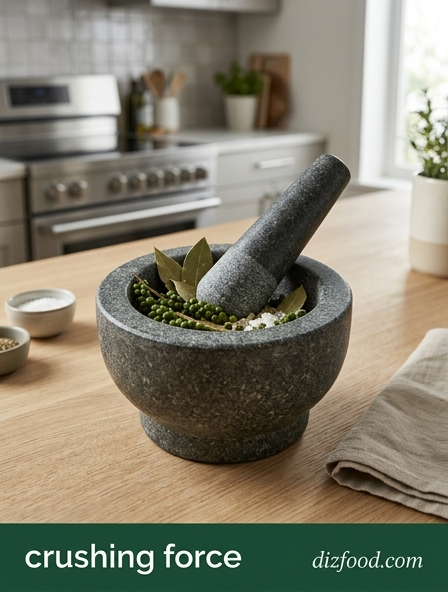
The Science of Cellular Disruption in Spices
At the microscopic level, whole spices are resilient storage vessels designed to protect a plant's genetic and chemical legacy. The application of crushing force initiates a process known as cellular disruption, where the rigid walls composed of cellulose and lignin are physically compromised. Unlike mere cutting, which cleanly severs cells along a narrow path, crushing subjects the entire structure to compressive stress. This pressure causes the internal vacuoles to rupture, spilling out a complex mixture of enzymes and secondary metabolites that have remained dormant since the spice was harvested. When these components interact, they undergo rapid chemical changes that generate the characteristic pungency and depth associated with freshly ground seasonings.
- Cell Wall Rupture: Physical breakdown of the protective fibrous exterior.
- Enzymatic Activation: Interaction between internal compounds previously separated by membranes.
- Lipid Release: Migration of fats and oils from the inner parenchyma to the surface.
- Structural Collapse: Conversion of a rigid seed into a malleable, flavor-dense paste or powder.
Essential Oil Release Through Manual Impact
The manual impact of a heavy pestle against a mortar provides a unique kinetic energy that cannot be replicated by high-speed spinning. As the stone or ceramic surface descends, it traps spice particles and applies a concentrated load that forces essential oils out of their specialized secretory pockets. These oils contain the high-definition flavor profiles of the spice, ranging from the piperine in peppercorns to the cinnamaldehyde in cassia. Manual crushing ensures that these oils are emulsified into the fiber of the spice rather than being splattered against the walls of a mechanical chamber. This direct contact facilitates a more intimate marriage of flavors, as the oils coat the newly exposed surface area of the spice solids.
- Initial Impact: The heavy weight cracks the outer husk of the spice.
- Shearing Action: Twisting the pestle grinds the fibers against the mortar's textured surface.
- Oil Migration: Pressure forces hydrophobic oils to emerge from the cellular matrix.
- Homogenization: The oil and solid matter are integrated into a potent, aromatic mixture.
Avoiding Heat Friction to Preserve Volatile Aromatics
Temperature control is a critical factor in spice preparation, as many of the most desirable flavor compounds are highly volatile. Electric grinders operate at thousands of rotations per minute, generating significant localized heat through friction between the blades and the spice. This heat often exceeds the flash point of delicate aromatics, causing them to evaporate before they ever reach the cooking vessel. In contrast, manual crushing remains a "cold" process. By utilizing heavy mass and low velocity, the mortar and pestle maintain the spice at room temperature, ensuring that the volatile esters and terpenes remain trapped within the grinds. This preservation results in a brighter, more nuanced flavor profile that displays the full spectrum of the spice's botanical character.
| Method | Temperature Influence | Aromatic Retention |
|---|---|---|
| Electric Grinding | High (Friction-based) | Low (Evaporative loss) |
| Manual Crushing | Low (Ambient) | High (Full preservation) |
The Structural Advantage of Crushing Over Blade Cutting
The mechanical difference between a sharp blade and a blunt crushing surface determines the final flavor extraction efficiency. Blades act by shearing, which creates clean, flat surfaces with minimal internal trauma to the surrounding tissue. While this produces a uniform particle size, it leaves much of the spice's internal oil locked within intact cells. Crushing, however, utilizes compressive and tensile forces to shatter the spice's architecture. This creates an irregular, jagged morphology that exposes more of the internal matrix to the cooking medium. The result is not just a change in size, but a fundamental change in the spice's porosity, allowing fats and liquids to penetrate the spice particles more deeply during the infusion process.
- Irregular Geometries: Crushing creates more "nooks and crannies" than slicing.
- Internal Trauma: Deeper disruption of the cellular storage units.
- Reduced Dusting: Crushing produces fewer "fines" that can lead to bitterness.
- Textural Integrity: Maintains a substantial body that contributes to mouthfeel.
Maximizing Surface Area for Rapid Flavor Infusion
In the culinary arts, flavor extraction is essentially a race against time and heat. The rate of this extraction is directly proportional to the surface area available for interaction with the solvent-be it water, oil, or alcohol. Crushing force transforms a spherical seed with a low surface-area-to-volume ratio into a multitude of fractured pieces with a vastly increased total surface area. This physical transformation is vital for rapid infusion techniques, such as blooming spices in hot oil or steepening them in a broth. By crushing rather than grinding to a fine dust, the cook creates a middle ground where the surface area is maximized for flavor release while the particles remain large enough to avoid clumping or over-extraction of bitter tannins.
- Fragmentation: Breaking the whole unit into smaller, irregular pieces.
- Exfoliation: Peeling back layers of the spice to expose the core.
- Solvent Access: Creating paths for hot oils to reach internal resins.
- Molecular Diffusion: Facilitating the movement of flavor molecules into the dish.
Preventing Premature Oxidation in Freshly Bruised Seeds
Oxidation is the primary enemy of spice potency, occurring the moment the internal chemistry is exposed to atmospheric oxygen. When spices are pulverized into a fine, uniform powder by a machine, the high surface area allows for almost instantaneous oxidation of delicate oils. Manual bruising or light crushing allows the cook to control the level of exposure. By gently cracking the seeds just before they are added to the pan, the cook ensures that the flavor compounds are released directly into the cooking medium before oxygen can degrade them. This "bruising" technique is particularly effective for seeds like cardamom or cumin, where the essential oils are highly reactive and prone to becoming rancid or dull when exposed to air for extended periods.
- Timed Release: Crushing only at the moment of culinary necessity.
- Protective Barriers: Keeping some cells intact to slow down overall degradation.
- Oxygen Shielding: Using the mortar to contain the spice in its own oils.
- Potency Maintenance: Ensuring the peak flavor reaches the final plate.
Textural Complexity and Its Impact on Palate Experience
The sensory experience of a dish is heavily influenced by the texture of the spices used within it. Electric grinders produce a homogenous powder that dissolves into the background, providing a consistent but often one-dimensional heat or flavor. Manual crushing allows for "variegated grinding," where the resulting mixture contains a range of particle sizes from fine dust to coarse chunks. This variety creates a dynamic palate experience; smaller particles provide the immediate upfront flavor, while larger pieces offer "flavor bursts" when bitten into. This heterogeneity adds complexity to the dish, transforming the spice from a mere seasoning into a functional component of the food's architecture that engages the eater's sense of touch and taste simultaneously.
- Particle Diversity: Creating a spectrum of sizes within a single grind.
- Sustained Release: Larger chunks provide flavor late in the chewing process.
- Mouthfeel: Adding a slight crunch or grit that complements soft ingredients.
- Visual Appeal: Visible spice fragments indicate artisanal preparation.
Comparing Mortar and Pestle Results to Electric Grinders
While the convenience of electric grinders is undeniable, the qualitative difference in the output is measurable. Electric grinders utilize centrifugal force to pull spices into a high-speed blade, which results in a very fine, uniform dust that is often devoid of the heavier, resinous oils. The mortar and pestle rely on human-directed force, which is inherently slower but more precise in its application of pressure. This manual method allows for the extraction of resins that are too thick or sticky for a blade to handle effectively. The result is a paste or powder that feels "damp" with its own natural oils, a clear indicator of superior flavor retention and chemical integrity compared to the dry, static-charged powder from a machine.
| Feature | Manual Crushing | Electric Grinding |
|---|---|---|
| Texture | Coarse to Fine (Adjustable) | Uniformly Fine |
| Oil Retention | Excellent (Emulsified) | Moderate (Dissipated) |
| Flavor Profile | Multidimensional | Flat/Linear |
Unlocking Dormant Fragrance via Traditional Physical Force
The olfaction of a spice is often its most potent attribute, yet these scents are frequently locked behind thick, woody exteriors. Physical force acts as the key to this olfactory vault. When a peppercorn or coriander seed is crushed, the sudden release of trapped gases and volatile oils creates an immediate aromatic plume. This is the result of potential energy within the seed being converted into kinetic energy that scatters fragrance molecules into the air. Traditional crushing methods enhance this because the open bowl of a mortar allows the cook to monitor the aroma as it develops, adjusting the force and duration of the grind to reach the peak "nose" of the spice. This sensory feedback loop is essential for achieving the perfect balance in complex spice blends.
- Volatile Aerosolization: Turning liquid oils into airborne scent molecules.
- Aromatic Evolution: Scents change as more layers are crushed.
- Feedback Loop: The cook adjusts pressure based on the intensity of the smell.
- Scent Synergy: Combining multiple spices to create a unified bouquet.
Achieving Optimal Consistency for Maximum Spice Potency
Consistency in the kitchen usually refers to uniformity, but in the context of spice potency, it refers to the "ideal state" for a specific culinary application. Achieving this requires a mastery of crushing force. For a dry rub, a coarse, heavy-handed crush is necessary to ensure the spices stand up to the heat of the grill. For a delicate sauce, a rhythmic, circular grinding motion is required to reduce the spices to a silky, integrated paste. The ability to manipulate the pestle-changing the angle, the weight, and the speed-allows the cook to tailor the spice's physical form to the cooking method. This precision ensures that the potency of the spice is perfectly calibrated, providing neither too little flavor nor an overwhelming, bitter concentration.
- Selection of Force: Using body weight for hard seeds and wrist motion for soft herbs.
- Angle of Attack: Tilting the pestle to target specific un-crushed fragments.
- Gradual Reduction: Moving from large cracks to fine grinding in stages.
- Final Integration: Gathering all particles to ensure a cohesive end product.




Comments