
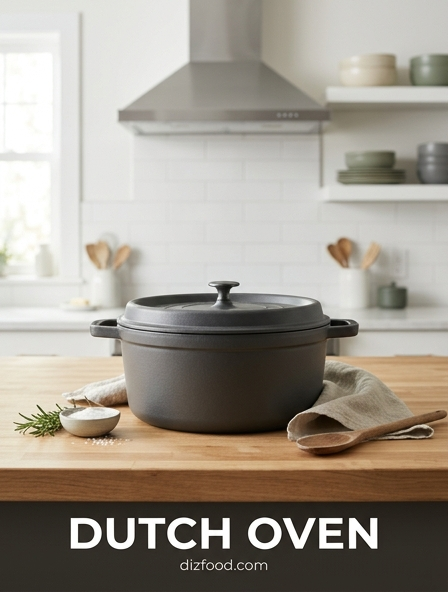
Maximized Volume for Layered Flavors
The profound depth of a Dutch oven is not merely a matter of capacity; it is a structural necessity for the systematic layering of complex flavors. Unlike shallow skillets that prioritize surface area for quick evaporation, the voluminous interior of this vessel allows chefs to build a foundation of aromatics, followed by proteins and deglazing liquids, without overcrowding. This vertical space ensures that each ingredient contributes its essence to the collective profile without the risk of boiling over or scorching. As ingredients are added in stages, the height of the pot protects the developing fond on the bottom from oxidizing too rapidly.
- Initial Searing: Provides a Maillard reaction base that remains undisturbed by subsequent additions.
- Aromatic Sweating: Vegetables soften in the rendered fats, trapped within the high walls.
- Liquid Integration: Adding stocks or wines creates a deep immersion environment for long-term infusion.
- Herb Infusion: Large bundles of herbs can be fully submerged to release essential oils.
This tiered approach to cooking is what defines the most celebrated stews and ragus. The maximized volume ensures that there is ample room for the liquid to circulate around the solids, preventing the ingredients from becoming a compacted mass and instead allowing them to remain distinct yet harmonious within the sauce.
Promoting Efficient Convection Cycles
The architecture of a Dutch oven is specifically engineered to facilitate natural convection cycles during long cooking processes. When the vessel is placed over a heat source or within an oven, the liquid at the base warms and rises toward the surface. Because the side walls are tall and typically made of thick cast iron, they maintain a consistent temperature that encourages the liquid to move in a continuous, rolling motion. This internal movement ensures that heat is not just applied from the bottom, but is distributed through the entire volume of the dish.
As the heated liquid reaches the cooler lid, it begins to move toward the sides, where it cools slightly and descends. This cycle provides a gentle agitation that prevents sediment from sticking to the bottom while ensuring that the top layers of the food are as thoroughly cooked as the bottom. This efficiency is why Dutch ovens are superior for recipes that require hours of simmering. The convection currents naturally bast the ingredients, eliminating the need for constant manual stirring and reducing the risk of thermal hot spots that could lead to localized burning.
Optimizing Moisture Retention and Recirculation
One of the most critical functions of a high-quality Dutch oven is its ability to manage moisture through a closed-loop system. The heavy, tight-fitting lid creates a pressurized environment that prevents steam from escaping, which is essential for maintaining the hydration of the dish. This process is often enhanced by specialized lid designs that facilitate "self-basting" cycles. As steam rises, it hits the cooler surface of the lid, condenses into droplets, and falls back onto the food.
- Evaporation: Liquid turns to steam, carrying flavor molecules upward.
- Condensation: The heavy lid captures the vapor, preventing moisture loss.
- Precipitation: Droplets form on the lid's underside and rain down evenly.
- Reabsorption: The food absorbs the seasoned liquid, keeping it moist and tender.
This recirculation is what allows tough cuts of meat to transform into succulent morsels. By optimizing moisture retention, the Dutch oven ensures that the cooking environment remains saturated with humidity. This prevents the surface of the food from drying out and creates a concentrated sauce that is rich in gelatin and flavor, as the water remains within the pot rather than escaping into the kitchen air.
The Role of Thermal Mass in Simmering
The term thermal mass refers to the ability of a material to absorb, store, and slowly release heat. Dutch ovens, usually constructed from heavy cast iron or enameled steel, possess an extraordinary thermal mass compared to thinner aluminum or stainless steel pots. This characteristic is vital for maintaining a steady simmer, which is the "sweet spot" for breaking down connective tissues in meats and softening fibrous vegetables. Once the Dutch oven reaches the desired temperature, its thick walls act as a thermal reservoir, resisting fluctuations.
This stability is particularly beneficial when adding room-temperature ingredients to a hot pot. While a thin pot would experience a significant temperature drop, a Dutch oven's massive walls provide enough stored energy to return the liquid to a simmer almost instantly. This prevents the "boil-and-stall" cycle that can toughen proteins. Furthermore, when moved from the stovetop to the oven, the thermal mass ensures that the heat radiates inward from all directions, surrounding the food in a consistent embrace of warmth that is impervious to the cycling of the oven's heating elements.
Vertical Design and Uniform Heat Distribution
The vertical design of a Dutch oven plays a sophisticated role in how heat is distributed throughout the vessel. Unlike a wide, flat pan where heat is primarily concentrated at the base, the high sidewalls of a Dutch oven capture radiant heat from the oven's atmosphere and conduct it through the thick material. This creates a 360-degree heating effect. This uniformity is essential for baking bread or slow-roasting vegetables, as it ensures there are no cold zones within the pot.
| Feature | Benefit for Distribution |
|---|---|
| Thick Base | Prevents scorching by diffusing direct flame heat. |
| High Walls | Captures radiant heat for lateral cooking. |
| Heavy Lid | Reflects heat back down onto the food surface. |
| Cast Iron Core | Provides high emissivity for deep heat penetration. |
By utilizing the entire surface area of the pot, the Dutch oven functions like a small oven within an oven. This verticality ensures that even if the pot is filled to three-quarters capacity, the top layer receives as much thermal energy as the bottom, resulting in perfectly even results every time.
Minimizing Evaporation for Richer Broths
In the world of broth and stock making, control over evaporation is the difference between a thin soup and a rich, velvety consommé. The Dutch oven excels at minimizing evaporation due to the precision fit of its lid and the weight of the material. While some reduction is often desired to concentrate flavors, uncontrolled evaporation can lead to over-salting and the loss of aromatic compounds that are carried away by steam. The Dutch oven keeps these volatiles trapped inside the vessel.
When liquid levels remain stable over several hours of cooking, the extraction process becomes more efficient. The steady volume allows for a constant osmotic exchange between the solids and the liquid. This results in a broth that is deeply saturated with the essence of the ingredients. Because the lid weight provides a slight increase in internal pressure, the boiling point is marginally altered, allowing for a more aggressive extraction without the turbulence of a rolling boil. This keeps the broth clear and prevents the emulsification of fats, which can make a stock cloudy and greasy if not managed correctly.
Supporting Large Cuts for Braising
Braising is a culinary technique that requires a specific ratio of liquid to solid, and the Dutch oven is the quintessential tool for this task. Its deep, wide interior is specifically designed to accommodate large cuts of meat, such as brisket, pork shoulder, or whole chickens. These cuts require a vessel that can hold them comfortably while leaving enough room for a surrounding "moat" of aromatic liquid and vegetables. The high sides ensure that the meat can be partially submerged, which is the hallmark of a proper braise.
- Space for Expansion: Ingredients can swell as they absorb liquid without crowding the pot.
- Immersion Depth: Allows for the "half-submerged" rule, where the top is roasted and the bottom is poached.
- Easy Manipulation: Plenty of room to turn large roasts using tongs without splashing.
- Vegetable Bedding: Enough floor space to rest meat on a bed of mirepoix.
The ability to support these large volumes means that the Dutch oven is the ideal choice for family-style meals or meal prepping. It provides the physical infrastructure necessary to handle heavy, dense ingredients while maintaining the delicate thermal environment required to turn tough collagen into tender gelatin over several hours.
Effective Steam Trapping with High Sidewalls
The high sidewalls of a Dutch oven do more than just hold liquid; they serve as a critical component in steam management. By creating a significant amount of "headspace" between the surface of the food and the lid, the pot allows for a vapor chamber to form. This chamber becomes saturated with superheated steam, which penetrates the food much more effectively than dry air. This is why Dutch ovens are often used to bake artisan bread; the trapped steam keeps the dough's surface moist, allowing it to expand fully before the crust sets.
In savory applications, this steam trapping ensures that even the parts of the food not submerged in liquid are cooked in a high-humidity environment. This prevents the "skin" that can sometimes form on the top of stews or beans. The high walls also act as a buffer against splattering when the lid is removed, keeping the stovetop clean. This containment of vapor and heat creates a micro-climate within the pot that is remarkably stable, ensuring that the ingredients are subjected to a gentle, humid heat that preserves their structural integrity while maximizing flavor infusion.
The Science of Steady Stew Temperatures
Maintaining a precise temperature is the most difficult aspect of making a great stew, and the Dutch oven simplifies this through its inherent physics. The combination of its heavy material and circular or oval shape promotes an even thermal field. When cooking a stew, the goal is to keep the liquid just below the boiling point-around 190 to 200 degrees Fahrenheit. The Dutch oven's insulation properties prevent the liquid from fluctuating wildly, even if the stovetop flame is inconsistent.
- Heat Absorption: The base absorbs energy from the burner.
- Lateral Conduction: Heat travels up the walls, warming the liquid from the sides.
- Radiant Emission: The internal surfaces emit infrared heat toward the center of the pot.
- Lid Reflection: Heat rising from the surface is bounced back down, creating a convection loop.
This "surround-sound" heating method ensures that the temperature gradient from the bottom to the top of the stew is minimal. Without this steady environment, the bottom of the stew might scorch while the top remains undercooked. The Dutch oven eliminates this risk, providing a laboratory-grade level of thermal consistency that is required for the long-term chemical reactions that create deep, savory "umami" flavors in slow-cooked dishes.
Enhancing Deep Flavor Extraction via Depth
The depth of a Dutch oven contributes to flavor extraction through the principle of hydrostatic pressure. While the pressure increase is subtle, the weight of the liquid in a deep pot exerts more force on the ingredients at the bottom than in a shallow pan. This, combined with the long duration of the cooking process, helps to force the seasoned liquid into the pores of the meat and vegetables. The depth also allows for a larger volume of liquid, which can hold a higher concentration of dissolved solids like sugars, salts, and proteins.
Furthermore, the deep environment allows for a gradient of flavor concentration. As the dish simmers, the heavier fats and proteins may settle or circulate differently than the lighter aqueous components. This complexity is what gives Dutch oven meals their "round" and "full" taste. The depth also facilitates the use of large "flavor anchors," such as ham hocks or marrow bones, which require full submersion to give up their gelatin and minerals. By providing the space for these large, flavor-dense additions, the Dutch oven allows for a level of extraction that is simply not possible in smaller, shallower cookware.

Comments