
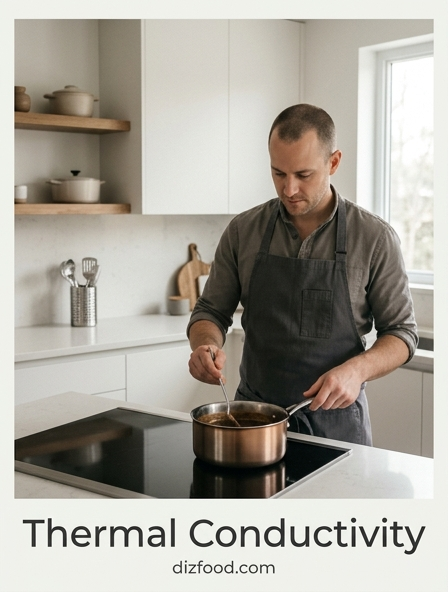
Understanding Thermal Conductivity Science
Thermal conductivity is a fundamental physical property that dictates how efficiently heat energy moves through a material. In the culinary world, this science governs how quickly a burner's energy reaches the food. At a molecular level, conductivity occurs when high-energy particles collide with neighboring atoms, transferring kinetic energy throughout the cookware's structure. Materials with high thermal conductivity allow for rapid and uniform temperature shifts, whereas low-conductivity materials act as insulators, resisting the flow of heat.
Understanding this concept requires looking at the Fourier Law of Heat Conduction, which relates the heat transfer rate to the temperature gradient and the specific material's properties. For a chef, this translates to the difference between a pan that responds instantly to a flame adjustment and one that exhibits significant thermal lag. Factors influencing this science include:
- Atomic structure and free electron movement within the metal.
- The thickness of the material, which dictates the distance heat must travel.
- The temperature differential between the heat source and the cooking surface.
- The presence of alloys which can disrupt pure metallic conductivity.
Copper and Silver Performance Ratings
When evaluating the pinnacle of kitchen performance, silver and copper stand unrivaled in their ability to move thermal energy. Silver possesses the highest thermal conductivity of any metal, though its extreme cost renders it a rarity found only in the most prestigious artisanal collections. Copper serves as the practical gold standard for professional environments, offering nearly 90% of silver's efficiency at a more accessible price point. These metals ensure that heat is distributed laterally across the base of the pan just as quickly as it moves vertically toward the food.
The following table illustrates the thermal conductivity ratings (measured in W/m·K) for common kitchen materials to highlight the disparity between high-performance metals and standard options:
| Material | Thermal Conductivity (W/m·K) |
|---|---|
| Pure Silver | 429 |
| Pure Copper | 401 |
| Aluminum | 235 |
| Cast Iron | 52 |
| Stainless Steel | 15 |
Optimizing Professional Heat Distribution
Professional kitchens demand equipment that provides absolute uniformity across the entire cooking surface. Optimizing heat distribution is not merely about using conductive materials, but about engineering the geometry of the cookware. A pan with a thick base and high-conductivity core ensures that energy from a focused gas flame or induction coil spreads outward to the edges before rising. This prevents the center of the pan from becoming significantly hotter than the perimeter, a common flaw in consumer-grade equipment.
To achieve professional-grade optimization, manufacturers focus on three primary factors. First, the cross-sectional area must be sufficient to carry the required thermal load. Second, the bond between different metal layers must be seamless to prevent air pockets that act as insulators. Third, the exterior finish must facilitate efficient energy absorption from the source. When these elements are aligned, the chef gains the ability to utilize every square inch of the cooking surface, allowing for higher volume production without sacrificing the quality or consistency of the final dish.
The Role of Thermal Diffusivity
While thermal conductivity measures the steady-state heat flow, thermal diffusivity describes how quickly a material adjusts its temperature in response to a change in the thermal environment. It is the ratio of thermal conductivity to the product of density and specific heat capacity. In the kitchen, diffusivity explains why an aluminum pan feels hot almost instantly, while a heavy ceramic dish takes a long time to warm up even if the heat source is intense. This property is crucial for techniques requiring rapid temperature fluctuations.
High thermal diffusivity is essential for tasks like sautéing, where the chef needs the pan to drop in temperature immediately when wine is added for deglazing, and then recover just as quickly. Materials with low diffusivity are preferred for slow-cooking and baking, where a "thermal buffer" is desired to protect the food from the volatility of the heating element. Understanding this distinction allows cooks to choose the right tool based on whether they need speed or stability during the cooking process.
Impact of Clad Metal Construction
Clad metal construction is a modern engineering solution designed to bridge the gap between high-conductivity metals and durable, non-reactive surfaces. Since copper and aluminum can react with acidic foods or tarnish easily, they are often "sandwiched" between layers of stainless steel. This multi-ply approach utilizes a core of high-conductivity metal to move heat efficiently while the exterior layers provide structural integrity, induction compatibility, and a food-safe interior. The thickness and number of these layers directly impact the performance of the vessel.
- 3-Ply: A standard configuration featuring an aluminum core between two steel layers.
- 5-Ply: Adds additional layers, often alternating aluminum and copper for enhanced response.
- 7-Ply: Designed for maximum heat retention and stability, often used in high-end sauciers.
- Copper-Core: Specifically utilizes a thick copper center for the fastest possible thermal transfer.
The effectiveness of cladding depends on the "roll-bonding" process, which uses immense pressure to fuse the metals at a molecular level, ensuring there is no thermal resistance between the different material interfaces.
Managing Searing and Heat Retention
Searing meat requires a massive initial burst of energy to trigger the Maillard reaction, followed by sustained heat to prevent the pan's surface temperature from crashing when the cold protein makes contact. This is where thermal conductivity intersects with thermal mass. A material with high conductivity but low mass, like a thin copper omelet pan, will lose its heat the moment a steak is dropped in. Conversely, a material with high heat capacity, such as cast iron, stores a vast reservoir of energy that can be discharged into the food.
Effective searing management involves preheating the vessel until it reaches the Leidenfrost point, ensuring the surface energy is high enough to vaporize moisture instantly. For thick cuts of meat, chefs often prefer heavy-gauge clad stainless steel or cast iron because these materials provide the necessary "thermal inertia." While they take longer to reach the target temperature due to their lower conductivity compared to copper, they provide the consistent, high-wattage output required to create a crisp, caramelized crust without steaming the meat in its own juices.
Eliminating Cold Spots in Cookware
Cold spots are the nemesis of consistent cooking, often resulting in unevenly cooked proteins or scorched sauces in isolated areas. These spots occur when the heat source-whether a gas ring or an induction element-is smaller than the pan base, or when the material's thermal conductivity is too low to distribute the energy laterally. In inferior cookware made of thin stamped steel or low-grade aluminum, the heat moves straight through the metal rather than across it, creating "hot spots" directly above the flame and "cold spots" everywhere else.
To eliminate these inconsistencies, high-quality cookware employs several strategies:
- Full-clad bodies that extend the conductive core all the way up the sidewalls.
- Encapsulated bases with thick aluminum or copper discs for superior lateral spread.
- Heavy-gauge construction that increases the distance heat must travel, allowing it to "blur" and even out.
- Concave base engineering that flattens when heated, ensuring maximum contact with flat cooktops.
By ensuring a uniform thermal profile, the chef can rely on predictable results regardless of where the food is placed within the pan.
Precision Temperature Response Times
Precision in the kitchen is often measured by response time-how quickly a pan reacts when the cook turns the dial. This is particularly vital for delicate tasks such as tempering chocolate, making hollandaise, or reducing complex sauces where a few degrees can mean the difference between success and curdling. High-conductivity metals like copper offer the most immediate response, allowing for "on-the-fly" adjustments that are impossible with more sluggish materials. This agility provides a safety net for the chef, allowing for instant cooling if a sauce begins to break.
Response time is a function of both high conductivity and low thermal mass. While cast iron is praised for retention, its response time is remarkably poor, often taking minutes to cool down even after being removed from the heat. In contrast, a professional copper or high-grade aluminum pan allows for "active" cooking, where the heat is manipulated as a dynamic ingredient. This level of control is why professional sauciers almost exclusively use high-conductivity vessels to maintain the strict temperature windows required for haute cuisine.
Cast Iron and Carbon Steel Dynamics
Cast iron and carbon steel represent a unique category where low thermal conductivity is balanced by high emissivity and significant thermal mass. These materials are relatively poor at moving heat quickly; a cast iron skillet over a small burner will often be searing hot in the center while the edges remain cool. However, once they are properly preheated, they become powerful radiators of infrared energy. This makes them ideal for tasks that require deep, penetrating heat rather than the "skimming" heat of highly conductive metals.
Carbon steel, being thinner and more conductive than cast iron, offers a middle ground. It is the preferred material for woks, where the "breath of the wok" (wok hei) requires intense heat in the base but a rapid drop-off in temperature up the sides. The dynamics of these materials also change with seasoning-the polymerized oil layer. While the oil slightly reduces raw conductivity, it improves the release properties and ensures that the radiant heat is absorbed efficiently by the food surface, creating the iconic blackened finish associated with these traditional materials.
Thermal Efficiency in Modern Kitchens
Thermal efficiency in the modern kitchen focuses on minimizing energy waste while maximizing the speed of heat transfer. With the rise of induction cooking, the requirements for cookware have shifted toward ferromagnetic materials that can also distribute heat effectively. Efficiency is no longer just about how fast a pan gets hot, but how much of the energy pulled from the wall outlet actually ends up in the food. High-efficiency systems utilize materials that couple perfectly with magnetic fields while maintaining a conductive core to prevent energy loss to the surrounding air.
Modern innovations include:
- Integrated heat-sink bottoms that capture stray thermal energy.
- Vacuum-insulated lids that prevent convective heat loss during simmering.
- Smart-sensor cookware that communicates with induction hobs to maintain exact temperatures.
- Advanced ceramic coatings that enhance the absorption of infrared radiation.
By selecting tools with high thermal efficiency, professional and home kitchens can reduce their carbon footprint, lower ambient kitchen temperatures, and significantly decrease the time required for prep and service, leading to a more sustainable culinary environment.


Comments