
Choosing between cast iron and carbon steel is like picking between a rugged off-road truck and a nimble sports car; both are legendary kitchen workhorses, but they excel in very different lanes. While cast iron is the undisputed king of heat retention and thick-crust searing, carbon steel offers a lighter, more responsive alternative that mimics the non-stick properties of Teflon without the chemicals. Both pans require a bit of love through seasoning to build a natural patina, yet your final decision hinges on whether you prioritize the heavy thermal mass needed for a perfect ribeye or the agile maneuverability required for delicate omelets and stir-frys.
| Feature | Cast Iron Cookware | Carbon Steel Cookware |
|---|---|---|
| Heat Retention | Exceptional; stays hot long after removing from heat source. | Moderate; loses heat faster, allowing for precise control. |
| Weight & Handling | Heavy (5-8 lbs); requires two hands or sturdy wrists. | Lighter (2-4 lbs); ergonomic for tossing and sautéing. |
| Thermal Response | Slow to heat up and slow to cool down. | Rapid; reacts almost instantly to burner adjustments. |
| Surface Texture | Slightly porous/pebbly; excellent for oil "grip." | Smooth; creates a glass-like non-stick surface quickly. |
| Best Used For | Steaks, cornbread, deep-frying, and Dutch oven stews. | Fish, eggs, stir-frys, and delicate French omelets. |
| Durability | Virtually indestructible but can crack if dropped. | Tough and malleable; more resistant to thermal shock. |
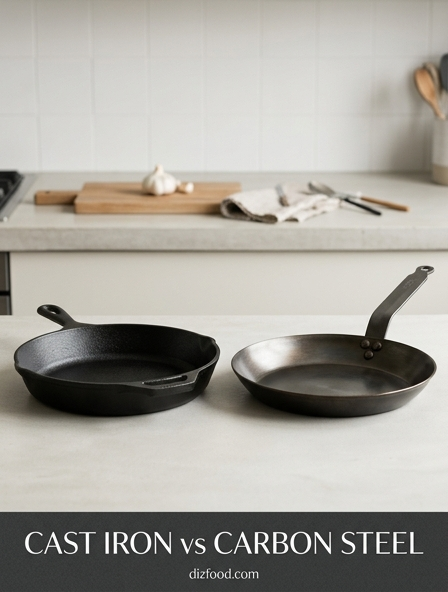
Cast Iron vs Carbon Steel Comparison
In the world of high-performance cookware, cast iron and carbon steel stand as the two most popular choices for chefs who value durability and natural nonstick properties. While they share several similarities-both being ferrous alloys that require seasoning and maintenance-they offer distinct cooking experiences tailored to different culinary techniques. Cast iron is often viewed as the rugged workhorse of the American kitchen, celebrated for its incredible heat retention and its ability to go from the stovetop to the oven with ease. It is the go-to tool for deep searing, frying, and baking hearty dishes like cornbread or cobblers.
Carbon steel, on the other hand, is frequently described as the professional chef's secret weapon. Predominantly found in restaurant kitchens and throughout Europe, it combines the best attributes of cast iron with the agility of stainless steel. It reacts much faster to temperature changes, making it ideal for delicate tasks that require precision. Despite their differences in weight and thermal behavior, both materials rely on the polymerization of fats to create a slick surface, and both can last for generations if handled with care. Understanding the nuances between these two metals is essential for any home cook looking to move away from synthetic nonstick coatings and toward a more traditional, lifetime-lasting kitchen setup.
- Both require a "seasoning" layer of baked-on oil.
- Both are compatible with induction, gas, and electric heat.
- Both develop better nonstick properties the more they are used.
- Both are highly susceptible to rust if left wet or unseasoned.
Key Differences in Material Composition
While cast iron and carbon steel are both made primarily of iron, the specific ratio of carbon within the alloy changes their physical properties and manufacturing processes. Cast iron typically contains between 2% and 4% carbon. This high carbon content makes the metal brittle, meaning it cannot be hammered or rolled into shape. Instead, it must be melted and poured into sand molds, resulting in its signature thick, heavy, and somewhat porous structure. This casting process also accounts for the "one-piece" design often seen with cast iron skillets, where the handle is part of the same mold as the body.
Carbon steel contains significantly less carbon, usually around 1%. This lower carbon concentration makes the metal more ductile and malleable. Rather than being cast in a mold, carbon steel is rolled into thin sheets and then stamped or spun into the shape of a pan. Because the metal is tougher and less brittle, it can be made much thinner and lighter than cast iron without the risk of shattering. The handles on carbon steel pans are typically made of a separate piece of steel or stainless steel and are riveted or welded onto the base, which is a key visual differentiator between the two styles.
| Feature | Cast Iron | Carbon Steel |
|---|---|---|
| Carbon Content | 2% - 4% | Approximately 1% |
| Manufacturing | Sand Casting | Stamping or Spinning |
| Grain Structure | Coarse/Brittle | Fine/Ductile |
Heat Retention vs Thermal Responsiveness
The most significant functional difference between these two metals lies in how they manage heat. Cast iron is famous for its thermal mass. Because the pans are thick and heavy, they take a long time to heat up, but once they reach a certain temperature, they stay there. This "heat sink" effect is invaluable when dropping a cold piece of meat into a pan; the surface temperature remains high, resulting in a superior, even crust. However, this same retention makes cast iron slow to respond if you accidentally overheat the pan, as it will take several minutes to cool down even after the flame is lowered.
Carbon steel is prized for its thermal responsiveness. Because it is thinner and less massive than cast iron, it heats up very quickly and, more importantly, cools down almost immediately when the heat source is adjusted. This makes it the superior choice for cooking proteins that require precise temperature control, such as fish or scallops, where a few extra seconds of high heat could lead to overcooking. While it does not hold heat as long as cast iron, its ability to "pivot" makes it much more forgiving for sautéing and stir-frying. For the cook, the choice often comes down to whether they want the steady, unstoppable heat of iron or the nimble, reactive control provided by steel.
Weight and Maneuverability Performance
Weight is often the deciding factor for home cooks choosing between these two materials. A standard 12-inch cast iron skillet can weigh anywhere from seven to nine pounds. This mass makes the pan very stable on the burner but difficult to maneuver with one hand. Flipping vegetables or tossing a pasta sauce "chef-style" is nearly impossible for most people using cast iron. To compensate for this weight, most cast iron pans feature a "helper handle" on the opposite side of the main handle to allow for two-handed lifting when moving the pan from the stove to the oven.
Carbon steel provides a much lighter alternative, generally weighing about 25% to 50% less than a cast iron pan of the same diameter. This reduced weight allows for much greater maneuverability. The handles on carbon steel pans are also typically longer and angled upward, designed specifically to facilitate the tossing motion used in sautéing. This ergonomic design makes carbon steel the preferred choice for high-activity cooking where the pan is frequently moved, shaken, or lifted. While still heavier than aluminum or modern nonstick pans, carbon steel strikes a balance that many find perfect for daily use.
- Cast Iron: Best for stationary cooking and oven roasting.
- Carbon Steel: Best for active sautéing and tossing ingredients.
- Cast Iron: Usually features short, stubby handles.
- Carbon Steel: Features long, ergonomic handles for better leverage.
The Seasoning Process for Both Metals
Both cast iron and carbon steel are "raw" metals, meaning they will rust almost immediately if exposed to moisture without protection. To prevent this and to create a nonstick surface, both must undergo a process called seasoning. This involves applying a very thin layer of unsaturated fat-such as grapeseed, flaxseed, or canola oil-and heating the pan past the oil's smoke point. At this temperature, the oil undergoes polymerization, transforming from a liquid fat into a hard, plastic-like solid that bonds to the metal's surface. Over time, these layers build up to create a deep black patina that is remarkably slick.
While the chemistry is the same, the application varies slightly. Cast iron, with its textured surface, "grabs" onto seasoning easily, making it very durable. Carbon steel is smoother, so the initial layers of seasoning may appear splotchy or uneven. It is common for a carbon steel pan to look "ugly" or multicolored during its first few months of use. However, because carbon steel is less porous, it often develops a slicker surface faster than cast iron. Maintaining the seasoning on both pans requires avoiding harsh soaps and acidic foods, like tomato sauce, which can strip the hard-earned patina and require the cook to re-season the metal from scratch.
- Clean the raw metal thoroughly to remove factory wax.
- Apply a microscopic layer of high-smoke-point oil.
- Buff away almost all the oil until the pan looks dry.
- Heat in an oven or on a burner until the oil smokes and hardens.
- Repeat the process to build a foundational layer of protection.
Surface Texture and Nonstick Properties
The texture of the cooking surface is a point of contention among enthusiasts. Most modern cast iron pans have a pebbly, sand-like texture. This is a byproduct of the sand-casting process. While some high-end manufacturers grind these surfaces smooth, the standard texture actually helps the seasoning layer adhere to the pan. Despite the bumps, a well-seasoned cast iron pan can be remarkably nonstick, though it may require a bit more fat (butter or oil) to ensure that delicate items like eggs do not catch in the microscopic valleys of the metal.
Carbon steel is naturally smooth from the rolling process. Out of the box, it feels much more like a stainless steel pan. Once seasoned, this smooth surface allows for a level of nonstick performance that rivals Teflon. It is often cited as the best pan for French omelets or delicate crepes because the food can slide across the surface with zero resistance. Because there are no "pores" or "bumps" to catch the food, many cooks find carbon steel to be the superior choice for low-fat cooking. However, that same smoothness means that if the seasoning is not applied correctly, it can flake off more easily than it would on the rougher surface of a cast iron skillet.
Durability and Lifetime Value Analysis
Both cast iron and carbon steel are considered "heirloom" cookware, meaning they are designed to last for decades or even centuries. Unlike modern nonstick pans that must be discarded once the coating scratches or fails, these pans can always be restored. If a cast iron or carbon steel pan is left in a damp basement and covered in rust, it can be scoured down to the raw metal and re-seasoned to look like new. This makes them some of the most sustainable and cost-effective purchases a cook can make for their kitchen.
However, they fail in different ways. Cast iron is incredibly hard but brittle; if dropped on a hard tile floor, it can actually crack or shatter. It is also susceptible to "thermal shock," where moving a screaming-hot pan into cold water can cause the metal to snap. Carbon steel is more resilient to impact because it is more flexible. It is highly unlikely to crack if dropped. However, because it is thinner, it is more prone to warping. If a carbon steel pan is heated too quickly on a high-output induction burner, the center may bow upward, preventing it from sitting flat on the stove. Despite these minor risks, both materials offer incredible lifetime value compared to any other cookware category.
- Indestructible under normal cooking conditions.
- Restorable even after severe rusting or neglect.
- Environmentally friendly due to the lack of chemical coatings.
- Value increases over time as the seasoning matures.
Maintenance and Cleaning Requirements
The maintenance of these pans is often misunderstood, leading to the myth that they are difficult to own. The primary rule for both is to never put them in the dishwasher. The harsh detergents and long exposure to moisture will strip the seasoning and cause immediate oxidation. Instead, they should be hand-washed with hot water. Contrary to popular belief, a small amount of mild dish soap will not hurt a well-seasoned pan, as the seasoning is a polymerized plastic, not just a layer of oil. However, most cooks find that a stiff brush or a chainmail scrubber is all that is needed to remove food debris.
The most critical step in maintenance occurs after washing. Both pans must be dried completely. Many chefs recommend placing the washed pan back on a warm burner for a minute to ensure every trace of moisture has evaporated. While the pan is still warm, a very light coating of oil should be rubbed into the surface to protect the metal until the next use. This "wash-dry-oil" routine takes less than two minutes but is the secret to keeping the pans in peak condition. If the surface ever feels sticky, it means too much oil was applied; if it looks dull or grey, it is time for a fresh round of seasoning.
- Scrape off food bits while the pan is still warm.
- Wash with hot water and a minimal amount of soap if needed.
- Dry immediately with a towel, then finish drying on the stovetop.
- Apply a tiny drop of oil and buff it into the surface.
- Store in a dry place, away from humidity.
Best Cooking Applications for Each Pan
Choosing between cast iron and carbon steel often depends on the menu. Cast iron is the undisputed king of the sear. Its ability to retain massive amounts of energy makes it perfect for thick steaks, pork chops, and burgers. It is also the ideal vessel for "low and slow" cooking or applications that require consistent ambient heat, such as baking focaccia, deep-dish pizza, or fruit crumbles. Because the walls of the pan are thick, they radiate heat effectively, cooking food from the sides as well as the bottom, which is why it is so favored for frying chicken or roasting vegetables.
Carbon steel excels in "active" cooking. Its shape and weight make it the perfect choice for sautéing vegetables, searing fish fillets, or cooking eggs. It is the traditional material for woks because of its ability to reach high temperatures and then cool down instantly when ingredients are tossed. Carbon steel is also excellent for making sauces that start with a sear, like a pan-seared chicken breast followed by a wine reduction. Because it is so slick and responsive, it is often the pan a cook reaches for first for breakfast, lunch, and quick weeknight dinners, leaving the cast iron for heavier weekend projects.
- Cast Iron: Steaks, Cornbread, Deep Frying, Roasting.
- Carbon Steel: Omelets, Crepes, Sautéed Veggies, Scallops.
- Cast Iron: Oven-to-table presentation.
- Carbon Steel: High-heat stir-frying and flipping.
Choosing the Right Skillet for Your Kitchen
Ultimately, the choice between cast iron and carbon steel is not about which is "better," but which fits your personal cooking style and physical comfort. If you value a pan that feels like a permanent fixture on your stove-one that can take a beating and provide a crust on a steak that no other pan can match-cast iron is the classic choice. It is affordable, widely available, and iconic. It is particularly well-suited for those who do a lot of baking or who enjoy the ritual of traditional American campfire or "slow-food" cooking. Its weight is its greatest asset for heat, even if it is a drawback for movement.
If you prefer a more "surgical" approach to cooking-where you are constantly adjusting the flame, tossing ingredients, and demanding a surface that is as nonstick as a modern coated pan-carbon steel is the better investment. It offers a more professional feel and is significantly easier on the wrists and forearms. For many home cooks, the ideal solution is not to choose one, but to own both. A 12-inch cast iron skillet for heavy searing and a 10-inch carbon steel pan for eggs and vegetables provide a complete toolkit that can handle almost any recipe without ever needing to rely on short-lived, chemical-laden nonstick cookware.


Comments