
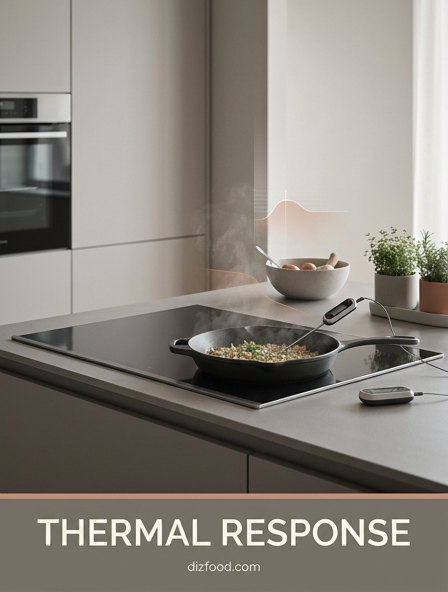
Understanding Thermal Conductivity in Professional Cookware
Thermal conductivity is the most critical metric for determining how a pan responds to heat adjustments. In a professional kitchen, the speed at which energy moves from the burner through the vessel wall determines the chef's level of control. High-conductivity materials like copper and aluminum distribute energy rapidly across the entire surface, minimizing hot spots and allowing for instantaneous temperature shifts when the flame is lowered.
In contrast, stainless steel possesses relatively poor conductivity. To compensate, manufacturers often use "cladding," sandwiching aluminum or copper between layers of steel. This creates a hybrid response profile that balances durability with thermal agility. Understanding these material properties is essential for tasks requiring precise heat modulation, such as tempering chocolate or reducing delicate emulsions.
- Copper: Highest conductivity for near-instant response.
- Aluminum: Excellent conductivity and lightweight, common in commercial bakesates.
- Stainless Steel: Low conductivity, primarily used for non-reactive durability.
- Carbon Steel: Moderate conductivity with superior seasoning capabilities.
The Impact of Material Density on Heat Retention
Material density directly influences the thermal mass of kitchen equipment, which dictates how well a vessel retains heat once a cold ingredient is introduced. High-density materials like cast iron act as thermal batteries; they require significant energy to heat up but provide a stable, unwavering output. This is vital for maintaining a consistent temperature during deep-frying or slow-braising, where fluctuations can compromise the final texture of the dish.
Low-density equipment responds faster to external cooling, which can be detrimental when searing meat. When a cold steak hits a low-density pan, the surface temperature drops precipitously, leading to steaming rather than browning. The following table compares common kitchen materials and their relative heat retention properties:
| Material | Density (kg/m³) | Heat Retention |
|---|---|---|
| Cast Iron | 7,200 | Excellent |
| Stainless Steel | 8,000 | Moderate |
| Aluminum | 2,700 | Low |
| Copper | 8,960 | Moderate-High |
Comparing Induction and Gas Thermal Response Times
The choice between induction and gas heating systems fundamentally alters the thermal workflow of a kitchen. Induction cooking utilizes electromagnetic fields to excite the molecules of the cookware directly. This method eliminates the middleman of an open flame and ambient air, resulting in a thermal response that is nearly twice as fast as traditional gas. Because the pan becomes the heat source, adjustments to the power level are reflected in the food almost immediately.
Gas ranges, while beloved for their visual feedback and compatibility with all cookware types, suffer from lower efficiency and slower response times. Much of the energy produced by a gas burner escapes around the sides of the pan, heating the kitchen rather than the ingredients. This creates a lag in temperature adjustment that chefs must learn to anticipate.
- Induction offers approximately 90% energy efficiency.
- Gas offers approximately 40% energy efficiency due to heat loss.
- Induction provides safer, cooler working environments.
- Gas allows for traditional techniques like charring and wok-tossing.
Managing Thermal Inertia for Consistent Searing
Thermal inertia refers to the resistance of an object to changes in its temperature. In the context of searing, high thermal inertia is a prerequisite for achieving the Maillard reaction without overcooking the interior of a protein. When a chef uses a heavy-bottomed pan, the energy stored within the metal resists the cooling effect of the cold moisture present on the surface of the meat. This ensures that the temperature stays above 300°F (150°C), facilitating rapid crust formation.
Managing this inertia requires preheating the vessel until it reaches a specific thermal equilibrium. If the pan is under-heated, the inertia is insufficient to overcome the heat sink effect of the ingredient. Conversely, excessive inertia can lead to burning if the heat source is not backed off at the correct moment. Professional cooks use water bead tests or infrared thermometers to gauge when the thermal inertia of their equipment is optimal for the specific protein being prepared.
The Role of Surface Area in Temperature Regulation
Surface area is a primary driver of heat exchange through both conduction and evaporation. A wide, shallow pan, such as a sautoir, maximizes the surface area in contact with both the heat source and the atmosphere. This configuration promotes rapid evaporation of liquids, which in turn cools the remaining contents through latent heat of vaporization. This is the fundamental principle behind reducing sauces; as the liquid volume decreases, the concentration of flavor increases, while the temperature remains stabilized by the boiling process.
In contrast, tall, narrow stockpots minimize the surface-to-volume ratio. This geometry reduces evaporative cooling and heat loss through the sides, making it ideal for maintaining a gentle simmer over several hours. Understanding the relationship between surface area and thermal loss allows chefs to choose the correct vessel for either rapid reduction or long-term temperature stability.
- Wide Pans: Accelerate reduction and evaporative cooling.
- Narrow Pots: Retain moisture and maintain stable internal temperatures.
- Flat Griddles: Provide maximum conductive surface for high-output searing.
Advanced Techniques for Controlling Carryover Cooking
Carryover cooking is the phenomenon where the internal temperature of a food item continues to rise after it has been removed from the heat source. This is caused by the thermal gradient established during the cooking process; the hotter exterior layers transfer their energy to the cooler core until equilibrium is reached. In high-precision environments, failing to account for this can result in a protein moving from a perfect medium-rare to an overdone medium during the resting phase.
To master carryover cooking, chefs must employ the following steps:
- Identify the thermal mass of the item; larger cuts exhibit more carryover.
- Pull the food from the heat 5°F to 10°F below the target temperature.
- Rest the item on a room-temperature rack to allow air circulation.
- Avoid tight foil tenting, which can trap steam and accelerate the internal rise.
- Monitor the internal peak temperature using a leave-in probe.
Calibrating Kitchen Equipment for Peak Thermal Sensitivity
Even the highest quality kitchen equipment can suffer from thermal drift over time. Ovens, deep fryers, and sous-vide immersion circulators rely on thermostats and thermocouples that require regular calibration to ensure accuracy. An oven set to 350°F might actually be cycling between 325°F and 375°F, leading to inconsistent bake times and uneven textures. Calibrating for sensitivity involves testing these cycles and identifying the "swing" or hysteresis of the appliance.
For precision work, chefs utilize independent digital thermometers to map out hot and cold spots within their equipment. This data allows for the strategic placement of items based on their thermal requirements. The table below outlines common equipment and the frequency of necessary thermal calibration.
| Equipment | Calibration Frequency | Method |
|---|---|---|
| Digital Probe | Weekly | Ice water / Boiling water |
| Convection Oven | Quarterly | Multi-point thermocouple mapping |
| Deep Fryer | Monthly | External oil thermometer check |
| Sous-Vide | Biannual | NIST-certified reference thermometer |
Optimizing Heat Flux for Delicate Protein Preparation
Heat flux is defined as the rate of heat energy transfer through a given surface. For delicate proteins like scallops, white fish, or eggs, high heat flux can be destructive, causing the protein fibers to contract too violently and squeeze out moisture. Optimizing flux requires a delicate balance between the temperature of the cooking surface and the thermal conductivity of the medium, such as oil or butter. By using a medium-low heat and a pan with moderate conductivity, a chef can ensure a gentle energy transfer.
This controlled approach allows for the slow denaturation of proteins, resulting in a tender, succulent texture. In many high-end kitchens, this is achieved by "basting" the protein with hot fats, which provides a more diffused heat flux compared to direct contact with the pan. This technique buffers the intensity of the heat source and allows for minute adjustments during the final stages of cooking.
The Science of Rapid Temperature Recovery in High-Volume Service
In high-volume commercial kitchens, "recovery time" is the interval required for a cooking surface to return to its set temperature after a load of food has been added. This is particularly critical for deep fryers and griddles. When a basket of frozen fries enters a vat of oil, the temperature can drop by 50°F or more. If the fryer has a slow recovery time, the fries will absorb excess oil, resulting in a greasy, soggy product.
Rapid recovery is achieved through high-output burners and high-performance heat exchangers that maximize the contact area between the heat source and the cooking medium. To optimize service flow, kitchens must monitor these recovery phases:
- Initial Drop: The immediate temperature plunge upon immersion.
- Stabilization: The period where energy input matches energy loss.
- Recovery Slope: The rate at which the temperature climbs back to the set point.
- Idle Cycle: The energy used to maintain heat between orders.
Implementing Real-Time Monitoring for Precision Heat Management
The integration of real-time thermal monitoring has transformed professional kitchens into data-driven environments. Using wireless probes and cloud-connected sensors, chefs can now monitor the internal temperatures of multiple items simultaneously from a centralized tablet or smartphone. These systems provide alerts when a product enters a specific thermal window, reducing the margin of human error and ensuring absolute consistency across different shifts and locations.
Beyond protein temperatures, real-time monitoring extends to storage environments and refrigeration units. By tracking the thermal fluctuations of walk-in coolers, managers can identify failing compressors before they result in food spoilage. This holistic approach to heat management not only improves food quality but also enhances food safety protocols and operational efficiency. As technology advances, the ability to analyze thermal data in real-time is becoming a standard requirement for modern culinary excellence.



Comments