
If you're chasing that elusive, golden-brown crunch without the vat of oil, you've likely wondered if a dedicated air fryer truly beats a standard convection oven. While both appliances rely on convection heating-using a fan to circulate hot air-the magic of the air fryer lies in its compact "tornado" effect. By blowing high-velocity air in a smaller chamber, air fryers rapidly dehydrate the surface of your food, mimicking the intense heat transfer of deep frying. Convection ovens offer more space for large batches, but they generally lack the concentrated wind speed required for that ultra-shattering crispness. Choosing between them ultimately comes down to whether you prioritize massive cooking capacity or the fastest path to a perfect, crackling exterior.
| Feature | Air Fryer | Convection Oven |
|---|---|---|
| Air Circulation | High-velocity fans; rapid "cyclone" movement. | Standard fans; steady, even distribution. |
| Crispiness Level | Superior; mimics deep-frying textures. | Moderate; achieves even browning. |
| Cooking Speed | 20-30% faster than traditional ovens. | Standard; limited by larger cavity volume. |
| Preheat Time | Near-instant (0-3 minutes). | 10-15 minutes average. |
| Capacity | Small (2-8 quarts); ideal for 1-4 people. | Large (5+ cubic feet); fits multiple trays. |
| Best For... | Frozen snacks, wings, and ultra-crisp veggies. | Roasting whole chickens, baking, and big meals. |
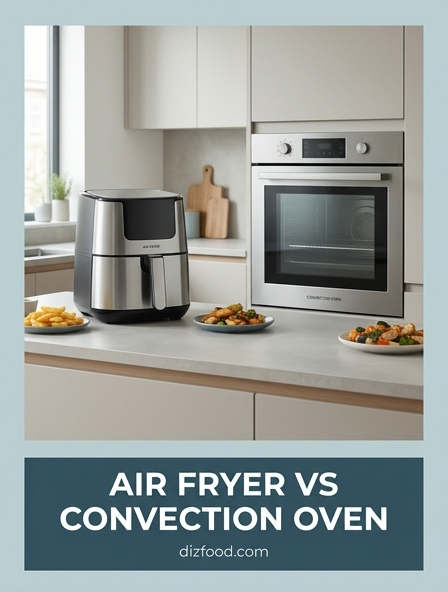
Understanding the Air Fryer vs Convection Oven Debate
The culinary world has seen a significant shift in home cooking technology, leading to a persistent debate between air fryers and convection ovens. While both appliances rely on the fundamental principle of circulating hot air to cook food, they cater to different kitchen needs and culinary styles. This comparison is not merely about which device heats food faster, but rather how the intensity of airflow affects the final texture, moisture retention, and overall flavor profile of various dishes. Home cooks often find themselves torn between the compact convenience of the air fryer and the versatile, high-capacity nature of the convection oven.
Understanding these differences requires a look at the history of kitchen evolution. Convection technology has been a staple in professional kitchens for decades, prized for its ability to eliminate cold spots and ensure even browning. Conversely, the air fryer is a relatively modern innovation designed to mimic the results of deep-frying without the excessive use of oil. The debate often centers on these primary factors:
- Space efficiency and footprint on the kitchen counter.
- The specific types of recipes usually prepared (e.g., snacks versus full meals).
- Health considerations regarding oil usage and fat reduction.
- User experience, ranging from manual dials to digital smart presets.
As kitchen space becomes a premium, choosing between these two often comes down to lifestyle. A busy individual might prioritize the speed of an air fryer, while a large family might require the volume of a traditional convection range.
How Air Fryers Differ from Traditional Convection Ovens
At their core, air fryers are essentially miniaturized, high-powered convection ovens, but the scale and intensity of their operation create a distinct cooking environment. The most immediate difference is the proximity of the heating element to the food. In an air fryer, the heating coil is positioned very close to the basket, allowing for intense, direct radiant heat. Traditional convection ovens, whether they are full-sized ranges or larger toaster oven styles, have more interior volume, which naturally dissipates heat more broadly across a wider area.
The design of the cooking chamber also plays a vital role in performance. Air fryers typically utilize a perforated basket designed to maximize air contact with every surface of the food. Traditional convection ovens use flat racks or baking sheets, which can sometimes block airflow to the underside of the food unless a specialized wire rack is used. This structural difference impacts the types of food that can be prepared; liquid-heavy batters may drip through an air fryer basket, whereas they flourish on a solid baking tray in a convection oven.
| Feature | Air Fryer | Convection Oven |
|---|---|---|
| Heating Proximity | Very Close | Distanced |
| Food Placement | Perforated Basket | Flat Racks/Trays |
| Primary Benefit | Concentrated Crispiness | Even Baking/Volume |
Heating Mechanism and Airflow Technology Comparison
The technical secret behind both appliances is convection-the transfer of heat through the movement of air. However, the velocity and volume of that air differ significantly. Air fryers utilize a powerful fan, often located directly above the heating element, to propel air at high speeds. This creates a "wind chill" effect in reverse, stripping moisture away from the surface of the food rapidly to facilitate the Maillard reaction. This rapid evaporation is what produces the characteristic "fried" crunch with minimal oil.
In contrast, traditional convection ovens use a fan to circulate air more gently. The goal here is not necessarily to "blast" the food, but to ensure that the temperature remains consistent throughout the entire oven cavity. This prevents the hot spots common in conventional radiant ovens. Because the air moves slower in a convection oven, the exterior of the food dries out more slowly, which is ideal for delicate items like cakes or large roasts that need to cook through to the center without burning the outside.
- High-Velocity Airflow: Found in air fryers to create a pressurized cooking environment.
- Cyclonic Motion: Many air fryers use a "starfish" design at the bottom to reflect air back up through the food.
- Steady Circulation: Convection ovens focus on moving large volumes of air to maintain a set temperature across multiple racks.
Cooking Speed and Preheating Efficiency Analysis
When it comes to time management in the kitchen, the air fryer is the undisputed champion. Due to its small chamber size and high-wattage heating elements, an air fryer can reach its target temperature in less than three minutes, and many models require no preheating at all. This efficiency is a result of the concentrated air volume; there is simply less "empty space" to heat up before the energy begins transferring to the food. For frozen snacks or single servings, the air fryer can often finish the entire cooking process in the time it takes a full-sized oven to reach 400°F.
Convection ovens require more patience. Even with the assistance of a fan, heating a large oven cavity takes 10 to 15 minutes. However, the efficiency of a convection oven is realized when cooking in bulk. While an air fryer is fast, it can usually only handle one or two portions at a time. If you are cooking for a family of five, the air fryer might require three separate cycles, whereas a convection oven can cook everything simultaneously on multiple racks. Therefore, speed must be measured by "total time to table" rather than just the clock on the machine.
Key efficiency factors include:
- Cavity Size: Smaller spaces heat exponentially faster.
- Wattage Density: Air fryers have a higher ratio of power to internal volume.
- Batch Cooking: Convection ovens save time by eliminating the need for sequential rounds of cooking.
Texture and Crispness Results for Popular Foods
The primary appeal of the air fryer is its ability to produce a crisp, golden-brown exterior that closely resembles deep-frying. For foods like chicken wings, french fries, and Brussels sprouts, the air fryer's intense airflow creates a superior texture. The rapid movement of air ensures that every nook and cranny of the food's surface is dehydrated and browned. This is particularly effective for "re-crisping" leftover fried foods, which often become soggy when reheated in a microwave or even a standard oven.
Convection ovens excel in "all-over" consistency but struggle to match the specific "crunch" factor of an air fryer for small items. They are, however, much better for items that require a balance of moisture and browning. For example, a whole roasted chicken in a convection oven will have beautifully browned skin while the meat remains succulent and juicy. In an air fryer, the high-speed air can sometimes dry out the exterior of a thick cut of meat before the interior is fully cooked. For baking pastries, the gentle convection fan ensures a perfect rise and even color, whereas the aggressive fan of an air fryer might cause delicate batters to lopsided or become overly tough.
Common results comparison:
- French Fries: Air fryer produces a superior crunch; convection oven results are more "baked."
- Cookies: Convection oven provides even edges and soft centers; air fryer can over-crisp the bottom.
- Vegetables: Air fryer offers a "charred" effect; convection oven provides a tender roast.
Capacity and Countertop Space Requirements
Space is often the deciding factor for many households. Air fryers are generally designed as countertop appliances. While "XL" models exist, most range from 3 to 8 quarts. This footprint can be cumbersome in smaller kitchens, especially since air fryers require clearance behind them for heat venting. They are ideal for individuals, couples, or as a secondary "side dish" appliance. However, their limited capacity means that crowding the basket will lead to soggy results, as the airflow becomes restricted.
Convection ovens offer far more versatility in terms of volume. A standard wall oven or range provides several cubic feet of space, allowing for the preparation of a 20-pound turkey, multiple sheets of cookies, or several pizzas at once. For those who don't want to sacrifice counter space, many modern toaster ovens now include a "convection" or even an "air fry" mode. These hybrid units attempt to bridge the gap, offering the capacity of a small oven with the specialized fan speed of a fryer. When choosing, consider whether the appliance will stay out permanently or be stored in a pantry, as the weight and bulk of these machines vary significantly.
| Appliance Type | Typical Capacity | Placement |
|---|---|---|
| Basket Air Fryer | 2-7 Quarts | Countertop |
| Toaster/Convection Oven | 0.5-1.2 Cubic Ft. | Countertop |
| Full-Size Convection Range | 5.0+ Cubic Ft. | Built-in / Floor |
Energy Consumption and Utility Cost Differences
From an energy perspective, the air fryer is significantly more cost-effective for small meals. Because it heats up almost instantly and cooks faster, it draws power for a much shorter duration. Furthermore, it does not heat up the entire kitchen, which is a hidden cost-saver during summer months when air conditioning systems must work harder to counteract the heat produced by a traditional oven. A standard air fryer typically pulls between 1,400 and 1,700 watts, which is comparable to a hair dryer, but its short run-time makes its total kilowatt-hour (kWh) usage relatively low.
A full-sized convection oven consumes much more energy-typically between 2,000 and 5,000 watts. Because it takes longer to preheat and is often used for longer cooking cycles (like roasting a roast or baking multiple loaves of bread), the utility cost per use is notably higher. However, the "energy per pound of food" can be lower in a convection oven if it is fully loaded. If you are using a 30-inch oven just to heat up a dozen chicken nuggets, you are wasting a substantial amount of energy compared to using an air fryer for the same task.
Considerations for energy savings:
- Use air fryers for snacks, leftovers, and small proteins.
- Reserve the convection oven for multi-dish meals or large-batch baking.
- Look for Energy Star ratings on full-sized appliances to ensure long-term efficiency.
Essential Features and Smart Cooking Functions
The modern market has transformed these appliances from simple heating boxes into "smart" kitchen assistants. Air fryers often come with a variety of presets for specific foods like fish, steak, or fries. These presets adjust both the temperature and the fan speed (in some high-end models) to achieve optimal results. Newer models also include "dual basket" technology, allowing users to cook two different foods at two different temperatures simultaneously, with a "match cook" feature to ensure both finish at the same time.
Convection ovens have also embraced technology. Many now feature Wi-Fi connectivity, allowing users to preheat the oven remotely via a smartphone app. High-end convection units may include steam-injection features (combi-ovens) which are excellent for professional-grade bread baking. Some ovens even include integrated meat probes that automatically shut the oven off once the internal temperature of a roast reaches a specific target. When comparing features, look for "True Convection" or "European Convection," which indicates the presence of a third heating element near the fan, providing even more consistent heat than basic fan-assisted models.
- Digital Presets: Simplifies the cooking process for beginners.
- Dehydration Mode: Low-temperature settings found in many air fryers for making dried fruit or jerky.
- Probe Thermometers: Ensures precision in large-scale convection roasting.
- Remote Monitoring: Useful for managing long cook times in convection ovens.
Ease of Cleaning and Maintenance Requirements
Cleaning is often the deciding factor for the daily user. Air fryers are generally easier to clean for small messes. Most air fryer baskets are coated with non-stick material and are dishwasher safe. However, the "drawer" design can accumulate grease in the bottom which, if not cleaned after every use, can lead to smoke and unpleasant odors during subsequent sessions. A significant challenge with air fryers is cleaning the heating element itself; since it is located at the top of the chamber, grease can sometimes splatter upward and become baked onto the coils.
Convection ovens are more traditional in their maintenance. While many offer a "self-clean" cycle (which uses extreme heat to incinerate residue), this process can be hard on the oven's internal components and produces significant fumes. Manual cleaning requires scrubbing large interior surfaces and racks. Toaster-style convection ovens often have a crumb tray at the bottom, but the glass doors and interior walls can become coated in grease over time, requiring degreasers and elbow grease. Because convection ovens are larger, they don't need to be deep-cleaned as frequently as a small air fryer basket, but the job is much more labor-intensive when it finally becomes necessary.
- Air Fryer: Dishwasher-safe baskets; high frequency of cleaning required.
- Convection Oven: Self-cleaning cycles; large surface area; less frequent maintenance.
- Toaster Oven: Crumb trays and removable racks; glass doors require frequent wiping.
Choosing the Best Appliance for Your Kitchen Lifestyle
Ultimately, the choice between an air fryer and a convection oven depends on your household size and your dietary preferences. If you are a fan of crispy textures, frequently cook frozen foods, or find yourself cooking for only one or two people, the air fryer is an indispensable tool. Its speed and ability to "fry" with air make it a health-conscious choice for those looking to reduce oil intake without sacrificing the satisfaction of a crunch. It is the king of convenience and a massive time-saver for busy professionals.
However, the convection oven remains the workhorse of the serious home cook and large families. If you enjoy baking cakes, roasting whole turkeys, or preparing multi-course meals, the air fryer's capacity will feel stifling. A convection oven provides the versatility to cook almost anything, and many newer ranges now include an "Air Fry" mode, essentially offering the best of both worlds in a single footprint. Consider your counter space, your average meal size, and whether you value the "crisp" of a fryer over the "evenness" of an oven before making your final investment.
Decision Checklist:
- Do you prioritize speed over volume? (Choose Air Fryer)
- Do you bake delicate pastries or large roasts? (Choose Convection Oven)
- Is counter space a primary concern? (Choose a Hybrid Toaster Oven)
- Are you cooking for more than four people regularly? (Choose Convection Oven)





Comments