
Embarking on the homebrew journey requires mastering the dual stages of fermentation to transform basic tea into a vibrant, probiotic powerhouse. The Kombucha First Ferment (F1) is the foundational phase where your SCOBY consumes sugar and caffeine to create a tangy, acidic base, while the Second Ferment (F2) is where the real magic of customization happens. By transitioning your brew into airtight bottles with fruit or herbs, you trap carbon dioxide to achieve that sought-after "pro-level" fizz. Understanding the delicate balance between these two phases is the ultimate secret to controlling both the health benefits and the explosive flavor profile of your finished beverage.
| Feature | First Ferment (F1) | Second Ferment (F2) |
|---|---|---|
| Primary Goal | Culture growth & acidification | Carbonation & flavor infusion |
| Vessel Type | Open-mouth glass jar (breathable) | Airtight, pressure-rated bottles |
| Key Ingredients | Tea, sugar, SCOBY, starter liquid | F1 liquid, fruit, juice, or herbs |
| Duration | 7-14 days (average) | 2-7 days (room temp) |
| Oxygen Needs | Required (aerobic process) | None (anaerobic process) |
| Final Profile | Tart, flat, vinegary base | Effervescent, sweet/savory finish |
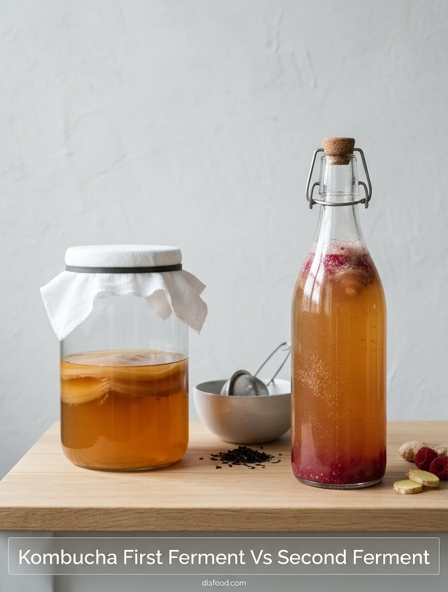
What is Kombucha First Fermentation
Kombucha first fermentation, often abbreviated as F1, is the foundational stage where sweetened tea is transformed into a tangy, probiotic-rich beverage. This process begins by combining brewed black or green tea with granulated sugar, which serves as the primary fuel source for the microbes. Once the tea has cooled to room temperature, a Symbiotic Culture of Bacteria and Yeast, commonly known as a SCOBY, is introduced along with a portion of "starter liquid" from a previous batch. This starter liquid lowers the pH of the new brew, creating an acidic environment that protects the culture from harmful pathogens during the early stages of fermentation.
Unlike later stages, the first fermentation is an aerobic process, meaning it requires oxygen to proceed correctly. The vessel is typically covered with a breathable cloth, such as a tightly woven tea towel or a coffee filter, secured with a rubber band to keep out dust and fruit flies. During this period, which usually lasts between seven and twenty-one days, the yeast consumes the sugar to produce ethanol and carbon dioxide, while the bacteria convert that ethanol into acetic and gluconic acids. The result is a liquid that gradually shifts from sweet to pleasantly tart.
- Base Liquid: Brewed tea (Camellia sinensis).
- Sweetener: Cane sugar or beet sugar.
- Inoculant: SCOBY mat and acidic starter tea.
- Vessel: Wide-mouth glass jar for maximum surface area.
- Cover: Breathable fabric to allow gas exchange.
The Purpose of Second Fermentation
The second fermentation, or F2, is where the artistry of kombucha brewing truly begins. While F1 creates the healthy base, F2 is designed to enhance the sensory experience through flavoring and carbonation. Once the first fermentation has reached the desired balance of sweetness and acidity, the liquid is bottled into airtight containers. At this stage, the SCOBY is removed and set aside for a new batch, meaning the second fermentation relies entirely on the yeast and bacteria suspended in the liquid itself. This process turns the flat, vinegary tea into a sophisticated, effervescent drink that rivals commercial sodas.
The primary goals of second fermentation include the following:
- Carbonation: By sealing the liquid in airtight bottles, the carbon dioxide produced by the remaining yeast is trapped, forcing it to dissolve into the liquid and create "fizz."
- Flavor Infusion: This is the time to add fruits, juices, herbs, or spices. The sugars in these additions provide fresh fuel for the yeast, allowing for complex taste profiles.
- Mellowing: A brief period of bottled fermentation can help round out the sharp edges of the acetic acid, resulting in a smoother mouthfeel.
- Portability: Transitioning the brew from a large crock to individual bottles makes it ready for refrigeration and eventual consumption.
Without F2, kombucha remains relatively still and carries a singular flavor profile dominated by the base tea. This secondary stage is essential for anyone seeking the signature "pop" and diverse palate associated with modern craft kombucha.
Key Differences in Flavor and Carbonation
Understanding the transition from F1 to F2 requires an appreciation for how the chemical profile of the beverage evolves over time. During F1, the flavor is in a constant state of flux, moving from the sugary profile of sweet tea to a sharp, vinegar-like finish. Because F1 is an open-air process, any carbon dioxide produced escapes into the atmosphere, leaving the liquid largely flat. In contrast, F2 is a closed system where the chemical reactions are intensified within a confined space, leading to significant changes in texture and aroma.
| Feature | First Fermentation (F1) | Second Fermentation (F2) |
|---|---|---|
| Flavor Profile | Tart, acidic, and tea-forward. | Complex, fruity, floral, or spicy. |
| Carbonation Level | Very low to still. | High, bubbly, and effervescent. |
| Sugar Content | Decreasing as yeast consumes it. | Temporary spike from added fruit/sugar. |
| Oxygen Exposure | Aerobic (needs oxygen). | Anaerobic (no oxygen). |
| Aroma | Vinegary and yeasty. | Aromatic based on added ingredients. |
The carbonation in F2 is not just for mouthfeel; it also influences flavor perception. The carbonic acid formed during this stage adds a slight "bite" that cuts through the sweetness of added fruit juices. While F1 provides the probiotic "gut" of the drink, F2 provides the "soul," making it palatable for everyday enjoyment.
How SCOBY Functions During First Ferment
The SCOBY is the biological engine of the first fermentation. Often called a "mushroom," it is actually a thick mat of cellulose produced by Acetobacter, a specific type of acetic acid bacteria. During F1, the SCOBY serves multiple roles: it acts as a physical barrier against airborne contaminants, and it houses the concentrated colony of microbes needed to process the tea. The yeast within the SCOBY structure breaks down the complex sucrose molecules into simpler sugars-glucose and fructose-which are then fermented into ethanol.
As the yeast works, the bacteria utilize the ethanol and oxygen to produce organic acids and more cellulose. This is why a "baby" SCOBY often forms on the surface of the jar during F1. This new layer is a sign of a healthy fermentation process and a vigorous bacterial colony. The SCOBY also regulates the environment by slowly releasing acids that lower the pH, ensuring that mold and "bad" bacteria cannot gain a foothold in the nutrient-rich tea. Without the physical presence of the SCOBY mat, the fermentation would still occur due to the microbes in the starter tea, but it would proceed much more slowly and with a higher risk of contamination. The SCOBY essentially acts as a highly organized factory, ensuring the conversion of ingredients is efficient and consistent across the 7-to-14-day cycle.
Creating Natural Fizz in Second Fermentation
The creation of natural carbonation is a hallmark of successful home brewing, yet it is often the most challenging part to master. In F2, fizz is achieved through an anaerobic (oxygen-free) process. When you bottle your F1 liquid and add a source of sugar-such as fruit puree or ginger-the yeast continues to feed. Because the bottle is sealed, the byproduct of this consumption, carbon dioxide (CO2), has nowhere to go. It builds up pressure inside the headspace of the bottle and is eventually forced to dissolve back into the liquid.
- Sugar Addition: Add about 10-20% fruit juice or 1-2 teaspoons of sugar to the bottle to provide fresh fuel for the yeast.
- Airtight Sealing: Use pressure-rated bottles with strong gaskets to ensure no gas leaks out.
- Warm Conditioning: Leave the bottles at room temperature (70-80°F) for 2 to 5 days. This is when the pressure builds.
- The "Burp" Test: Occasionally open a bottle to check the pressure level, though this can release the very carbonation you are trying to build.
- Chilling: Once the desired fizz is reached, move the bottles to the refrigerator. Cold liquid holds CO2 much better than warm liquid, which prevents the kombucha from "volcanoing" when opened.
The amount of fizz depends on the yeast activity from F1, the amount of sugar added in F2, and the ambient temperature. Warmer rooms will produce carbonation much faster than cooler ones, sometimes in as little as 24 hours.
Temperature and Timing for F1 Success
Temperature is perhaps the most critical variable in determining the success of the first fermentation. The ideal range for kombucha brewing is between 75°F and 85°F (24°C to 29°C). Within this window, the yeast and bacteria work in perfect harmony. If the temperature drops below 70°F, the process slows down significantly, making the brew susceptible to mold because the pH does not drop fast enough. Conversely, if the temperature exceeds 85°F, the yeast can become overactive, leading to a "yeast-dominant" brew that tastes overly bready or funky and produces a thin, weak SCOBY.
Timing is inextricably linked to temperature. In a warm kitchen, an F1 cycle might be complete in just 6 or 7 days. In a cooler environment, it may take 14 to 21 days to reach the same level of acidity. Brewers should start tasting their F1 around day 5. Use a clean straw or a glass dropper to take a sample from beneath the SCOBY. You are looking for a balance where the initial sugary taste has faded, replaced by a bright, vinegary zing, but before it turns into pure vinegar. Once you find that "sweet spot," you know it is time to move to the second fermentation. Consistency in temperature leads to consistency in flavor, which is why many serious brewers use seed seedling heat mats or wrap their jars in Christmas lights during winter months to maintain the ideal metabolic pace.
Best Bottles and Equipment for F2
The equipment used in second fermentation is drastically different from the wide-mouth jars used in F1. Because F2 involves high pressure, the choice of vessel is a matter of both quality and safety. Using the wrong glass can lead to "bottle bombs," where the internal pressure causes the container to shatter. The industry standard for home brewers is the flip-top or "swing-top" bottle, specifically those made with thick, pressure-rated glass. These are often called Grolsch-style bottles.
- Flip-Top Bottles: These provide a built-in mechanical seal with a rubber gasket that can withstand significant PSI.
- Plastic Testers: Many brewers fill one small plastic soda bottle alongside their glass bottles. When the plastic bottle becomes rock-hard to the touch, it indicates that the glass bottles are also fully carbonated.
- Funnels and Strainers: A stainless steel funnel is essential for transferring liquid from the F1 jar to the narrow necks of F2 bottles without aeration or mess.
- Bottle Brushes: Since F2 often involves fruit chunks or purees, a high-quality bottle brush is necessary for cleaning the narrow vessels afterward.
- Heating Mats: If your kitchen is cold, a small heating wrap can be used for F2 bottles to ensure the yeast remains active enough to produce bubbles.
Always avoid decorative glass bottles or recycled wine/liquor bottles with corks or screw caps, as these are rarely designed to hold carbonation and are prone to leaking or exploding under the pressure of fermentation.
Flavoring Ingredients for Second Ferment
The second fermentation is the stage where you can customize your kombucha to suit your personal preferences. The sky is the limit when it comes to ingredients, but they generally fall into a few specific categories. Fresh fruit is the most popular choice, as it provides both flavor and the necessary sugars for carbonation. However, many brewers prefer using fruit purees or cold-pressed juices to maximize the surface area for the yeast to interact with, which often results in faster and more intense carbonation.
- Berries: Strawberries, raspberries, and blueberries add vibrant color and a classic sweetness.
- Citrus: Lemon, lime, and grapefruit zest or juice add a refreshing acidity that complements the natural tartness of the tea.
- Spices: Fresh ginger is a powerhouse in F2, as it contains natural enzymes that boost carbonation and adds a spicy kick. Cinnamon and cloves are excellent for autumn-themed brews.
- Herbs: Mint, basil, rosemary, and lavender provide aromatic complexity. These are often best paired with fruit (e.g., Strawberry Basil).
- Dried Flowers: Hibiscus or rose petals can be used to add a floral note and a deep pink hue to the final product.
When using whole fruit, it is recommended to chop it into small pieces that can easily fit through the bottle neck. For a cleaner final pour, many brewers choose to strain the fruit out after F2 is complete and before the final refrigeration, resulting in a clear, professional-looking beverage.
Sugar Conversion Stages in Kombucha
The biology of kombucha is a multi-stage chemical conversion that changes the molecular structure of the tea over several weeks. It is not a single reaction but a relay race between yeast and bacteria. Understanding these stages helps a brewer troubleshoot why a batch might be too sweet, too sour, or failing to carbonate. The process relies on the breakdown of sucrose, which is a disaccharide, into its component parts to be metabolized by the culture.
- Hydrolysis: The yeast produces an enzyme called invertase, which breaks down the cane sugar (sucrose) into glucose and fructose. This makes the energy source accessible to the microbes.
- Ethanol Production: The yeast then metabolizes these simple sugars through glycolysis, producing ethanol (alcohol) and carbon dioxide as byproducts. This occurs throughout F1 and F2.
- Oxidation: In the presence of oxygen (F1), the Acetobacter bacteria consume the ethanol produced by the yeast and convert it into acetic acid. This is why kombucha has a vinegar-like smell.
- Secondary Carbonation: In the absence of oxygen (F2), the bacteria's ability to convert ethanol into acid is limited, but the yeast continues to produce CO2. This trapped gas creates the fizz.
- Gluconic Acid Formation: Specialized bacteria also produce gluconic acid from glucose, which contributes to the unique, mellow tartness that distinguishes kombucha from pure apple cider vinegar.
Troubleshooting F1 vs F2 Issues
Brewing kombucha is a biological process, and like all living systems, it can sometimes go off track. Most issues arise from temperature fluctuations, hygiene lapses, or imbalances in the yeast-to-bacteria ratio. The problems you encounter in F1 are usually related to the health of the SCOBY and the safety of the brew, while F2 issues are almost always related to carbonation and flavor. Recognizing the difference is key to saving a batch before it becomes unsalvageable.
| Problem | Likely Cause | Phase | Solution |
|---|---|---|---|
| Mold (Fuzzy patches) | Low temp or low acidity. | F1 | Discard everything and sanitize. |
| Flat Kombucha | Weak seal or low sugar. | F2 | Check gaskets; add more fruit. |
| Overly Sour/Vinegary | Fermented too long. | F1 | Use as starter or for salad dressing. |
| Sulfur/Rotten Egg Smell | Stressed yeast (bad water). | F1 | Use filtered, chlorine-free water. |
| Exploding Bottles | Too much sugar or heat. | F2 | Refrigerate sooner; use less juice. |
If you find that your F1 is healthy but your F2 is consistently flat, the issue is likely either a temperature problem (too cold for the yeast to wake up) or a mechanical problem (leaky bottle seals). If your F1 develops mold, it is usually a sign that your starter liquid wasn't strong enough or your kitchen was too cold, allowing the pH to stay high for too long. Always prioritize safety: when in doubt about mold or strange smells in F1, it is better to start fresh with a new culture.

Comments