
Choosing between the classic French Press and the innovative AeroPress is like deciding between a soulful jazz record and a precision-engineered synth track-both deliver incredible results, but the experience is worlds apart. If you crave a rich, full-bodied cup with natural oils and a heavy mouthfeel, the French Press's traditional immersion method remains the undisputed king of leisurely mornings. However, for those who value speed, portability, and a sediment-free brew that rivals a clean espresso, the AeroPress uses air pressure to unlock vibrant, nuanced flavors in under two minutes. Whether you're a homebody who loves a large pot to share or a traveler seeking the ultimate portable caffeine fix, understanding the nuances of body, grind size, and cleanup will help you crown the champion for your daily ritual.
| Feature | French Press | AeroPress |
|---|---|---|
| Brew Method | Pure Immersion (Steeping) | Immersion + Air Pressure |
| Grind Size | Coarse (Sea salt consistency) | Fine to Medium-Fine (Table salt) |
| Flavor Profile | Bold, heavy body, oily, textured | Clean, bright, crisp, versatile |
| Brew Time | 4-5 Minutes | 1-2 Minutes |
| Portability | Low (Usually glass/bulky) | High (Lightweight, durable plastic) |
| Cleanup | Messy (Rinsing wet grounds) | Easy (Self-cleaning "puck" pop) |
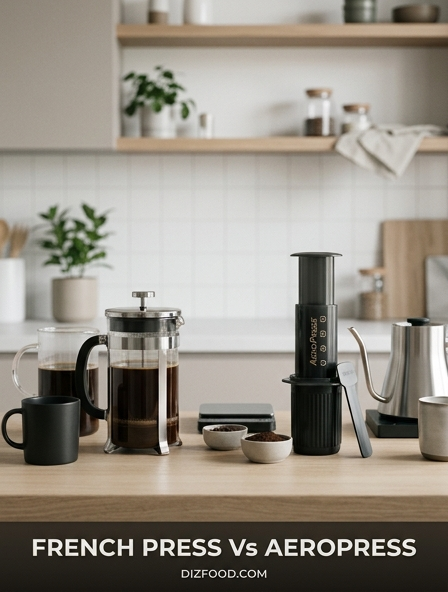
French Press vs AeroPress Comparison Guide
The debate between the French Press and the AeroPress is a cornerstone of modern kitchen discourse, representing two distinct philosophies of home brewing. The French Press, patented in its most recognizable form in 1929, is the quintessential immersion brewer. It relies on time and a coarse metal mesh to create a rich, textured cup of coffee. It has long been the centerpiece of weekend brunches, valued for its ability to serve multiple people at once and its elegant aesthetic that looks at home on any kitchen counter.
In contrast, the AeroPress is a relatively modern invention, debuting in 2005. It utilizes a combination of immersion and pressure to extract flavor, using a paper or fine metal filter to produce a concentrated, clean cup. While the French Press is often made of glass or stainless steel, the AeroPress is constructed from high-quality, BPA-free plastic, emphasizing utility and durability over traditional style. Understanding which tool fits your kitchen depends on your volume needs and your preference for coffee texture.
| Feature | French Press | AeroPress |
|---|---|---|
| Brew Method | Full Immersion | Immersion + Pressure |
| Capacity | 3 to 12 cups | 1 to 2 cups |
| Filter Type | Metal Mesh | Paper or Metal Disk |
| Invention Era | Early 20th Century | Early 21st Century |
Both devices have earned their place in the specialty coffee world, yet they cater to different lifestyles. The French Press offers a slow, meditative ritual, while the AeroPress provides a fast, scientific, and highly customizable approach to extraction. Choosing between them is not merely about the coffee, but about how you want your morning routine to feel.
Taste Profiles and Coffee Body Differences
The most significant difference between these two brewers lies in the "mouthfeel" and clarity of the resulting beverage. Because the French Press uses a coarse metal screen, it allows the natural oils of the coffee beans to pass directly into your cup. These oils contribute to a heavy, velvety body and a long-lasting finish. However, this method also allows "fines"-tiny particles of ground coffee-to settle at the bottom of the mug, creating a sediment that some find comforting and others find "muddy."
The AeroPress typically employs a paper filter, which traps most of the biological oils and nearly all of the sediment. This results in a much higher level of clarity, allowing the taster to identify bright, acidic notes and subtle floral or fruity undertones that might be buried in a French Press brew. The body is lighter, similar to a traditional drip coffee but with much more intensity due to the pressure used during the plunge. If you prefer a clean, crisp cup where you can taste the specific origin of the bean, the AeroPress is superior. If you crave a bold, hearty, and rustic cup that pairs well with milk or cream, the French Press remains the champion of the kitchen.
Ultimately, the French Press highlights the "weight" of the coffee, while the AeroPress highlights the "flavor" of the coffee. Professional tasters often use the AeroPress to test new beans because of this clarity, while home drinkers often return to the French Press for its unrivaled ability to provide a satisfying, mouth-coating experience that feels like a meal in a mug.
Brewing Speed and Total Preparation Time
When time is the primary factor in your kitchen routine, the AeroPress is the undisputed winner. The total contact time for an AeroPress brew is usually between 60 and 90 seconds. Because it uses a finer grind and manual pressure, the extraction happens rapidly. Even when you account for the time it takes to boil water and set up the device, you can have a finished cup of coffee in less than three minutes. This makes it an ideal choice for busy professionals or those who need a quick caffeine fix before heading out the door.
The French Press requires patience. The standard brewing protocol involves a four-minute steep, followed by a gentle stir and sometimes an additional minute of settling to allow the grounds to sink. When you add in the time for water preparation and the "blooming" of the grounds, you are looking at a seven to eight-minute commitment. This slower pace is often considered a feature, not a bug, for those who enjoy a slow morning, but it can be a hindrance during a frantic workweek. The workflow for each is summarized below:
- AeroPress: 30s setup, 60s brew, 30s plunge, 10s cleanup. Total: ~2-3 minutes.
- French Press: 30s setup, 4m steep, 1m settle, 2m cleanup. Total: ~7-8 minutes.
It is also worth noting that the French Press allows for "passive" brewing; you can set it and walk away to toast bread or feed the dog. The AeroPress requires "active" brewing, meaning you must stay with the device to stir and plunge. In a busy kitchen, the ability to multi-task might make the French Press feel faster even if the clock says otherwise.
Portability and Best Choice for Travel
If you are looking for a coffee maker that can leave the kitchen and survive a trip in a suitcase or backpack, the AeroPress is arguably the best brewer ever made. Its construction is primarily high-quality polypropylene, which is virtually indestructible. It won't crack if dropped on a tile floor, and it is light enough to go unnoticed in a carry-on bag. Furthermore, the compact design allows the components to nest within each other, and there are even "Go" versions designed specifically to fit inside a dedicated drinking mug.
The French Press is generally the opposite of portable. Most traditional models are made of borosilicate glass, which is notoriously fragile. Even a small bump against a granite countertop or a slight tip in a sink can lead to a shattered carafe. While stainless steel double-walled versions exist and are much more durable, they are heavy and bulky. A standard 8-cup French Press takes up significant real estate in a kitchen cabinet, let alone a travel bag. Furthermore, the mess associated with cleaning a French Press makes it difficult to use in hotel rooms or campsites where drainage might be an issue.
For the frequent traveler, camper, or even the office worker who wants a private stash of coffee at their desk, the AeroPress provides a level of freedom that the French Press cannot match. The French Press is a stationary monument to the home kitchen, meant to stay on the counter or in the cupboard, while the AeroPress is a versatile tool designed for a life on the move.
Ease of Use and Brewing Techniques
The French Press is often cited as the easiest way to make "real" coffee because its technique is incredibly straightforward. There are very few variables to manage, making it a "low-skill, high-reward" device. However, the AeroPress offers two distinct methods of brewing that appeal to the more adventurous or technical home barista. The standard method involves placing the brewer over a cup, while the "Inverted Method" involves flipping the device upside down to prevent any leakage during the steep. The steps for each are generally as follows:
- French Press: Add coarse grounds, pour hot water, wait 4 minutes, press the plunger slowly, and pour immediately to avoid over-extraction.
- AeroPress: Insert filter, add fine-medium grounds, pour water, stir for 10 seconds, and press the plunger firmly until you hear a "hiss" sound.
While the French Press is harder to mess up, it is also harder to "perfect." Because it is a simple immersion method, you have limited control over the nuances of the flavor. The AeroPress, conversely, is a playground for experimentation. You can vary the pressure, the grind size, the water temperature, and the filtration method to create wildly different results from the same bag of beans. This makes the AeroPress slightly more intimidating for a complete beginner but far more rewarding for someone who views coffee brewing as a hobby rather than just a morning necessity. In the context of a shared kitchen, the French Press is more accessible to guests, whereas the AeroPress often requires a brief demonstration for the uninitiated.
Cleanup and Daily Maintenance Requirements
Cleanup is where the AeroPress truly shines and where the French Press often becomes a chore. The AeroPress is essentially self-cleaning; once the brew is finished, you simply remove the cap and push the plunger again. This ejects a compressed "puck" of coffee grounds directly into the trash or compost bin. A quick rinse of the rubber seal is all that is required before the device is ready for its next use. Because it uses a paper filter, there are no oily residues left behind on a mesh screen, and the entire process takes about ten seconds.
Cleaning a French Press is a more involved affair. You are left with a glass carafe full of wet, loose grounds that cannot easily be dumped into the trash without making a mess. Most users find themselves rinsing the grounds down the sink, which can lead to plumbing issues over time, or using a strainer to catch them. Additionally, the plunger assembly consists of several layers-the top nut, the spring disk, the mesh filter, and the bottom cross-that trap coffee oils and tiny particles. To maintain a fresh taste, this assembly must be unscrewed and deep-cleaned regularly to prevent the oils from turning rancid and ruining future brews.
For the daily user, the "ease of cleanup" factor cannot be overstated. In a busy kitchen where counter space is at a premium and time is short, the "pop and rinse" nature of the AeroPress makes it much more likely to be used frequently. The French Press, while beautiful, often ends up sitting in the sink waiting for someone to deal with its soggy remains.
Durability and Material Construction Comparison
When investing in kitchen hardware, durability is a primary concern. The French Press is traditionally a "lifetime" purchase, provided you choose a stainless steel model. However, the majority of consumers purchase glass models for their aesthetic appeal. These glass carafes are susceptible to thermal shock-cracking if cold water is hit against hot glass-and physical impact. While replacement glass is often available, the frequency of breakage is a common complaint among owners. The mesh filters also tend to fray at the edges over years of use, occasionally resulting in sharp wires that can prick a finger during cleaning.
The AeroPress is built from a rugged, heat-resistant copolymer. While it may not look as "premium" as a chrome-plated glass press, it is incredibly resilient. It is designed to withstand the significant manual pressure required to force water through the coffee bed, and it does so without showing signs of stress for years. The only part that typically requires replacement is the rubber plunger seal, which can lose its airtight fit after several years of daily use; fortunately, these seals are inexpensive and easy to swap out.
- French Press Materials: Borosilicate glass, Stainless steel, Chrome-plated plastic (for handles/lids).
- AeroPress Materials: BPA-free Polypropylene, Thermoplastic Elastomer (for the seal).
- Longevity: Steel FP (20+ years), AeroPress (5-10 years), Glass FP (Variable, prone to accidents).
In terms of sustainability, the French Press has a slight edge because it does not require disposable paper filters. However, the AeroPress can be used with a reusable metal disk filter, which brings it into alignment with the French Press's zero-waste potential. From a purely structural standpoint, the AeroPress is the more "bulletproof" addition to a high-activity kitchen.
Versatility and Coffee Style Options
If you like variety in your coffee styles, the AeroPress is significantly more versatile than the French Press. Because it uses pressure, the AeroPress can create a very concentrated "espresso-style" shot. While it isn't true espresso (which requires 9 bars of pressure), it is thick and intense enough to be used as a base for lattes, cappuccinos, or Americanos. You can also use it to make a quick "bypass" brew, where you make a concentrate and then dilute it with hot water, similar to the way many coffee shops operate.
The French Press is a one-trick pony. It makes excellent immersion coffee, and that is all it does. You cannot make a concentrated shot with a French Press; if you try to use less water, the coffee simply becomes over-extracted and bitter because the grounds must be fully submerged to brew correctly. However, the French Press does have one secret kitchen hack: it is an excellent manual milk frother. By pumping the mesh plunger rapidly through warm milk, you can create a surprisingly thick microfoam for homemade cafe-style drinks.
The AeroPress also excels at cold brewing. While you can make cold brew in a French Press by letting it sit in the fridge for 12 to 24 hours, the AeroPress can produce a "flash cold brew" or a specialized cold drip style in just a few minutes using a fine grind and room temperature water. If you are someone who likes to switch between hot coffee, iced coffee, and milk-based drinks, the AeroPress provides a much broader toolkit within a single device.
Grind Size and Water Temperature Requirements
Technical precision is vital for getting the most out of your beans. These two brewers occupy opposite ends of the grind spectrum. The French Press requires a very coarse, "sea salt" like grind. If the grind is too fine, it will pass through the mesh filter, making the coffee incredibly gritty, and it will be nearly impossible to push the plunger down due to resistance. Conversely, the AeroPress is very forgiving. While a medium-fine grind (similar to table salt) is standard, you can successfully use anything from drip-grind to espresso-grind depending on your preferred brew time.
| Brewer | Ideal Grind Size | Recommended Temp |
|---|---|---|
| French Press | Coarse / Extra Coarse | 195°F - 205°F |
| AeroPress | Fine to Medium-Fine | 175°F - 185°F |
Water temperature is another area of divergence. Traditional French Press recipes call for water just off the boil (around 200°F) to ensure proper extraction over the long four-minute steep. However, the inventor of the AeroPress famously recommends a much lower temperature of 175°F for dark roasts and 185°F for light roasts. The lower temperature, combined with the faster brew time, prevents the extraction of bitter tannins, leading to a much smoother cup. This makes the AeroPress a bit more "temperature sensitive," but it also means you don't have to wait as long for your kettle to boil or for your coffee to cool down to a drinkable temperature.
Final Verdict Which Coffee Maker is Best for You
Choosing between the French Press and the AeroPress ultimately comes down to your kitchen habits and your palate. The French Press is the best choice for those who value tradition, aesthetics, and volume. If you frequently host guests or live in a household with multiple coffee drinkers, the ability to brew a liter of coffee at once is an advantage the AeroPress cannot match. It is the brewer for the "slow morning," the person who loves a heavy-bodied cup, and the cook who appreciates the classic look of glass and steel on their counter.
The AeroPress is the best choice for the solo drinker, the traveler, and the coffee nerd. If you only need one cup at a time and want it to be as clean and flavorful as possible, the AeroPress is superior. Its ease of cleanup makes it the most practical choice for a daily driver, and its durability ensures it will be a part of your kitchen for years to decline. It rewards experimentation and offers a versatility that allows you to play with different styles of coffee without needing multiple expensive machines.
In many modern kitchens, the answer is actually "both." The AeroPress serves the Monday-through-Friday rush with its speed and easy cleanup, while the French Press is brought out on Sunday mornings for a leisurely, shared pot of coffee. If you must choose only one, ask yourself: do I want to savor the process (French Press), or do I want to optimize the result (AeroPress)? Your answer to that question will lead you to your perfect brew.



Comments