
Ever sat at a Mediterranean café and wondered if there is a real secret behind that thick, velvet foam? While both Turkish and Greek coffee share the same ancient DNA-ultra-fine grinds simmered in a copper pot-the hidden difference that defines the perfect brew lies in the roasting profile and cultural preparation. Turkish coffee traditionally favors a darker, more intense roast that produces a bold, earthy punch, whereas Greek coffee often utilizes a lighter, blonde roast that highlights a mellow acidity and floral aroma. Mastering these subtle nuances, from the bean's origin to the stability of the kaimaki (froth), is what separates a standard caffeine fix from a centuries-old ritual of flavor.
| Feature | Turkish Coffee | Greek Coffee |
|---|---|---|
| Roast Level | Medium to Dark; bold & smoky. | Light to Medium; "blonde" & mild. |
| Traditional Pot | Cezve (typically copper/brass). | Briki (narrow neck for high foam). |
| Flavor Profile | Strong, bittersweet, and earthy. | Smooth, aromatic, and slightly nutty. |
| Bean Variety | 100% Arabica (Brazilian origin focus). | Arabica (often Santos or Rio Minas). |
| The Foam | Thick, dark, and persistent. | Creamy, light-colored "Kaimaki." |
| Serving Style | Served with Water & Turkish Delight. | Served with Water & Koulourakia/Spoon Sweets. |
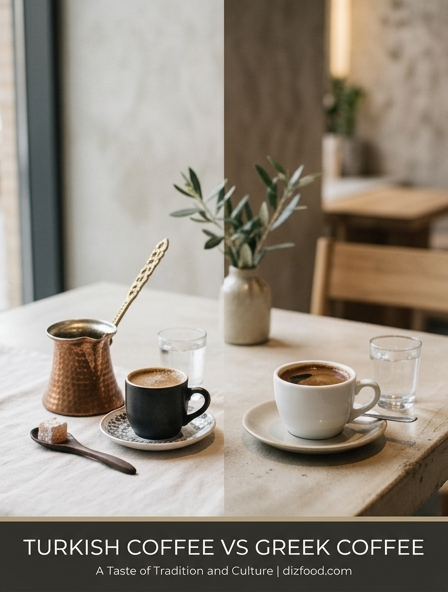
Historical Origins of Coffee in the Eastern Mediterranean
The shared history of coffee in the Eastern Mediterranean is a narrative of cultural exchange and geopolitical shifts. Coffee originally found its way to the Ottoman Empire in the mid-16th century, arriving from Yemen through trade routes that converged in Istanbul. The first coffeehouses opened in the Ottoman capital around 1554, quickly becoming centers for intellectual discourse, social gathering, and political debate. During the expansive reach of the Ottoman Empire, this specific method of brewing-unfiltered and prepared in a small pot-spread across the Balkans, the Middle East, and North Africa, including Greece.
For centuries, the beverage was universally referred to as "Turkish coffee" across the region, including within Greece. This nomenclature remained standard until the mid-20th century. The linguistic shift in Greece occurred primarily due to political tensions surrounding the 1974 conflict in Cyprus. In a move to assert national identity and distance Greek culture from Turkish influence, the term "Greek coffee" (ellinikos kafes) was officially promoted through advertising and public sentiment. Today, while the brewing methods remain nearly identical, the names serve as significant markers of national pride. Despite the different labels, both traditions are rooted in the same centuries-old Ottoman tradition that prioritized the social ritual of the "kahvehane," where the slow preparation of the drink mirrored the unhurried pace of Mediterranean life.
Understanding the Grind and Roast Variations
The defining characteristic of both Turkish and Greek coffee is the grind size, which is significantly finer than any other coffee preparation in the world. The beans are pulverized into an ultra-fine powder that resembles the consistency of cocoa powder or confectioner's sugar. This extreme fineness is necessary because the coffee is not filtered; the grounds remain in the cup and must be fine enough to settle at the bottom, creating a muddy sediment while allowing the liquid above to be consumed. Traditional manual brass grinders are still favored by purists to achieve this specific texture without heating the beans excessively during the process.
While the grind is identical, subtle differences emerge in the roasting profiles preferred by each culture. Turkish coffee traditionally favors a medium to dark roast, often resulting in a more pronounced chocolatey, earthy, and bold flavor profile. In contrast, Greek coffee often utilizes a lighter or medium-light roast. This lighter roasting process preserves more of the bean's natural acidity and nuttier undertones. Below is a comparison of typical bean characteristics found in many households:
| Feature | Turkish Coffee Typical Profile | Greek Coffee Typical Profile |
|---|---|---|
| Roast Level | Medium to Dark | Light to Medium |
| Grind Texture | Ultra-fine powder | Ultra-fine powder |
| Predominant Notes | Spices, Earth, Cocoa | Nuts, Fruit, Toasted Bread |
The Essential Brewing Tools Cezve Versus Briki
The equipment used to brew this coffee is as iconic as the drink itself. In Turkey, the small, long-handled pot is known as a "cezve," whereas in Greece, it is called a "briki." Despite the different names, the design is functionally the same, optimized for creating the signature foam that defines a successful brew. Traditionally made of hammered copper or brass, these pots are often lined with tin to prevent the metal from reacting with the coffee. Modern versions may be made of stainless steel or ceramic, but copper remains the gold standard for its superior heat conductivity.
The specific geometry of the cezve or briki is crucial to the brewing process. The pot features a wide base that tapers to a narrow neck before flaring out again at the rim. This hourglass-like shape serves two purposes: the wide base allows for rapid heating of the water, while the narrow neck concentrates the rising grounds and bubbles to form a thick, stable layer of foam. The long handle, traditionally made of wood or brass, allows the brewer to manage the pot over an open flame or hot sand without being burned. Using a pot that is too large for the amount of coffee being made is a common mistake, as it prevents the foam from reaching the narrow neck and thickening properly. For a single serving, a small pot is essential to ensure the ratio of surface area to volume is correct for foam development.
Comparing Traditional Preparation Techniques
Preparing coffee in the Eastern Mediterranean style is a slow, deliberate process that requires patience and attention. Unlike modern espresso or drip methods, this technique involves "cooking" the coffee rather than simply passing water through it. The process begins with cold, filtered water, which is measured using the same small cup that will be used for serving. The coffee and sugar are added to the water while it is still cold, allowing the flavors to integrate as the temperature rises. The mixture is stirred only at the beginning; once the pot is placed on the heat, it is left undisturbed to allow the foam to develop.
- Measure one cup of cold water into the pot for every serving desired.
- Add one heaped teaspoon of ultra-fine coffee per cup.
- Add sugar if requested (sade/sketos is plain, orta/metrios is medium, sekerli/glykos is sweet).
- Place over low heat. In traditional settings, this may be a bed of hot sand known as "hovoli."
- Watch closely as the coffee heats. A dark foam will begin to rise from the edges toward the center.
- Just before the coffee reaches a boil and the foam threatens to spill over, remove the pot from the heat.
- Carefully pour the foam into the cups first, then fill with the remaining liquid.
The primary difference in technique often lies in the "double boil." In some Turkish traditions, the pot is returned to the heat after the first rise to create a second rise, which is thought to deepen the flavor. Greek preparation typically focuses on a single, slow rise to maintain the delicate "kaimaki" foam without scorching the lighter-roasted beans.
The Significance of the Perfect Foam
The foam is the most critical element of the coffee, serving as a visual indicator of the brewer's skill and the coffee's freshness. In Turkish, this foam is called "köpük," while in Greek, it is known as "kaimaki." A cup served without foam is often considered an insult or a sign of poor hospitality. The foam acts as an insulator, keeping the coffee underneath hot for a longer period, and it traps the volatile aromatic compounds that give the coffee its distinct smell. A thick, velvety kaimaki with tiny, uniform bubbles is the hallmark of a master brewer.
Achieving the perfect foam requires a delicate balance of heat and timing. If the heat is too high, the water boils too quickly, and the bubbles become large and unstable, eventually popping and leaving a flat surface. Conversely, if the coffee is removed too early, the foam will be thin and watery. When serving multiple people, the foam must be distributed equally among all cups using a spoon or a careful pouring technique. This ensures that every guest receives the "heart" of the brew. In cultural contexts, the quality of the foam was historically used to judge the domestic skills of a potential bride or the sincerity of a host's welcome. It remains a point of pride for home cooks and professional baristas alike across the region.
Flavor Profile and Taste Nuances Explained
Both Turkish and Greek coffees offer a flavor experience that is intense, viscous, and multisensory. Because the coffee is unfiltered, the liquid has a heavy body and a silt-like texture that coats the palate. The initial sip is dominated by the concentrated essence of the bean, often followed by a lingering finish that can last for several minutes. However, the specific nuances differ based on the roast and the optional addition of spices. Turkish coffee is famously associated with the addition of cardamom, which introduces a herbal, menthol-like top note that complements the deep, roasted flavors of the medium-dark beans.
Greek coffee, being generally lighter in roast, presents a different spectrum of taste. It often leans toward toasted nuts, grains, and a slight fruity acidity. Greek coffee is rarely spiced, with the focus remaining entirely on the pure flavor of the coffee blend. The level of sweetness also drastically alters the flavor profile. In both cultures, sugar is never added after the coffee is brewed, as stirring would disturb the settled grounds at the bottom. Instead, the sugar is caramelized during the brewing process, leading to a more integrated, syrupy sweetness that balances the natural bitterness of the concentrated coffee. The result is a drink that is meant to be sipped slowly, allowing the complex layers of flavor to reveal themselves as the cup cools.
Traditional Serving Rituals and Cultural Etiquette
Serving coffee in the Eastern Mediterranean is a ritualized act of hospitality that follows specific rules of etiquette. The coffee is always served in small porcelain cups, often called "fincan," which are roughly the size of an espresso cup. It is never served alone; a glass of cold water is an essential accompaniment. The water is meant to be sipped before the coffee to cleanse the palate, allowing the drinker to fully appreciate the coffee's flavor. In some traditions, if the guest drinks the water first, it indicates they are hungry, prompting the host to bring food.
- The Sweet Side: Turkish coffee is traditionally served with a piece of Turkish delight (lokum). Greek coffee is frequently paired with "spoon sweets"-preserved fruits in syrup-or a small butter cookie (koulourakia).
- The Pace: This coffee is the antithesis of "to-go" culture. It is designed for "keyif" or "parea"-the art of relaxation and conversation. Drinking it quickly is considered improper.
- The Settlement: One must wait at least a minute after the coffee is served for the grounds to settle to the bottom of the cup before taking the first sip.
- The Finish: One never drinks the very last bit of the coffee, as it consists entirely of the thick, muddy sediment.
The Practice of Reading Coffee Grounds
One of the most intriguing cultural aspects of this coffee tradition is "tasseography," known as "fal" in Turkish or "kafemanteia" in Greek. This is the practice of telling one's fortune by interpreting the patterns left by the coffee grounds on the inside of the cup. After the liquid has been consumed and only the sediment remains, the drinker places the saucer over the cup and flips it upside down. The cup is left to cool, allowing the grounds to slide down the sides and form various shapes, lines, and symbols.
The "reading" is usually performed by a friend or a professional fortune teller. Symbols are interpreted based on their placement: the area near the handle relates to the person's love life or home, while the bottom of the cup represents the past. Common symbols include birds (news coming), rings (marriage), or mountains (obstacles). In Turkey, it is common to place a ring or a coin on top of the inverted cup to speed up the cooling process or to neutralize bad luck. While many view it as a lighthearted social activity, for others, it remains a serious tradition that adds a mystical dimension to the daily coffee ritual, bridging the gap between a simple beverage and a tool for social connection and storytelling.
Key Similarities Between Turkish and Greek Brews
Despite the heated debates over the origin and name of the beverage, the similarities between Turkish and Greek coffee far outweigh the differences. Both represent a shared heritage of the Eastern Mediterranean and the Balkans, reflecting a common culinary vocabulary that has survived for centuries. From the kitchen perspective, the preparation methods are virtually interchangeable, and the sensory experience of drinking the coffee is identical for the uninitiated. Both cultures view the coffee break as a vital social institution rather than a quick caffeine fix.
- Unfiltered Nature: Both are prepared with the grounds remaining in the water, requiring an ultra-fine grind that is unique to this region.
- Equipment: Both use the tapered, long-handled pot (cezve/briki) and serve the coffee in small, handleless or small-handled porcelain cups.
- Social Significance: In both Turkey and Greece, coffee is a symbol of friendship and hospitality. To refuse a cup of coffee is often seen as a social slight.
- Functional Preparation: Both styles emphasize the creation of a thick foam and require the coffee to be brewed over a low, steady heat source to prevent boiling.
- The Sediment: The practice of leaving the "mud" at the bottom and the subsequent tradition of fortune-telling are common to both cultures.
Final Verdict on the Great Coffee Debate
The "Turkish versus Greek coffee" debate is less about the contents of the cup and more about history, politics, and national identity. If you were to conduct a blind taste test, most people would struggle to distinguish between a medium-roasted Turkish coffee and a medium-roasted Greek coffee, provided they were prepared with the same sugar level and technique. The variations that do exist-such as roast depth or the addition of cardamom-are often regional or personal rather than strictly national. In Turkey, you will find light roasts, and in Greece, you will find darker blends.
Ultimately, the "correct" name for the coffee depends entirely on where you are standing and who you are talking to. In Istanbul, it is Turkish coffee; in Athens, it is Greek coffee; in Sarajevo, it is Bosnian coffee; and in Nicosia, it is Cypriot coffee. Each culture has adopted the Ottoman legacy and woven it into their own national fabric. For the coffee enthusiast, the best approach is to appreciate the nuances of each, respecting the terminology used by the host. Whether you call it Turkish or Greek, the result is the same: a rich, flavorful, and ancient brew that fosters conversation and community. The final verdict is that both are exceptional expressions of a shared Mediterranean soul, best enjoyed slowly in good company.






Comments